
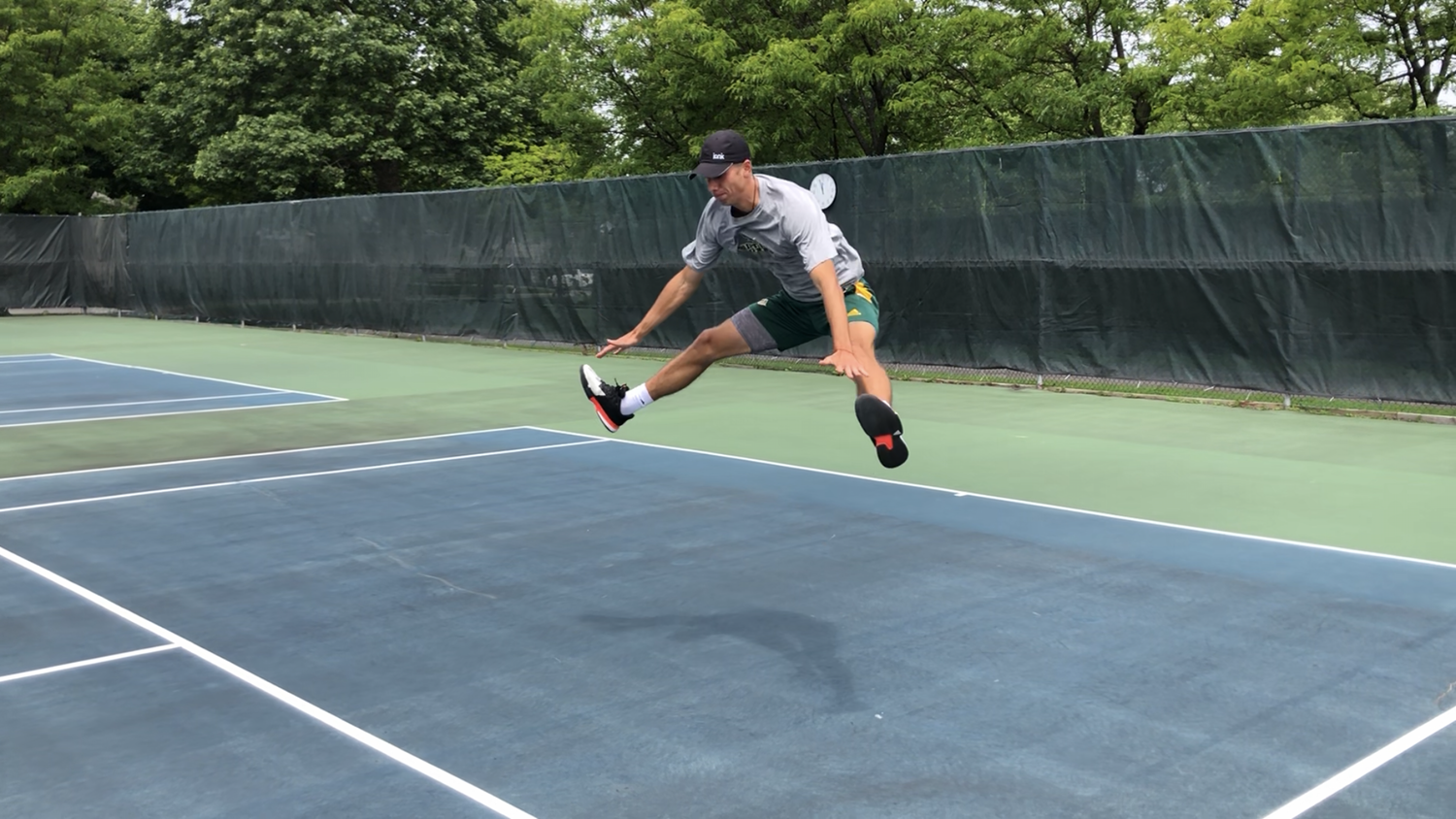
There are countless ways that tennis players can get into shape. From running workouts to weight training, on-court drills and more.
All have their pros and cons. And all can be utilized at different times of the year + at different stages of a player’s development.
Recently, plyometric and jump training has resurfaced as a popular training modality amongst tennis players. You’ll see many performing hurdles, line hops and other types of jumping variations. It’s proposed that this training method will take advantage of certain deficiencies in elastic abilities, power endurance and neuromuscular development.
There’s one type of plyo/jump method that we use year-round (to some extent) and that has proven to be invaluable – in-place jump circuits.
What’s an In-Place Jump Circuit?
An in-place jump circuit is essentially what it sounds like. It’s a type of circuit training whereby you perform various jumping exercises within – more or less – the same spot, with brief periods of rest between exercises and sets.
Whether it’s during preparatory periods – or even on tour between events (or part of extended warm-ups) – we use these regularly to improve a host of factors.
While in-place jumps can be plyometric, often, they are not. Recall that a plyo activity needs to fulfill certain criteria and many in-place jumps (and jumps in general) are more ballistic in nature (rather than plyometric).
Below I’ll share a video of an in-place jump circuit that we employ on a weekly basis with our tennis players. But before that, here are the benefits.
Benefits of In-Place Jump Circuits
1 – Less Intense than Other Plyos
Firstly, in-place jump circuits don’t have the same type of ground reaction forces as other forms of jump activities like horizontal bounding and leaping. Because of this, we generally classify them as low to moderate intensity jumps. But just because they aren’t as intense as other forms of jumps + plyometrics, doesn’t mean they aren’t critical (they are…keep reading).
2 – Exercise Variety
Because they’re not as intense, they lend themselves to many different variations. Some movements use smaller amplitudes that might target more of the lower leg (and ankle complex in particular). Other jumps, on the other hand, may be deeper – which in turn target the knee and/or the hip (plus surrounding musculature). Getting a variety of jumps into each circuit ensures we’re getting enough variability to tackle all 3 joints + multiple muscle groups.
3 – Multiple Movement Planes and Directions
We can perform jumps on two legs, on one leg or contralaterally (like skater jumps – vid below). We can perform these jumps with a vertical, rotational or frontal plane emphasis – all of which are axis and planes players will encounter on the tennis court. Not to mention that perform jumps in different planes/directions ensures we’re not stressing the body in a repetitive manner (it’ll get enough of that on the court). This may help reduce injury risk.