
Published June 17, 2026 01:28PM
Whether I like to admit it or not, I am a privateer. To the uninitiated, in gravel a privateer is part cyclist, part influencer, and a one-man traveling show that cobbles together sponsors in an effort to race bikes and create content. As a former WorldTour pro I know—because at one point I did this as well—that many in the upper echelons of the sport look down on these individuals. Privateers are story tellers, so when thinking of things I wanted to tell when crafting this calendar at the start of the season, half jokingly I asked myself; “If a privateer wins, and doesn’t post about it, did they actually win at all?” I never thought I would have an event in my season that could get to the bottom of this question, however, surprisingly, this past weekend, in Cowichan Valley, British Columbia, I think I actually found the answer.
Nine days after arriving in Andorra with a scratched cornea and a body wrecked from completing two thirds of Unbound and traveling across seven time zones, I boarded a plane to traverse nine. My final destination: Vancouver Island, to race the Canadian National Gravel Championships.
In all honesty, I had no plans of writing a blog for this race. I had no thoughts of creating any social media post regarding competing in it. I have been working with Ventum for the past two months on a project called Ways to Race. The YouTube series’ aim is to cast me as the Anthony Bourdain of endurance events. The goal of the show: travel to interesting endurance races in an effort to test myself and give people perspective on them. It has been a project that I am loving doing but the work required, along with training, being a dad, and managing the logistics of racing this calendar, has made my ability to manage my social media more challenging. I also didn’t think that the Canadian National Championships would—win, lose, or draw for me—create anything compelling enough to write about. I was wrong.
Posting on social media, in my new role as a privateer, is a challenge. Although Ventum is my main sponsor, I have other great sponsors supporting my calendar, and based on some of the contracts that I have signed with these sponsors, I have to fulfill a certain amount of posts and meet a number of social media obligations per month/quarter of the year. This, to me, is the closest my life feels to work (I know, I am very lucky). Work that I, at this moment, have limited time for. A part of me feels bad not committing the adequate time and creativity to these posts; I dislike doing bad work. Another part of me thinks; “just make the post quick” as it’s a great way to subsidize doing something that I love. And another part of me gets depressed at the fact that deep down, I know that the majority of the things that I am putting out there are only contributing to the vast cesspool of vanity, human decline, and inauthenticity that is social media.
To be truly great at something you need to devote yourself fully to it. It’s one of the reasons I stopped writing this blog years ago. I knew, deep down, that writing stories about what I was doing was, from a cycling perspective, a cop-out. It took time that wasn’t devoted to the craft of being the best cyclist, and it had me—only slightly— looking at races less with an aim to win, and more as to how to tell the best story. Because of this, I used to think that influencers/privateers were simply people that were copping out in the disciplines that they chose to pursue. In some instances this is true, but doing this year has given me a greater respect to those that privateer well. It isn’t easy, as I used to think, to create things that people are actually interested in.
In many ways, privateers are the people that are propping up gravel. There are no traditional forms of media comprehensively covering the sport, so to many, their only window into this world is via Youtubers, Instagrammers, and TikTokers. Would races like Unbound or Traka be as big in the world of cycling were it not for privateers? I doubt it. As Dan Hughes, the four time winner of Unbound, said, on the With Pace podcast, it was a “watershed moment” when Ted King (a former WorldTour rider turned privateer) did the race. The followings of these individuals are often much greater than the events that they perform in. People are interested in participating in these events—it is why the sport is booming—but the events themselves don’t do a good enough job, yet at least, to create content worth subscribing to. However, privateers have created that compelling content, and, because of this, they are often the only narrators of the actual race. Hence why I asked myself the question: if they don’t post about it, did they actually win?
Well, this past Saturday, I won the Canadian National Gravel Championships, and, until now, I didn’t post about it, and, in what is one of the most anticlimactic ends to a race that I have ever had in my career, I didn’t actually win.
Although I am now acclimatizing to it, like every gravel race I have done this year, going to race on the logging roads outside of Duncan, BC, was a logistical battle. A bike was lost in transit, hours were spent fiddling with things, unpacking, doing course recons, prepping nutrition, and driving to and from the course. Many speaker phone calls, while adjusting tire pressure, or tightening a bolt, were done with my unofficial teammate, gravel mentor, and reigning Canadian National Champion, Ben Perry. Ben is a guy I have raced with, and against, since 2012. He is witty, his knowledge of music is encyclopedic, he hosts a regular trivia night in Girona, and he is an outlier in the sport of cycling, having bounced around in the professional ranks for over a decade, racing everywhere from continental racing in Asia, to competing for Astana in the WorldTour. He has a boat load of great stories, and has since transitioned into gravel where he has found his groove. Sponsors love him as he can turn a dry product launch party into a banger. He has an energy that is contagious, and is one of the few people who can do all this while still waking up the next day and being competitive in a race.
At this year’s Traka 360 he did a skateboarding shoot with Muc Off days before he placed 4th (outsprinting Romain Bardet). Not many elite athletes have the head for this.
Ben has also been gracious enough to let me pick his brain on all things gravel, and the insight and knowledge he has given me has made this season far easier. Because of this, I told him that I wanted him to win the race as much as I did, and, prior to the race, we made an agreement that we would share responsibilities in order to make it hard enough so that the race would come down to the two of us.
Taking place on a beautiful course, in a beautiful region, this race could not have been more Canadian. As Ben and I stood on the front line post elite call-up, a guy came up to me, literally within a minute or two of the start and said “I met your uncle in Girona, he was wearing a Maple Leafs hat.”
There was no pump-up music, there were no big crowds, there was no Dave Toll (a well known American Cycling announcer) “launching us into orbit.” It was just a few parents, and support crews, standing awkwardly, and politely saying “good luck boys.”
This race was so culturally representative of Canadian cycling that even the guy who won was apologetic for beating the guy in second. At one point, the eventual third placer, and mountain biker, Andrew L’Esperance, apologized to Ben and I for dropping us on a descent. L’Esperance can handle a bike beautifully, and were he from Belgium, I would wager that he would have used that skill to assassinate Ben and I. Instead, there he was, apologizing mid race.
Despite our cordiality, Ben and I did take to this race like a pair of hungry wolves. Our moves were deliberate, attacks focused, and in concert with the technical skills of L’Esperance, by 30km into the 126km course, we had whittled the group down to the three of us. Then, for the next 40km we swapped off pulls, and began to cook in the unseasonably hot weather.
We had been warned the day before, by Jon Watkin, the race organizer, in the pre-race meeting, that conditions would be hot. We had been told to make sure to bring extra water. Ben spoke with many riders, and encouraged a truce at kilometer 67 to stop and grab bottles at the second aid station so that we could all manage the heat better. We had planned.
It was hot though, and for somebody who had been riding in unseasonably cold weather in the mountains of Andorra, and in the rain of Unbound, I was not heat adapted. Despite this, on the second to last climb of the day, with roughly 50km remaining, I decided to ride full. My aim, try to go solo. The effort worked, and soon I found myself alone, with a headwind, and temperatures pushing 35 degrees. I tried to stay cool, hydrate well, and continue to fuel, but soon the signs of heat exhaustion began to express themselves.
My muscles in my feet started to contract, a tickling and tightening sensation in my hamstrings could be felt, and my guts began to churn. I stayed calm and told myself “you just need to get to the long descent with 20km to go.” That descent could not have come sooner. Just before getting to it, a race marshal came up beside me on his motor bike and said “the race may be canceled.” Truthfully, when he said it, I thought: “thank fuck.” I was starting to go to a dark place, and the gravity of having to ride full, for another 20km feeling the way I was feeling, even with a national title on the line, was daunting. I coasted for a brief moment, then decided to keep riding in case he was wrong. Soon after he returned and said “it’s ok! race is still on!”
I kept turning the pedals and when I reached the descent that I had been longing for, I decided that the only way I would hold Andrew and Ben off would be to not brake, so I didn’t. This thing was a screamer. Loose gravel was everywhere, and the turns were just straight enough that you could go through them without braking, but the consequences of taking them wrong were high, very high. Riding at 75km/h on a gravel bike, over washboard gravel, is a terrible sensation. Every part of your being shakes; I looked and felt like one of those astronauts in a g-force trial. However, I made it through clean, took a turn, and did everything in my power to keep my momentum going. At 15km to go I threw up, at 12 km to go I started talking to myself, for the last 10km I probably looked behind every 200m, waiting to see my pursuers. It wasn’t until I finally hit the final 200m that I realized I had managed to hold them off, and that my suffering would be over.
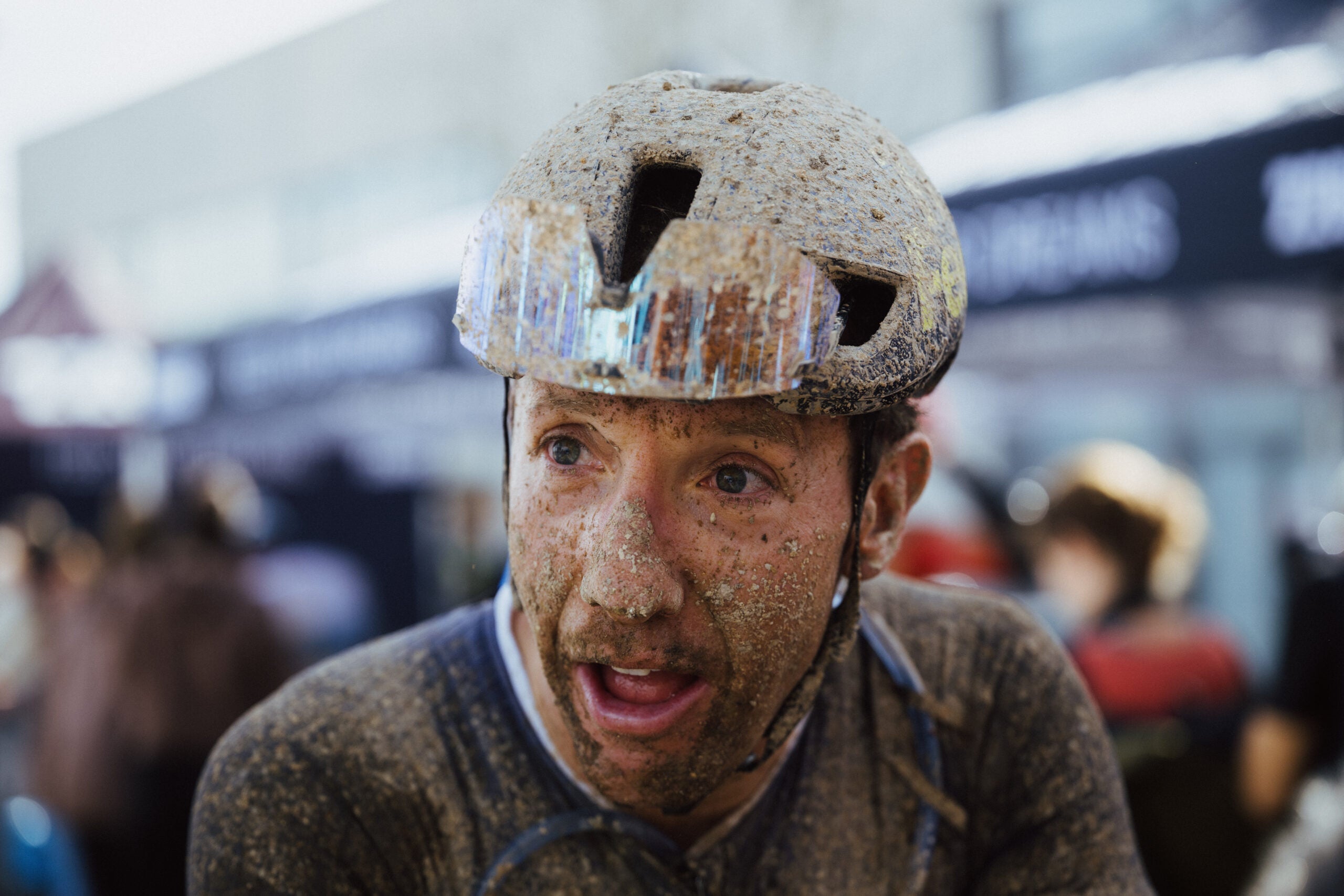
I went to a dark place in those final kilometers. Mental battles were fought, time stretched on, I lived lives, and although I put my hands up in celebration, they quickly came back down after I crossed the line. I rode directly to the shade and lay down. I was spent. I hadn’t gone that deep in a long time. For 20 minutes, I sat there. People occasionally came and brought me water. Others asked me “what was it like to win on Puy d’homme,” a journalist asked if he could ask me questions. To all of them I grimaced, said little, and just suffered. I wasn’t even happy that I had won, I was just wrecked. Then, in my haze, someone came up to me, and told me the race was canceled.
Although the organizer had warned us of the heat the day before, riders were going to aid stations with heat exhaustion. They were running out of water, and medical support, so Jon made the tough decision to cancel the race. Riders from the elite women’s category and all the other categories, were rerouted on course and sent back home. The top 10 men were unaffected by this decision. Having talked to Ben and Andrew—they finished second and third respectively—they experienced what I had, and felt the results should stand. But this is Canada. I love this country. We are one of the most accepting, and welcoming places on earth, and you feel that when you come here, however sometimes we let our desire for equity get in the way of reality. In what is a painful example of this, an official explained to me that because the other categories had been impacted by the race cancellation, and there could not be a winner in those categories, there could also not be an elite men’s winner.
In my mind the race should not have been canceled. I empathize with Jon and the organizers for making the decision that they made and understand why they did it, but their decision to cancel touches on something that I wrote about for Traka and Santa Vall. In gravel, I believe, there is an understanding that you signed up for this. At Traka I lost both bottles with 80km remaining in the race and at one point, when I asked a course marshal for water, he said “sorry no outside feeding.” I just had to deal with it; I had to ride slower, I had to debate whether I should drop out, and I had to solve the problem myself. I love that. Gravel is more of a test against yourself than it is against others. You are responsible for getting yourself home. Those who partook should have been more self-sufficient, and those that organized should have told them that they had been warned.
It is a very big shame that the women’s elite race was impacted by this—as I know the riders planned appropriately as well—and honestly, I don’t have an answer for what to do for them, and I don’t envy those that now have to come up with a solution. But when it comes down to the reality of it, in the men’s field, the race was ran, men finished in an order they all agreed with, and yet, after I had cooled off in a beautiful river beside the race course, and swapped war stories with Ben, the race commissaire explained to me that there would be no podium presentation, no jersey, and no medals.
In that moment, I wasn’t upset. I was still too cooked from going so deep. However, after stopping at a 7eleven to chug Pepto Bismal, I drove back to Victoria, to the place I was staying (Shout out to the Whitney family for hosting me at their beautiful house.) I grew increasingly annoyed. I suffered like a dog for this. I traveled half way around the world for this. And, although Cycling Canada officials have since said they will find a solution for this, I received no medal, no jersey, and I have no results, and that is lame.
That night I talked to my wife and son on FaceTime. They were on Andorra time so it was their morning. Willy was snuggling beside my wife Elly, and she told him “daddy won a bike race.” The look in his eyes, the pride he had in that moment, almost brought me to tears. The wave of emotion took me by total surprise. I had not thought much about the accomplishment until that point—I was at first too messed up and then too annoyed. But man, I had just won a national championship. There are many things I want to be, but if I can be one thing in this life, it is to be something that my kids are proud of. I had won a race, and to Willy, that was cool. He then asked, “Did you get a medal?”