
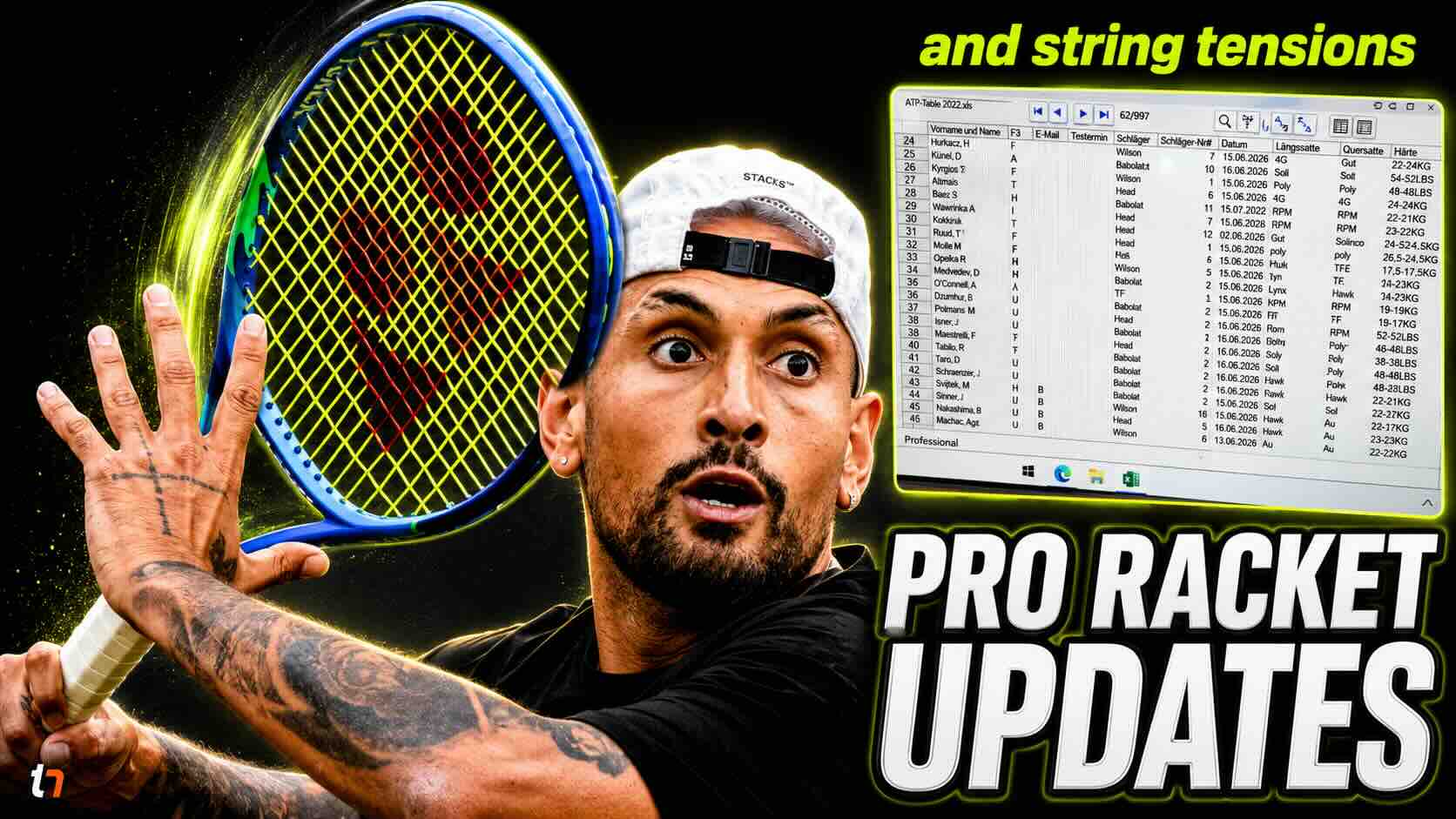
The grass court season is in full swing and we have some pro player string tensions from Halle to go through. Thanks to you who shared the string tension sheets via Instagram.
If you have observations or corrections, drop them in the comments below.
You can also watch the video embedded.
Ben Shelton — Polytour Strike / Polytour Pro, 54/57 lbs
Stuttgart winner Ben Shelton is a player who largely sticks to his setup, similar in philosophy to Rafa Nadal who rarely strayed from 56–57 lbs. Shelton uses Polytour Strike in the mains and Polytour Pro in the crosses, stringing the crosses higher at 57 lbs because Polytour Pro is a softer, more comfortable string. Polytour Strike is the firmer of the two, so this setup balances control and comfort reasonably well.
Daniil Medvedev — Tecnifibre Razor Soft, 21 kg (47 lbs)
Medvedev experimented with natural gut for a while — as many players do — but has settled back into a full bed of Razor Soft at 21 kg (47 lbs). It’s a tension that seems to suit him well. He’s been playing with real confidence lately after a bit of a rough patch, and the setup doesn’t look like it’s going anywhere soon. One to watch in Halle.
Taylor Fritz — Natural Gut Mains / Hawk Crosses
Finalist Fritz doesn’t deviate much either. He runs gut in the mains and Hawk in the crosses, stringing the gut two kilos higher than the crosses. Not everyone strings gut higher, but it makes some sense — gut is livelier and benefits from the added tension to dial in control. Interesting to compare with Alexander Zverev, who tends to go only one kilo higher on the gut. Slightly different feel, same general idea.
Alexander Bublik — Crosses Higher Than Mains
Bublik, now with Diadem (and possibly using a prototype, though that’s unconfirmed), sticks to his well-known philosophy of stringing the crosses at a higher tension than the mains. The idea is to kill the launch angle and keep his shots flatter — important for a player who takes big cuts at the ball. An aerodynamic racquet will naturally want to launch the ball higher, so stringing the crosses tighter helps neutralize that. It’s a quirky approach, but it’s very deliberate.
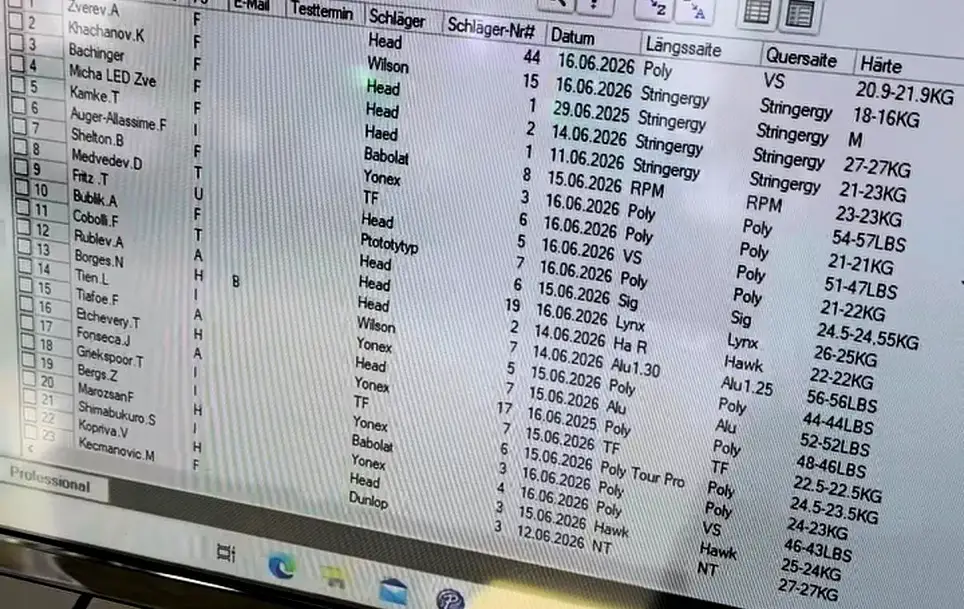
Flavio Cobolli — Full Bed of Firestorm
There was debate in the comments a while back about whether Cobolli uses natural gut or a full bed of Signum Pro Firestorm. As far as we know, it’s been a full bed of Firestorm for a while now — he did play gut a few years back, but this setup seems to confirm the switch. Nothing too flashy, but a solid, durable poly that works for his game.
Andrey Rublev — HEAD Lynx Tour
Rublev is back on Lynx Tour. He’s been on quite the string journey — 4G, gut hybrids, other experiments — but for now he’s returned to Lynx Tour, which he used for a stretch before. If you go further back, Rublev was a Luxilon Adrenaline player. The equipment searching is often a symptom of something deeper in the game, and Rublev has clearly been searching for something. He did lose to Hurkacz fairly heavily, but Hurkacz on grass is a tough draw for anyone.
Hubert Hurkacz — 4G Mains / Natural Gut Crosses (Wilson)
Speaking of Hurkacz — now with Wilson instead of Yonex — he’s using 4G in the mains and natural gut in the crosses. Natural gut hybrids are everywhere at the top of the tour. The gut provides feel and comfort in the crosses, while a firm poly in the mains handles spin and durability. It’s expensive, and you need a quality stringer who knows how to handle gut (it can be finicky). That’s part of why you see it less on the Futures and Challenger circuit, where players don’t always have their own personal stringer and may be relying on whoever is working the tournament desk.
Learner Tien — ALU (Rough), 130 Mains / 125 Crosses
We made a video about his racquet setup that’s worth a look if you are curious about his quite unique racquet. In terms of strings, Tien uses two different gauges of what appears to be ALU Rough — 130 gauge for the mains and 125 for the crosses. The crosses are shorter strings, so going slightly thinner there can help with feel and movement. Some players run a shape string in the mains and a smooth string in the crosses for spin (Casper Ruud does something like this), but Tien sticks with the same string in two gauges. A neat approach.
Frances Tiafoe — Polytour Pro, 44 lbs
Tiafoe is another one who just… doesn’t change. Polytour Pro at 44 lbs, same as ever. It must be nice to not have to think about your setup. He seems perfectly content and it keeps things simple on the road.
Joao Fonseca — Polytour Force, 48/46 lbs
This one is a little surprising. Fonseca strings his Polytour Force at 48/46 lbs, which feels low given how hard he swings — particularly on the forehand. Polytour Force is a stiffer string, which offers some natural control, but you’d still expect control to be more of a concern at those tensions with his ball-striking. Worth keeping an eye on as he develops.
Miomir Kecmanovic — Dunlop NT, 27 kg
Kecmanovic uses the Dunlop NT, a softer round black poly — notably softer than Dunlop’s Explosive Speed string. He goes up to 27 kg to compensate for the extra elasticity in the string. Makes sense: softer string, higher tension to bring in the control.
Ethan Quinn — Solinco Confidential
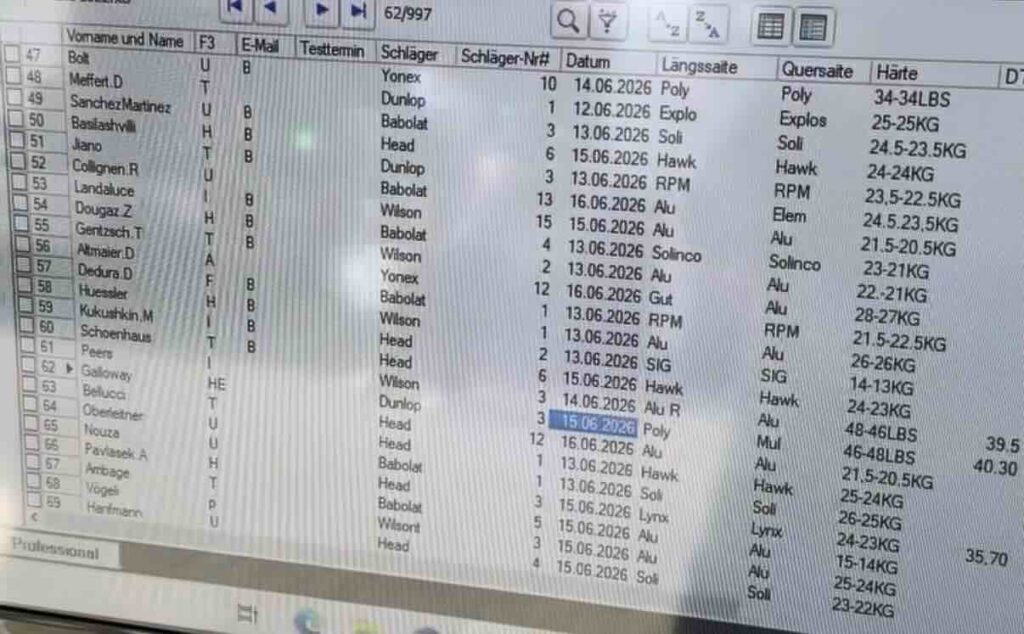
Quinn has switched from RPM Blast to Solinco Confidential. Solinco is extremely popular on the American college circuit, and Confidential is one of their better-known strings. Solinco recently released a softer, pink version of Confidential Soft.
Nick Kyrgios — Polytour Pro, 48 lbs
Good to see Kyrgios back on tour with a solid win in Stuttgart. He’s in Halle now — but had to pull out due to another injury setback. He’s on Polytour Pro at 48 lbs, similar to Tiafoe. A soft string at a relatively low tension, which makes sense for someone who hasn’t been playing much and may be easing back in.
Shevchenko — T-Fight (Tecnifibre), Customized
Shevchenko has switched from the Pure Strike to the T-Fight — a notable frame change. His specs are visible on the court (courtesy of the ever-present Dieter Calle stickers, solid marketing from him): 310g, 31.6 cm balance, 294 swing weight. That’s a relatively low swing weight by pro standards, which ties into a broader trend Dieter talks about — you don’t necessarily need a high swing weight if the balance point is a bit higher.
The Bigger Picture: Tensions and Swing Weights Are Going Down
It’s worth stepping back for a moment. Tensions and swing weights are both trending downward across the tour. Some of you raised questions in the comments about whether this leads to more arm issues — and the answer, as usual, is: it depends.
A lighter racquet with less string tension can mean less mass behind the ball, more vibration reaching the arm, and less stability on off-center hits. Couple that with the modern game’s emphasis on heavy topspin — where players are hitting higher in the string bed rather than in the center — and you have a recipe for increased stress on the arm, even with softer setups. Everyone is on poly now (many using gut hybrids for more comfort and power), but at much lower tensions than even five or ten years ago.
That said, heavier isn’t automatically better either. It all depends on technique, physicality, and what you’re working with. If you’re having arm, wrist, or shoulder issues, it’s worth talking to someone who can actually assess your setup and your swing — not just assume that going lighter or heavier will fix the problem.