
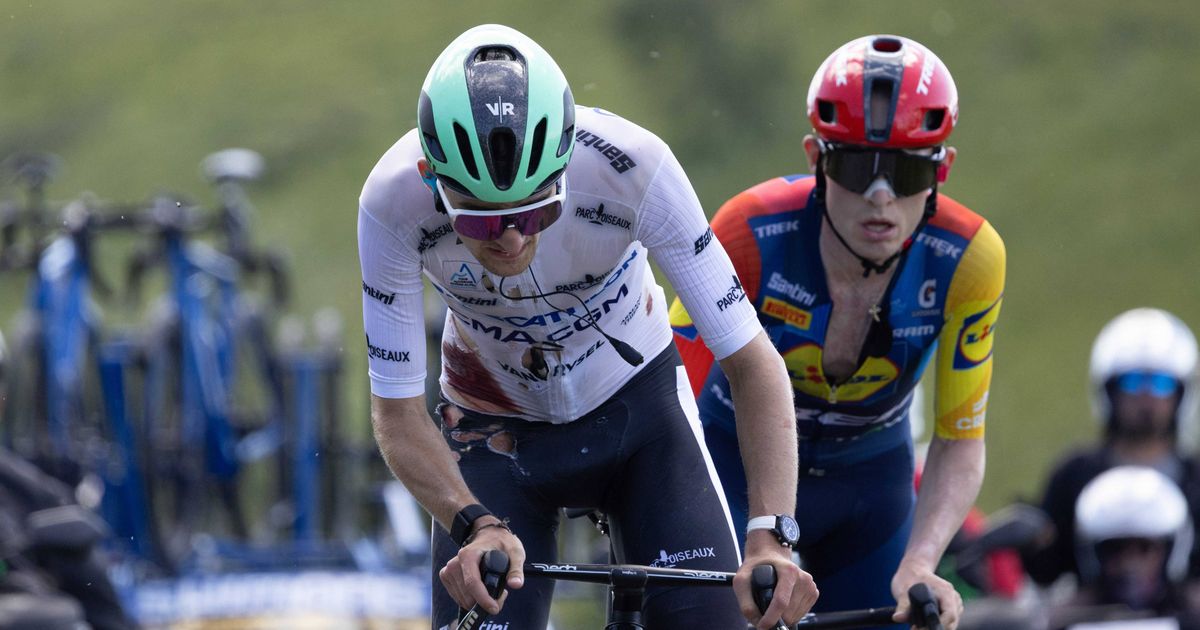
“If we look for Paul Seixas’s weak spot, for me, it’s his descending. Everything he does is pretty, fluid and clean, but he has no margin for error. I already said it during Itzulia: he’ll have to brake a little more and, above all, work on his technique in fast corners. I repeat, he has no safety buffer. At the slightest mistake, or with a touch too much speed, he can’t recover.”
Exposing himself to unnecessary risks
The Frenchman believes the issue is not poor descending ability, but rather the lack of control. A rider with strong cyclocross background which saw him finish 6th at the junior European Championships, Seixas definitely doesn’t lack in technical aspect – and he’s not afraid to show it – but sometimes haste makes waste.
Guimard expanded on that idea when pressed on a view that few publicly share within the cycling milieu.
“I never said he descends badly. I said he has no margin for error, which is different. His lines are clean. He may open them too early, but that’s another matter. The main issue is his angles, which he doesn’t fully master yet. So he can’t correct much. While it works, it’s marvellous, perfect, extraordinary. But the day it doesn’t, you sink straight away.”
In his analysis, the young French rider operates on a very fine line between efficiency and risk, a situation that, in his view, was once again exposed by the crash in the French race.
Paul Seixas at the Tour Auvergne-Rhone-Alpes
Doubts over his presence at the Tour de France
Beyond the crash, Guimard was also asked about Seixas potentially landing at the Tour de France. Far from embracing the idea, he insisted it is premature to take on a race of such magnitude at such a young age.
“The reality, as I’ve already said, is that he’s too impatient. And patience shows no mercy. If we look at Pogacar’s dominance and Isaac Del Toro, we’re already talking about two riders from the same team. And then there’s Vingegaard. Racing the Tour at 19… The talking points are ready: ‘He’ll learn, he’ll gain experience.’ I’m sorry, but when you sit an entrance exam for a prestigious university, you don’t go to learn how to take exams. You go to succeed.”
The commentator went even further, outlining when, in his view, would be the right time to debut at the Grande Boucle.
“Paul Seixas is a rider who should make his Tour de France debut when he’s practically in a position to win it. That’s not the case today. Even if he had finished second, he’d have been beaten. If it had been David Gaudu, for example, we’d say it was a fantastic result. But not for Seixas. There are lots of people with a vested interest in seeing him on the Tour start line… Well, he’s already made his decision, full stop.”
Despite the Decathlon CMA CGM rider’s abandonment, Guimard does not believe the incident changes his overall assessment of the rider or the wisdom of him racing the Tour.
“No. He has plenty of time to recover, and I hope it doesn’t affect his physical well-being. But ultimately, this crash could be a positive if it pushes him to seek more safety. If so, all the better. It won’t change anything for the Tour, but it might make some people think twice. I mean those with political and economic interests. Because for him, riding the Tour is also a commercial matter.”
Isaac Del Toro keeps confirming his rise
The other big name assessed by Guimard was Isaac Del Toro, winner of the Tour Auvergne-Rhone-Alpes and one of the most closely watched riders in the international peloton.
Asked about the Mexican’s performance, the Frenchman made clear that his display did not surprise him.
“No, I wasn’t impressed. It’s consistent with his level since last year. If you look closely, he must have eighteen or twenty wins since last year (26, editor’s note). He wins some major races, often solo, and he also produces big rides in support of his leader. He’s on a perfectly logical trajectory.”
For Guimard, Del Toro’s evolution follows a natural progression he has shown for months and which was again evident in this latest race.
“Clearly, he came into this Dauphiné not fully prepared, then improved as the stages went by. The three summit finishes largely locked down the race, and we didn’t see a real battle between the leaders before that. This allowed riders not in the GC fight to produce standout performances. The race was lively and interesting.”
Finally, Guimard also weighed up the performances of other key names present at the race.
“As for the general classification, we didn’t learn much. We know Ayuso isn’t quite at his best. Del Toro is on the up. As for Matteo Jorgenson, he’s coming off a collarbone fracture from the Amstel Gold Race. His ride there was more than acceptable given the injury. At his best, he could have been a dangerous rival for Del Toro, perhaps even more so.”

Isaac del Toro at the 2026 Tour Auvergne-Rhône-Alpes
An analysis that again places the Mexican among the standout riders of the moment, while keeping open the debate on the sporting management of one of French cycling’s brightest prospects.