
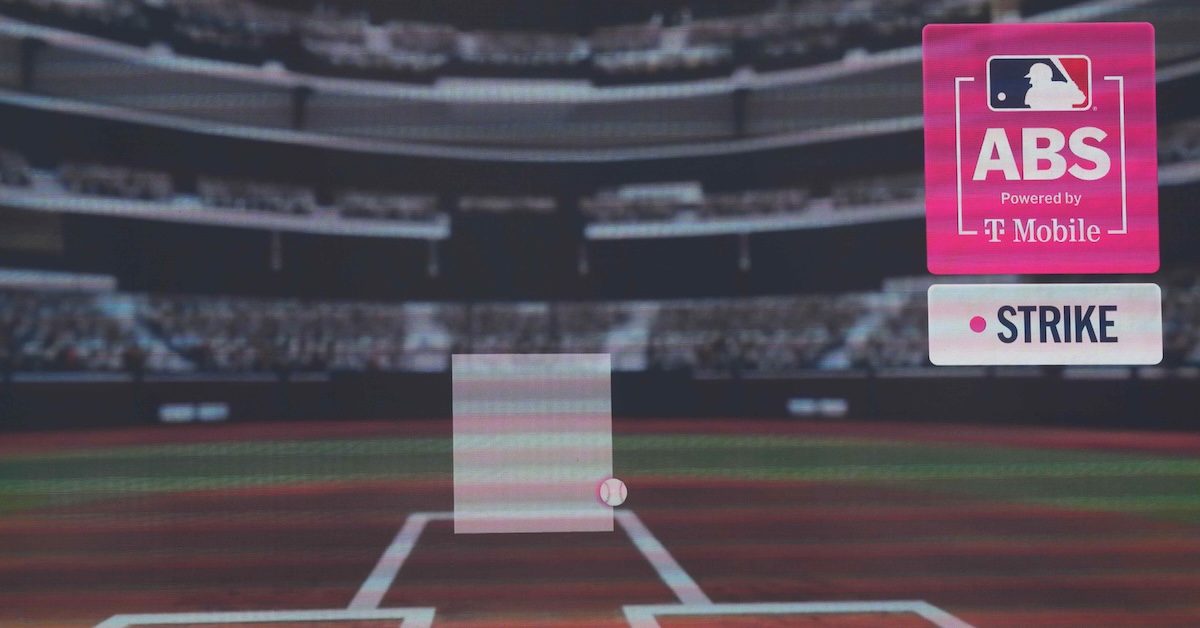
On April 15, Zach Neto was at the plate with one out and nobody on in the top of the fifth inning of the Angels’ game in the Bronx, where his team trailed the Yankees, 3-2. The first two pitches, a low changeup and a high slider, were nowhere near the zone, and Neto laid off easily. The 2-0 pitch from Luis Gil was another slider, this one about belt high and bending away from the right-handed Neto, who kept the bat on his shoulder and watched as the pitch appeared to clip the outside edge of the zone. Home plate umpire Lance Barksdale held up his hand. Strike one. Neto tapped his helmet immediately to challenge the call.
The graphic on the gigantic video board in center field showed that the pitch had missed by 0.4 inches. The call was overturned; the count was now 3-0. Neto walked on the next pitch. Mike Trout stepped in, took a fifth straight ball from Gil, then let a four-seam fastball over the heart of the plate get deep on him. He unloaded, clobbering the cookie 383 feet into the right field seats for a go-ahead two-run blast.
The no-doubt Trout clout would have been the decisive blow in an Angels win if not for a misplayed popup and a Jordan Romano meltdown. The Yankees walked it off on a José Caballero single, relegating Neto’s challenge to a footnote in that night’s game story, if it was mentioned at all. Even so, the gamble was an early example of how the new automated ball-strike challenge system can make the difference between winning and losing a game.
“He used the ABS exactly how it was meant to be used,” said Yankees catcher Austin Wells, who was behind the plate for Neto’s walk. “Being in the spot before Trout, and Trout’s on fire, so he’s got to get on any way he can get on to give Trout the chance to take the lead with one swing.”
This season, for the first time ever, major league players can challenge an umpire’s ball-strike call. By now, the rules are probably familiar: Each team begins the game with two ABS challenges, but unlike replay review challenges, which are initiated by the manager, only the batter, catcher, and pitcher can challenge a ball-strike call. And while managers have 30 seconds to decide whether to challenge calls on the field, the players can only challenge a pitch within two seconds of the call. If a challenged call is confirmed to be correct by ABS, the team loses that challenge; if the call is overturned, the team retains it. The extremely fine margins between a ball and a strike — the pitch to Neto was off the plate by less than a ball-length — and the instantaneous turnaround between a call and a challenge have combined to create a cocktail of uncertainty and urgency. There’s drama in every close pitch, not just in what the umpire will call, but also in how the batter or battery will respond and, if challenged, what the electronic strike zone will reveal.
A lot has been written about the impact that the ABS system has had on walk rates and scoring league-wide. We also know that, since the implementation of ABS, players are shorter, the strike zone is tighter, and games are longer. These elements are important to understand because they deal with the fan experience, but they don’t matter as much to teams and players during games. Instead, clubs are far more focused on the strategic side of challenging ball-strike calls and how they can use the ABS system to their advantage.
You Aren’t a FanGraphs Member
It looks like you aren’t yet a FanGraphs Member (or aren’t logged in). We aren’t mad, just disappointed.
We get it. You want to read this article. But before we let you get back to it, we’d like to point out a few of the good reasons why you should become a Member.
1. Ad Free viewing! We won’t bug you with this ad, or any other.
2. Unlimited articles! Non-Members only get to read 10 free articles a month. Members never get cut off.
3. Dark mode and Classic mode!
4. Custom player page dashboards! Choose the player cards you want, in the order you want them.
5. One-click data exports! Export our projections and leaderboards for your personal projects.
6. Remove the photos on the home page! (Honestly, this doesn’t sound so great to us, but some people wanted it, and we like to give our Members what they want.)
7. Even more Steamer projections! We have handedness, percentile, and context neutral projections available for Members only.
8. Get FanGraphs Walk-Off, a customized year end review! Find out exactly how you used FanGraphs this year, and how that compares to other Members. Don’t be a victim of FOMO.
9. A weekly mailbag column, exclusively for Members.
10. Help support FanGraphs and our entire staff! Our Members provide us with critical resources to improve the site and deliver new features!
We hope you’ll consider a Membership today, for yourself or as a gift! And we realize this has been an awfully long sales pitch, so we’ve also removed all the other ads in this article. We didn’t want to overdo it.
“We have a strategy, but it’s still an individual, in-the-moment [decision],” Yankees manager Aaron Boone said in early May. “And so, I still think players are finding their way in when to do it, when not to do it, and in a split second. I’m finding everyone’s a little bit different with it. Some are obviously a little more eager and willing and fearless. Others are more hesitant than you want to be. So, I think that’s something that’s going to continue to shake itself out throughout the year, and frankly the years ahead, as guys get used to this being just second nature to them.”
Over the first 12 weeks of the season, I’ve spoken with a total of 40 people — 27 players, seven managers, one bench coach, and a handful of club officials — from nine different teams to understand how they are approaching the ABS challenge system. I wanted to know what factors players consider when they’re deciding whether to challenge a pitch, and how managers and front offices shape their teams’ ABS strategy. Is there a team-wide mandate? Are some players given more freedom to challenge pitches than others? Are some players more willing to risk losing a challenge than others? Also, I wondered how ABS strategy changes when a team has only one challenge remaining.
The people I talked to all said their teams have some sort of strategy, and for the most part, the broad strokes of their strategies are the same. The difference is in the details. How teams implement, evaluate, and adjust their strategy varies from club to club.
The coaching staff and front office analysts of some teams, such as the White Sox, Rays, and Reds, have assumed a more hands-on role in their club’s ABS strategy, whereas others, such as the Pirates and Cardinals, have been more laissez-faire. Nationals manager Blake Butera told me in mid-April that his staff and the front office initially took a more exacting approach before backing off. “As a coaching staff, our preference is when there’s runners on base, if it’s late in the game, to be more aggressive, or when there’s nobody on base earlier in the game, to maybe not challenge,” he said. But it “was kind of a lot” for his players to consider “when it’s such a quick decision.”
“You don’t have time to be like [after the] pitch happens, ‘Alright, what’s the count? Can I do it right now? It’s too late, right?’ It happens so quickly,” Butera said. “At the end of the day, they need to figure it out as they go. It’s hard to say, ‘Hey, you’re only allowed to do it in this inning, with this runner on base, in this count, with this guy on the mound.’ That’s just a lot.”
It is a lot, which is why players think about the various scenarios that could play out before they step into the box, get into their squat, or toe the rubber. They know the count, the score, the inning, the number of outs, the bases that are occupied. Situational awareness is part of the job.
Teams generally want to save at least one of their challenges for the final few innings, and they try not to waste them in low-leverage spots. The data, compiled by Jon Becker and updated as of Wednesday morning, bears that out. League-wide, players are challenging a greater percentage of called pitches in the later innings and in higher-leverage situations. “We can’t carry them over into the next game,” said Reds catcher Tyler Stephenson, who has been one of the best challengers in the game this season. “Especially in the ninth inning, if we’ve got one or two, even if it was a ball, I’m just gonna fire away just to see, because you never know. It might be a clipper.” They’re also taking more chances on pitches later in games and as the leverage index increases. Said Rangers catcher Kyle Higashioka, “We’re more likely to fire off a questionable challenge when the situation is very high leverage.”
Challenge Distance by Leverage
| Leverage | Average of Challenge Distance (Inches) |
|---|---|
| Low | 0.48040318 |
| Medium | 0.050196217 |
| High | 0.05651058 |
| Grand Total | 0.050055099 |
The same is true when there are runners in scoring position or when there are two outs, and especially when there are runners in scoring position and two outs. With nobody in scoring position, players are challenging just 2.5% of called pitches. The challenge rate climbs to 3.7% with runners in scoring position, and to 4.0% when there are multiple runners on base. Players are challenging 3.2% of all pitches taken with two outs, higher than the overall league-wide challenge rate of 2.8%. With runners in scoring position and two outs, the challenge rate is 3.9%, compared to 2.8% with two outs and nobody in scoring position. In these situations, the inning matters less than the leverage.
“A run in the first counts the same as a run in the ninth,” said Nationals outfielder Joey Wiemer. “If there’s bases loaded, there’s more leeway with it. If it’s a 50/50 ball, go ahead and rip it.”
Challenges by Baserunners
| Baserunners | Total Challenges | Total Called Pitches | % Challenged |
|---|---|---|---|
| ‘— | 2326 | 96889 | 2.4% |
| ‘–3 | 102 | 3150 | 3.2% |
| ‘-2- | 387 | 11183 | 3.5% |
| ‘-23 | 104 | 2669 | 3.9% |
| ‘1– | 884 | 29582 | 3.0% |
| ‘1-3 | 150 | 4313 | 3.5% |
| ’12- | 392 | 10333 | 3.8% |
| ‘123 | 192 | 3740 | 5.1% |
| Grand Total | 4537 | 161859 | 2.8% |
| No RISP | 3210 | 126471 | 2.5% |
| RISP | 1327 | 35388 | 3.7% |
| 2+ Men On | 838 | 21055 | 4.0% |
The score also plays a role. A whopping 77.4% of all challenges this season have come with a score differential between zero and three runs. “If you’re down by four runs and nobody’s on with two outs in the third inning, it might not be worth it in that situation if you’re not 100% sure,” Cardinals outfielder Lars Nootbaar said. “So, understanding the weight of the at-bat, understanding how it could swing the game one way or the other.”
A situation similar to Nootbaar’s hypothetical played out on Sunday night, when the Red Sox trailed the Rangers, 6-2, with one out, nobody on, and Willson Contreras at the plate in the bottom of the fourth. Boston had already burned a challenge in the top of the inning, yet Contreras deemed this pitch worthy of risking the other:

The Red Sox managed to score two more, in part because of Contreras’ second home run of the night in the sixth inning, and they brought the tying run to the plate in the eighth. Not having a challenge left didn’t come back to bite Boston; none of the strikes called against Red Sox batters would’ve been overturned if they were challenged. Still, this was an obviously bad situation in which to challenge, on a pitch that wasn’t all that close to the edge of the zone.
Players also said they are more willing to challenge close pitches that could decide plate appearances. The counts with the highest challenge rates are 3-1 (5.6% of pitches taken) and 3-2 (9.4%). Interestingly, called pitches in 0-2 counts aren’t challenged as frequently (2.6%) as those in 1-2 counts (3.1%), 2-2 counts (4.6%), or 3-2 counts. Some of this could be attributed to the pitcher, who is more likely to throw waste pitches in 0-2 counts than when it’s 3-2. But the catchers I spoke to said they are less likely to risk a challenge on a borderline pitch when ahead 0-2 or 1-2 than they are when it’s 2-2 or 3-2. The flip side of this is also true. Only 2.0% of called 3-0 pitches are challenged. That’s interesting when you consider that umpires tend to expand the zone on 3-0 pitches. With two more strikes to give and only one more ball needed to walk, batters overall don’t seem to think a close 3-0 pitch, even if it’s a ball, is worth risking a challenge.
The league-wide data, though, doesn’t reflect the differences in philosophy and approach. “Obviously, there’s differing views on it,” White Sox bench coach Walker McKinven said Tuesday at Yankee Stadium. “We’re generally an aggressive team with challenging, not waiting for something that may or may not happen later. If it’s up front and there’s a high confidence level, we generally encourage our guys to go after it.”
Based on work from a group of analysts over the winter, the White Sox implemented that approach at the start of spring training, McKinven said. It was on display as early as Opening Day, when catcher Edgar Quero successfully challenged three pitches in the first two innings. The first challenge was on the fourth pitch to the leadoff batter, an extremely low-leverage spot, while the second two came with the bases loaded in the second inning. All three plate appearances ended in hits, and the White Sox ultimately lost 14-2, so the challenges weren’t all that impactful. Quero challenged a fourth pitch, this one in the sixth inning with runners on the corners and his team down by eight, but he was incorrect.
“We knew that there would be room to grow both in the aptitude of the players and the fluidity of the strategy,” McKinven said. “But generally, we knew we were going to be aggressive from the start, and we’ve maintained that.”
McKinven is “not the czar of challenges,” he said, but in his role as bench coach, he’s heavily involved with shaping the team’s ABS strategy. The White Sox have a group of analysts tracking the team’s ABS data, and he’s tasked with presenting that information to the players.
“When a high-leverage moment comes up later in a game and you’re out of challenges, that’s not great, of course,” he said. “We track that. We know how many of those situations we wished we had a challenge in but didn’t because we were aggressive early. We know which players’ aptitude is better than others, and we’re paying attention to that. And we might put some different restrictor plates on different guys in different situations just to get better at that, to finely tune it, I suppose.”
The White Sox have placed restrictions on some players, but McKinven didn’t specify which ones or how many. “We’ve addressed where guys can get better, in what spots, who’s been accurate, who’s been crushing leverage, all those things,” he said. “But, more or less, we’re letting our guys go, and they have a basic understanding of why and how we want to deploy them.”
While Chicago has maintained an aggressive approach to challenging all along, the Rays took more time before adopting that strategy. Before a game in the third week of May, multiple Rays position players told me that the coaching staff and front office had recently directed the team to air on the side of aggression. The purpose, though, was about more than just getting calls overturned. “I think they are just trying to accumulate as much data as they can,” said shortstop Taylor Walls. “A challenge not used is worthless.”
Gathering troves of data would allow front office analysts to hone their team’s strategy. To provide a basic example of how the Rays could benefit from amassing so much data, let’s look at something Davy Andrews researched last week, that catchers are less successful challengers on pitches thrown to the part of the plate where they’re better at framing. The Rays could take that information to tell their catchers to be more selective on the pitches they challenge on their stronger-framing side. Or, if one of their right-handed hitters struggles against outside breaking balls from right-handed pitchers, and if those pitches are also a framing strength but a challenge weakness for the opposing catcher, the Rays could tell that batter not to swing at those offerings, with the goal being either to let the catcher waste a challenge on a ball off the plate that he framed, or to have the batter challenge a pitch off the plate that the umpire called a strike because it was framed well.
Beyond just the data-collection component of being more aggressive, Walls said the Rays believe “there’s more negative value in not challenging a pitch that could be overturned rather than the positive value of saving it.” Or, looking at it a different way, you have something to gain from challenging an unfavorable call. If you don’t challenge, the best that you can get is an unfavorable call and the opportunity to maybe challenge a different unfavorable call later.
Think of this philosophy in terms of baserunning. If you’re never getting thrown out trying to take the extra base, you’re probably not trying to advance enough and are leaving runs on the table. The White Sox and Rays consider the same to be true for challenging ball-strike calls.
But as is the case with baserunning, there’s a difference between being aggressive with your challenges and being reckless. In this analogy, pitchers challenging a ball call are the same as slow runners attempting to score from first on a single — they should almost never do it. Yankees right-hander Will Warren laid out the only situation in which it might be a good idea for a pitcher to challenge: If the catcher is set up on the inside edge of the zone for a right-handed batter, and the pitcher misses his spot badly but clips the outside corner, forcing the catcher to reach across his body to receive it and thus messing with the view of the umpire, who is set up behind the catcher but shaded to the right-handed batter’s-box side of the plate. Only then, in this most convoluted scenario, would the pitcher have the best vantage point to see that the pitch was, in fact, a strike.
Recognizing that this series of events rarely comes along, at the start of spring training, Reds manager Terry Francona decided to completely take away the temptation for pitchers to challenge. “We don’t let our pitchers challenge,” he said in late May, “because they think everything’s a strike.” Backup backstop P.J. Higgins elaborated on why it’s a bad idea for pitchers to challenge: “I’d rather them just leave it up to us as catchers. They already have a lot going on. They’re throwing the ball, and their eyes are moving. We’re also framing. A lot of people only see the end result of what we do with our work, so it’s harder on them. Our job is to make it look good for them and the umpire, so it’s just easier if they stay out of it.”
As of the start of play Wednesday, the Reds were one of only five teams that hadn’t had a pitcher challenge, along with the Diamondbacks, Twins, Rays, and Blue Jays. On the other end of the spectrum, the Pirates lead the way with eight pitcher challenges, only one of which was successful. Half of those were initiated by closer Gregory Soto; he’s 0-for-4.
Pitchers don’t challenge was the only rule Francona set in stone, but unlike the White Sox and Rays, the Reds have more guardrails in place. For example, if Cincinnati has both a late lead and a challenge remaining, Francona tells his batters, “No more challenges. Leave it for the catcher.” If the Reds are behind, he is more encouraging of his hitters to challenge, but only “in leverage situations. Not for personal reasons. Not because ‘I need a hit.’”
“We told our guys it’s not a personal, emotional challenge,” he said. “It can’t be. And it happens sometimes. But it’s gotta be team-oriented, and it’s gotta help us.”
The emotional challenge was often cited in my conversations with players and coaches as something to be avoided as much as possible. “It’s easier for our strategy to be implemented with the catcher,” said Orioles manager Craig Albernaz in early May. “They’re less emotionally tied to the pitch because they’re behind the plate.” Hitters, though, have a personal stake in every plate appearance. Their stats, and therefore their potential future earnings, are tied to their outcomes at the plate, and they may only bat three or four times in a night. Catchers, on the other hand, might be on the receiving end of 10 times as many plate appearances in a game.
Other managers, such as Oliver Marmol of the Cardinals and Don Kelly of the Pirates, have a lot of faith in their players to leave emotions out of it, and thus give them a lot of latitude to execute their team’s strategy. “They have the freedom to use it whenever they want,” Marmol said last week at Citi Field. “Very rarely do we have to step in and talk about a challenge that was used in an inopportune time, based on how it gets handled pretty quickly afterward.” By “we,” Marmol was referring to the coaching staff. The ones doing the handling are the players, who “do a nice job of policing that.”
Some players are more comfortable with that freedom than others. Cardinals shortstop Masyn Winn had challenged just one pitch this season when I spoke to him last Tuesday night. It’s not that he’s agreed with the umpire on all but one occasion; far from it, actually. For him, there’s strategy in not challenging.
“There are too many pitches that are 50/50 — that I think are balls, and then I go back and look at them and they’re strikes — for me to be super confident around the edges,” Winn said. “So, I’d rather save them for guys like Noot[baar] in big situations, guys like [Jordan Walker] that can really do some damage with that extra strike. I like to save them for the defense, too. There are so many times where I feel like our catchers do a great job and they don’t get the call, so I want them to be able to have the luxury if we do have one to burn.”
Still, despite his general hesitation, Winn knows there are moments when it’s worth letting it rip, even if he’s unsure. On Sunday afternoon against the Twins, Winn was batting in the eighth inning with two outs, a runner on first, and the score tied, 4-4. In a 1-2 count, he took a 98-mph four-seamer up and away from righty reliever Andrew Morris for strike three. Winn calmly turned toward home plate umpire Jen Pawol and tapped the top of his helmet. The call was overturned, barely. The pitch missed the zone by 0.1 inches. It was as close a call as they come.