
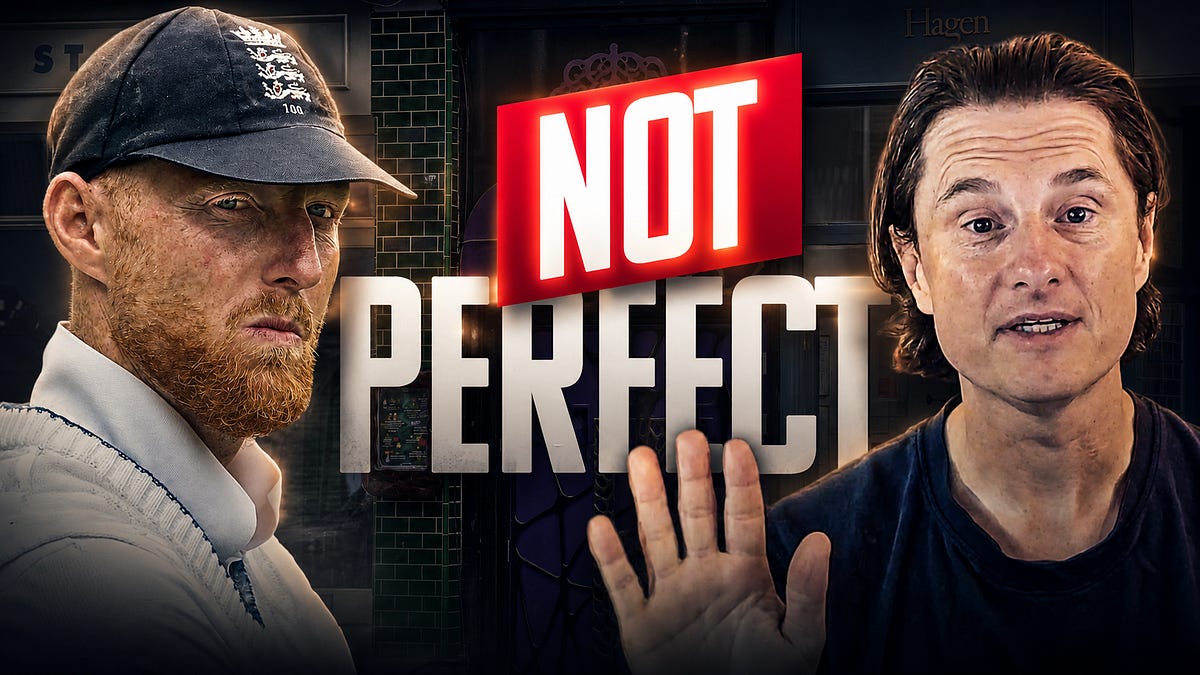
Ben Stokes’ shoulder is about to fall off.
Whether it’s true or not, that’s never the point. There is something wrong in his arm, yet he is going to bowl anyway. And he wants us to know.
These are the two crucial bits; that he is going to defy pain, again. And that he is going to let us know about it, again.
There is no doubt Stokes is a warrior. But also he’s a showman. When he’s dismissed, it is simply the best ball anyone has ever faced. Has any cricketer ever stared down at the surface with more suspicion after missing a straight delivery that bounced normally?
There is nothing he does softly. Even when he decides to dead-bat the ball, there is a sense of aggression. We are supposed to feel something every moment we watch him.
The shoulder is clearly hurt, but England need a wicket and so he bowls on, reattaching his arm for each delivery to ensure he can get one more Indian batter out. It’s masochistic, but also like a weird cabaret. The pain is clearly real, he’ll miss the following Test, but it’s also a performance.
Ben Stokes knows people are watching him, he understands his legacy is toughness, and he plays to it.
Does it matter that there is a sense of performance in what he does, if his shoulder is genuinely in tatters? Is this a man with a higher pain tolerance than other mortals, or just someone who watched too many action films in his youth? Was he inspired by his father’s decision to cut off part of his finger for rugby, or is this ruthless pragmatism part of Stokes’ DNA?
Ben Stokes is the lead character in the film Gladiator, Maximus Decimus Meridius. Someone who wants to just do the job and survive. But he is also the actor who plays him, Russell Crowe, understanding that the performance matters too.
And at the end, we are entertained.
There is no cricketer more likely to run through a wall for his country. However, there’s also no other player that’d choose to run through a wall when there was an open door available.
Ben Stokes wants the wall, he wants the pain.
***
Ben Stokes is a beast athletically, but his run up has always been lowkey; it feels like a club bowler coming in after a few weeks off. The look on his face after Carlos Brathwaite’s six is also familiar to amateur players. A look of dread and impending doom.
13 from 5 needed.
Ben Stokes screams, and then is standing mid-pitch, pursing his lips like he’s preparing for a stage play. No one is watching him; they are searching for which row at Eden Gardens Brathwaite has launched the ball.
7 from 4 needed.
Ben Stokes is squatting down on the pitch, his hand over his mouth, almost stifling the scream. Then he runs his hand through his hair and looks down. He is alone, desolate, broken. This is the image of a man who has lost a World Cup for his country.
1 from 3 needed.
Ben Stokes is staring into nothing, waiting to deliver the final ball. The last six is hit, it’s over.
Stokes should not have been a death bowler in that T20 World Cup, he almost never did it before that day. And when it went wrong, it did so in one of the most spectacular ways we’ve ever seen.
Earlier in the same year, Stokes made 258 from 198 balls against Morne Morkel and Kagiso Rabada in Cape Town.
In the space of three months, Stokes produced two moments that would define most cricketers. And they’re his footnotes.
***
Ben Stokes should not have been suspended for being out at a nightclub at 3:30AM.
Ben Stokes should have been suspended for being in charge of a culture where so many players have misbehaved, and breaking a rule he was part of implementing.
The issue is that the players needed a curfew, and that it was Stokes who first broke it. It is not a career-ending problem, but this team (and even the management) have acted like children for much of their reign. So when one of the people who was in charge of that broke the rule, he kind of left the ECB no choice.
What is fascinating is whether any of this would have come out at all if there had been no fight, of which at the moment it looks like he had nothing to do with. The fight was made public, but the ECB would have known Stokes had broken the curfew regardless, as their security guard was there.
And none of this is a secret. They know a lot about his after-hours prowess. So does the rest of the world.
***
In 1966, Garfield Sobers averaged almost 100 runs with the bat, when bowling, it was 24. He was the best fielder in the world, too. Averages don’t really tell the story here.
That year he was the leading run scorer in Tests by almost 300, though he only played 11 innings.
With the ball he took 32 wickets, good enough to be the second-highest wicket taker.

In the field, he was equal first in terms of catches by non-keepers (he was still second if you keep in glovemen).
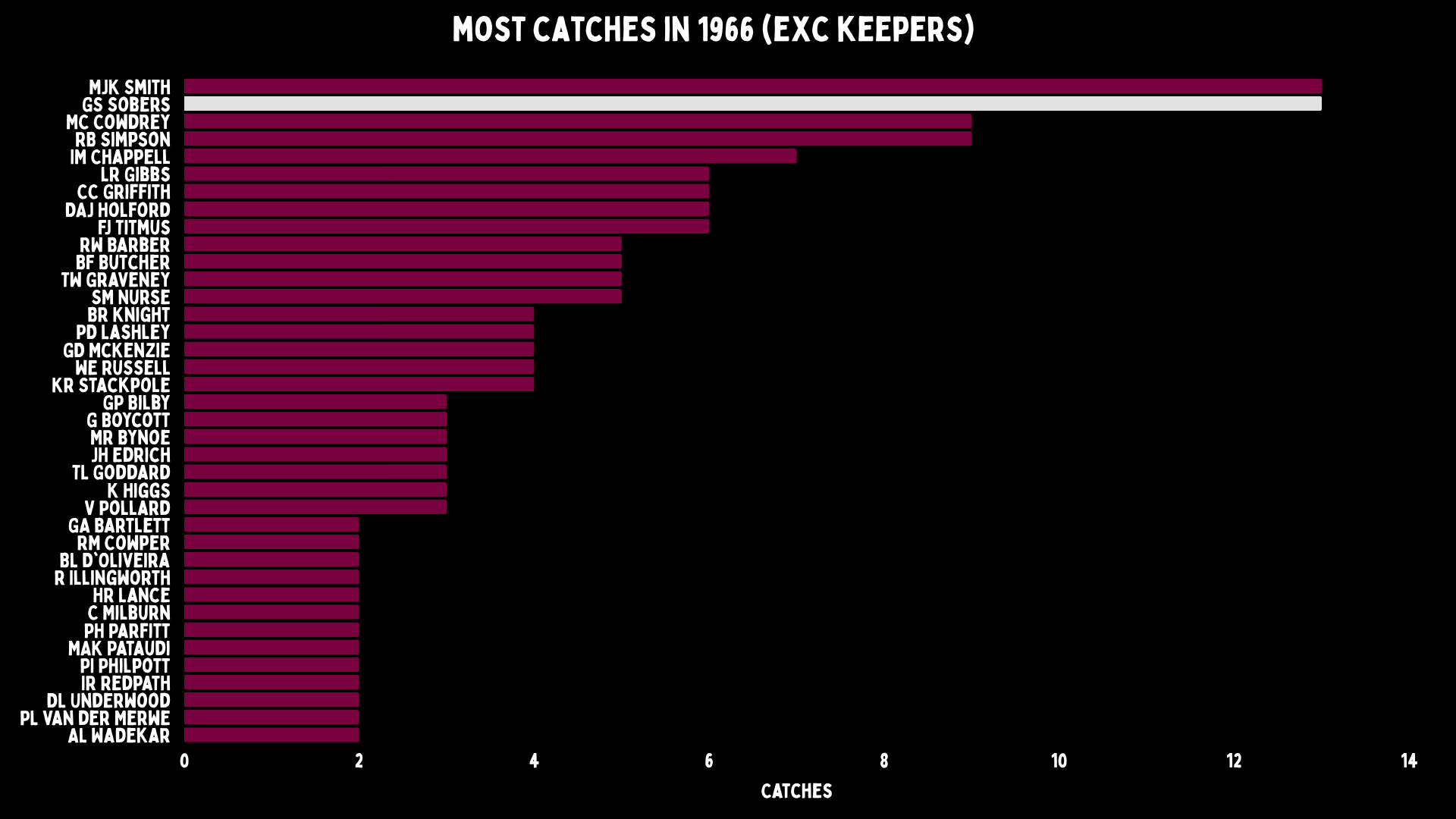
It means that for one year, the West Indies had Don Bradman with the bat, Shaun Pollock bowling seam, Ashley Giles with finger spin, Simon Katich’s part-time wristies and Steve Smith in the slips. Oh, and he was captain. West Indies unsurprisingly won five of their seven Tests.
That may be the greatest single-year performance ever, but we’ve had others. Ian Botham took 66 wickets at 18 in 1978, with three Test hundreds. For Don Bradman, you have to choose between two years. 1948, 1000 runs in 8 Tests, from 13 innings. Or 1930, 8 knocks for 970 runs.
The most overlooked great, Hashim Amla, poured in more than 2300 in 26 matches for 2010 across formats: 10 hundreds, and a combined average of 76.

In 1976, Viv Richards made 1710 runs at 90 in just 11 Tests. And Ricky Ponting in 2003 won a World Cup final in an innings, but also averaged 100 in Tests, with three double tons.
Muthiah Muralidaran took 136 wickets at better than 20 in 2001. Which sounds great, but Waqar Younis added 96 at better than 15s to start the nineties.

Without getting too dudes saying dudes and just remembering old great cricketers, you could add years of Jasprit Bumrah, Imran Khan, Virat Kohli, Steve Smith and Sachin Tendulkar.
These are very specific types of great years, it’s about overall numbers, not vibes.
Compare that with Tillakaratne Dilshan’s 2009. 10 centuries across all three formats, but also gave the world the Dilscoop. That doesn’t include his incredible 96 from 56 balls in a World Cup semi-final that was more than 60% of his team’s runs.
But if you want impact, the next three are incredible. In 1994, Brian Lara broke two world records. First, the highest Test score, then going back to pick up the highest first-class score as well.
In 1983, Kapil Dev took 75 wickets at 23 in Tests. That was a huge year for him, but he also made 175 from 138 balls to save India’s World Cup campaign against a nagging Zimbabwe team. Then in the final, he ran back to catch Viv Richards. There is a film about that World Cup victory under Kapil’s captaincy.
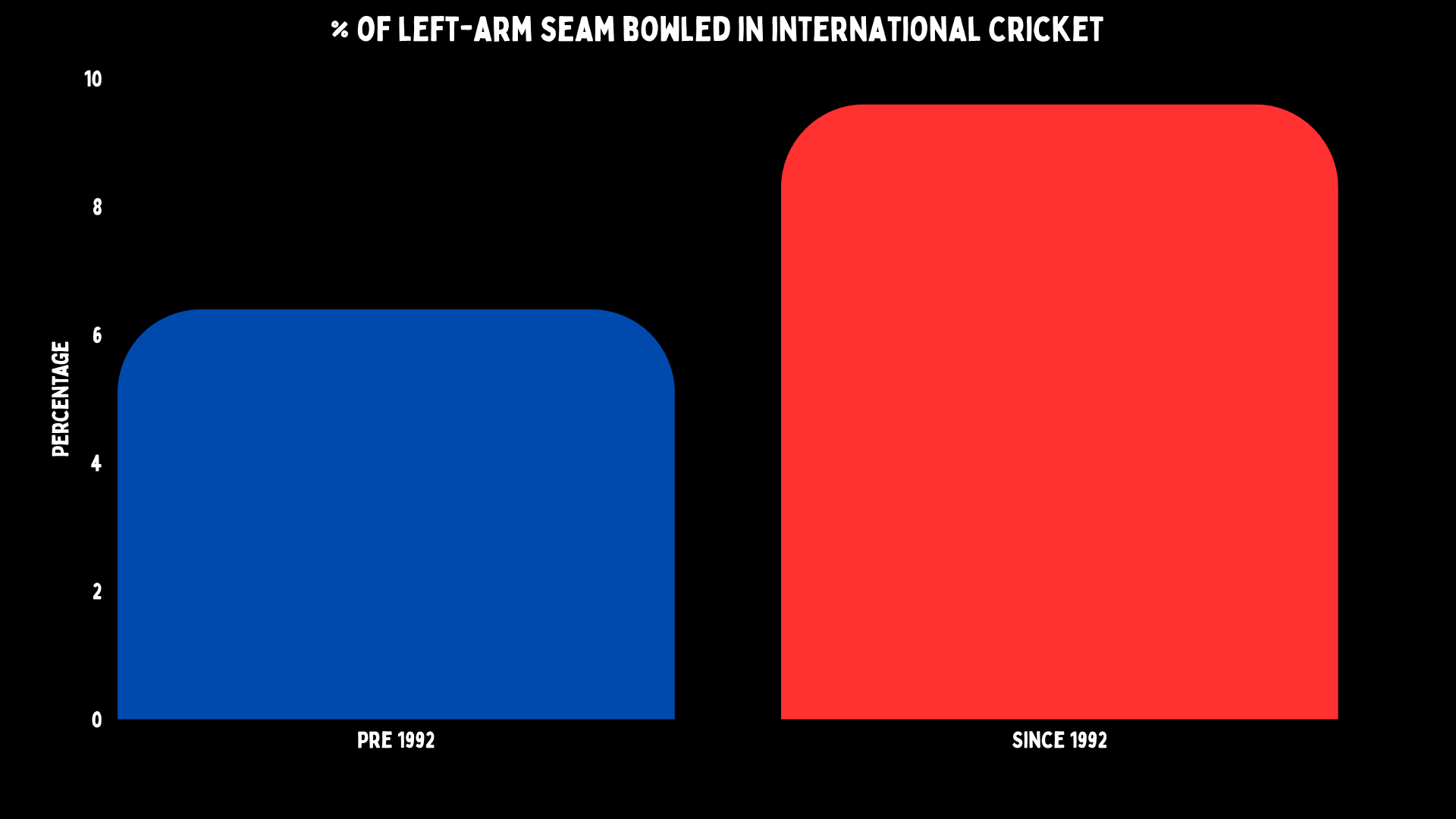
But what about Wasim Akram, who found himself in the World Cup final against an experienced English team and the old ball? In two deliveries, he showed the entire planet what reverse swing was, and won the cornered tigers a World Cup. Then later on in the year he went to England and ended their entire decade’s hopes and dreams. There was a 66% increase in the amount of left-arm seam after 1992 (from 6.4% pre 1992 to 9.6% since 1993). That is not all Wasim, but he fathered more than most.
The names in this section are incredible: either the best peak players ever, or just the greatest to do it.
Ben Stokes is neither. He’s never made more than four hundreds in a year, or taken 50 wickets. In terms of pure form, his best year was 2020, where he averaged more than 50 and took his wickets at 18.
But the year he will always be remembered for is 2019. Arguably his best year with the bat, though poor when bowling. But it’s really about two moments, the 2019 World Cup final and the chase at Headingley.
In one year, he pulled off the best World Cup final heist, and a top five at worst Test innings. It’s not that it is automatically better than some of the years we have mentioned here. But it is nearly unrivalled in terms of pure impact.
Ben Stokes played 38 innings for England in 2019, and two of those might be talked about as long as cricket is mentioned.
***
Ben Stokes is slogging to the short leg side boundary, where he has just cleared a length ball by Trent Boult easily. This time, it’s a juicy full toss, and he smashes it out to deep midwicket with a messy overhit.
But it finds a pocket between long on and deep midwicket. New Zealand’s Martin Guptill rushes around, picks it up, but his throw is weak, and it limps towards the keeper’s end as Stokes is stealing a second.
Then something truly bizarre happens, Stokes’ dive is perfectly timed to have the bat meet the ball, and fly off to the boundary for another four runs. The umpires were confused, and missed that it wasn’t really a boundary. And instead, this weird convolution of events means England are gifted a free four.
The throw was so limp that if the keeper had simply let it go through his legs, it might have barely got to the rope. But it races off the diving bat.
And Stokes gets up, raises his hands up high like a kid who was stealing food from the table, and he’s as confused as everyone else.
It will be this moment he is remembered for.
But England are chasing 242, and never quite getting above the rate, while constantly losing wickets. With just over five overs to go, England had run out of specialist batters with Stokes. And not only would end up with the tail, he would bat with all of them. The final three batters faced one ball combined, as Stokes – and the overthrows – did it on their own.
It’s probably one of the greatest innings in World Cup history, considering the match situation, and it’s his second-best knock of 2019.
This was the year of Ben Stokes. He went from a cult to a religion.
***
2011: Ben Stokes is arrested on a night out. He has only just started playing for England at the time. The charges will eventually be dropped.
2013: Ben Stokes is sent home by the England Lions for unprofessional behaviour. This involved drinking and not listening to team rules.
2014: Ben Stokes misses the T20 World Cup after punching a locker. He fractures his scaphoid.
2017: Ben Stokes knocked out two men and fractured an eye socket in a fight that led to him being charged with affray. He was later found not guilty on the grounds of self-defence for himself and others.
2026: Ben Stokes is dropped from the English cricket team after a fight in a Chelsea nightclub. He was not involved in the original part of the conflict, but he was also out later than the curfew. A curfew that he helped set.
This is not the worst list in the world, but it’s also not the kind you expect from an English cricketer. A footballer, yes. Certainly not a cricket captain.
English leaders used to be gentlemen (landed gentry, upper class, illuminati), and then later they were often college-educated and still the right kind of family. It was only in 2014 (during Stokes’ career) that then ECB chairman Giles Clarke said that Alastair Cook and his family were “very much the sort of people” England wanted for their captains.
Traditionally, English cricket has a type, and Stokes is not it. But he is their most famous player and a captain. He’s not some wild-boy outlier. He’s the face of the English cricket brand, a naturally conservative organisation.
However, he is also a player who appeals to a market that English cricket has been losing. The non-privately educated and Asian fanbase. Stokes speaks to cricket and non-cricket fans.
So in some ways, he is exactly what English cricket wants, a true crossover athlete.
The best barometer of what the English public think about athletes is from the BBC Sports Personality of the Year award. Only in the UK could someone receive an award for the most prestigious personality, and not just performance.
In the last 50 years, three cricketers have won the award. Ian Botham in 1981, Freddie Flintoff in 2005 and Ben Stokes in 2019.
James Anderson, Geoffrey Boycott, Kevin Pietersen, David Gower, Alastair Cook, Graham Gooch and Joe Root have never won it. When the BBC likes cricket personalities, it is almost always troubled, dramatic, genius all-rounders.
The British public has a type, and Ben Stokes is it.
***
Ben Stokes is not a normal batter. It’s simply both a strength and weakness.
Brian Lara is perhaps the best example of what a batter does. He gave the bowler the first 20 balls, and the rest were for him. But he wasn’t after the bowlers the whole time. He would gear up when he had a bowler he liked, the ball stopped seaming, or the field was wrong. He was playing to the situation, but allowing for change even within an over. Gear up, down, whenever he needed it.
That is the extreme version of what professional batters do: they block, nudge, turn over strike, punish bad balls, attack, and some huge bashing all when it is needed.
It has never been what Ben Stokes does. He has five of these gears, but he’s not really a nudger. What is different about him is that he doesn’t change gears regularly. He can block for a day, strike rotate on loop, and then go into arch attack mode. But he stays in these zones.
And this limitation to flow with the game is what makes him such a special batter. Because once he chooses the gear, and it’s right, he will not change like others. A normal batter will get themselves in trouble in an extreme situation; Stokes’ batting is already extreme.
That explains some of his greatest innings.
On our KimAppa pod, Robin Uthappa said, “Things have to be dire for Ben Stokes to make up his mind”. So he lacks clarity, until something huge happens, and suddenly he is more mission-driven than the rest of cricket combined.
But his bowling is a better explainer of who he is as a cricketer. It might sound weird, but Stokes has a wonderful outswinger, and very few people talk about it. There is a reason for that. Often, when he comes in, he delivers a couple in a row.
A normal bowler would continue with that attack. Stokes will follow up with a yorker, slower ball, bouncer and one at the top of off-stump. His stock ball is almost non-existent.
It meant that outside two old-ball GOATs (Jasprit Bumrah and Neil Wagner) he is one of the best old-ball flat-wicket seamers. And a lot of it is simply the variety. There is no pattern. When a batter has the conditions in their favour, soft ball, tired bowlers, and the fifth option comes on, usually it is more of the same, or respite. But Stokes bowls fast, on random mode, and it upsets the pattern of normal flat wicket batting.
Now, there could be a reason for this. We see him struggling with accuracy in limited-overs cricket. So instead of fighting that in Tests, he’s gone the complete other way.
It is also a strength that Stokes has two modes of bowling, stock ball and chaos mode. But not if he uses them wrong. And the problem is, Stokes is in love with anarchic bowling. He uses it when he can bowl normally and be even better.
There are technical flaws in his game, with bat path and consistent line and length that ultimately cap his ceiling. But when conditions suit, he’s exactly what you need: a non-traditional batter and bowler.
***
Two times in one year, the world was watching England play cricket, Stokes was in, and the rest of the team was out. All the eyes are watching.
There is an element of control in the 2019 World Cup innings. At Headingley, Stokes is playing and missing Nathan Lyon’s offspin like he’s allergic to the ball. When he decides to hit, it is frantic and lucky. There are missed LBW reviews, fumbles on run outs, and balls that go up, but find grass instead of the fielder.
At the ground, it never feels like it will happen, but the ghost of the World Cup final is there. Could anyone do this? Probably not. But maybe Stokes can.
It would be easy to say it was a lucky innings, but it was also the kind of situation Stokes’ unique batting style and gears work in. It needed three extreme modes over two days, and that’s what he did. This is probably the ultimate Stokes’ innings technically. It involved block mode, single accumulation period and Bazball slogging. And it’s also the ultimate narrative Stokes knock. The world is ending, and only I can save us.
And once he knew what his job was, there was an element of him and the crowd chasing it as one. As if they all morphed into one unlikely army storming Australia’s seemingly impregnable fortress. He didn’t feel like a cricketer for England, but the embodiment of what English cricket wishes it was.
If the World Cup final was tense and needed for a team who had been dominant, Headingley was a celebration for the fans.
Ben Stokes batted so well that he got Jack Leach a glasses contract. That is impact.
***
At the height of James Anderson’s fame, he had a supplement brand as his sponsor, meaning he was on the back of a bus quite a lot. On that ad, there was a line saying his name, and what he had achieved for English cricket.
Footballers in the UK do not get that treatment. So cricketers lead parallel lives to their fellow athletes in England’s biggest sport. There is football famous in the UK, and then everyone else.
The cricketers often feel ignored, despite regularly outperforming their football friends. But it also means a different level of fame. You don’t read a lot of articles calling the cricketers idiots and showing pictures of their toilets for instance.
Being that cricket journalists don’t really break off field stories unless it’s administration, it means the private lives of cricketers can largely stay that way. Yes, we will get the odd story on a Pedalo, or someone missing their dog and screwing up COVID protocol.
But there is no industry around who cricketers are dating, or how their families spend their money. This isn’t really a part of the English media diet.
Joe Root is the better cricketer out of him and Stokes, and it really isn’t close. He has performed so well in so many places, and has way more moments than Stokes overall. But in all three of the major markets, the allrounder is searched for more than Root by a wide margin.
In the UK, I compared Stokes to all the main players of his era, and he beat them all comfortably.
The only players on his level in cricket are the other all-rounders. Botham is still going strong despite retiring before Google existed. And Flintoff is almost as famous for being famous as he was as a cricketer now.
Less than a month after Stokes’ innings at Headingley, the Sun put up a story that you only write when someone is a star. It was technically about a murder tragedy in his family. But it was before he was born.
The story only existed because Stokes was one of the most famous people in England. It was, if anything, really a story about his mother. The Sun paid damages and admitted it should not have been published. And yet, it was Stokes who really paid for his newfound fame.
When you transcend your sport, you are no longer an athlete, you’re a commodity. Your pain sells things, your actions activate SEO and there is an industry built around you.
Stokes is a naturally beastly athlete, but he worked hard to make himself a professional at a similar level. As an all-rounder, he does more work than most. He looked after his body, pushed himself more than most ever do, and he got to the very top of his game. Then when there, fame did what it always does, and it knocked him down.
He is at his best when playing against extreme conditions, but this is a new game.
Ben Stokes was finally the hero he’d always wanted to be, and he found out what that really meant.
***
Stokes has the best captaincy style you can have to win over people watching the game; interventionist. There is no captain in my 20 years of covering that sport who has moved fielders more. This works for people watching the game, because that is how we all think. If the game drags for even a moment, we think you need to make a change. Even former players fall into this trap.
So the best captains for the masses are the ones who make constant changes. It looks proactive. But most skippers who make endless moves are just following the ball, which is a terrible way to lead the side. Stokes definitely follows the ball. But more than that, he is also proactive.
What usually happens is that Stokes makes a change at around the third ball, and then later in the over there is a score, and he moves them again. Often the bowler will walk back to his mark, then turn to deliver, without having seen what Stokes has done.
On flat pitches, Stokes can change things three times an over. If you asked him what the field was two overs back, there is no way he would remember.
It’s not just interventionist; it’s stream-of-consciousness captaincy. The only leader I have seen make nearly as many changes is Shane Warne. He could be a lot more patient, but if the game was going the wrong way, he would change it every ball.
It is a different form of cricket to play against. Because there is pattern to batting, and people rarely change it. Stokes is really bringing a theory that Eoin Morgan used. England knew their bowling was not the best in the world, but that in the middle overs they would set fields and bowl in a way that would get them regular wickets. Believing that their longer batting lineups would carry them, and most teams would slow down when wickets fell.
Stokes uses a similar idea, in Tests. England don’t mind you trying to score against them in under Bazball, because they think they will eventually lure you into a mistake. But this is where he adds his own flavour. In one over you can face three different fields. The idea makes sense.
But the issue is usually that when something is working, Stokes also changes it. So if you’re watching casually, and someone says, Stokes just got a wicket with a field change, it blows your mind. But it is impossible for him not to get a wicket with a fielding change, because all he ever does is change the field.
There are moments of captaincy genius from him, but also, other times where he’s a petulant child who can’t wait for dinner, so he ends up eating playdoh.
The other thing he shares with Warne is the idea that you’ve got to be prepared to lose to win. I’d argue really that Warne’s idea of giving the other team a sniff is what you see a lot in first-class cricket, where sporting declarations were given to get more points. But in Tests, people would rather die than let another country win. So, for well over 100 years, most teams played to not lose.
Clearly, with the World Test Championship, teams are far more open to this new style. But Stokes was ahead of the game on this, as Robin Uthappa said on our Kimappa pod, “He’s played a part in building the culture of results mattering in Test cricket.”
Of course, what he did differently than Warne was that Stokes would gamble even when England were on top. Or, worse. Sometimes he would give the opposition a chance because he believed so much in the Bazball mantra that he’d press the button when he just didn’t need to.
So under Stokes, England would storm back into games because of their method. But also give up matches that they should’ve never lost.
His best work was always overshadowed by his worst.
As a leader it was clear he was a think from the front guy. Running through walls and assuming everyone would follow. When they didn’t, like in the last Ashes, he was broken by it.
But it is worth remembering that people loved playing under him. Professional grumbler James Anderson loved him, erstwhile critic Stuart Broad as well, and their megarun knight-in-waiting Joe Root was born again under Stokes.
So while we all sit back and critique, pointing out that he couldn’t beat India and Australia at home, and was humbled away, Stokes also still has a fantastic record for an English captain. Of those who have led 15 times, only five have a win percentage above 50.
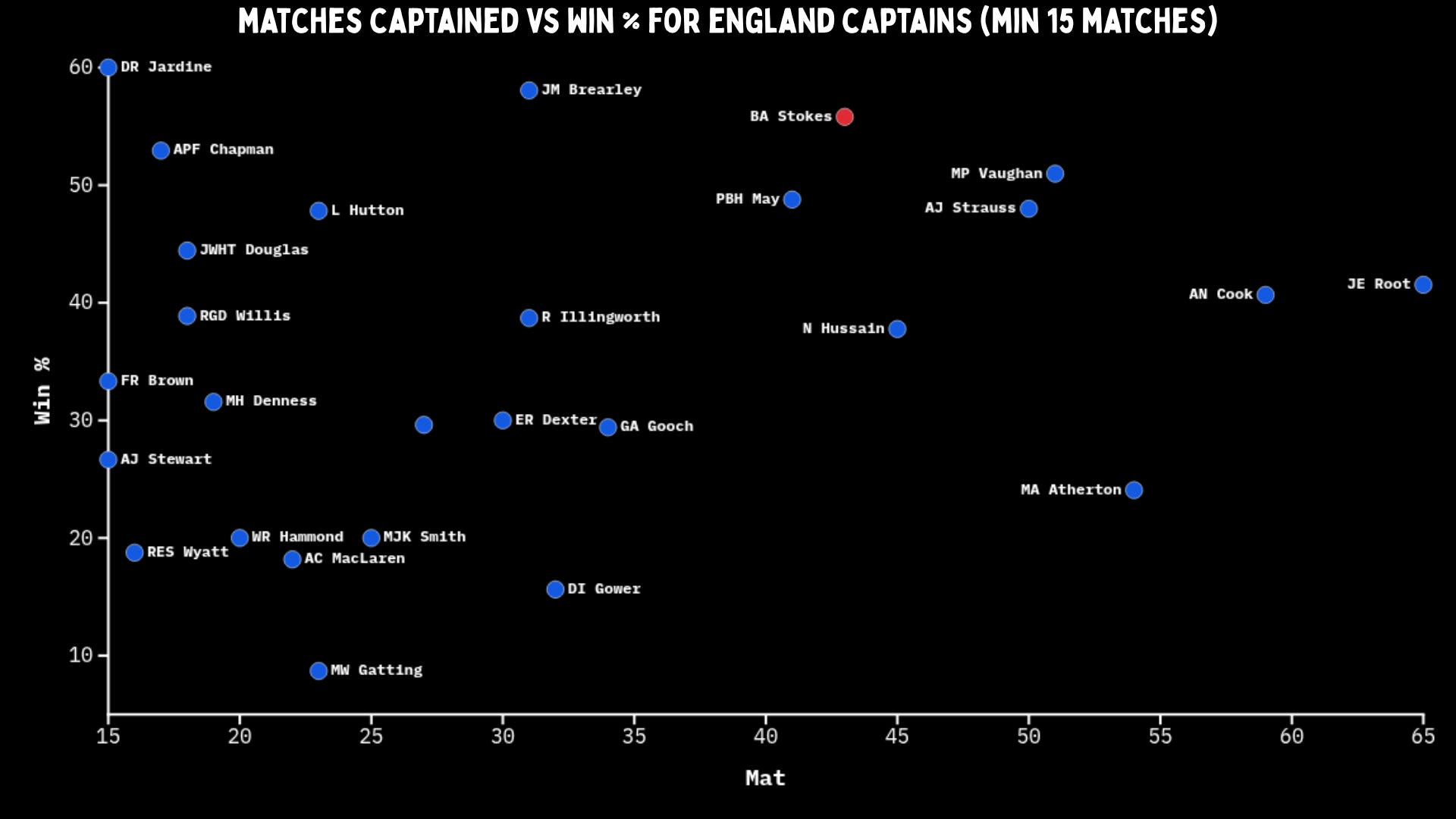
However, this is in part because there are only two draws in his record. Partly because England don’t play in them, but also because the WTC and wobbleball have ended them. In terms of win/loss ratio, he’s much more middle of the road.
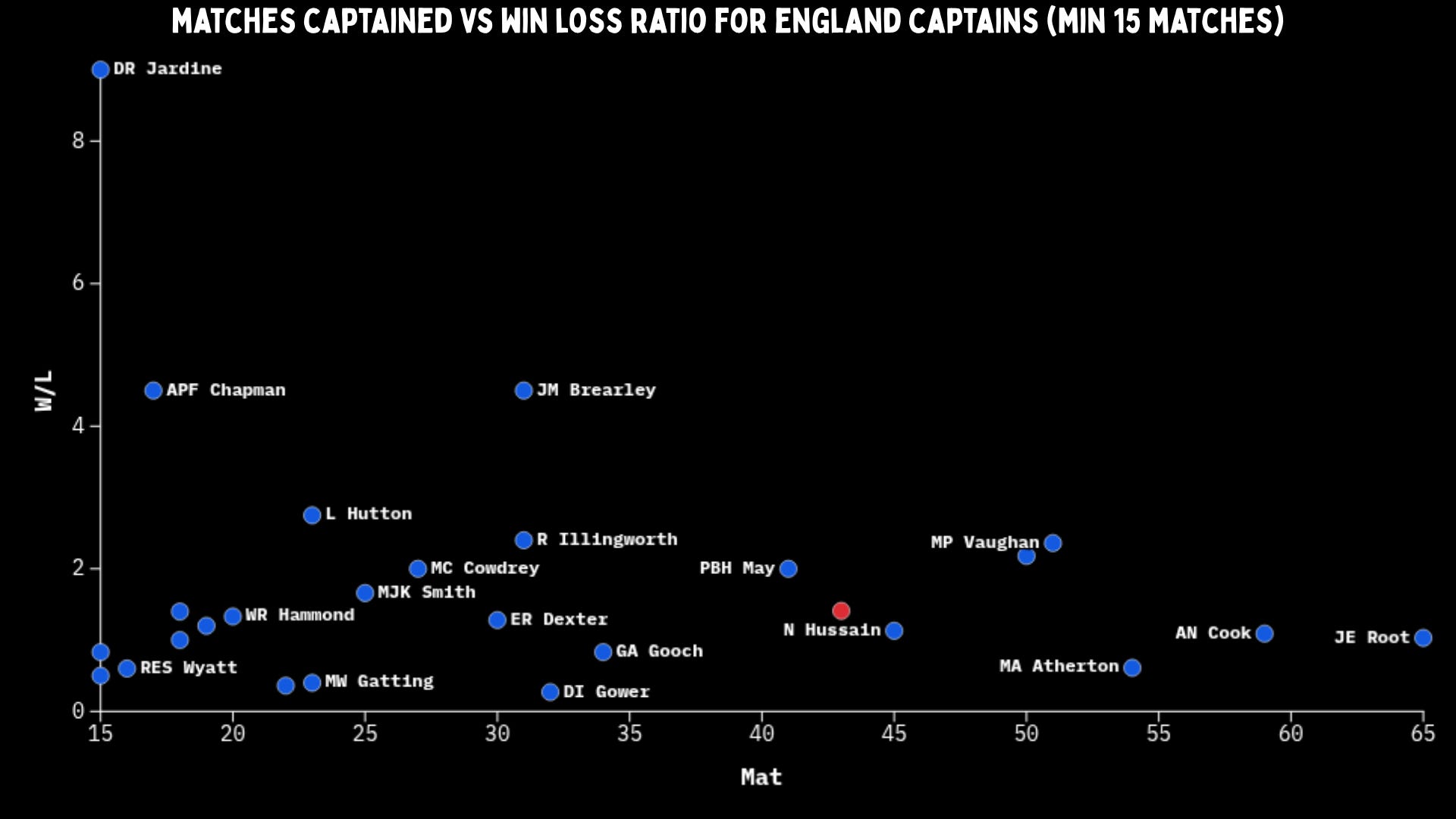
His 1.4 record is closer to Nasser Hussain’s mark than it is to Andrew Strauss’. Under his leadership, Stokes lost 17 Tests – only four captains have lost more for England.
So under Stokes, England has the third-best winning percentage and the sixth-worst losing percentage.
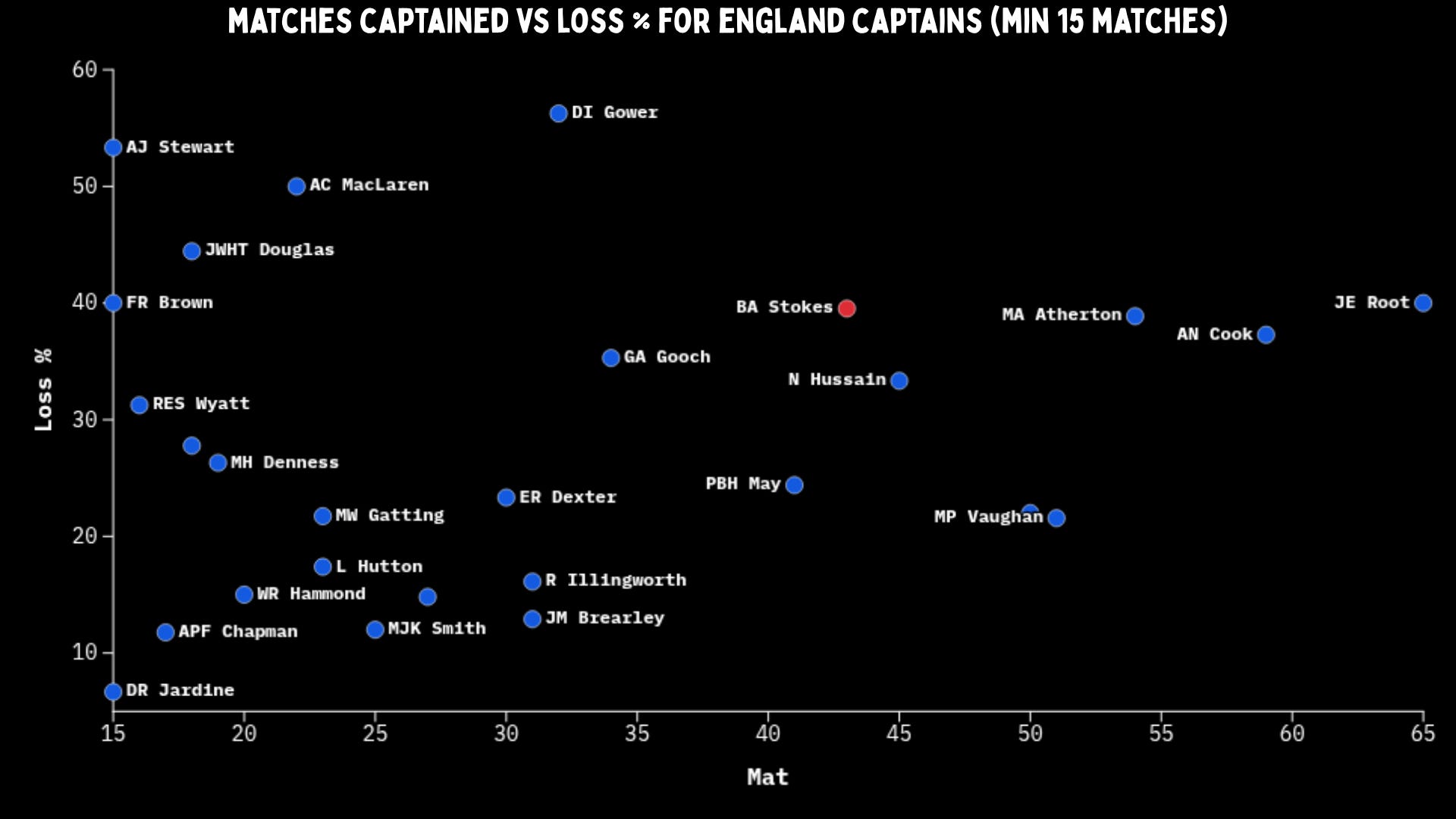
Ben Stokes was prepared to lose to win. And he lost and won more than most England captains.
***
England should have won the 2016 T20 World Cup final, but Brathwaite brained Ben. England should have won the 2017 Champions Trophy, and didn’t make the final. They should have won the 2021 T20 World Cup, but five injuries during the tournament deflated them. Had Stokes not scored an accidental illegal boundary, they might have lost the 2019 edition as well.
And yet, between 2015’s disaster campaign and 2022, they completely changed white ball cricket forever. No more middle overs accumulation, no more bowling dry all the time. They hit middle overs runs and pushed for wickets. But they kept finding ways not to win the main tournaments.
There was a theory that as a batting team, they were set up for the early part of the tournament and bilaterals, but at the end, not as much.
Their batters simply went too hard, too often. Chasing Pakistan’s 138, they were 45/3 when Stokes came in for the 2022 T20 World Cup final. Usually England would have pressed on, hit hard, and let the boundary riders decide their fate.
Instead, Stokes blocked and turned over strike. He had lost a trophy to big hitting, and here he inverted Brathwaite’s plan. But he kept England whole, and he would score 52 from 49 (slower than a Bazball blast) to win the World Cup.
In keeping with the biopic nature of this man’s career, it was his only international 50 in T20s. And as always, it was extreme, this time, extreme nudging. He found clarity, and played his part as the hero who trudges home.
***
Form is the hardest thing to understand in sport. It’s a nebulous concept that is used as a shortcut for something being right, or something being wrong.
Few players ever really control it, in either direction. They just ride waves. But if you are a captain, you cannot always control the results, ten other players are involved in that. You can ensure you are performing.
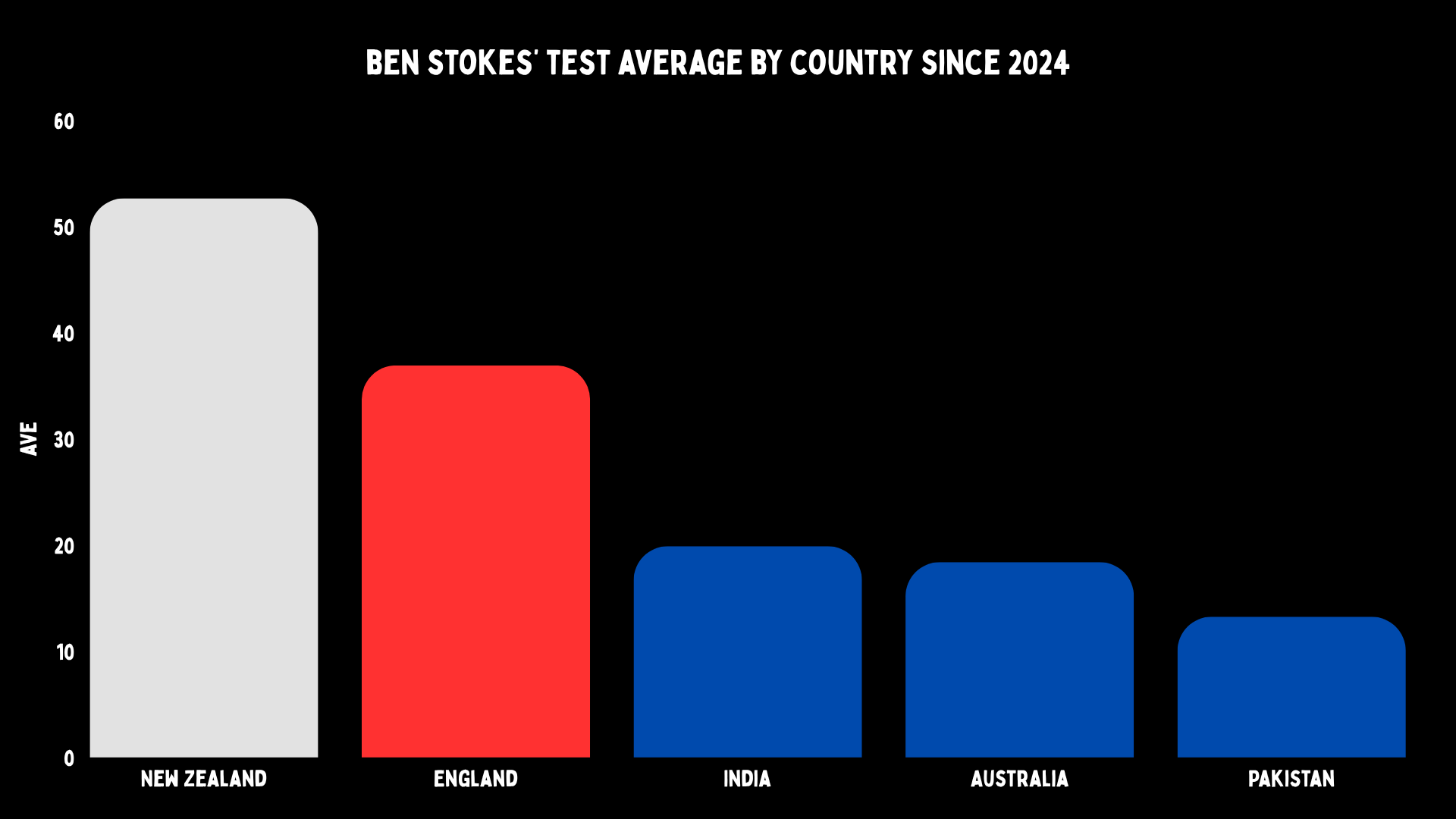
Stokes has not batted well for years now. In 2025, he might have been at his best with the ball. But with the bat, the last time he averaged more than 40 in Tests was 2020. Some of those years were fine. But from 2024 until now, it’s been a horror show.
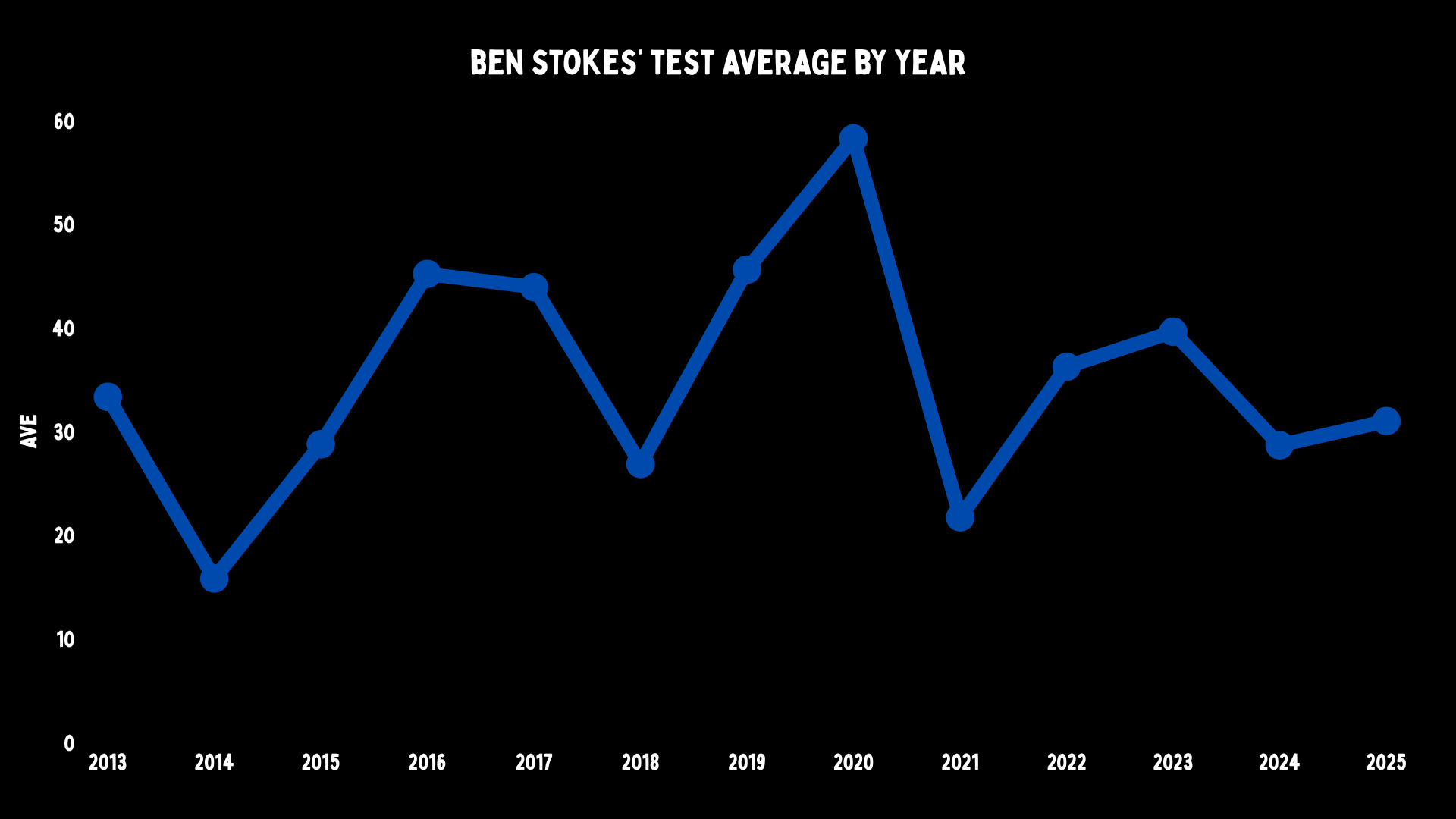
Some of that is touring. At home, Stokes has always been a genuine top six batter. But away, he’s been a number seven.

He averages above 37 in England and South Africa, that’s it.
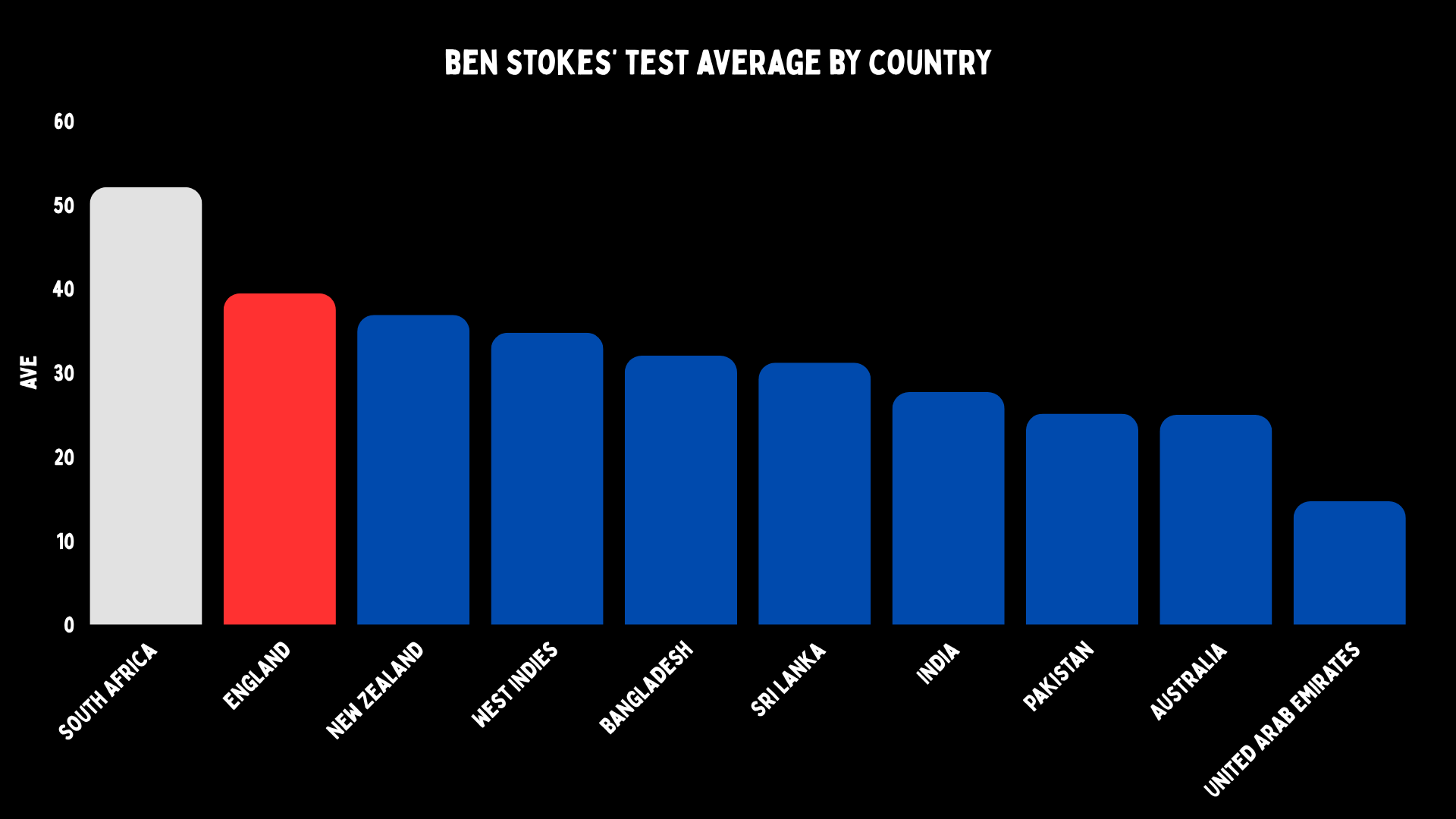
And one issue for him is that in this period, he’s played 15 matches on the road.

Those include ten against two of the best teams in the world, India and Australia. Then he got done by Pakistan going extreme with their pitches as well. Those three places allowed him 12 matches, where he scored 436 runs at 18. So his record is propped up by scoring in the New Zealand series.
There is no real pattern for why he’s struggled. But from his career, we can find two of his main recurring issues are causing problems: spin in Asia and Australian pitches.
Years ago, an analyst for England told me that he did much better on wickets with more bounce than usual. And his fourth innings in Australia certainly followed that pattern. His next score above 50 was in his 18th.

So him making runs in Australia this last series was always unlikely as he was in bad form. But it wasn’t just him that was the issue, England’s batters all seemed to lose form as well.
When things usually go wrong, Stokes just tries harder to right them. At the Gabba, he decided to settle in for a blocky day. He batted for 235 minutes and made 50 runs. England still lost by eight wickets.
Ben Stokes was doing what had always worked for him, but without the form. The warrior was there, without a single weapon to wield.
***
Vine was a six-second video app that changed the world. Before anyone had ever uttered the phrase, pivot to video, Vine was a near-perfect short-format video platform for fun and creativity. Eventually, it got bought by Twitter, then shelved, as everyone had their own short video plays.
Stokes doesn’t have his name on Bazball, but he’s forever linked to it. And while the theory behind it has changed the game, for England, it is now, at the very best, tainted. They couldn’t beat Australia or India, home and away.
The first couple of years were a vibe, though. Watching Trent Boult at Trent Bridge shake his head, India’s body language while Ollie Poped or the first ball boundary of Zak Crawley, these were cultural moments in how cricket was changing.
The problems were due to the fact that England’s mantra was “move fast and break things,” and, as most tech startups have shown us, that only ends in the enshitification of their products.
A smart, controlled Bazball that was constantly adapting to new needs, staying one up ahead of the cricket world, could have been amazing. One single idea spammed until you ruin the PlayStation controller was not ideal.
Ultimately, Bazball was a market disruptor that was taken over by better-run organisations with better talent.
Bazball was cricket’s Vine moment. The game will never be the same again, but others have swallowed it up.
But without the badness of pre-Bazball cricket, and then the wondrous pairing of Ben and Baz, we might not have this current freedom and excitement in Tests. And let’s be honest, the sport isn’t going back.
Bazball was only slightly ahead of the T20 curve that was coming through. But it sped up the change (literally) and also supersized it.
There really are two forms of Test cricket, Before Bazball and After.
Yet, because of the Ashes, and really many things leading up to them, this team that crashed through a wall of Test cricket history will largely be forgotten and mocked.
But that same team was incredible, arrogant, dramatic, entertaining, morally obsessed, hilarious and flawed.
And, isn’t that Ben Stokes?
He built a team completely in his image, and we knew what that was coming in. Winning games no one could, losing ones they really shouldn’t, but forcing us to watch every gloriously entertaining moment.
It was a team that would break, but never bend. Like the man.
***
The career of Ben Stokes makes no sense.
His entire legacy has been in the IPL era, and yet the only real lasting moment he leaves us there is Stephen Fleming being upset at how much he cost.

And that in itself is a story. Because Stokes has never been good at T20s. Which is crazy, because he’s an attacking batter who clears the fence and can bowl at 90MPH.
The only other cricketers like him are Andre Russell or Hardik Pandya, who both conquered T20 at various times.
Stokes averaged 25 in all T20 cricket with the bat, and 31 with the ball at eight and half an over, despite mostly bowling in the middle overs.
But his England career is insane. He lost one of the most famous games in history, then he won another by nudging.
So he was a high-paid IPL player, despite his record being poor before and after and most people have forgotten in the 2017 season he won the most valuable player award. He won and lost a World Cup. And he missed the 2014 edition because he broke his hand punching a locker.
Make of that what you will. But his T20 career was stupid.
After winning the 2019 ODI World Cup, he retired from the format in 2022. Then came back to play in the 2023 edition, like everyone knew he would. But in 2015, he didn’t play, because they dropped him.
At this stage he had been playing ODIs since 2011, but he averaged 15 in them. However with the ball, he’d taken wickets. Crucially, he had 16 against Australia at 26.
But they didn’t pick him.
So Stokes was not selected for the 2015 edition, won the 2019, and didn’t play much after until he had a go at a comeback. It’s a crazy arc.
Then there was his bowling, we were told that he was counting down the number of deliveries he could bowl. His knees were gone, he might bowl offspin or become a specialist batter.
Then he completely reformed his body, lost a bunch of muscle, and redid his knees. And know he is back to overbowling himself in endless spells.
His Test career has really been the most normal. But remember, in the middle of it, he took a mental health break. Clearly that is more common now, but think about this. Stokes will bowl until there is only sand in his knees, he will bowl until his arm falls off. He was willing to play with pain almost every game. But mentally, he stopped.
This is part of the Stokes dichotomy; he is the fearless warrior who runs through walls, but then he is a very sensitive man who mourns his father so much that he can’t play.
Yet through it all, he’s committed to a documentary on himself. I think it is true he feels every emotion, but he performs them as well.
***
WG Grace pressured umpires and changed scores, while believing women shouldn’t play. Sunil Gavaskar wrote in Sunny Days that the West Indian fans “certainly hadn’t graduated from the trees”. Geoffrey Boycott was found guilty of assault in France. Garfield Sobers said that if it wasn’t for the other people around, he would have taken money to play cricket in Rhodesia. Mike Gatting did in fact take those Krugerrands and played in South Africa. On Wasim Akram, “cannot be said to be above suspicion” in the Qayyum report. Wally Hammond probably had syphilis. And Don Bradman didn’t serve for Australia in World War II, and had many questioning how he took over his boss’s stockbroking firm.
These are not how we remember these players, but, of course, they are part of what they did, who they were, and everything else. You can’t just ignore it, but at the same time, it’s not really how they are remembered today.
Ben Stokes is one of the greatest all-rounders England has ever had, and so he will be linked without doubt to players along the lines of Ian Botham and Freddie Flintoff. A part of their legacy is the mucking around. It is the drinking. It is the shenanigans and everything else. In fact, now looking back, it almost feels like they were loved more for it. Were they always at the time? Probably not.
In the UK, this seems to work more in cricket. Stokes appeals to non-cricket fans, because he’s more like a footballer. He’s not polished, he’s fiery. He didn’t go to a nice school. He’s someone they’d like to have a drink with.
Compare that to the team England has after Stokes was dropped (or rested, or suspended) at the Oval. Ten out of the 11 England players were privately educated. Stokes isn’t just playing-acting a different personality; he is different.
The entire English cricket community finally had a moment of reflection after looking into racism and exclusion in their game. That ended up in the Independent Commission for Equity in Cricket report, which dropped while Stokes was preparing for a Test, and he had to do a press conference.
In his statement, he said, “I am Ben Stokes, born in New Zealand, a state-educated pupil who dropped out of school at 16 with one GCSE in PE. I needed help with the spelling and grammar in this speech and I am currently sitting here as the England men’s Test captain.”
***
Ben Stokes is flying up and back. He’s Spiderman, the world’s best goalkeeper and a Cirque du Soleil performer – all at once. The ball hits his right hand, which he has thrown up backhand, instead of using his left. Then he rolls towards the boundary, rises, and points over the crowd.
Behind him are wide, gaping mouths. These lucky people are probably never going to have something this amazing happen that close to them ever again. This is a freak event; few people in the game of cricket would ever have been able to pull this off.
But let’s rewind a moment, why is Stokes diving up and back for this ball? It’s a slog sweep by South Africa’s Andile Phehlukwayo, and it was hit pretty low. If Stokes was on the rope or backed up when he saw the shot, he would have caught this on his chest.
This was a series of mistakes, saved by a freak moment, and celebrated like a superhero landing in a crowd. Ben Stokes took one of the greatest catches ever, because he was in the wrong spot. His mistakes are still highlights.
His legacy will be fascinating in the future. He doesn’t have the stats of other greats, he has massive weak spots, and even things where he just should have been better.
But despite his flaws, maybe even because of them, when he needed to, he performed feats of cricketing genius that should last forever. He’s not perfect, and that is what makes him so fascinating.
Ben Stokes runs through walls. Sometimes the wall wins. For those watching, often the collision with the wall is all we remember.