
Bill Simons
Sports are crowded with glorious narratives.
Babe Ruth took baseball to the stratosphere. Jesse Owens defied a tyrant. Billie Jean King changed the gender landscape. Michael Jordan leapt to the heavens. Tiger Woods transformed his too-proper sport. And the Knicks brought joy to a supposedly dysfunctional metropolis.
These icons taught us about strength, resilience, courage, grace, improbability and the beauty of athletic genius.
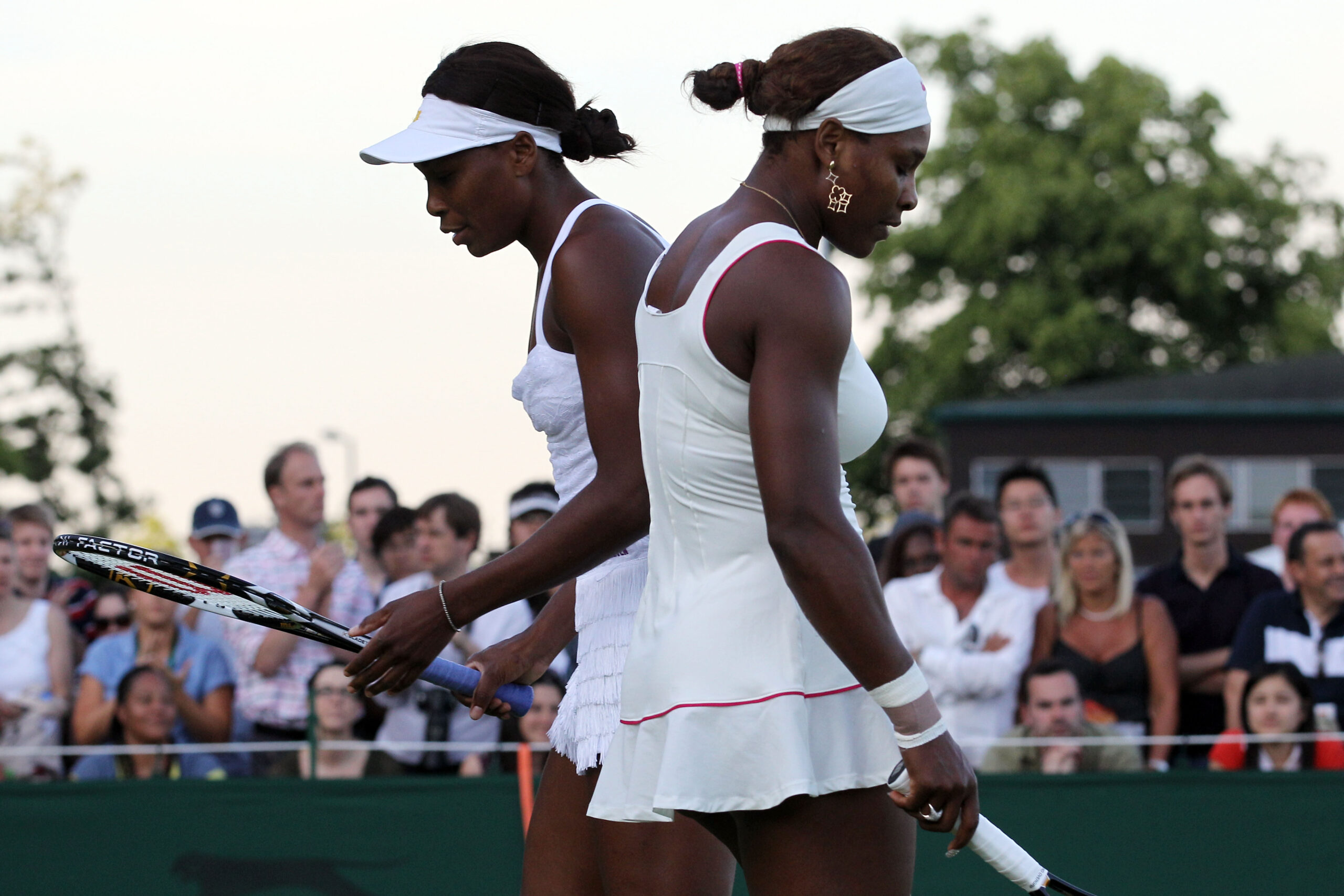
And then there was an astounding duo, Venus and Serena, who woke ‘em up at the country club, powerhouses that emerged out of the inner city and transformed a sleepy sport into a must-watch circus.
Richard Williams came up with the most inventive game plan in sports history. Venus evolved from a waif to a legend who seemed to stay in orbit for an eternity. Serena was the greatest woman player to ever pick up a racket. Matriarch Oracene kept the ship afloat with pride and dignity – just us against the world, baby.
Whether you adore the clan or you’re suffering a serious case of Williams fatigue, you have to admit they’ve had more influence on sports than any other family. We saw them grow before our eyes.
They were adored, resented, celebrated, criticized, mythologized, misunderstood – and, unless you were a monk holed up in a monastery, it was impossible to ignore them.
After all, they didn’t merely arrive in tennis, they landed like a thunderclap. Their greatest wins weren’t over Hingis, Davenport, Clijsters, Sharapova, or Henin. They were over imagination itself. Before them, tennis had champions. After Venus and Serena, tennis had possibilities. Just ask Coco, Madison, Sloane, Mboko, or one of thousands of kids banging backhands on hardscrabble courts.
Famously, it all began when the son of a Louisiana sharecropper saw a WTA player on TV win $40,000 and had a brainstorm: “Let’s us have a kid – no, make that two kids – and make a whole lot of money. Here’s the game plan: I’ll write a 78-page manual on how to produce a champ and you’ll have the kids.”
Soon, the bold, visionary and fiercely defiant Richard Williams was informing a skeptical world that 13-year-old Venus was “pretty much ready to revolutionize tennis. These pro girls will have a major-league problem dealing with her.”
Never mind that Venus would turn out to be only the second best player in her family. Her dad was tennis’ answer to Nostradamus. His claim that his two daughters would become No. 1 and No. 2 proved to be the most astounding prediction in sports history.
Venus put it simply: “Serena and I are exactly the opposite of anything that ever happened before in the game. The old tennis world was pretty reserved, but Serena and I are bold. We stand out. We have color. We’re strong. We’re pretty. We have personality. We think things out. We’re smart.”
The Williamses put tennis into shock. I know – I was there. In 1994, the most ballyhooed debut in tennis history unfolded two miles from Inside Tennis’ office, at the Oakland Civic Auditorium when a brave, skinny 14-year-old drew the attention of a skeptical sporting world.
Tennis didn’t know what to think. Many saw Venus and Serena as a singular unit.
But soon it became clear that, although they dearly loved each other, lived together and were inseparable, they each had their role. Older Venus was the protector, the caretaker, the comforter. At school, she gave her sister her lunch. When she beat eight-year-old Serena in a tourney, she told Serena, “I like silver better than gold. Here, take my trophy.”
Serena, the youngest of five Williams girls, was both cute and entitled. She worked her daddy like a charm and confided that as a kid she had “five P’s: pampered, princess, pet, pest and prima donna.”
Venus made Serena conceivable. She softened the ground.
A brave, bold trailblazer with braids in her hair and a $12 million Reebok contract in her pocket, Venus challenged assumptions about power, race and ambition before Serena became a dominant force. Venus opened the door, Serena walked through.
Tennis had long accepted outsiders, provided they looked, talked and behaved like insiders. The Williamses rejected that bargain.
And, early on, many in tennis rejected Venus and Serena. Their bags would be kicked in the locker room. The N-word would be hurled, entire stadiums would boo. Martina Hingis, at 19, was sarcastic: “They’ve had big mouths. They always talk, but it’s a lot of talk…Why should I look up to them? Maybe we should just all go home and pack up our rackets and let them play by themselves.”
A Romanian would careen courtside into the elder Williams,and then grin and scoff: “She thinks she’s fucking Venus Williams.”
The Williamses were a tight clan. Some claimed it was a competitive strategy; others said it was armor.
Elizabeth Weil gushed: “Serena’s talent is so singular that it feels as if it dropped whole from the heavens, a dense, crystalline meteorite of athletic prowess and drive.” But an early, rather racist, narrative suggested the powerful sisters were prevailing just because they were great athletes. Only slowly did tennis begin to heed Brad Gilbert’s advice: “Never underestimate a Williams.”
It’s not only that, incredibly, the duo faced off in four straight Slam finals and together won 30 singles Slams, won 14 doubles titles together, nine Olympic medals and $138 million in prize money.
As for Venus, it’s not only that she was a key leader for equal prize money, and rebuffed anti-Semitism in the Middle East. It’s not only that Serena once said, “The day I don’t fight for justice is the day I die,” and became the most impactful sportswoman of our era. And it’s not just that the two are A-list superstars – “Which way to the royal wedding? I can’t talk, I’ve got to do my Super Bowl commercial and then head off to the Met Gala.”
It’s more that the sisters are alchemists.
They’re far more than the sum of their parts. They empower each other. While Venus is a card-carrying introvert – elegant, removed and mysterious – Serena is anything but serene. She’s loud, spontaneous and emotional.
When a foe first hears her yell “C’mon!” a sense of doom descends. Sports Illustrated noted that, “Her groundstrokes are struck so fiercely they could leave exit wounds.”
Throughout her career, an imposing, Rafa-like ferocity was her driving force that rarely could be countered. Sue Mott informed us that, “her role was less Chris Evert than Thor.” Pam Shriver added, “When Serena wants revenge, it’s crush city.” Like Michael Jordan and Jimmy Connors, she adeptly used perceived slights to pump herself up.
She was outraged by a New York Times story in the 1990s that families produce only one star. In 2002, after Redskin linebacker LaVar Arrington dumped her, Serena went on a tear. After she was humiliated by France’s low-ranking Virginie Razzano in the first round of the 2012 French Open, Serena promptly sought out coach Patrick Mouratoglou and won 4 of the next 6 Slams she played.
Yes, the Williamses were the focus of many an advisor and commentator. When Serena’s focus seemed to wobble, Chris Evert warned her to not squander her talent. Linda Robertson said Serena would “end up just like Paris Hilton, coasting on vapors.” In 2007, Russian Nadia Petrova suggested, “It looks like everything is leading to the end of the Williamses’ careers because they have talk shows, books, and clothing lines.”
A decade later, when Serena won the Australian Open while two months pregnant, Stephen A. Smith stated the obvious: “C’mon! We can pull a lot of things out of our hat, but there’s no man alive that can do that!”
Jon Wertheim noted how things changed over the years: “Serena’s ‘irreverence’ has become her ‘taking the path less traveled.’ Her ‘arrogance’ has been recast as ‘confidence.’ Her ‘brute force’ has been upgraded to ‘sleek power.’ Outfits once described as ‘lapses in taste’ are now ‘bold and provocative.’ The consummate outsider has become the sport’s figurehead.”
Mary Carillo quipped, “Serena and her sister dance on the edge of a volcano.”
For decades, the sisters whiplashed from memorable triumphs to horrific setbacks. There was Venus, twirling with glee after downing Lindsay Davenport in one of the best Wimbledon finals ever. There she was winning Olympic gold, earning a college degree, starting her own apparel company and inspiring with her commencement speech.
But then she not only suffers career fatigue, she becomes entangled in a fatal car accident, loses in the opening round of Wimbledon to a 15-year-old named Coco, is told her sister Yetunde has been senselessly murdered and has to battle Sjögren’s Syndrome.
For Serena, catastrophe was never far from the door. Coping with crises — to borrow the title of my father’s how-to book — became a defining theme of her career.
Her foot was shredded. Blood clots threatened her life. Childbirth nearly did the same. Mid-career and post-partum depression descended. Desperate, full of demons and hatred for tennis, there were times she was a weary, silent hermit who could barely walk. Racism, sexism, body-shaming and double standards followed her through the years like a dark entourage.
Yet, each time, Serena somehow reassembled herself. She came back from operating rooms and heartbreak, from public scorn and private anguish, from the edge of fear itself. Her greatness was not just that she won 23 majors and twice won the Serena Slam. It was that she won after being broken, doubted, diminished and endangered — and still walked onto the court as if she owned the horizon.
She wrote in her journal, “UR queen. U have been waiting for this moment…For billions of years, this energy has been building up in your for this moment…U don’t have to be perfect. Just be strong, and brave.”
Of course, with Venus and Serena, it’s rarely simple. Yes, Serena’s life, her very essence, has been a call for justice – no question. Together with Michelle Obama and Beyoncé, she’s one of three black avatars for African-American women.
America loves celebs, we’re hot wired – we do need heroes. The woman who long ago spoke of the power of visiting slave fortresses in Ghana and who refused to go to South Carolina because of the Confederate Flag poignantly told us, “The day I stop fighting for justice for people who look like me and you will be the day I’m in my grave.”
But critics dare to suggest a recent realignment: high finance, high fashion, non-stop ads, a giddy embrace of our celebrity culture, a coyness with the media and rare engagements with the issues of the day. Oh, well, that’s Serena – and she is backing a cadre of women and Black entrepreneurs.
And then there’s Trump. She’s his Palm Beach neighbor. Sure, years ago she helped open his Virginia country club. Okay, but why does she bristle when the New York Times and Inside Tennis bring him up? “Why are you on his speed dial? What do you talk about? And, by the way, why did your husband Alexis Ohanian go to that UFC fight on the White House lawn?”
Serena’s greatest asset is her warrior ferocity. But where did it come from? From her African roots? From the pain her Dad endured when, as a kid, a band of thugs banged a spike in his leg. The gunshots she heard when she was practicing her Compton forehand? She once wrote, “I drew a line that ran from Ghana to Michigan to California to Florida to Australia.”
Serena said that ultimately her fighting spirit came from within. But her warrior sensibility, that brings Rafa and Connors to mind, also led her to one controversy after another.
In 2003 Serena accused Justine Henin of “lying and fabricating” about a pivotal serve in Paris. Then, after she got four lousy calls during a US Open battle against Jennifer Capriati, the injustice drew a USTA apology and led to electronic scoring.
At crunch time in the 2009 US Open semis against Kim Clijsters, Serena was called for a foot fault. She told the linesperson she was going to shove a ball “down your f–ing throat” and was fined $100,000. Then, at a key moment against Sam Stosur in the 2011 US Open final, she was penalized for yelling “C’mon!” just while hitting a winner. Serena told the ump she was “unattractive inside.”
The three most tumultuous matches at big time tourneys were the near riot at the 1979 US Open between John McEnroe and Ilie Nastase, the 2001 Indian Wells final and the 2018 US Open final. Serena was front and center in two of them.
At the last minute in Indian Wells, Venus pulled out of her semifinal match against Serena. Fans were livid – how could she? Maybe the National Inquirer had it right, and Richard Williams orchestrated the whole thing?
The next day the crowd was unhinged. When Serena walked out for the final, the stadium rang out with boos. When the 19-year-old double-faulted, they let her have it. They even let out Bronx cheers at the award ceremony. Officials could have announced, “As a courtesy to the players, please be respectful.” They didn’t.
Too many in the crowd were more than rude. I watched the whole match about 20 yards from Richard Williams. It was ugly. Richard told me, “This was like being in South Africa.”
Serena wept the whole way home to LA, as she held the winners trophy. For years, she and Venus would boycott the tourney. Thirteen years later, I had a long talk with Patrick Mouratoglou in the Australian Open media cafeteria. “Patrick,” I noted, “I’ve long said how outrageous some in the crowd that afternoon were. I’ve long backed Serena and Venus’ boycott. I told tournament officials they had to step up. But please tell Serena that her not going back to Indian Wells is the one asterisk in her career. Thirteen years is enough. If she returns, she’ll be welcomed as a prodigal daughter.”
Did my advocacy have any effect? Who knows?
But 14 months later, Serena ended her 14-year boycott and was greeted as a hero. WTA boss Stacey Allaster told her, “This is your Martin Luther King moment.”
The 2018 US Open women’s final was different.
The most anticipated American match in years, it was a delicious matchup between tennis’ prevailing queen and the darling debutante Naomi Osaka. But fury and fire descended.
Many hoped that Serena, who only a year ago had barely survived death while giving birth would prevail and make history, equaling the record of 24 singles majors.
Instead, Serena imploded, while young Osaka, just 19, was stunned. Robbed of her glory, Naomi wept. Tennis has endured dreadful moments – near riots, a stabbing, howling arenas, cheats and chokes. The 2018 Open final was a dystopian freefall.
To some, umpire Carlos Ramos blew one whistle too many: a coaching warning, a point penalty for racket abuse and, deep in the deciding set, a match-altering game penalty.
Fans were outraged, claiming the ump should have read the room and used his discretion. Instead he derailed the moment. Now we’ll never know whether the game’s foremost comeback artist would have pulled off one more miracle.
Outside the arena, many felt Serena had blown it. Mouratoglou admitted he’d been coaching. She knew the rules, but didn’t follow them. She should have been aware that a no-nonsense ump was calling the match. Ramos was going by the book – Serena was playing with fire.
Was Serena’s vein-bulging sense of injustice justified? Was she a captive of uncontrollable anger? At her very worst, claimed Carillo, Serena’s a bully.
Once again she’d been triggered. Volcanic emotions erupted. Critics contended she’d been untrue to the sport and the essence of athletic competition – play by the rules, give your all, be accountable, let the better player win.
At the end of her press conference, I asked her, “If you could change one thing about tonight, what would it be?” Fierce and emotional, she offered a provocative, teary answer that would be heard around the world: “I can’t sit here and say I wouldn’t say he’s a thief, because I thought he took a game from me. But I’ve seen other men call umpires several things. I’m here fighting for women’s rights and equality…To say ‘thief’ [to me] and for him to take a game, it made me feel it was a sexist remark. He’s never taken a game from a man because he said ‘thief’…
“It blows my mind. But I’m going to continue to fight for women and to fight for us to have equal [rights]…This is outrageous. That I have to go through this is just an example for the next person that has emotions, and wants to express themselves, and wants to be a strong woman. And they’re going to be allowed to do that because of today. Maybe it didn’t work out for me, but it’s going to work out for the next person.”
There was applause.
On Twitter I mused, “Has any other athlete ever provoked us, prodded us, frustrated us, taught us, entertained us, amazed us, baffled us and taken us to as many shores as this flawed and fabulous wonder woman?”
Some chided me – “Give it a rest – enough already. Serena taught us what?”
But, say what you will, Serena taught us that you don’t have to come from a country club to prevail; sisterhood is powerful; you can boycott an event that mercilessly booed you; body suits rock, and it’s fine to combat bodyshaming; you can emerge from a traumatic childbirth and two brushes with death; you can win a Slam with a baby in your belly, and, as a mother, become a four-time Slam finalist; there’s no problem with interracial marriage, and it’s good to advocate for racial justice in our legal system and even stand up for a quarterback who kneeled. And why not come back and play Wimbledon singles and doubles at 44?
What other woman has been such a lightning rod?
That night in 2018, after I’d written a think piece about the debacle, a Florida photographer told me, “That was the best tennis piece I’ve ever read.” Then, just as my ego bounced off the stratosphere, a European journalist told me that it was the worst piece I’d ever written. Welcome to Serenaville!
Two different narratives soon emerged. Many noted the rules were clear. Coaching is illegal. Man or woman, black or white, first round or final, rules are rules. But Serena’s backers noted that she didn’t see the signals. There’s coaching in all sports, and it should be allowed in tennis. And this was the first time Mouratoglou had ever been called for coaching.
Cindy Shmerler countered, “You can complain about the rules. But you can’t re-invent them in the middle of a match. What do we say to our loved ones when they’re caught speeding and they argue that everyone else was doing it? Too bad, you got caught.”
As for Serena bashing her racket, some said, “Be real. Players should be able to show their emotions. Tennis is stifled by too many rules – it’s all too proper. Sports are raw – let fans see the emotions.”
The rubber hit the road when Ramos called a third violation for verbal abuse deep into the deciding set of the final. A game penalty quite like that never happened before – right?
Sure, Serena was pushing the limit. But, don’t umps have to read the room and use discretion? Billie Jean King contended, “Serena was out of line – there’s no question. No one’s saying she was a good sport. The point is he aggravated the situation.”
Ramos drew many backers who insisted he was a courageous ump who’d made the right decision – even though it essentially ended the match.
There were many questions. What was the effect of Serena’s struggles with postpartum depression? She’d been stuck in a funk, wrestling with maternal guilt – she’d missed her daughter’s first steps.
And what was the role of racism and sexism? “You are attacking my character!” Serena told Ramos. “This has happened to me too many times. Do you know how many men said a lot worse?…Because I’m a woman you’re going to take this away from me?…Every single year it’s something!”
“No way,” many responded. “You’re the one that owes an apology. Gender and race had nothing to do with it.” Then again, there was a vile Australian cartoon portraying Serena as subhuman.
So why has Serena drawn so much criticism? She’s the GOAT, but go figure, so often she’s been attacked and called rude, fat, masculine, old and not good for the game.
Yet, around the world, millions adore her. Writer Gillian White suggested, “The support…[comes] because some have an enduring memory of how difficult it is for women of color to make it in expensive, mostly white sports.”
Serena’s backers noted that male rage – say Connors’ finger-wagging accusation, “You’re an abortion!” or McEnroe’s “You cannot be serious” rants – have long been embedded in tennis and have been used to sell tennis, razors and rental cars.
Writer Sally Jenkins claimed Ramos “couldn’t take it. He wasn’t going to let a woman talk to him that way, pointing a finger and using a tone of aggression.” Billie Jean added, “When a woman is emotional, she’s hysterical and penalized for it. When a man does the same, he’s ‘outspoken’ and there are no repercussions.”
Martina Navratilova differed, contending that it wasn’t good “to apply a standard of, ‘If men can get away with it, women should be able to, too.’…We cannot measure ourselves by what we think we should also be able to get away with…It is on players to conduct themselves with respect.”
Others said, “Hold on. Well-behaved women seldom make history.” Rebecca Traister suggested that women, especially women of color, are often expected to absorb injustice without expressing anger.
Salamishah Tillet wrote that Serena “was punished for showing emotion, for defiance, for being the player she has always been – driven, passionate, proud and fully human. She liberated herself of constraint…fought back and reminded the world of her greatness.”
But Shmerler insisted, “For Serena to suggest that her treatment was gender-related is just plain wrong.”
One longtime tennis observer said, “I hope Serena embraces her humanity. She may have lost that night at the Open, but she’s still winning the journey to become her full self, and that’s what really matters.”
Ultimately, we know that Serena is a force like no other. Some say she became unhinged. Others believe she was expressing the righteous rage of a bold warrior.
Can we possibly hold these two vastly different narratives within ourselves? And if we can, is that somehow a mark of progress?
Yes, as Chris McKendry observed, “Our sport is a little better when there’s a touch of crazy.” But it’s more than that.
Tennis is better when it embraces every shade, every body type, every voice, every style of greatness. It’s better when power and grace can occupy the same court. It’s better when big serves come with big emotions and big dreams.
And it’s better when a little girl looks across the net and no longer thinks she belongs somewhere else.
After all, before Venus and Serena, tennis had champions. After Venus and Serena, tennis had possibilities.