
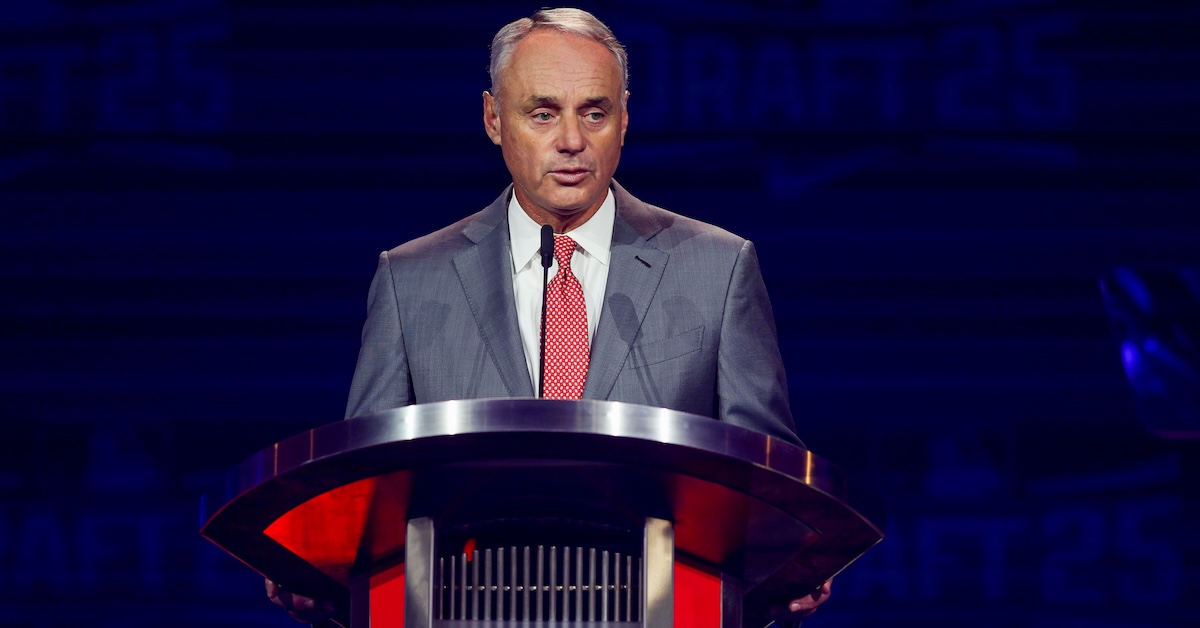
Late last week, Major League Baseball proposed to drastically change the game’s player developmental system. Beginning in 2028, the domestic draft would be cut from 20 rounds to 12, and eliminate eligibility for high schoolers — players would need to be at least 20 years old and two years removed from high school to be drafted. Players who choose to play for a JUCO school would need to do so for both seasons, rather than the one-year requirement currently in place. Most players at a four-year college would become draft eligible a year earlier under MLB’s new proposal; right now, they are not eligible for the draft unless they turn 21 by August 1 of their draft year or until after their third year a four-year college. MLB’s proposal would move the age cutoff date back to September 1. More than 40% of the dollars would be pared from the draft pool, with the most recent $358.7 million available slashed to $200 million.
On the international side, MLB proposed instituting a new draft, an idea originally discussed during the last set of CBA negotiations. The draft, which would begin in 2027, would require players to be at least 18 years old by September 1 of their draft year. The draft pool would stay mainly intact otherwise, with the same $200 million available for international draftees as domestic ones, pretty close to the nearly $199 million that was in the final draft bonus pool in 2025.
We don’t need to do any detective work to figure out where the savings go. As was the case with the league’s parallel salary cap proposal, which management disingenuously promoted as a way to improve competitive balance, this proposal is part of the ever-continuing quest of owners to transfer money from the players’ pockets to their own. Based on pretty much every example ever, the money saved will not offset consumer costs, and I’d be shocked if it was redirected to improve the pay of team staffers, who tend to take in reduced salaries for the privilege of working in baseball, or minor leaguers.
J.J. Cooper covered the proposal in greater detail over at Baseball America, so I won’t go too in the weeds on it here today. Instead, I want to spotlight how much money the proposal would cost the game’s top players.
Increasing the age requirement for players to join the affiliated-ball ranks, and thus increasing the entry age to make the major leagues, has the additional benefit for the owners of increasing the ages of when players reach free agency. Players are most likely to have the best portion of their career before they hit the open market, and under MLB’s new proposal, this phenomenon would become even more pronounced.
Of the 146 players last winter who became free agents after accruing six years of MLB service time, as opposed to those who were non-tendered, only 13 were still in their 20s for the 2026 season. None of the 13 was drafted in accordance with the proposed rules, with eight drafted players out of high school and five signed as 16-year-old amateurs. And no, college players are unlikely to be accelerated as compensation for this. Another 13 of those 146 free agents were entering their age-30 season; only three of those 13 players could have signed when they actually did under the proposed rules.
You Aren’t a FanGraphs Member
It looks like you aren’t yet a FanGraphs Member (or aren’t logged in). We aren’t mad, just disappointed.
We get it. You want to read this article. But before we let you get back to it, we’d like to point out a few of the good reasons why you should become a Member.
1. Ad Free viewing! We won’t bug you with this ad, or any other.
2. Unlimited articles! Non-Members only get to read 10 free articles a month. Members never get cut off.
3. Dark mode and Classic mode!
4. Custom player page dashboards! Choose the player cards you want, in the order you want them.
5. One-click data exports! Export our projections and leaderboards for your personal projects.
6. Remove the photos on the home page! (Honestly, this doesn’t sound so great to us, but some people wanted it, and we like to give our Members what they want.)
7. Even more Steamer projections! We have handedness, percentile, and context neutral projections available for Members only.
8. Get FanGraphs Walk-Off, a customized year end review! Find out exactly how you used FanGraphs this year, and how that compares to other Members. Don’t be a victim of FOMO.
9. A weekly mailbag column, exclusively for Members.
10. Help support FanGraphs and our entire staff! Our Members provide us with critical resources to improve the site and deliver new features!
We hope you’ll consider a Membership today, for yourself or as a gift! And we realize this has been an awfully long sales pitch, so we’ve also removed all the other ads in this article. We didn’t want to overdo it.
A year or two is actually quite significant when dealing with an elite free agent or free agent-to-be. When you’re talking to guys that land megadeals, getting a player like Juan Soto or Vladimir Guerrero Jr. a couple years early basically allows you to swap a year in their 40s for a year in their prime. This isn’t just mean math guys and their even meaner projection systems; teams are aware of this, which is why someone like Pete Alonso largely gets shrugs in free agency, certainly relative to how early-30s non-elite sluggers were treated 15 years ago. And yes, I’m fully aware of the irony of my noting how much teams have soured on non-elite free agents in their 30s, since, as I’ve been told both by multiple front office decision makers and multiple agents, I’m one of the people responsible for the spread of that attitude!
ZiPS originally projected Soto to get a 15-year, $719 million contract in free agency after the 2024 season, compared to the $765 million he actually netted. Keeping everything the same and making him two years older drops that projected salary from $719 million to $588 million, a pay cut of $131 million.
Similar results occur with other big contracts currently in force. After getting his GED to finish high school early and playing one year at the JUCO College of Southern California, Bryce Harper, who was born on October 16, 1992, was drafted first overall as a 17-year-old in 2010. He made his major league debut in his age-19 season, meaning he won the NL Rookie of the Year award a season before he would’ve been draft eligible under the league’s proposal. The first year of his contract with the Phillies was 2019, his age-26 season. At the time, ZiPS evaluated a 13-year deal for Harper as being worth $314 million, compared to $330 million he actually received. Aging him by two years slashes the projection from $314 million to $259 million, and by three years, to $224 million.
Let’s do that with some other biggest contracts of the last four offseasons for players who would have had free agency delayed. Looking at deals that were valued at $150 million or more, Willy Adames would lose $53 million, Dylan Cease $51 million, Xander Bogaerts $47 million, and Brandon Nimmo $41 million. All in all, if the league’s proposal were in place during the last four offseasons, only nine players would’ve received contracts worth at least $150 million, losing an average of $47 million apiece. Naturally, the same effect exists for the lucrative long-term extensions signed by players during their club-controlled years. Bobby Witt Jr.’s projection sheds $43 million from the 11-year, $288.778 million contract he signed ahead of the 2024 season. According to ZiPS, Corbin Carroll’s projected extension would’ve been for $31 million less than the $111 million he’s currently making over eight years, while Julio Rodríguez would’ve gotten $20 million less than what he received from the Mariners.
Is this good for baseball? My personal feeling is no. I think baseball is best when players get a generous slice of the pie, and MLB’s new proposal threatens to make free agency itself less lucrative for top talent, and that’s before accounting for any changes to free agency or the luxury tax system. It should be noted that this is an early proposal and is likely to shift dramatically, but like the proposed salary cap, if the owners insist on sticking to it, baseball is bound for a long lockout.