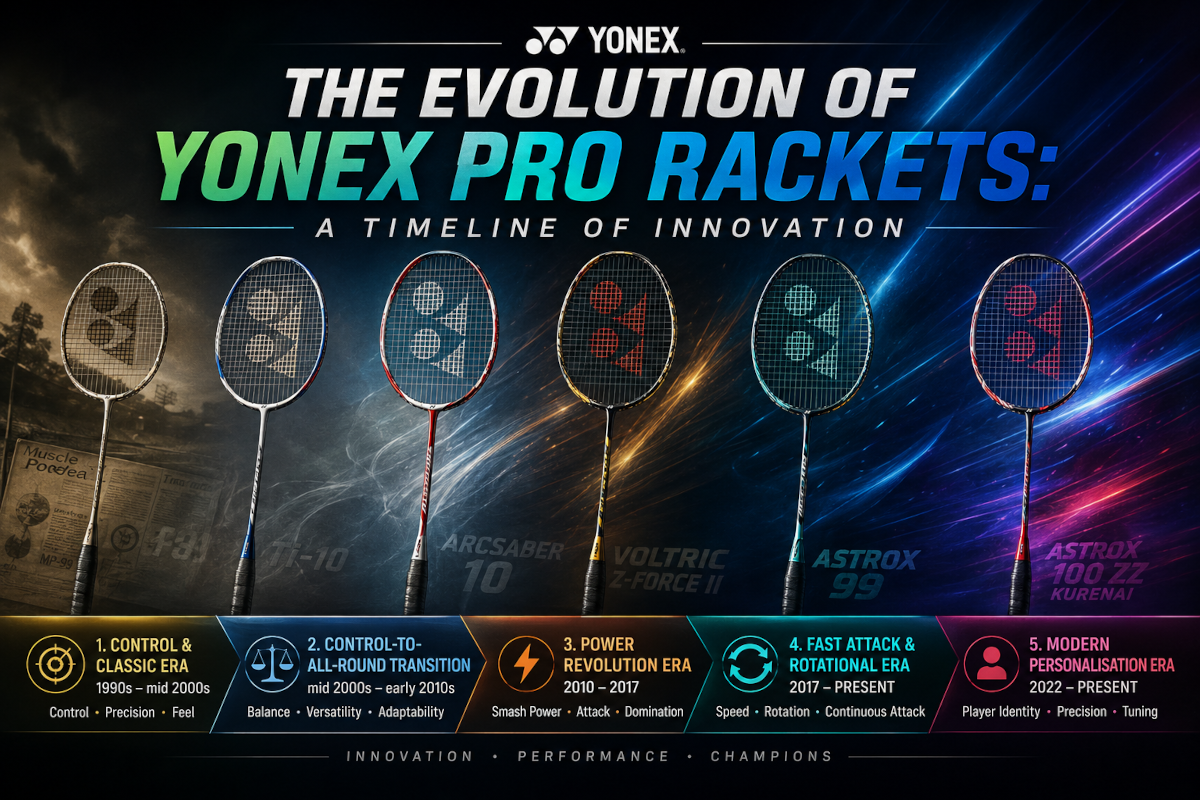
For decades, Yonex has shaped elite badminton through continuous racket innovation. Each era reflects how the modern game evolved, from long rallies and control-based play to today’s explosive, fast-paced attacking system. Below is a clear timeline of how Yonex Pro rackets have developed over time.
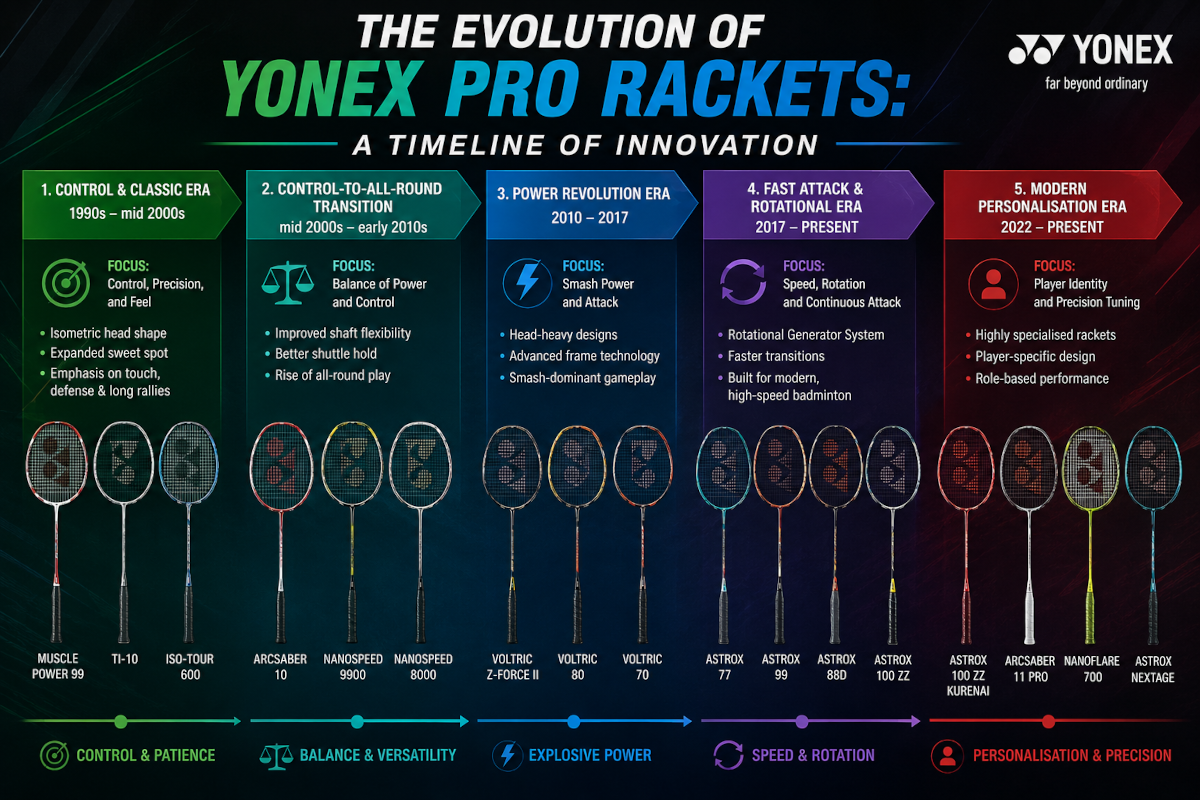
1. Control & Classic Era (1990s – mid 2000s)
This was the foundation of modern Yonex design. The focus was on control, precision, and feel rather than raw power.
Key developments:
- Introduction of Isometric head shape (expanded sweet spot)
- Lightweight graphite frames becoming mainstream
- Emphasis on touch, defense, and long rallies
Iconic racket models:
- Yonex Muscle Power series (MP-99, MP-100)
- Yonex Ti series (Ti-10, Ti-7)
- Yonex Iso series (early Isometric models)
Playing style:
- Longer rallies
- Tactical placement over attacking smashes
- Endurance-based gameplay
2. Control-to-All-Round Transition (mid 2000s – early 2010s)
As the sport became faster, Yonex began balancing control with attacking capability.
Key developments:
- Improved shaft flexibility variations
- Better shuttle hold and repulsion balance
- Rise of “all-round” racket philosophy
Iconic racket models:
- Yonex ArcSaber 10 (released 2007)
- Yonex NanoSpeed 9900
- Yonex NanoSpeed 8000
Playing style:
- Balanced attack and defense
- Faster rallies compared to earlier era
- More variation in shot-making
3. Power Revolution Era (2010 – 2017)
This period marked a clear shift toward aggressive badminton.
Key developments:
- Head-heavy designs for smash power
- Introduction of advanced frame reinforcement systems
- Power-focused engineering philosophy
Iconic racket models:
- Yonex Voltric Z-Force II
- Yonex Voltric 80
- Yonex Voltric 70
Playing style:
- Smash-dominant gameplay
- Faster point finishes
- Rise of aggressive singles and doubles tactics
4. Fast Attack & Rotational Era (2017 – Present)
Modern badminton is defined by speed, rotation, and continuous pressure. Yonex responded with a new design philosophy focused on rapid recovery and transition play.
Key developments:
- Rotational Generator System
- Improved weight distribution for fast transitions
- Focus on back-to-back attacking shots
Iconic racket models:
- Yonex Astrox 77
- Yonex Astrox 99
- Yonex Astrox 88D / Yonex Astrox 88S
- Yonex Astrox 100 ZZ
Playing style:
- Continuous attacking pressure
- Faster front–back court transitions
- Doubles-focused speed domination
5. Modern Personalisation Era (2022 – Present)
Today, Yonex no longer designs rackets just by “power vs control.” Instead, they design around player identity and precision tuning.
Key developments:
- Highly specialised racket categories
- Player-specific endorsements shaping design
- More refined shaft and balance variations
Key models:
- Yonex Astrox 100 ZZ Kurenai
- Yonex Arcsaber 11 Pro
- Yonex Nanoflare 700
- Yonex Astrox Nextage
Playing style:
- Highly personalised setups
- Role-based racket selection (front court, rear court, all-round)
- Focus on feel, timing, and precision tuning
Final Thoughts
The evolution of Yonex rackets mirrors the evolution of badminton itself:
- 1990s → control and patience
- 2000s → balance and versatility
- 2010s → explosive power
- 2020s → speed, rotation, and personalisation
Understanding these eras helps players choose rackets based not just on popularity, but on how they actually play the game.