
On a dry Lord’s pitch hosting its first match of the tournament, England punished the West Indies for bowling too short in the early exchanges, scoring seven boundaries in the first 20 balls of the innings. But when the Windies got their discipline right, they immediately got their reward.
Despite being two-down within the first four overs, Danni Wyatt-Hodge and Alice Capsey kept up England’s run-scoring momentum. When they couldn’t find the boundaries, they made sure the score ticked over, and the dots were minimized. In 5.5 middle overs in the partnership, there were just four dot balls.
When Capsey was dismissed for 28, she was replaced by Heather Knight, who swept and reverse-swept her way to a quick-fire 26-ball 43 to complement Wyatt-Hodge’s top-scoring knock of 65 runs off 42 balls as England reached a formidable total of 186.
The start of the second innings was in sharp contrast to the first. Unlike Chinelle Henry, Lauren Bell was consistently full enough to trouble Hayley Matthews with deliveries moving both ways.
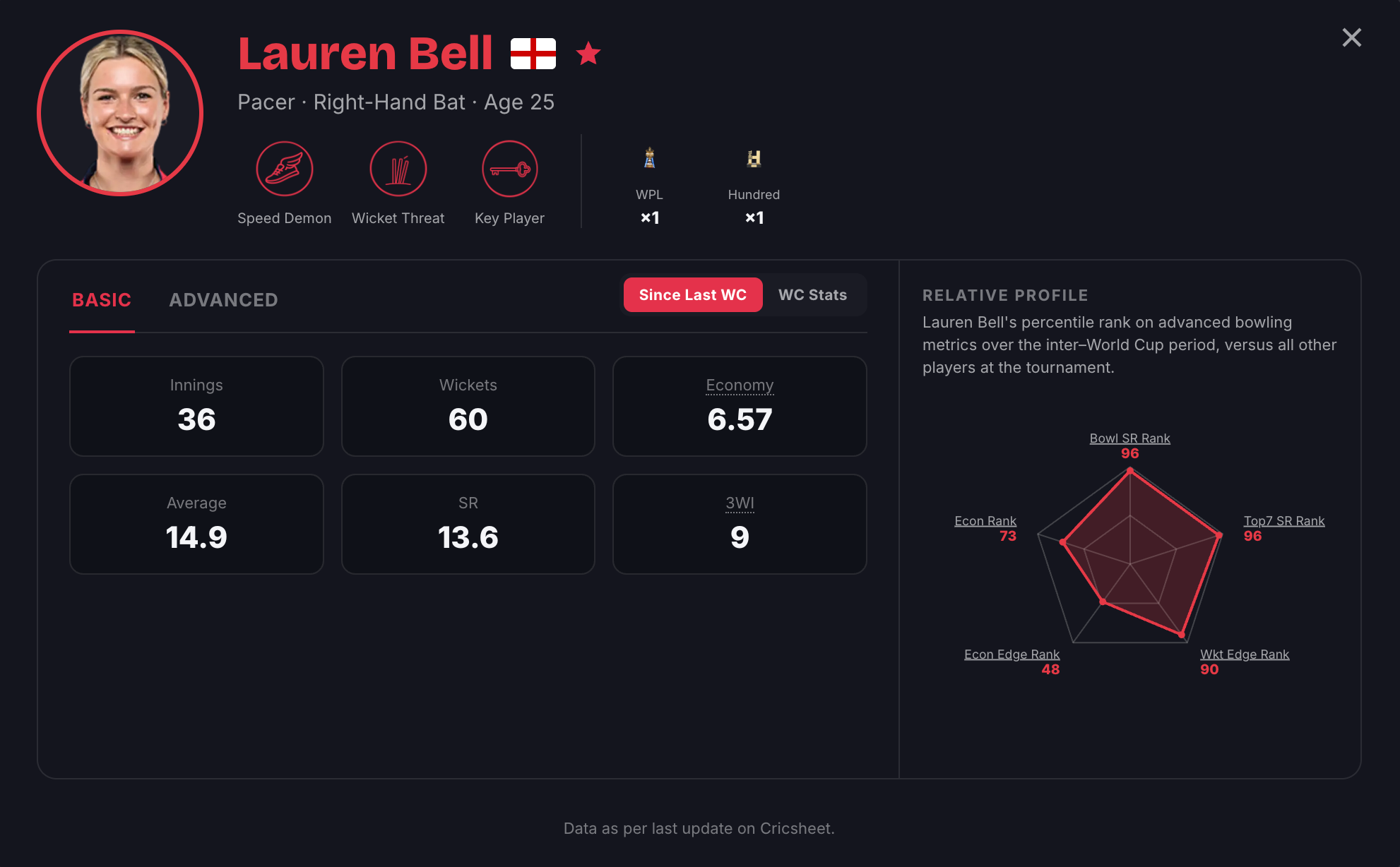
By the start of the fourth over, West Indies did not have a single boundary compared to England’s six at the same point. Matthews decided to attack every delivery of Linsey Smith’s following over. She scored two boundaries, but on the fourth ball of the over, Matthews was beaten by a quicker length ball for the second time in the over. A contentious third umpire decision followed, and Matthews was fuming as a caught-behind decision was given.
In the middle overs, the English spinners gave a masterclass in how to bowl on a dry surface with assistance by generating defensive and false shots by bowling near-unhittable lengths while keeping the stumps in play. Unlike the first innings, the West Indies batters failed to alter the lengths of the English bowlers to maximise run-scoring opportunities in the middle phase, as the result seemed never in doubt following Dottin’s dismissal.
Wyatt-Hodge’s century was the obvious talking point from the team’s opening night win; Freya Kemp and Danni Gibson’s 21-ball 61-run partnership was the defining phase in the win vs Scotland. Tonight, the two finishers combined to score 6 runs between them, but it didn’t matter; England were well ahead of the game by the time they came out to bat, thanks to the multiple great batting performances before them, and a comfortable win would be sealed by the bowlers soon after.
Wyatt Hodge’s field and crease manipulation: Wyatt-Hodge’s offside range is no secret, but the batter was able to fetch multiple boundaries over the offside in-field from deliveries pitched down leg. Respecting Wyatt-Hodge’s range, WI soon placed a fielder in the deep cover region, vacating the deep square-leg region in the process. Wyatt was able to generate multiple run-scoring opportunities in the deep square-leg region as a result, including a boundary, as the batter often moved to the offside early to premeditate shots.
🔻 Wyatt-Hodge keeps it agile: Wyatt-Hodge had the same number of boundaries and dot-balls (8) in her 42-ball innings.
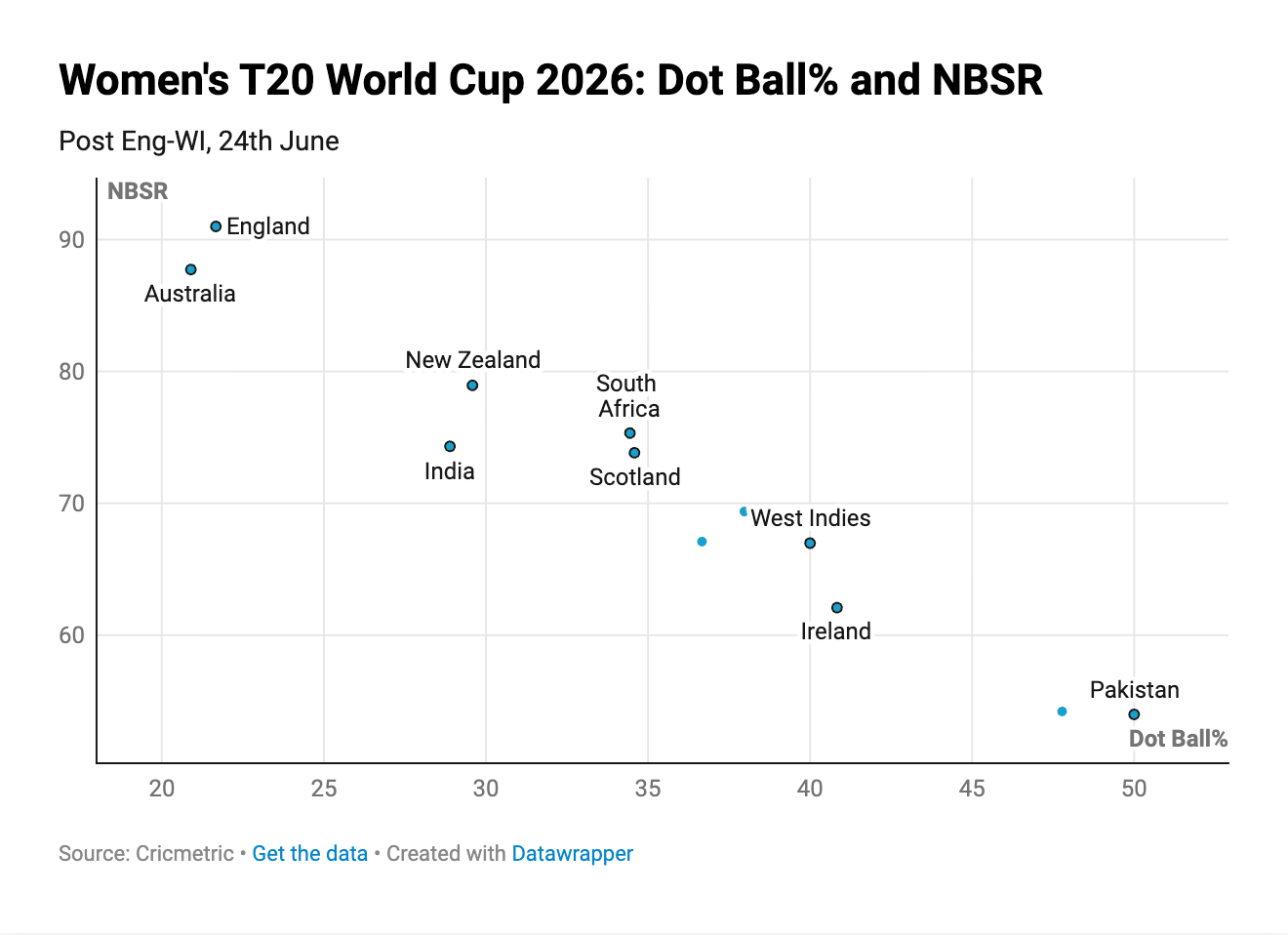
🏃 England move it around: England has been among the best strike rotation teams with the bat through the middle overs at this World Cup. They have the highest Non-Boundary Strike Rate in these overs (91) while closely trailing Australia as the second-best side at minimizing dot-balls with a dot-ball percentage of 21.67%.
Against one of the three unbeaten sides in the competition coming into tonight’s clash, England made their best case for a World Cup title with a well-rounded and dominant performance.