

It is an ordinary urban scene—so ordinary that most cyclists barely expect it to change. And yet it is also a direct conflict with the law in many cities.
What happens next is a confrontation that shows just how normalized this behaviour has become.
“The fucking bike lane, man”
The cyclist, who shares videos from the Twin Cities area in the United States on social media under the name MPLS Bike Wrath on YouTube, approaches the truck, then rides up the loading ramp to have a chat with the driver.
The discussion is immediate. The bike lane, he says, is not a loading zone. There is a parking lot nearby. The vehicle should not be stopping “for any length of time for any reason.”
The tone escalates quickly: “You don’t get paid to violate the fucking law and endanger people in our community,” the cyclists adds.
The driver’s response is calm and resigned to just getting the job done as it always gets done: the delivery is happening, the job has to be completed, and there is nowhere obvious to stop closer to the restaurant.
Anyone who has ridden a city for more than a day has encountered this situation.
A restaurant employee comes to the defence of the delivery driver. At first, the reaction is neutral—this is just how deliveries arrive, and the driver is doing nothing wrong. But the cyclist pushes harder, arguing that repeated reliance on bike lanes for loading shifts risk onto cyclists who must weave into live traffic and normalizes illegal behaviour in front of businesses that benefit from it.
At one point, the cyclist adds: “This is happening every day outside your establishment,” he says, while asking why his restaurant is condoning behaviour that is a community safety risk.
The employee changes his attitude and suggests the issue might be something management needs to “figure out.”
What becomes clear is that nobody in the moment is getting too confrontational, recognising that the system is not working well for everyone involved—often at the expense of cyclists safety.
YouTube screenshot of MPLS Bike Wrath video
The legal reality: bike lanes are not loading zones
In most North American cities, blocking a bike lane is not permitted for commercial deliveries, but it happens countless times each and every day. We’ve all seen it.
Exceptions are narrow and typically include emergency vehicles, utility work, transit operations, and specific passenger loading situations such as taxis or accessible transport.
Delivery vehicles—restaurant suppliers, courier vans, furniture trucks, contractors—generally do not have a blanket exemption to stop in a bike lane simply because loading is inconvenient.
In legal terms, what is shown in the video is not a grey area. It is a violation. End stop.
Fines exist—but enforcement is inconsistent
Cities do have penalties for blocking bike lanes, but they vary widely and are rarely enforced in real time.
Examples include:
- New York City: fines typically around $100–$115 for bike lane obstruction
- Chicago: enforcement programs with penalties that can reach roughly $250 in some cases
- Many Canadian cities: fines commonly in the $150–$250 range depending on jurisdiction
Sure, it seems like the message is that bike lanes are not legal loading zones. On the street, enforcement is another story, and tends more towards this being an unavoidable so accepted occurrence given the constraints of the streets.
Most violations go unwatched and unpunished. By the time enforcement could respond, the truck is gone and the risk has already been transferred onto cyclists. Or they get fined, and it is just another cost of doing business.
That gap between law and enforcement is where the behaviour becomes routine.
What actually happens when a bike lane is blocked
For cyclists, a blocked bike lane is not a minor inconvenience—it is an immediate safety disruption.
The options are limited:
- stop suddenly
- merge into moving vehicles
- attempt to navigate around a truck into an active lane
None of these are neutral choices. They are forced risk transfers onto the most vulnerable user of the roadway.
This is why bike lanes exist in the first place: to remove cyclists from unpredictable interaction with heavier, faster vehicles.
When they are blocked, that protection disappears instantly.
Safe and separated bike lanes with solid concrete barriers are a solution so delivery vehicles can’t stop wherever they want in a bike lane, but that isn’t happening fast enough.
What cyclists can do
There is no perfect solution at street level, but there are practical responses.
First is the obvious one: slow down and treat every blockage as a potential hazard, not a minor obstacle. Most collisions in these situations happen not from the obstruction itself, but from the sudden merge into traffic where distracted drivers are the norm.
Second is communication. A calm exchange can sometimes be effective. Many drivers and delivery workers are not intentionally disregarding safety—they are operating under pressure and within systems that leave them few alternatives.
But escalation is rarely productive. Viral confrontation videos may highlight the issue, but they do not change curb design.
Increasingly, cyclists are turning to documentation and reporting.
Platforms such as Bike Lane Uprising allow riders to log blocked bike lanes and repeat offenders. Over time, this creates data that cities can no longer ignore—patterns that show exactly where infrastructure is failing and how often it is being compromised.
In many cities, 311 systems or parking enforcement apps also allow reporting of blocked lanes, even if response times vary.
And, of course, continued advocacy for safe cycling infrastructure that keeps all vehicles physically separated from bike lanes.
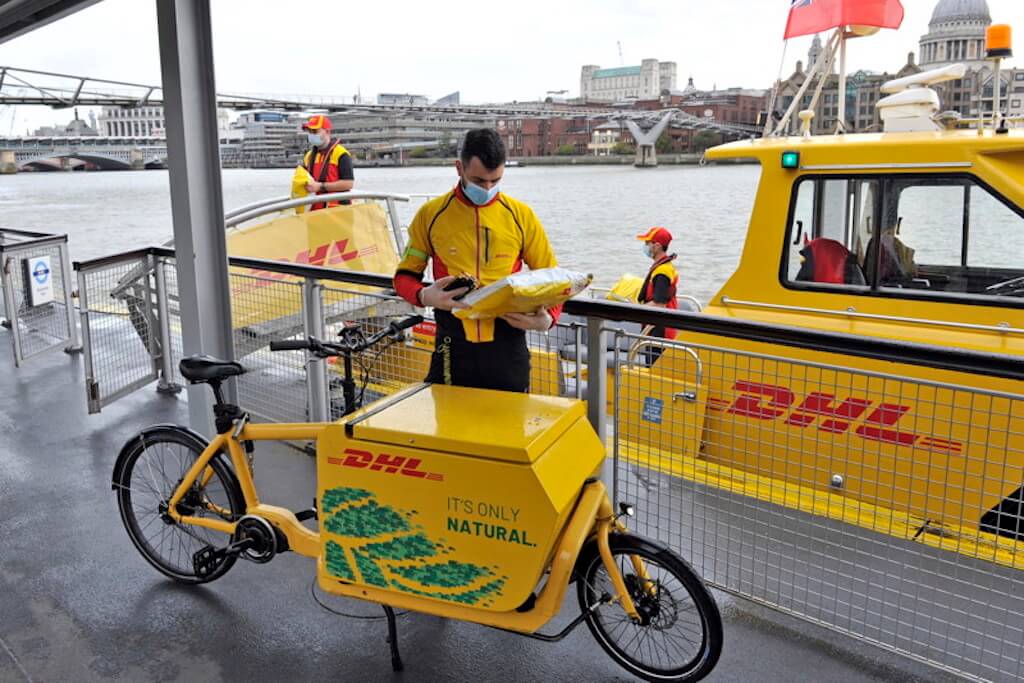
DHL cargo bike in London
What cities should do
The driver’s reality is also structurally predictable: delivery has to happen somewhere, and curb space is limited.
Modern cities are now asking the same stretch of street to accommodate:
- bike lanes and protected cycling infrastructure
- deliveries for restaurants and retail
- construction activity and service vehicles
- ride-share pickups and drop-offs
- parking and loading zones
Physically separated bike lanes make streets function better. Everything is clear, park in parking spaces, drive in vehicle lanes, cycling in bike lanes. Drivers are safer, cyclists are safer, even pedestrians are safer.
At the same time, delivery volumes have increased significantly with e-commerce and app-based logistics. And, deliveries via bicycle, e-bike and scooter have also increased meaning the risk of conflict is even greater.
Not only that but many cities are testing pilot projects for alternatives like e-cargo bike deliveries, as are many delivery companies like FedEx.
It is not happening fast enough. There needs to be greater investment, greater enforcement, great incentives for companies to move beyond giant delivery vehicles that make no sense in dense urban areas. It’s better for all.
A bike lane is either protected or it isn’t
What makes the confrontation in the video resonate is not the argument itself, but how familiar it feels.
Everyone involved is working within constraints. The driver is trying to complete a delivery. The restaurant is trying to function. The cyclist is trying to move safely through a space that is supposed to be protected.
But only one of those people is being forced to accept immediate physical risk.
And that is the cyclist.
This is where the debate stops being theoretical.
A bike lane is either a protected piece of infrastructure—or it is a suggestion that disappears whenever it is inconvenient.
Right now, in most cities, it is treated as both. And cyclists are the ones who pay for that every single day.