
Most of us have been there: During the cycling season, we head out for rides and adventures whenever we can, and maintenance is reduced to checking that there’s enough air in the tires, and maybe a quick glance at the brake pads… And then we suddenly realize that we haven’t changed the chain in months—or was it years?
We put on a new chain and test-ride the bike. Now comes the moment of truth: Had the old chain ‘stretched’ so much that the cassette is ruined too? What about the chainrings? We shift all gears and pedal hard in each one. Will the chain suddenly skip because the old (longer) chain has worn the cog teeth into a different pitch, so they don’t mesh with the new (shorter) chain? If yes, then it’s time for a new cassette, too. (The chainrings usually are fine, unless the chain has really stretched.)
Experts will tell you that the sideplates of the chain don’t actually stretch. That’s correct! What happens is that the rollers and pins wear, and so there’s more play in the chain. Pedaling pulls on the chain, so all that play makes the chain longer than it should be to mesh with the chainrings and cassette cogs.
You don’t need special tools to check your chain. A long ruler will work. Almost all bicycle chains have a one-inch pitch. That means 24 chain links are exactly 12 inches long—when the chain is new. It the distance between the 1st and the 24th pin is off by 1/16″, the chain has ‘stretched’ by 0.5% and is due for replacement. Why measure over 24 links? Because 1/16″ is the smallest increment most rulers show, and it’s about as small as you can measure reliably. Even so, holding a ruler to the upper chain run while putting pressure on the pedals to pre-stretch the chain, and then getting an accurate measurement can be cumbersome. Measuring the chain that way is just enough hassle that I tend to postpone it in my busy day-to-day life.
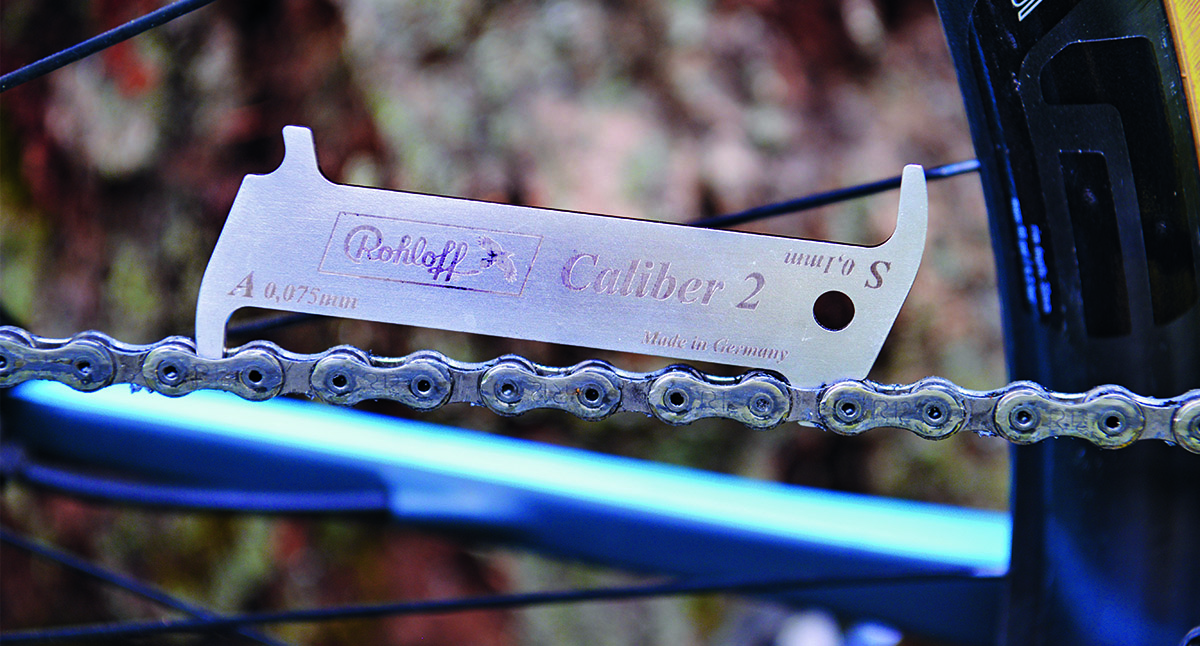
In the Autumn 2025 Bicycle Quarterly, we tested a number of chain checkers. The clear winner was the Rohloff Caliber 2. It’s so easy to use that I now check the chain at least once a week: Simply put the hook at the right end of the tool onto a chain link, then push down. The tool pre-stretches the chain to get an accurate measurement. If the curved finger on the left end of the tool goes all the way into the chain, it’s time to replace the chain.
Checking the chain takes just a few seconds—I do it as I head out the door. By the way, the chain in the photo is almost new—it belongs to our BQ test bike, the remarkable Fairlight Strael 4.0. As the chain wears, the tool goes down further and further, giving ample warning when the chain approaches the wear limit.
The Rohloff tool has two sides: One is for aluminum cogs, with a wear limit of 0.075 mm chain stretch (0.3%). The other, for steel cogs, allows a more generous 0.1 mm (0.4%). I tend to be conservative when it comes to maintenance, so I use the ‘aluminum’ side of the tool for all my bikes, even though most have steel cogs.
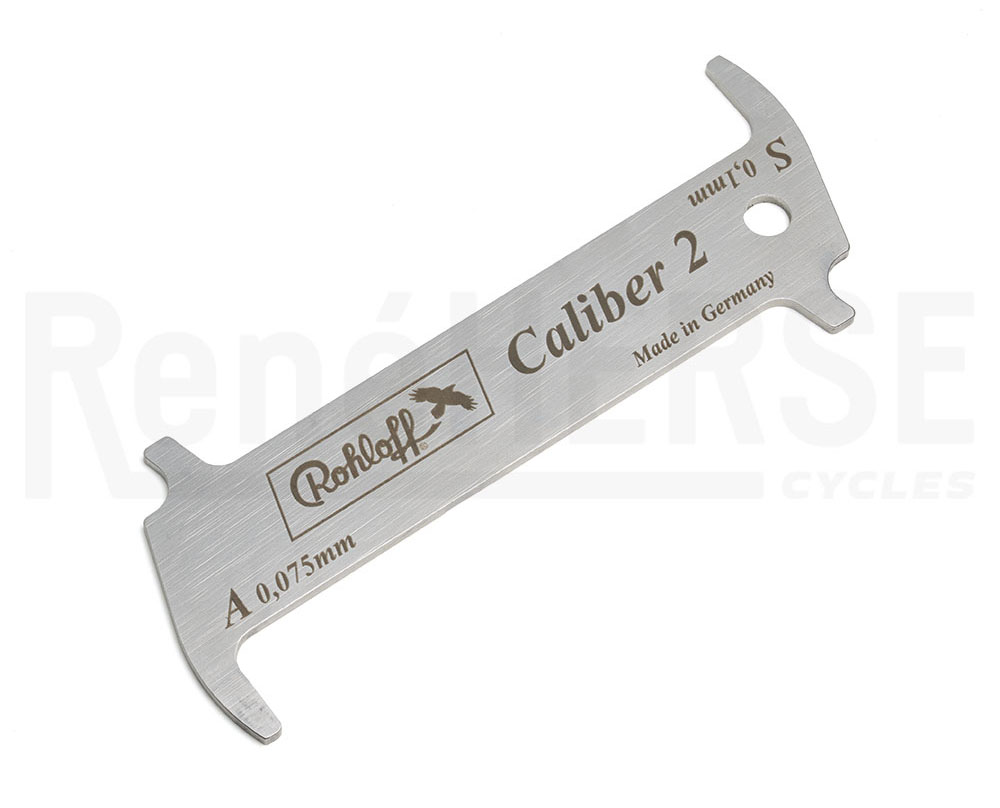
The key to this type of tool is precision manufacture—you’re trying to measure a difference of less than half a percent! There are similar tools that are laser cut, but they often don’t have the accuracy you need. Either you’ll replace your chain too often, or you still run the risk of ruining your drivetrain.
There’s only one caveat: Since the Rohloff tool (and similar ones) measures the distance between rollers, it only works with chains that have standard-diameter rollers. That’s all bicycle chains today, except SRAM flat top chains. For those, you need a different tool (or use the ruler method).
Unless all your bikes have flat top chains, the Rohloff chain checker is a tool you’ll soon find indispensable. Not only will it save you money—it costs far less than a cassette—but it’ll also provide peace of mind. In fact, we like the Rohloff chain checker so much that we’ve added it to the Rene Herse program. And, of course, all that also makes it a great gift for the favorite cyclists in your life.
More Information: