

Some subscribers have asked for a Mail Bag-style post where I answer some questions in more depth.
Given we had such a top-heavy season with Sinner and Alcaraz dominating a lot of finals, I figured off season now was a good time to trial something like that.
So, drop your questions in the comments section! I’ll aim to get the post out in 7 days or so.
If it gets significant interest I’ll consider making it something I do more regularly throughout the season.
Things I’ve noticed lately…
This kind of training is a good example of the constraints-led approach:
“Through the manipulation of certain constraints, different information is presented to the learner. In turn, the learner is then challenged and channelled to find their own movement solutions to the problems faced or the goals needed to be achieved.”
Observe how Rune has unconsciously (I assume) tapped into a longer backswing as a solution to make up for the lack of leg drive. This is always the first tool I try and use to change a pupil’s swing: unconscious, intuitive, implicit.
It’s more elegant than describing in words what you want elbows and hands to do.


Dolgopolov was one of the most unorthodox players in recent memory. A jack-in-the-box service technique, and an all-round twitchy player, he made his career-high #13 at the zenith of the Big-4 era: 2012.
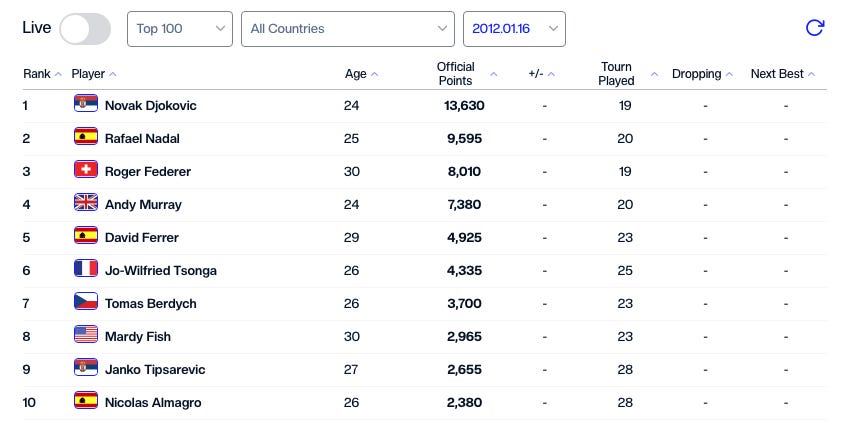
The players in the chasing pack:
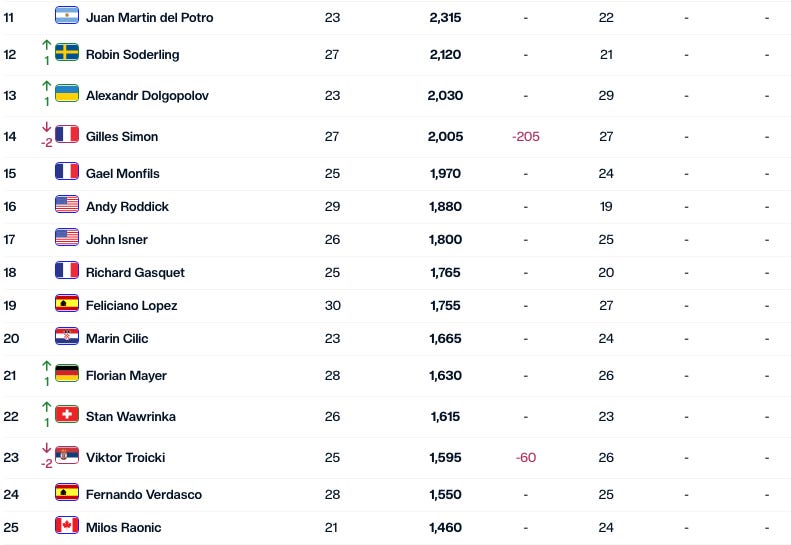
I agree with Dolgopolov’s 3-15 sentiment. Today’s chasing pack are less established, less dangerous, or past their best (Djokovic for sure, but maybe (and I hope I’m wrong) also Medvedev, Rublev, Tsitsipas).
I also agree that today’s depth is much greater. 50 to 100, or to 150 and beyond, are stronger relative to the top 15-50 players. I’ve noticed this also in college tennis. The depth of college tennis, and calibre of top players, has improved drastically since I finished in 2012.
But I disagree that Sinner and Alcaraz are less consistent now. Sinner (58-6, or 90.6%) and Alcaraz (71-9, or 88.8%) posted incredible season win-rates in 2025 (Sinner also in 2024). Similar to the Big-4, many of their losses came at the hands of each other (Alcaraz steadied the ship post Miami, where against the field he only lost to Rune and Norrie).
Compare 2012:
Djokovic went 75-12, losing four times to non-Big 4 players (del Potro, Isner, Tipsarevic, Querrey).
Nadal went 42-6 in 2012, cutting his season after Wimbledon due to injury, but he also lost 4 times to non-Big 4 players (Rosol, Kohlschreiber, Verdasco, Monfils).
Federer went 71-12, losing six times to non-Big 4 players (del Potro x2, Berdych, Haas, Roddick, Isner)
Murray was only slightly more mortal, going 56-16, losing (Janowicz, Raonic x2 Chardy, Mahut, Ferrer, Gasquet, Berdych, Garcia-Lopez).
Sincaraz are playing — and posting the numbers — of generationally great tennis.
Jeff Sackman of Tennis Abstract fame just dropped a piece on Sinner’s recent statistical achievement of leading the tour in hold and break percentage in 2025 — a feat never done before — and weighed in on why it might be happening more often in recent times:
“In short, we’ve reached peak server. You could find players with the potential to develop bigger weapons than those of Sinner, Draper, Ben Shelton, Alexander Bublik, and the like. But they’re already holding 85% of the time. Even Ruud and Alex de Minaur, with their limited first-strike capabilities, are able to hold nearly that often. At the risk of a misleading pun, we’ve reached diminishing marginal returns. A better server might eke out another percentage point or two, but at what cost? A whole lot of guys would love to have Shelton’s serve, but would they take the Shelton return along with it?”
I’ve often said something similar, but emphasising the reverse: modern tennis rewards the three core baseliner skills: topspin forehand, topspin backhand, and movement proficiency. Maximise those three things (as Djokovic and Sinner have done best most recently), and serve effectiveness becomes massively overrated. Those three core skills help you on every shot after the serve: returning, serve-plus-one, passing shots, approach, change-of-direction, etc.,
Alex de Minaur is a good recent example. The Aussie is 17th in hold-% but is 69th in average aces/match in the last 52-weeks.
My favourite example of this is to look at career hold-% on clay, and see who the leaders are, as well as who the odd-man out is:
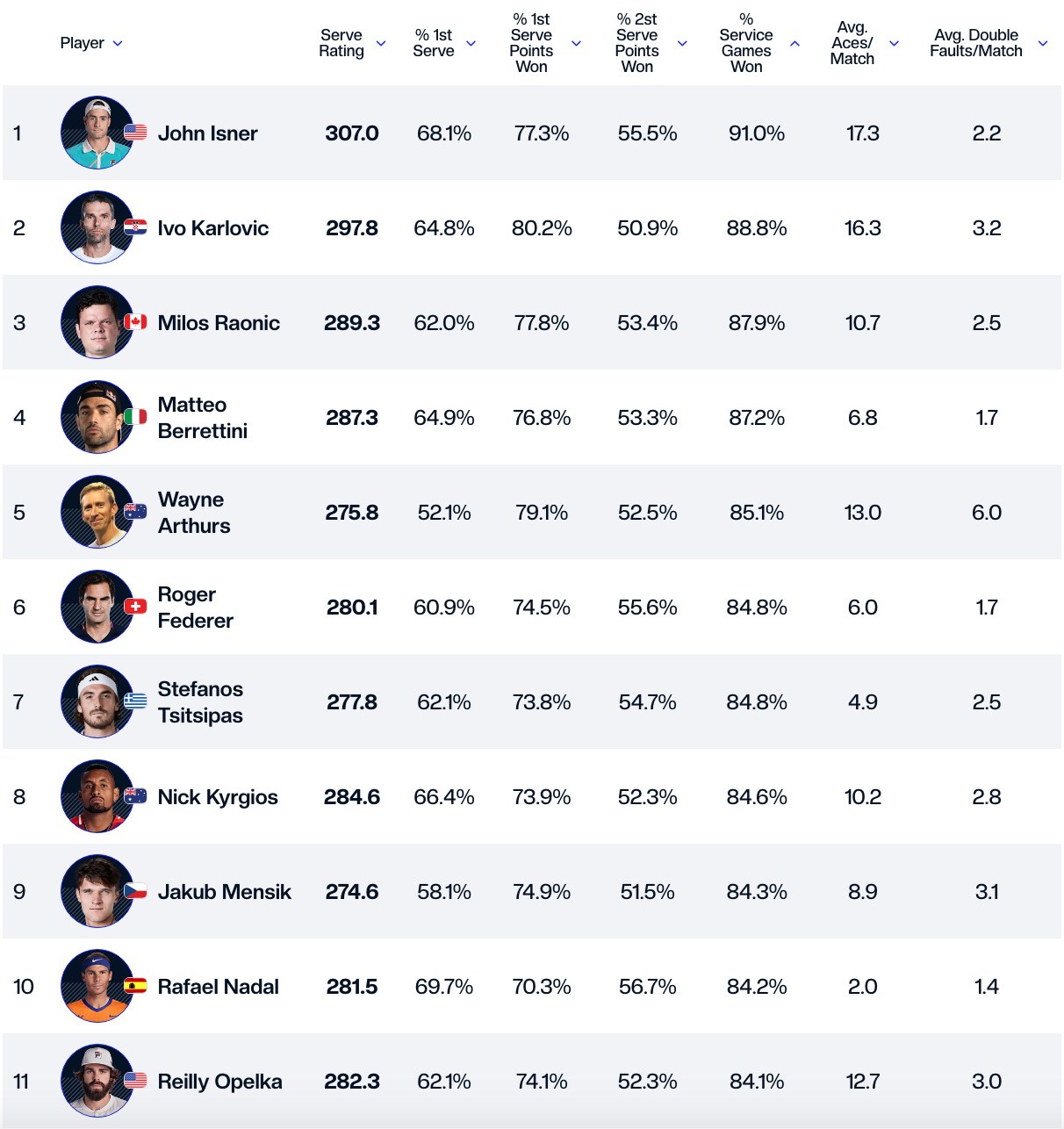
No prizes for guessing why Nadal was able to hold serve in the same ballpark as Mensik and Opelka despite a serve that paled in comparison.
See you in the comments. HC