
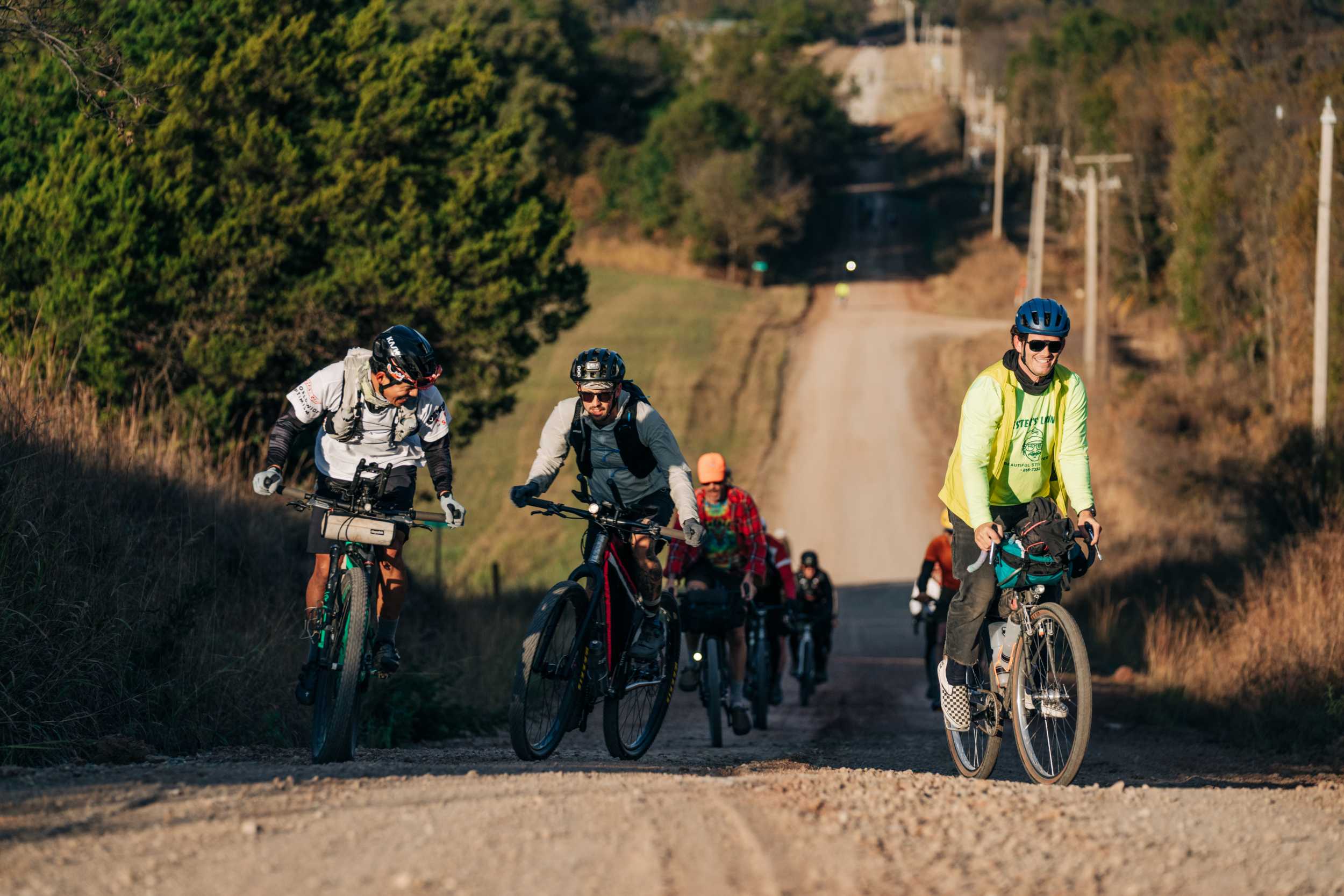
After attending the inaugural event last year, Nic returned to Stillwater for Mega Mid South 2025 in search of a different kind of journey. Having experienced the unique sense of community created by those close to the organizing team, this tale of fortune and failure at Mega Mid South goes beyond a race recap…
Photos by Will Moss and Tilly Shull
Taking on Mega Mid South last year seemed like a natural transition. I’d endeavored on longer and longer rides over the past two years, hitting 200 miles in a single day twice. Those rides were in the flattest state in the union, so, in my mind, they incurred an asterisk, but 300 miles didn’t seem like a stretch too far. Doing so turned out to be one of the best decisions I’d ever made, as the inaugural Mega felt like it extended beyond bikes. Of the 120 or so riders who showed, only about 30 finished due to the dour conditions that plagued what’s supposed to be a pretty mild time of year in Oklahoma. But those who finished finished, and it felt like an experience that brought what was once a group of strangers closer together.


It was with that same sense of camaraderie in mind that I wanted to return for Mega Mid South 2025. Busy documenting and creating both a written article and a video piece about my experience in the race, I found myself thinking about how fast I could complete the course for what seemed like months. Not so much because I was obsessed with speed or performance, but because the event seemed like the perfect environment to find yourself while doing something hard.
At just over 300 miles, Mega is a “short” ultra. A tantalizing distance that seems to silently taunt riders, saying, “Yeah, but what if you pushed it?” I have a bit of a tortured relationship with performance. I appreciate it, I see its value, and I think it sometimes gets an unfair shake in today’s environment. That isn’t to say I think there’s anything wrong with the rise in messaging that devalues performance over other kinds of experiences, rather that I think everything and every approach has its place. It’s an idea I spoke about a lot with Dawson Allen, someone I shared my first Mega Mid South with. In the months leading up to Mega, we texted each other often.
“Dude, are we doing this thing?”
“Whatcha thinkin, bud?”
“30 hours sounds about right…”


What started as a lighthearted conversation transformed into a burning impetus. Spurned on by a willingness to push, Dawson and I catalyzed each other’s approach without really knowing. We’d both grown up in competitive sports environments, the kinds that demanded six-hour practice days and regimented discipline. It’s why the two of us appreciated not doing that. When I found cycling, I found an activity that gave me the physical outlet I had always wanted, without the negatives that had led to a lot of disappointment and a misguided sense of what it was to engage in physical achievement. Growing up as an athlete, you become refined for purpose. You learn the tools of the trade. Your body becomes a means to accomplishments. It’s fun to push the buttons, tip the scales, move the needle, and get it to do something.
As you get older, it’s a practice you realize fewer and fewer people have ever had the privilege of taking part in, and those old patterns and rhythms stick around. You pick up athletic activities quickly, but for me, it has sometimes been a frustrating medium. Fit and proficient enough to get going faster than most, but short of being talented enough for any kind of top-level competition. Others see quick progress and always encourage entering into a race or competitive environment, but those things come with baggage. The type of baggage I’ve spent almost two decades trying to find a healthier relationship with. Keeping the negatives at bay requires a considered approach to how hard I push and to noticing when I’ve gone too far.
“What’s the move here? No sleep? I don’t think I’ve ever done something like that.” I said to Dawson.
“Yeah, I don’t think there’s much of a point in bringing anything like that. Only slows you down,” he joked.
The 30-hour time goal wasn’t born of nothing. Dave Easley had set the singlespeed record at 34 hours in the first year, but he reckoned it could be done faster when conditions weren’t mind-numbingly hot. Having seen Dave put together some big wins in 2025, I occasionally pestered him with an Instagram message, poking and prodding to see if he was really going to give it a go this year. After some haranguing, I discerned he was, and things really started to heat up.


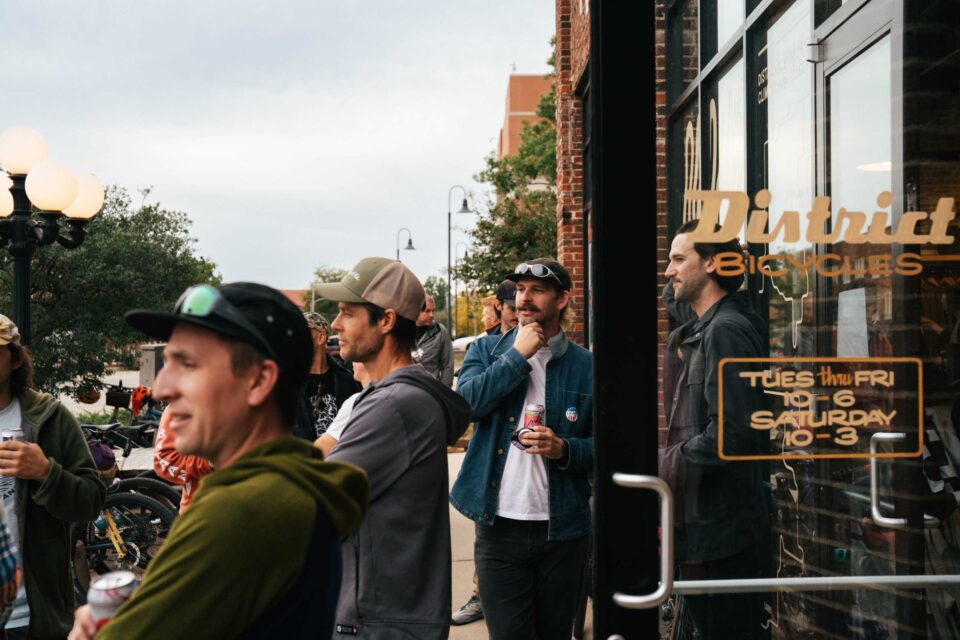
“Dude, what is UP!” Bobby said, excitedly. “Can you give me a hand with this, actually?” he laughed. I’d arrived in Stillwater a day before the grand depart and seemingly picked things up where I’d left off last year. I caught Bobby frantically moving stuff out of his van and into the shop, and when I saw him, we immediately started chatting about how we thought things were going to shake out.
“Some freakin’ hitters are coming, dude. Some really fast guys.”
I took a peek at the single-speed field on the District shop computer. Chock-full of names I recognized—Joe Fox, Dave Easley, Tanner Frady—they’d all ridden at some big events and taken some huge wins in the past year or so. My aspirations of finishing in the top two or three seemed less and less realistic as I gathered more information. In addition to the stiff competition, I’d somehow contracted a rare case of what appeared to be chikungunya just two weeks out from the race, an illness that left me feeling like I was lucky to have survived it. I tried to focus on the nature of the experience ahead.
Like last year, I was taking on something that I’d never really done before. Three hundred miles in one go, riding all the way through the night, and taking away all but one gear. It was a lot to handle. But, Mega seemed like the perfect place to push the limit. In conversations with Dawson, we’d agreed that the culture around Mega and the Mid South team seemed uniquely positioned to invite a sense of “safe” competition. Between the course, community, and camaraderie, there was something special about this event and how one approached it.
After carrying in a few boxes of coconut water and snacks for the pre-race party, I spoke candidly to Bobby about his own approach to the race. We’d briefly touched base throughout the year, but recent personal struggles meant this weekend was more of an opportunity to work through difficult emotions. With a recent cancer diagnosis in the family, Bobby had also arrived at a sub-30-hour time goal, intending to do all 300 miles in one go. Bouncing around town in the Mid South team van, we caught up while purchasing as much ride food as we thought could fit in our bare bones setups. Easy conversations quelled nerves, and despite the seemingly serious approach, there was an air of ease about the 17 or so singlespeeders, most of whom were looking to take on 300 miles with as few stops as possible.
Out of the Frying Pan
The grand depart was a true inverse of the year past. Moved up about a month or so after the trauma of two 100+ degree days, this November 1st start was frigid enough for most of the field to don gloves and shoe covers. With a freeze on the forecast for the same evening, I was concerned about what would happen if I found myself stranded out in a frozen field come the early hours of the morning.
“Well, all the more motivation to keep moving, I guess,” we joked as head units beeped and people said their goodbyes.
Soon enough, the massive peloton left from in front of District Bikes. The anxiety of what could or couldn’t happen started to melt away as the sun rose from beyond the plains in the distance, and the cadence of my 40 x 18T gear started humming. Racing singlespeed was relatively new to me, but it’s something I’d done a few times in the year or so. With some minor podiums in local races, I appreciated the simplicity. Though the hills would present their challenges, it was a bit harder to let pre-race jitters get the better of your legs. You just had to pick the right gear and go for it. The decision is final, and it’s one you have to live with for the duration of the event you’re participating in.
My 40 x 18 gearing was far too steep for my home terrain in Asheville but a hopeful guestimation for the flat, straight roads of northeast Oklahoma. After the first 50 or so miles, it was an estimate I wasn’t sure I’d gotten totally right. Though the course was front-loaded with its 17,000 feet of elevation gain, my ego got in the way of a few climbs. Sure, I was near the front of the race, but pushing it up some of the climbs would’ve been smarter. Nevertheless, I was encouraged by my progress.
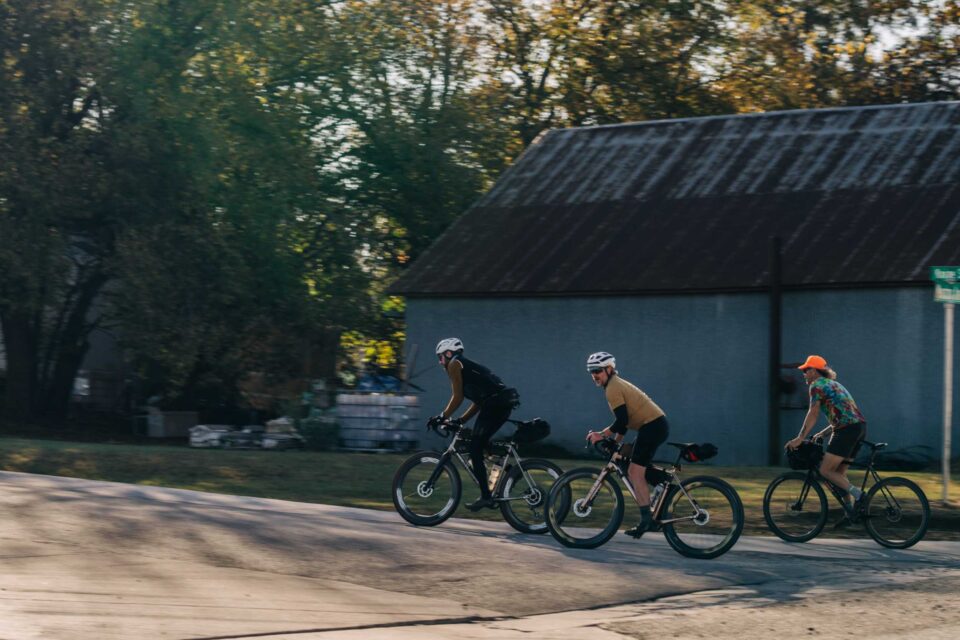
As the group moved through stops at a record pace, it started to really feel like a race. Tactics and mind games set in on the climbs, and people warily sussed each other’s energy levels at gas stations and other gathering points. Leap-frogging between groups of geared riders, I didn’t see too many of those in my field for most of the day. Worry started to set in as I wondered whether I’d been passed at some point, but for the most part, I was having fun.
Approaching Gnaria, the course’s sole marked rough singletrack section, I saw Josh McCullock, creative director at the Mid South, waiting with a giant camera and gimbal. Be it a lack of focus, cold, or just bad luck, my tire hit a big rut at the very start, forcing me to unclip to keep from falling. My foot slid into a large pile of wet mud, and Josh, looking through the viewfinder, simply said, “Ugh, that’s gross.” Collecting myself, I trudged on through a much rougher section of trail than I remembered from the year prior, my foot slowly getting soggier as the mud and moisture sank in from the initial dip. As I trudged on through the long, straight road on the other side of the singletrack, I hoped the moisture wouldn’t saturate my shoes and continued to move through the night.


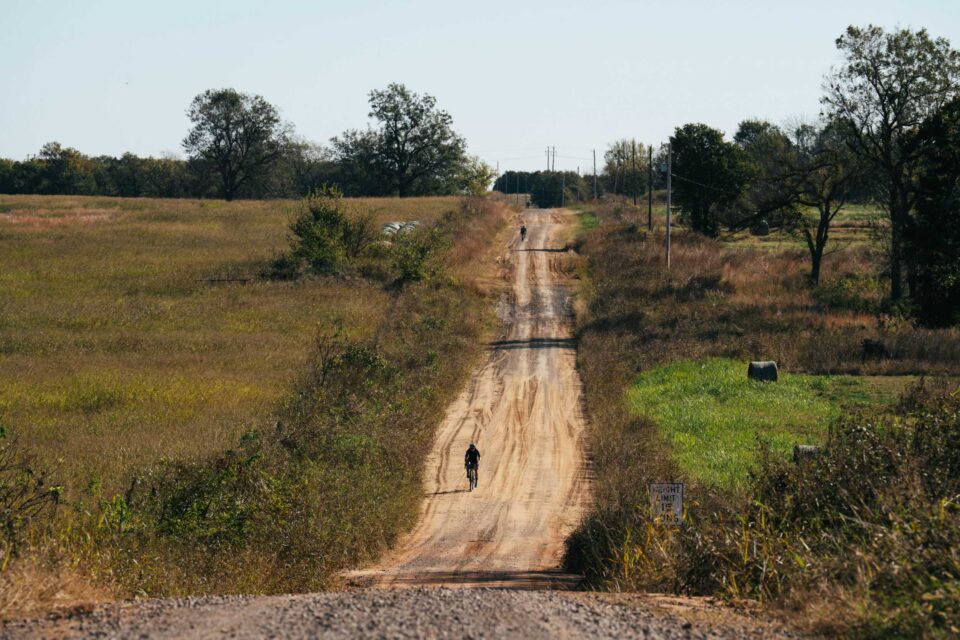

Two hours on, and I had started to struggle through the cold. What were once pleasant, undulating hills had turned to dangerous descents filled with rock-hard ruts that were all but impossible to see. Though I had two lights, I was unsure of the runtime on specific settings, so I kept them on the lower power setting to try to get me through the night. As two geared riders passed, I asked if they knew where the next stop was.
“It’s a 24-hour Love’s, but it’s a bit up the road. Maybe 10-15 miles,” they barked, rolling by much quicker.
I figured it would likely take me over an hour, given how much I’d slowed, so I decided to go off-course for a stop I knew was open and had food. At the Cowboy Travel Plaza, I scarfed down a large order of fried pickles and mashed potatoes, eventually putting on every layer I’d brought with me, including my rain pants. I was warm enough, but it required significant physical output to stay warm in the dark of night. As I rolled on, I looked for any motivation to keep moving at pace. Fumbling around in the dark with TrackLeaders, I discovered I was still at the front. In fact, I was in second. Having ridden past the Love’s, most of the men’s singlespeed field was in there or huddling in some shack near mile 180. Bolstered by my progress and the fact that I’d fully re-fueled, I pressed on past Perry and into the night.
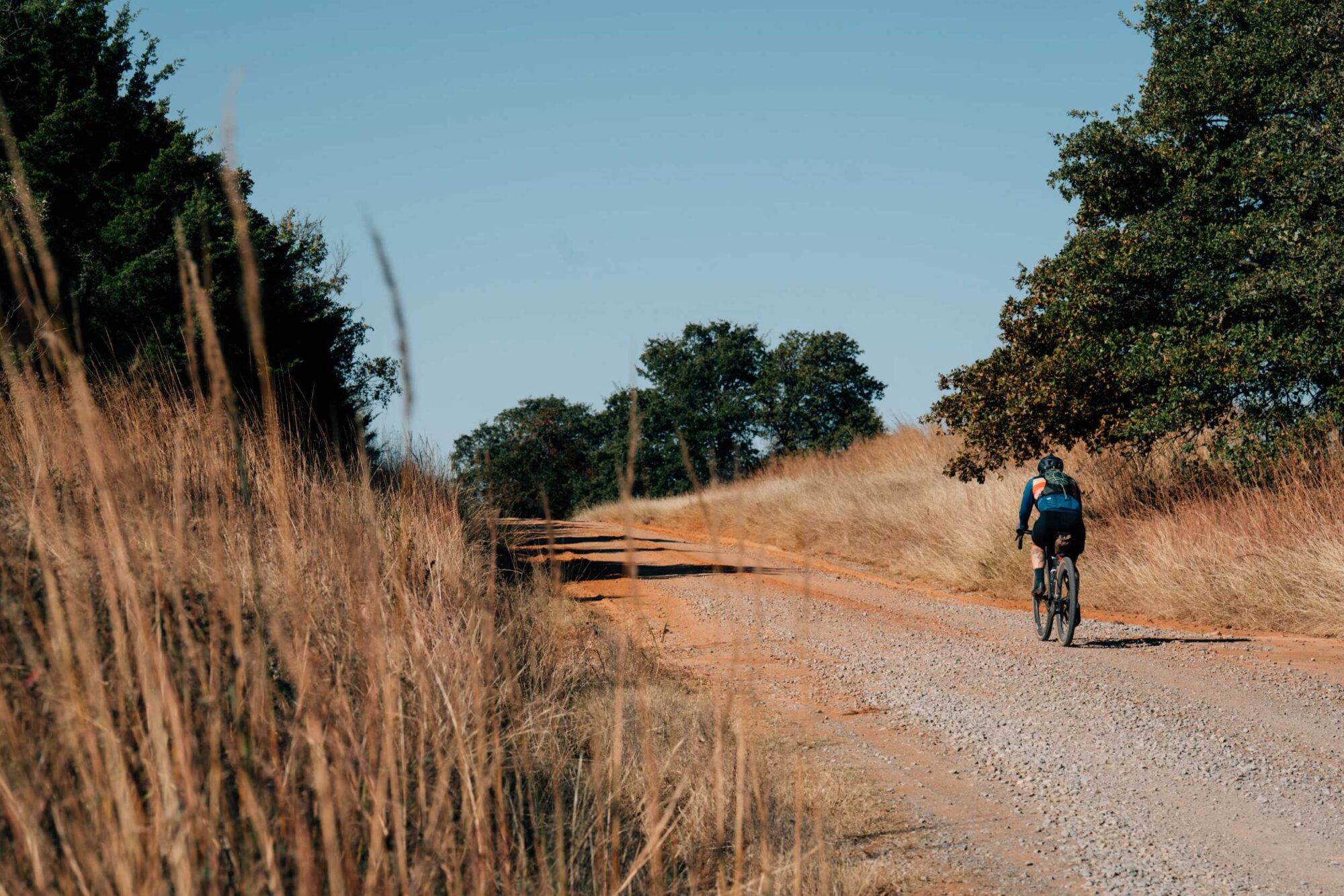
Over the next few miles, I really started to suffer. I’d kid myself that I could still wiggle the toes on my right foot, and despite a consistent intake of food and water, I wasn’t feeling as spry as I had in the first 100 miles. As my Dura head unit ticked past 200, I thought, “Can I really do another century?” I tried to quiet the doubt-filled voices in my head, but they just kept getting louder and louder. As I tried to get going again, wet, freezing mud slowed my wheels to a near stop. I had to keep scraping it off to get going, and I was pretty much out of water. Looking at the course, I knew the final third was the most remote and devoid of stops, especially in the early hours of the morning. Checking Trackleaders once more at the side of a pasture, I was still in second, trailing Dawson by about 10 miles.
It was in that moment that I felt a rush of opposing emotions. On any other day, 208 miles on a singlespeed would’ve felt like a significant achievement. But here, it felt like a failure. I didn’t have it in me to keep going, and I thought it would be foolish to continue given the state of my increasingly wet hands and feet, and the fact that they weren’t going to get any warmer for another six hours. Sure, I could push on, but why? I’d come out here to have an experience. To dig deep and find something at the opposing end of a big push. But pushing further didn’t feel like it would yield anything other than pain. After calling a friend who had tagged along on the trip to get me, I processed what I considered, and still think, is a failure.
And Away from the Fire
Over the next day, I caught up with others who had scratched or finished. Listening to their tales of success and perseverance. Of calling it or pushing through. Chief among them, my friend Dawson, who’d gone on to win and set the new FKT. Over Braums, a classic Oklahoma burger joint, we spoke about his record-breaking ride. Unable to feel his fingers or toes, Dawson said he’d walked a heck of a lot more than expected. His devices had shut down at various times due to a cold warning. He’d done strange and unnatural things to keep warm, but that he’d just kept going. No matter what, he’d just kept moving.
“I was intimidated by all the folks in the field, so I just always imagined that someone was going to catch me. I knew I couldn’t waste any time, so I just kept moving. Every time I saw a light, I thought it was you. I pushed and pushed to keep whatever lead I thought I had,” he recalled.
Laughing, I said, “Man, it was never me. You left me in the dust!”

Last year, Dawson was a first-time bikepacker and had a lot going on in his personal life when he took on Mega. Heck, it was why he’d driven the eight hours from Albuquerque for the event. He needed a break from the happenings of his personal life. Through the experiences and sense of community found in Stillwater, he’d not only discovered that sense of escape but found purpose in the event itself. While he never expected to set the new FKT, let alone win the race, it was through the community of competition at Mid South that he’d felt comfortable in taking on a challenge. Despite our shared struggles with competition, the sense of expectation that comes with a life in sport was no longer present. As he put it, engaging with sport and cycling was “regulative,” but freed from the pressures, he could “just let it rip.”
As the plains of Oklahoma disappeared into my rearview, I thought about the other characters in the story of this year’s Mega. Bobby, having decided to roll with his good friend Lester Acker, took the journey over a few days. Taking breaks when necessary was the right way to process his ongoing struggles. Ultimately, he was just proud to have seen his friends and neighbors take part in the challenge Mega provides and was stoked with the approach everyone has taken to the event. After a hard year in the aftermath of a natural disaster that affected the Mid South event in the spring, it felt like a necessary journey. To some, it was a bikepacking route they could take over three or four days. For others, a chance at seeing exactly where their limits lie. To Bobby, it’s a culmination of so many years of community, and an event that has established its own identity and unique experience as a Midwest ultra.

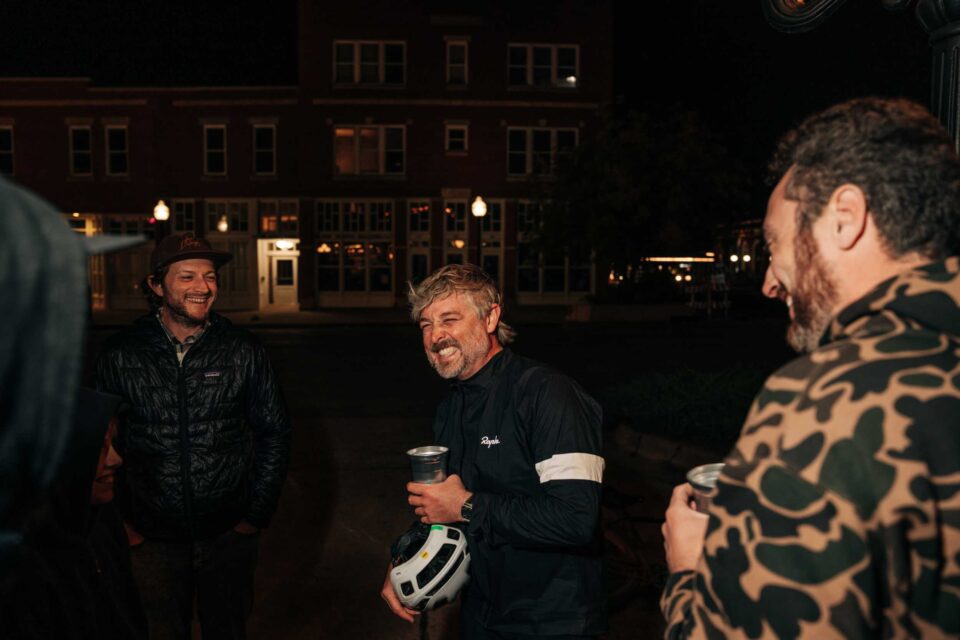


It’s through our post-race conversations that I feel my own experience this year was resolved. Normally, I’d just view my effort as a complete failure and move on, perhaps using it as motivation for the next goal. But I tried my best and eventually did something I’m not sure I would have been able to even a year or so ago. I’ve pushed my body beyond its limits more times than I’m proud to admit. Where others see achievement, I see torn ligaments, everyday pinchpoints and pains, surgeries, and physical therapy that never seems to end.
At the ripe old age of 30, your body tells you what’s going to be sustainable moving forward, and using it in the largely thoughtless way I have for my entire life isn’t going to cut it. Though I searched for an obvious, immediately discernible mental transformation at the other end of a 300-mile push, what I found after scratching at mile 208 was a subtle but equally earth-shattering idea: it’s okay to stop. As unsexy as it appears, it’s a revelation I’m glad to have arrived at, even if it meant falling short.
Further Reading
Make sure to dig into these related articles for more info…
Please keep the conversation civil, constructive, and inclusive, or your comment will be removed.