
It’s been pointed out that in this study, the RER in the final 5-mins of each lower intensity block looked exactly the same irrespective of whether it was or was not preceded by a high-intensity block. It’s argued therefore that the lactate produced in the high-intensity blocks was having no impact on fat oxidation rates during the low-intensity blocks.
One concern with this interpretation of the data is that lactate levels in the high-intensity blocks only reached 5mmol/L, which is not particularly high. It’s therefore wholly possible that (i) lactate levels were not high enough to notably impact fat oxidation rates or (ii) lactate levels had fallen back to baseline by the time the RER measurement was taken, but fat oxidation may have been suppressed earlier within each low-intensity block.
In relation to this latter theory, the participants in the study were described as ‘trained’, which might mean that these cyclists were particularly good at clearing lactate from their blood during the low intensity blocks, and that less well-trained cyclists would have had a measurable suppression of fat oxidation during the final 5-mins of each block.
Overall therefore, we don’t believe the studies above provide convincing evidence that lactate DOES NOT suppress fat oxidation or lipolysis.
So what evidence is there that it DOES?
Other Scientific Literature
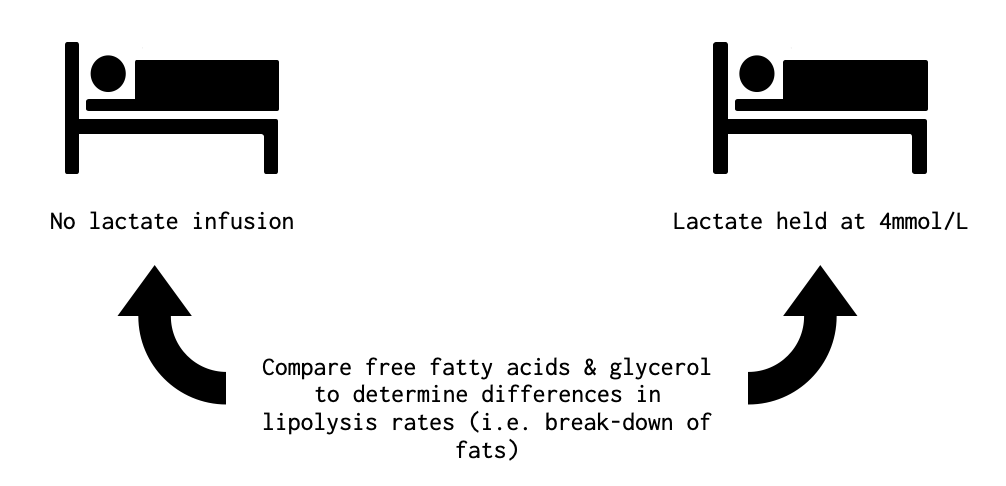
A key study is that of Boyd et al. (1974), where 6 untrained men exercised at 40% VO2max for 1.5 hours. In the last 30-mins of the exercise bout, lactate was infused to raise blood lactate levels to an average of 8.8 mmol/L. In response the levels of circulating free fatty acids and glycerol were found to be suppressed, indicating a reduction in lipolysis caused by lactate infusion.
However, other studies following a similar design have failed to detect an impact of lactate infusion on markers of lipolysis and fat oxidation (Ferrannini et al., 1993; Trudeau et al., 1999). Notably though, these studies used relatively low lactate levels (2mmol/L and 6.4mmol/L respectively). It could therefore be suggested that lactate only suppresses lipolysis and/or fat oxidation when lactate levels are high.
This theory is supported by research conducted in dogs (Fredholm, 1971), where lactate was observed to suppress free fatty acid release from subcutaneous adipose tissue when lactate levels were in the region of 10-14mmol/L, but there was no observable suppression at 5-7mmol/L and below. [Note this study helps explain why there was no suppression of fat oxidation shown in Coggan (1987), as described above!]
More recent studies have also found mechanistic evidence looking at the impact of lactate on receptors in adipose tissue suggesting lactate inhibits lipolysis (e.g. Liu et al., 2009). Moreover, as well as suppressing lipolysis, lactate might also act to reduce fat oxidation in other ways. For example, there is some evidence that hydrogen ions (which are produced alongside lactate) may interfere with CPT1, which is a key enzyme in fatty acid metabolism (Achten & Jeukendrup, 2004). It’s also thought that lactate potentially acts in conjunction with pyruvate to stop the transfer of free fatty acids into the mitochondrial reticulum (Brooks, 2020).
Overall, therefore, we think that there’s some good evidence that lactate does inhibit fat oxidation during exercise. However, what doesn’t seem to be acknowledged very often is that lactate levels may need to be quite high (e.g. 8mmol/L or above) to have a meaningful impact.
Summary and Practical Recommendations
In summary, we agree that training at a Zone 2 intensity is not the only way to improve fat oxidation capacity. However, we don’t believe there’s enough evidence to say whether Zone 2 is better, worse or equal to other types of training for improving fat oxidation capacity among trained cyclists.
In the absence of any other evidence to guide us, then it seems logical that working at a Zone 2 intensity, where fat oxidation rates are high, is probably a good approach to take if looking to maximise fat oxidation rates. Anecdotally, we find that the athletes who do the highest amounts of this type of training tend to have a fitness profile suggesting a strong capacity to oxidise fats.
We believe there’s good evidence to suggest that lactate does suppress fat oxidation, but only at high lactate levels. Therefore, very short power surges (<30-seconds), or extended efforts performed at or just below threshold probably don’t have a long-term impact on fat oxidation, and are safe to include within a Zone 2 ride, where improved fat oxidation is a key goal.
Care probably needs to be taken to avoid repeated hard efforts above threshold lasting ~30-seconds and upwards, as these are more likely to cause a more significant jump in lactate levels that may suppress fat oxidation for a period of time after each surge. Of course, there’s still the argument that you don’t need to be burning fat in order to get better at burning fat. Nevertheless, until we get a better understanding of what’s ‘optimal’ in terms of developing this ability, we’d be inclined to steer clear of hard efforts like these within a Zone 2 ride if you really are trying to work on your fat oxidation capacity as a priority.
What’s often lost from the debate around Zone 2 rides and power control is a discussion of wider reasons why power control is important. In our view, the most compelling reason to keep a lid on power output comes down to fatigue-management and recovery. It’s important to keep Zone 2 rides well-regulated in terms of intensity simply because this fosters better recovery between key high-intensity sessions. Put simply, there’s no point riding harder than you need to!
Another point of note is that we think athletes and coaches are potentially getting tied up in trying to isolate specific physiological adaptations (e.g. fat oxidation). The adaptations that contribute to improved fat oxidation (e.g. increased mitochondrial density) also contribute to abilities like improved VO2max and anaerobic capacity, so it’s difficult to say one form of training is good for one specific ability, and there’s always a high degree of overlap.
What’s most important is that you’re doing a mixture of different types/intensities of training across the medium/longer term (e.g. across a period of several weeks), and importantly including sufficient recovery between key high-intensity sessions, so that these can be performed to a high standard. This will challenge the body in different ways to help avoid fitness stagnation.
References
Achten, J., & Jeukendrup, A. E. (2004). Relation between plasma lactate concentration and fat oxidation rates over a wide range of exercise intensities. International journal of sports medicine, 25(01), 32-37.
Atakan, M. M., Guzel, Y., Shrestha, N., Kosar, S. N., Grgic, J., Astorino, T. A., … & Pedisic, Z. (2022). Effects of high-intensity interval training (HIIT) and sprint interval training (SIT) on fat oxidation during exercise: a systematic review and meta-analysis. British Journal of Sports Medicine, 56(17), 988-996.
Boyd III, A. E., Giamber, S. R., Mager, M., & Lebovitz, H. E. (1974). Lactate inhibition of lipolysis in exercising man. Metabolism, 23(6), 531-542.
Brooks, G. A. (2020). Lactate as a fulcrum of metabolism. Redox biology, 35, 101454.
Coggan, A. (1987). Effect of carbohydrate supplementation on metabolism and performance during prolonged exercise.
Burgomaster, K. A., Howarth, K. R., Phillips, S. M., Rakobowchuk, M., MacDonald, M. J., McGee, S. L., & Gibala, M. J. (2008). Similar metabolic adaptations during exercise after low volume sprint interval and traditional endurance training in humans. The Journal of physiology, 586(1), 151-160.
Purdom, T., Kravitz, L., Dokladny, K., & Mermier, C. (2018). Understanding the factors that effect maximal fat oxidation. Journal of the International Society of Sports Nutrition, 15(1), 3.
Ferrannini, E., Natali, A., Brandi, L. S., Bonadonna, R., De Kreutzemberg, S. V., DelPrato, S., & Santoro, D. (1993). Metabolic and thermogenic effects of lactate infusion in humans. American Journal of Physiology-Endocrinology And Metabolism, 265(3), E504-E512.
Fredholm, B. B. (1971). The Effect of Lactate in Canine Subcutaneous Adipose Tissue in Situ1. Acta physiologica Scandinavica, 81(1), 110-123.
Gibala, M. J., Little, J. P., Van Essen, M., Wilkin, G. P., Burgomaster, K. A., Safdar, A., … & Tarnopolsky, M. A. (2006). Short‐term sprint interval versus traditional endurance training: similar initial adaptations in human skeletal muscle and exercise performance. The Journal of physiology, 575(3), 901-911.
Gillen, J. B., Martin, B. J., MacInnis, M. J., Skelly, L. E., Tarnopolsky, M. A., & Gibala, M. J. (2016). Twelve weeks of sprint interval training improves indices of cardiometabolic health similar to traditional endurance training despite a five-fold lower exercise volume and time commitment. PloS one, 11(4), e0154075.
Liu, C., Wu, J., Zhu, J., Kuei, C., Yu, J., Shelton, J., … & Lovenberg, T. W. (2009). Lactate inhibits lipolysis in fat cells through activation of an orphan G-protein-coupled receptor, GPR81. Journal of Biological Chemistry, 284(5), 2811-2822.
Miller, B. F., Fattor, J. A., Jacobs, K. A., Horning, M. A., Suh, S. H., Navazio, F., & Brooks, G. A. (2002). Metabolic and cardiorespiratory responses to “the lactate clamp”. American Journal of Physiology-Endocrinology And Metabolism, 283(5), E889-E898.
Trudeau, F., Bernier, S., de Glisezinski, I., Crampes, F., Dulac, F., & Riviere, D. (1999). Lack of antilipolytic effect of lactate in subcutaneous abdominal adipose tissue during exercise. Journal of applied physiology, 86(6), 1800-1804.
Westgarth-Taylor, C., Hawley, J. A., Rickard, S., Myburgh, K. H., Noakes, T. D., & Dennis, S. C. (1997). Metabolic and performance adaptations to interval training in endurance-trained cyclists. European journal of applied physiology and occupational physiology, 75(4), 298-304.