
It’s another Sinner/Alcaraz final to finish 2025.
I jumped on Gill Gross’ Monday Match Analysis podcast before the semifinals on Saturday and said I was leaning Sinner if they were to meet in the final. I still hold that view following the semifinals, but the Italian has the pressure on him to win no doubt, given he’s at home, on an indoor hardcourt streak, and behind in their H2H.
Both are playing at the peak of their powers. Alcaraz has tweaked everything in 2025 (serve, forehand, backhand), and has never looked better in fast conditions against attacking players. Since the US Open Sinner has tweaked the serve — a slightly deeper elbow/coil, a ball toss more aligned — and the improved performance on that wing has been dramatic. He’s also thrown in the forehand drop shot very successfully and in big moments.
Staying on the theme of Sinner’s serve, I’ve been doing some digging on his numbers post US Open.
(Credit to TennisViz for all analyses and Tennis Data Innovations for all data that follows)
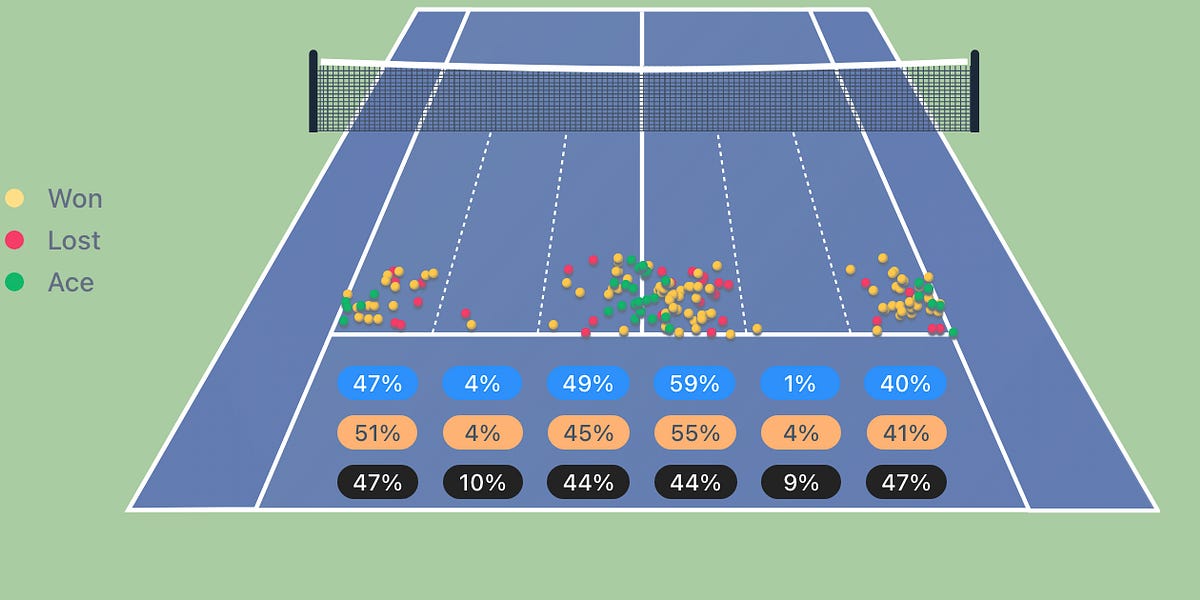
First of all, if we look at the distribution of Sinner’s first-serve placement in 2024 we get this:
I don’t have data for the 2025 Australian Open or bulk of the 2025 French Open, but Sinner’s 14 other ATP matches leading up to the 2025 US Open were similar in their distribution.
I do have some rough numbers from the 2025 Wimbledon final and 2025 US Open final — both matches against Alcaraz — and because I’m rushing this out on Saturday night you’ll have to make do with my back-of-the-envelope chart:

But this has been interesting for me: since Beijing (when Sinner first started to make noticeable technical tweaks to the motion) his deuce side first-serve distribution has become markedly more T-biased. He’s up 12% on his 2024/early 2025 average when serving deuce T: 55%!

When under pressure since the US Open, his deuce T jumps up to 59% (his 2024 number was 43%).
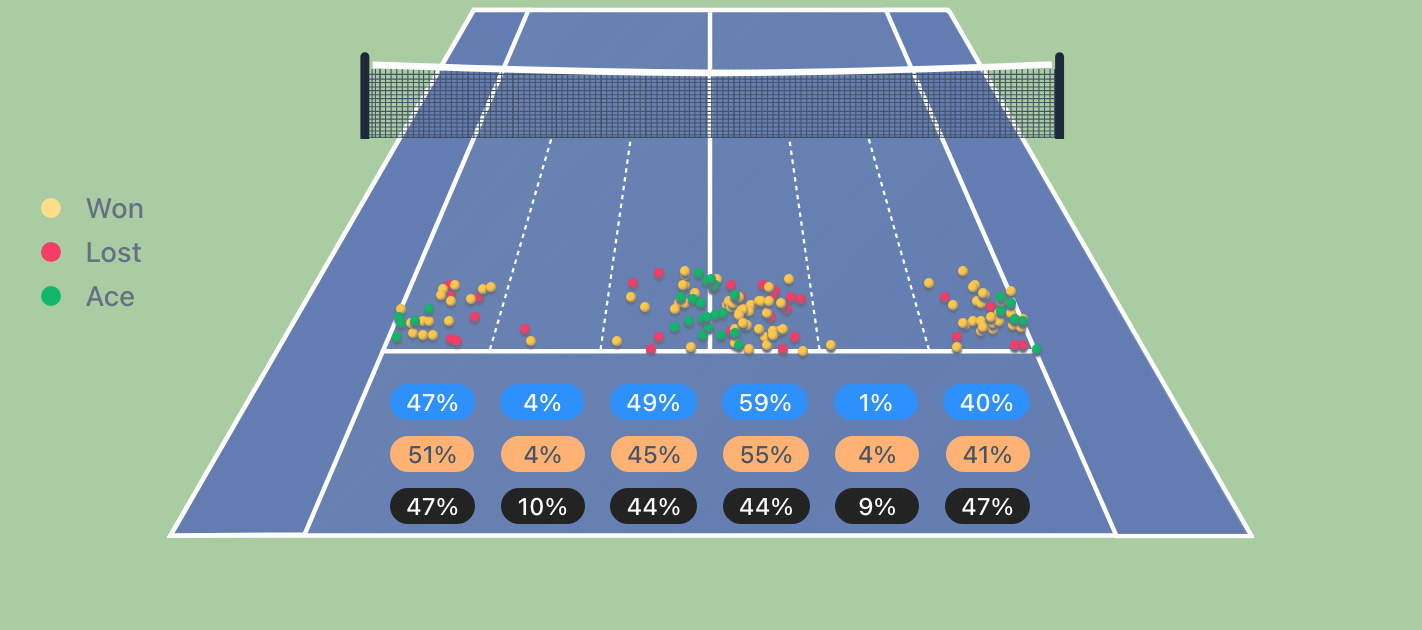
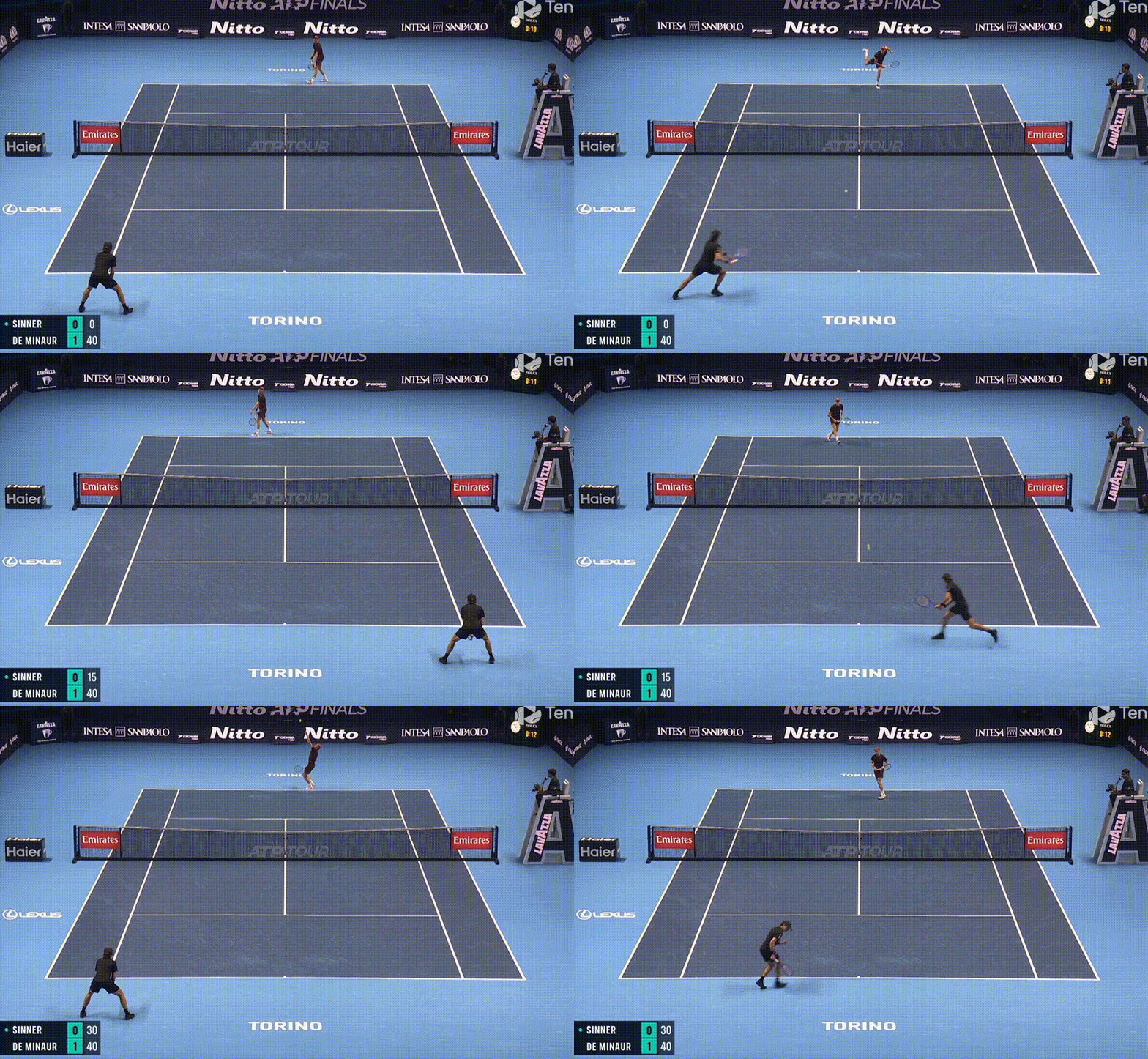
This is a huge swing in preferences. And the implication is that if Alcaraz doesn’t stand too close and tempt Sinner with the body serve, he’d be wise to lean on post-US Open Sinner serving down the T in bigger moments on both sides. It’s exactly what Sinner attempted when he got in a 0-40 hole in his opening service game against de Minaur in their semifinal:
It’s hard to know what the exact reasoning is behind this for Sinner, but the fact that his first serve percentage has markedly improved since the US Open (he’s making 68%, up from 62% in 2024) might be simple enough; Sinner wins around 20% more points when he makes a first serve compared to a second serve, and hitting serves down the T means hitting over the lower part of the net. I’m spitballing here, but given how balanced he is off both sides — that is, heavily fucking armed — perhaps the Sinner team did some quick math and figured it’s less consequential that he start the point with his opponent pulled off the court so often.
Sinner’s second serve has also become more backhand deliberate on both sides; he’s hitting far less serves into the body, but I think he might revert to that against Alcaraz when the Spaniard adopts an aggressive position.
So that’s something I’ll be keeping a close eye on. If Sinner serves as well tomorrow as he has been all week in Turin, it will be a tough ask to beat him.

But of course, if anyone can beat Sinner, in Turin, on an indoor hard court, it’s Carlos Alcaraz, and you just know the Spaniard is relishing this challenge. The way he came out against FAA in that first set was ridiculous.
Outside of that serve trend, much of their rivalry has been covered in recent pieces this year, so I won’t rehash that. But if I had to summarise some key rally points I’ll be watching for:
-
How often does Sinner pull the trigger on the backhand down the line? That shot has been instrumental in getting Alcaraz away from his ad-side forehand plays.
-
How much does Alcaraz use the backhand slice? Indoors, I think Sinner can take more risk on that reply, and I think Sinner will be looking to make a statement shot early on against that play should it come out.
-
Sinner’s forehand drop shot has been executed at a very successful rate in recent tournaments, and he hasn’t been afraid to deploy it in big moments. He nearly always plays it crosscourt from where he is standing, over the low part of the net.
-
Both guys have torched the forehand at times in this tournament. Both can win that battle tomorrow. I have no idea who will, but looking forward to finding out.
-
Sinner’s been able to get to net as often, or more often, than Alcaraz in recent matches, but the Spaniard is freakishly good at getting the ball below the net and stealing points at an alarming rate. It will be interesting to track the defensive backhand slice of Alcaraz, against Sinner’s ability to close the net before it gets too low.
Let’s hope both bring their best to cap off 2025. See you in the comments. HC