
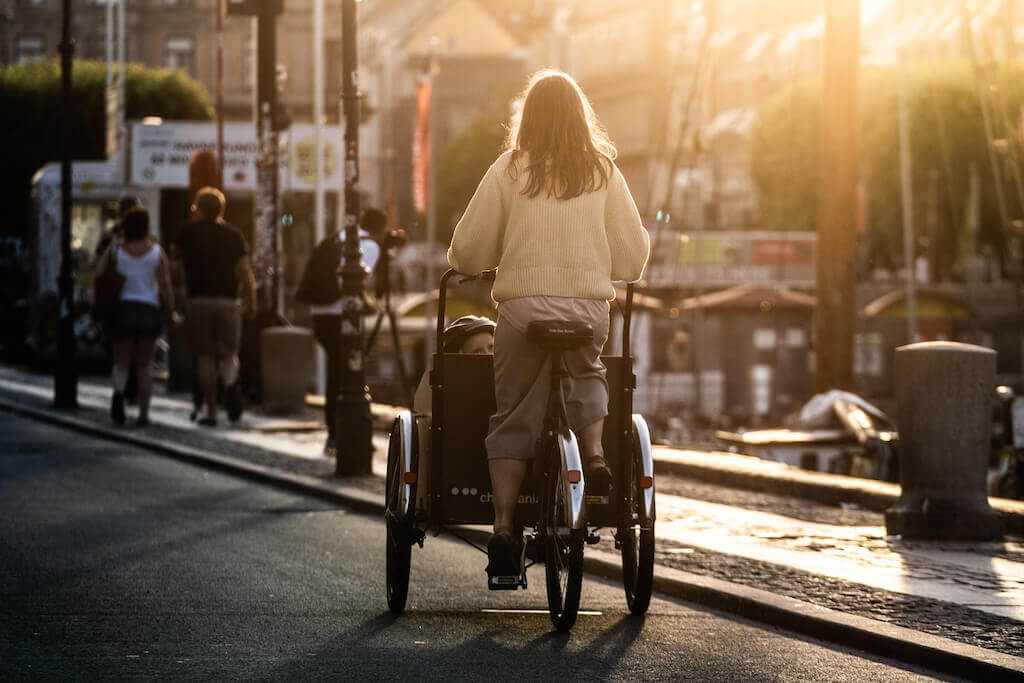
When discussing urban non-motorized transport, few cities command as much attention as Copenhagen and Amsterdam. These cycling capitals have redefined what is possible when bicycles are woven into the daily rhythms of city life. Other European cities—Berlin, Brussels, London, Paris and more—are quickly catching up, accelerating a continental shift toward pedal-powered mobility.
Yet one particular bicycle is stealing the spotlight: the cargo bike. Also known as freight or utility bikes, these human-powered (or electric-assisted) workhorses are increasingly viewed by experts as more promising for urban logistics than drones or even autonomous vehicles. Their rise suggests that despite the allure of futuristic transport technologies, the urban mobility of tomorrow—especially in older, denser cities—may rely more on human muscle than machine horsepower.
The Rise of Cargo Bikes: An Old Idea With New Purpose
Cargo bikes offer a compelling mix of advantages: they are sustainable, affordable, quiet, and capable of door-to-door service for most last-mile deliveries. Their growing popularity is part of a broader cycling renaissance that includes both traditional bicycles and e-bikes.
EU-commissioned research estimates that 60% of urban deliveries could be serviced by cargo bikes, a substantial opportunity as cities grapple with air pollution and congestion. Millennials and Gen Z consumers are pushing companies toward greener logistics solutions, and a zero-emission cargo bikeparked outside a customer’s door perfectly aligns with that expectation.
The enthusiasm is shared by policymakers. As Denmark’s former “cycling minister” Benny Engelbrecht famously stated at the 2019 opening of the DHL Copenhagen City Hub: “The bicycle can’t change the world, but it is damn close.” DHL is now one of many major logistics companies integrating cargo bikes into their delivery fleets.
Klaus Bondam, a former CEO of the Danish Cycling Federation, highlighted the enormous potential of the electric cargo bike in particular, pointing to innovative services already thriving in Copenhagen—from cycling locksmiths to cycling undertakers. Even removals in Sweden are performed by cargo bike.
Cargo bike
A Global Movement Takes Shape
In Copenhagen alone, 40,000 cargo bikes are used daily, and 26% of families with two or more children own one. In Amsterdam, 90% of cargo bikes are sold primarily for carrying children. Importantly, they are completely unisex—equally embraced by mothers and fathers.
Weight capacity is impressive: traditional cargo bikes can haul about 250 kg, while electric versions manage 350 kg with a carrying volume of roughly one cubic meter.
Although strongly associated with Scandinavia and the Netherlands, the cargo bike’s origins lie in England. Cycling inventor James Starley produced early designs in 1877, and Denmark’s iconic Long John Bicycle debuted in the 1920s.
Today, the growth is extraordinary. Germany’s Two-wheel Industry Association (ZIV) reports that electric cargo bikes have recently outsold electric cars, despite receiving far fewer subsidies. A University of Southampton study showed cargo bikes completing urban delivery routes up to 50% faster than vans.
Beyond Europe, momentum is also building”
- In Rio de Janeiro, more than 11,000 cargo bike deliveries occur daily.
- In Kigali, they double as passenger taxis and goods carriers, providing livelihoods for thousands.
- In Lagos, cargo bikes are used for waste collection.
- London has seen its daily bicycle journeys increase from under 300,000 in 2000 to more than 700,000 by 2017—a testament to the resurgence of human-powered mobility.
Enter the Rickshaw: A Mirror for the Future?
Because cargo bikes resemble traditional rickshaws in form and function, comparisons are inevitable and instructive. Rickshaws—originally invented in the 19th century and later adopted widely across Asia—were once a dominant mode of urban transport. Yet over time, they declined dramatically due to motorization, urban planning decisions, and political pressures.
Dhaka, Bangladesh, once the global rickshaw capital, offers a cautionary tale. Though rickshaws are zero-emission and move 40% of all daily trips(approximately 3.5 million rides), they occupy 60% of road space in a city where only 7% of land is allocated to roads. Despite their environmental benefits and vital role in employment, rickshaws were banned from key roads in 2019 in an attempt to combat congestion. Ironically, the ban was justified on the basis that rickshaws slow down motorized traffic—exposing deep flaws in urban planning logic that prioritizes cars over people.
Dhaka’s predicament raises an essential question: Can cities build their way out of congestion? Evidence from Los Angeles and Bangkok suggests otherwise.
A Lesson the Cargo Bike Industry Cannot Ignore
As global urbanization accelerates—70% of the world’s population will live in cities by 2050—the pressure on transport systems will intensify. Cargo bikes are emerging as a key solution, but their success depends on more than product innovation. The industry must advocate for an ecosystem that includes infrastructure, regulation, maintenance, safety standards, and cultural acceptance.
The fate of the rickshaw offers crucial insights:
- Pedal-powered transport can thrive, but
- Inadequate infrastructure, poor regulation, and social stigma can undermine it, even when it is efficient and sustainable.
Cargo bikes risk a similar plateau unless these lessons are studied and applied early—especially as the Global North becomes saturated and demand growth is expected to shift toward developing countries.
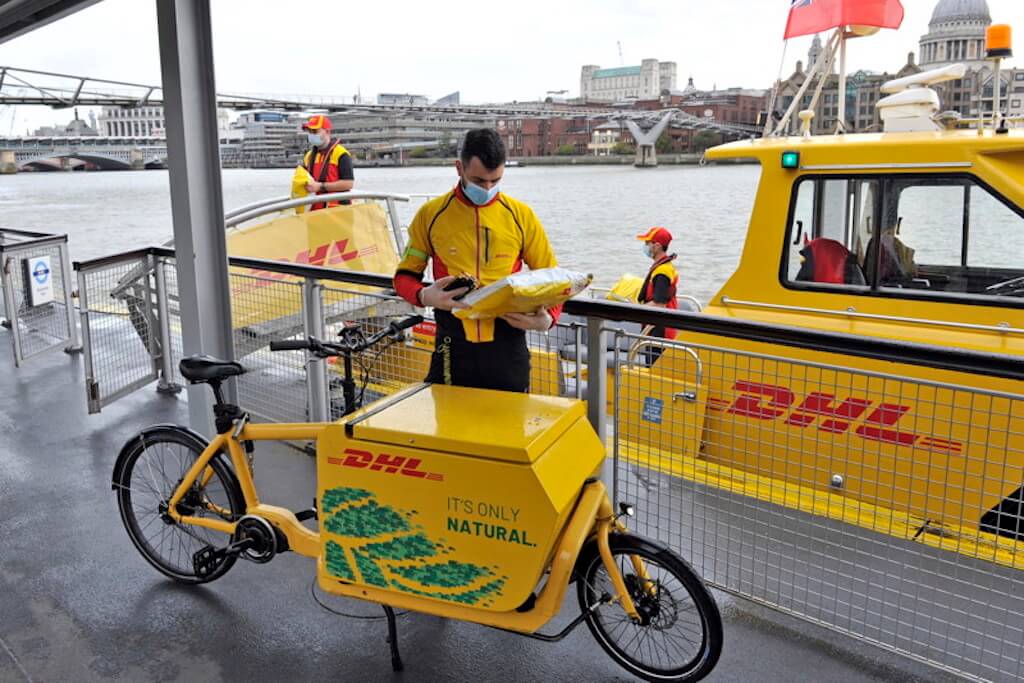
DHL cargo bike in London
Final thoughts: A 19th-Century Solution to 21st-Century Problems
Whether in Copenhagen or Kigali, London or Lagos, the cargo bike is arriving—quietly but powerfully. As cities confront the dual challenges of traffic congestion and climate change, cargo bikes offer a rare convergence of social, environmental, and practical benefits.
As Indian environmentalist Vandana Shiva remarked: “Cycling is to mobility what organic farming is to agriculture.”
Smart, sustainable, and socially inclusive cities cannot be built without bicycles—and cargo bikes will likely be at their center. The future may not hinge on replacing the rickshaw outright, but on recognizing cargo bikes as their natural evolution: a resilient, equitable, and human-scaled solution for megacities worldwide.