
METHODOLOGY
With any golf ranking list there are really only two key things – who is doing the judging and how are the doing it?
Let’s start with the ‘who’. The GOLF website lists the 115 people who sit on the panel. This was last updated in November so there might have been a few changes since then, but the make-up is relatively stable.
Of these 115 people, 85 are based in North America. 6 are in the UK, 5 are in Australia, 4 in Canada and 4 in Ireland. There is then a smattering of representation from elsewhere round the globe. It’s hard to tell from the names alone, but I think that fewer than 10 of the 115 are women.
The panel comprises people with an educated eye and wide experience of golf courses throughout the world. Some do it out of passion, others are in industry. There is healthy representation of the world’s leading course architects, their employees and their clients.
Other US-based rating panels have thousands of members who pay for the privilege of joining – often in the hope of access to courses. GOLF magazine has none of that nonsense. You need to be chosen by a committee including the editor, Ran Morrissett. founder of Golfclubatlas.com and co-contributor to the Confidential Guide. He describes the panel as a group of the people whose opinion he values most.
As for the ‘how’, again, this is a lot simpler than for other rankings. Morrissett describes it thus –
‘For the newly released 2023-24 World list, each panellist was provided a ballot that consisted of 504 courses globally. He or she was given seven months to complete it. Beside the list of courses were 11 “buckets,” or groupings. If our panellists considered a course to be among the top three in the world, they ticked that first column. If they believed the course to be among Nos. 4-10 in the world, they checked the next column, followed by 11-25, 26-50, and so on out to 250+ and even a column for remove.
Points were assigned to each bucket; to arrive at an average score for each course, we divide its aggregate score by the number of votes. From those point tallies, the courses are then ranked accordingly. It is an intentionally simple and straightforward process.’
You can read more about the methodology here.
I really like this way of doing it. Of course, it means that the make-up of the panel is even more important for this ranking than for those where more guidance and criteria are given. But the methodology has consistently produced what is widely considered to be the best listing of the world’s top courses.
DEMOGRAPHICS
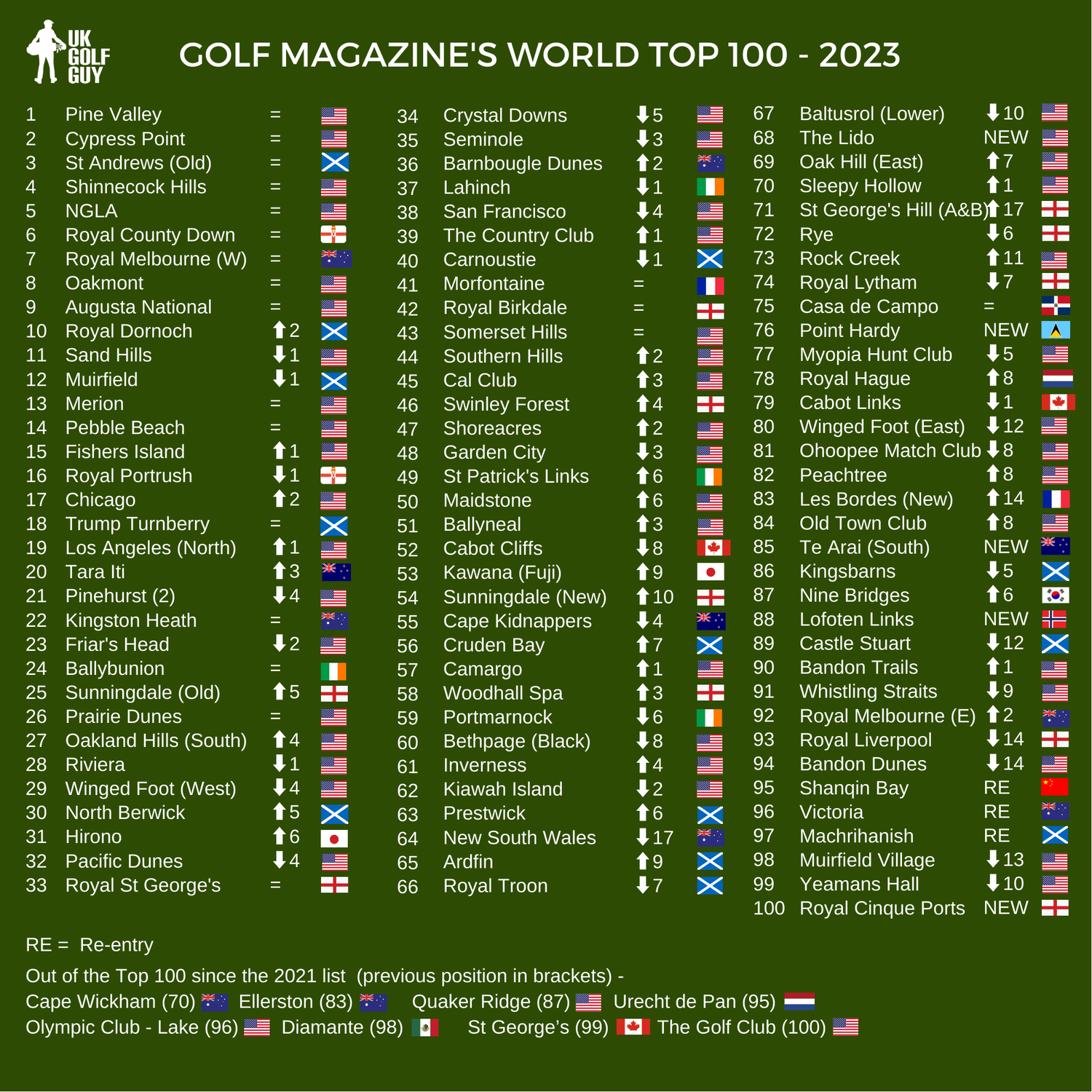
Here’s a quick look at the make-up of the 100 courses.
Geography
The US and the UK absolutely dominate the list. Throw in English-speaking Canada, Ireland, Australia and New Zealand and you’ve got 90 of the top 100!
USA – 49
UK -26
Australia – 7
Republic of Ireland – 4
New Zealand, France, Japan, Canada – 2 each
Norway, St Lucia, Dominican Republic, South Korea, Netherlands, China -1 each
Age
70 of the Top 100 courses were built before the Second World War. There is something of an architectural wasteland from that golden age until the turn of the 21st century, before a renaissance in the last twenty odd years.