
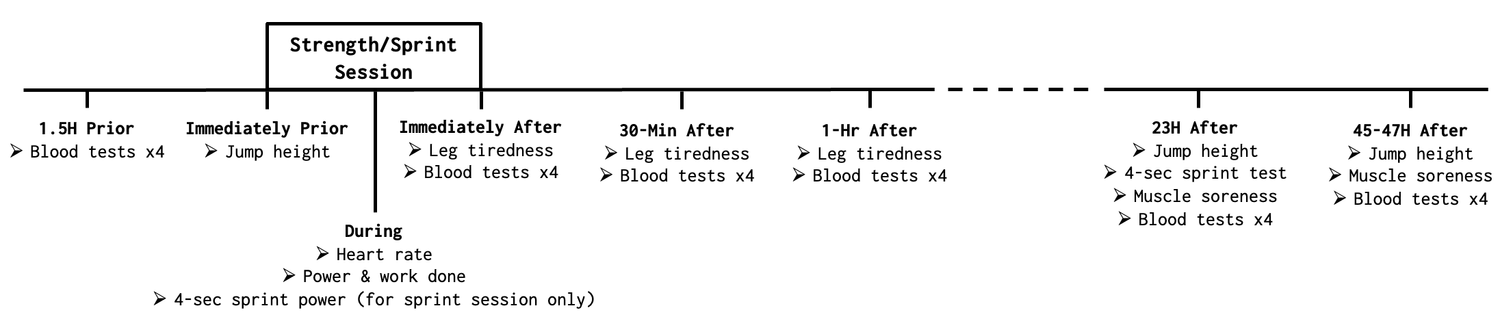
The researchers controlled for various factors including prior exercise and nutrition, and the sessions were performed in a randomised order, so that session order were performed wouldn’t cause any bias.
Key Findings
The study showed that there were notable differences in the metabolic stress response and muscle damage following the two different session types.
The key take homes are that:
1. Sprint training induces a large metabolic stress, but with a shorter stress time-course than strength training
The sprint training resulted in a much higher metabolic stress than strength training. For example, the average blood lactate concentration immediately following the session was 14.8mmol/L, compared with just 4.4mmol/L after the heavy-load strength session.
Lactate levels remained significantly elevated relative to the strength session for 1-hour after the session, but by 21 hours, there was no difference in lactate levels. The levels of human growth hormone (another indicator of metabolic stress) followed a very similar pattern.
The sprint training also resulted in almost twice the overall workload (kJ) compared with the strength training, despite both sessions being the same duration.
2. Strength training results in muscular damage with longer-lasting effects than sprint training
In contrast, the strength training resulted in much bigger perturbations in the levels of creatine kinase and myoglobin; key indicators of muscle damage. Creatine kinase was highest 21 hours after the training session, and was still significantly elevated 45-hours after the session.
The myoglobin response was shorter, and had returned back to baseline after 21 hours.
The participants also reported significantly higher muscle soreness levels 45-hours after the strength session compared with the sprint session, although the overall muscle soreness levels were not particularly high in either case (e.g. an average of 2.5/10 at 45-hours in the case of the strength session).
3. Elite-level cyclists who are familiar with regular sprint and strength training don’t experience performance detriment after these types of sessions when performed in isolation.
Interestingly, despite the clear stress responses to the training sessions, there was no decrease in maximal jump height at 21- and 47-hours after the session. This was true both for both the sprint and strength sessions.
There was also no change in 4-second sprint power.
Limitations
The study did have a number of factors that impact how we should interpret the results.
Firstly, and perhaps most obviously, the participants were all highly-trained cyclists, and therefore we can’t extrapolate all the findings of this study to less well-trained riders. Most pertinently, the study found that there was no performance detriment in response to either session, and this is unlikely to be the case in less well-trained cyclists.
Moreover, even among well-trained cyclists, we should interpret the lack of performance detriment with caution, because the participants were required to avoid any strenuous exercise over the 48-hours prior to and the 48-hours following the two training sessions. This would likely reflect a reduction in overall training load relative to the athletes’ habitual training, and might help explain why the athletes seemed to recover so well from both sessions.
Another concern surrounding the observed lack of performance impairment relates to the way performance was tested. The baseline 4-second power was determined during the sprint training session itself (which involved 8-second sprints), whereas the follow-up sprint test involved 4-sec maximal efforts. The longer efforts within the first test may have impacted 4-sec peak power, and obscured any actual performance decline.
Another limitation is that the sprint session was performed indoors on a Wattbike. Most cyclists who ride both indoors and out are acutely aware that it’s much harder to produce a truly maximal sprint indoors, and therefore the sprint training session may not have been as taxing (and thus may not have created as much training stress) as it would have if it had been performed outdoors.
A final point of note is that although the metabolic stress response as measured from levels of human growth hormone and lactate was quite short-lived, there will likely have been a longer-lasting metabolic stress caused my reduced muscle glycogen levels. We know from other research that muscle glycogen levels can be replenished within roughly 12-24-hours in most cases, and with good nutrition. Thus, in practice, recovery from the sprints session may take longer than it appears from the blood data alone.
Our Take-Aways
The main lesson to take away from this study is that different types of training session induce different types of fatigue, which follow different recovery time-courses.
This might sound obvious when written out explicitly, but it’s something that’s often overlooked.
Indeed, platforms like TrainingPeaks, which model parameters such as ‘training stress’ (TSS), chronic training load (CTL), acute training load (ATL) and training stress balance (TSB) apply a one-size-fits-all approach to fatigue.
These models assume that two sessions with the same TSS score will induce the same amount/type of fatigue and take the same amount of time to recover from, but this isn’t always correct.
Thus while these fatigue models can provide a helpful guide when planning training, by helping predict fatigue levels on a given day, the model does need to be interpreted with a lot of caution. You should draw on your past experiences of how long it usually takes you to feel recovered from a given session type, and bear this in mind when planning training.
At the end of the day, a simple subjective assessment of how your legs are feeling, how high your motivation is, and how tired you’re feeling overall can tell you a lot about your readiness to train, and we are always quick to encourage our athletes to rearrange their training and take an easier day if they are ever feeling too tired to perform a key session.