

We ask a lot from our tires. The best bicycle touring tires need to resist punctures, last for thousands of kilometres, and roll with minimal resistance.
The challenge is finding the right balance between efficiency and protection – tires with extreme puncture resistance are usually noticeably slower on the road.
In this guide, we’ll find the best bicycle touring tires using scientific test data from Radfahren magazine. We’ll begin by comparing 10 different models to show what’s available, but only five truly stand out once rolling resistance, puncture protection, and price are taken into account.
Let’s get into it!
Why High-Quality Bicycle Touring Tires Are So Important
I consider tires to be one of the three most important components on a trouble-free touring bike, alongside strong rims and durable racks. Once you’ve fitted these three, most of your bike touring worries practically disappear.
Almost every rider experiences punctures on a tour, but choosing the right tires can make them virtually vanish. In fact, I wouldn’t be surprised if any of the tires recommended here end up being the best upgrade you’ve ever made on your bike!
Beyond puncture resistance, these tires tend to outlast almost anything else you’ve used. A minimum of 10,000 km is realistic, and 20,000 km isn’t unusual.
You may even find yourself riding faster for the same effort. That means covering more ground each day, or conserving energy for activities off the bike.
Let’s now dive into the data behind this ranking. There’s a table below comparing the best bicycle touring tires, so don’t worry – you won’t need to commit to memory any of these numbers.
The Data Behind The Best Bicycle Touring Tires
Rolling Resistance Test
| Touring Tire | Rolling Resistance | Difference Per Tire |
|---|---|---|
| Schwalbe G-One Overland 365 | 15 Watts | Best Performer |
| Schwalbe Green Marathon | 17 Watts | 2W More Resistance |
| WTB Venture SG2 | 18 Watts | 3W More Resistance |
| Schwalbe Marathon E-Plus | 19 Watts | 4W More Resistance |
| Teravail Cannonball | 19 Watts | 4W More Resistance |
| Continental Contact Plus | 20 Watts | 5W More Resistance |
| CST Platinum-E | 23 Watts | 8W More Resistance |
| Scalato Mondano S | 23 Watts | 8W More Resistance |
| Condura Velt XR | 27 Watts | 12W More Resistance |
| Michelin City Street | 33 Watts | 18W More Resistance |
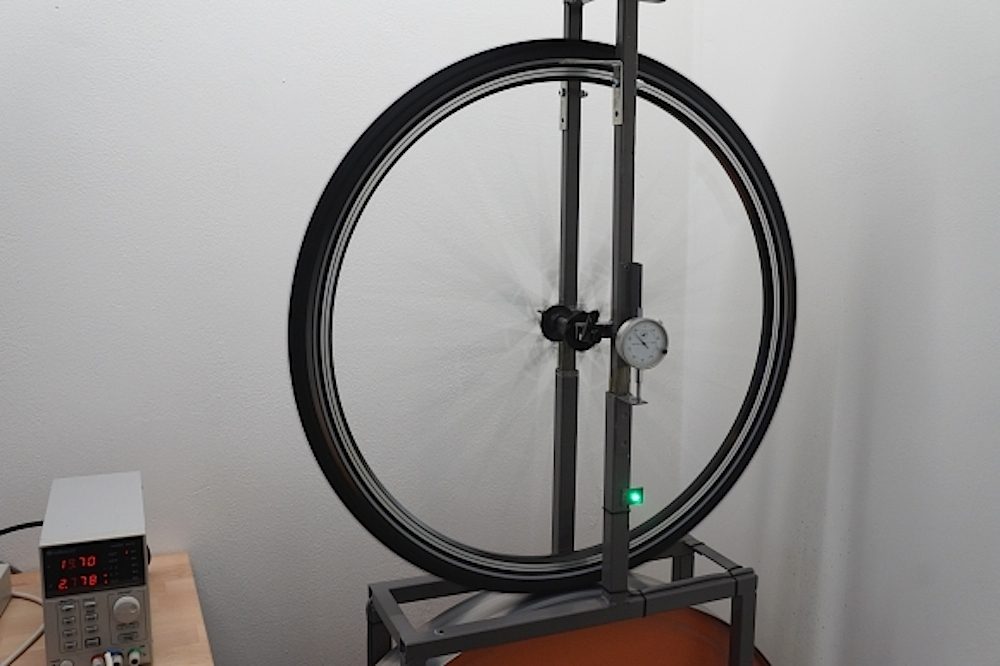
The first test measured rolling resistance using a metal drum roller. Rolling resistance indicates how much of your pedalling effort is absorbed by the tires as you ride. In this test, lighter tires with less heavy-duty puncture protection typically perform the best.
To put the rolling resistance numbers into context, most people pedal along at around 100 to 200 watts, so rolling resistance can take anywhere between 15 to 45% of your pedal power! It’s obviously in your best interest to minimise this.
The Schwalbe G-One Overland 365 was the clear winner here, producing just 15 watts of drag per tire with the Schwalbe Green Marathon and WTB Venture GS2 not far behind.
Further down the spectrum, the Cannonball and the heavy-duty Marathon E-Plus showed a slightly higher rolling resistance, with roughly 4 watts more drag per tire than the G-One.
The slowest tire in the test was the Michelin City Street, which consumed 18 extra watts per tire – a difference that would be very noticeable on the road and likely represent a significant share of your total power output.
Let’s hope the slowest-rolling tires make up for their higher rolling resistance with strong puncture protection…
Sharp Puncture Test
| Touring Tire | Sharp Puncture Force | Difference |
|---|---|---|
| Schwalbe Marathon E-Plus | 203 N | Best Performer |
| Michelin City Street | 200 N | 1% Less Force |
| CST Platinum-E | 200 N | 1% Less Force |
| Schwalbe Green Marathon | 170 N | 16% Less Force |
| Condura Velt XR | 170 N | 16% Less Force |
| Continental Contact Plus | 150 N | 26% Less Force |
| Scalato Mondano S | 150 N | 26% Less Force |
| Schwalbe G-One Overland 365 | 150 N | 26% Less Force |
| WTB Venture SG2 | 150 N | 26% Less Force |
| Teravail Cannonball | 150 N | 26% Less Force |
This is the first of four puncture tests. It evaluates resistance to sharp objects such as thorns, nails, and wire by forcing a 1.5 mm thick pointed metal spike through the tire tread.
In the sharp puncture test, the slower rolling tires often proved to be the most resistant. The Marathon E-Plus led the field, closely followed by the Michelin City and Platinum-E. The Green Marathon and Velt XR ranked in the next grouping, puncturing at roughly 16% lower force.

At the lowest end of the results were five tire models, all of which all required 26% less force to puncture. It’s worth noting, however, that the G-One, Venture SG2 and Cannonball are tubeless tires that require liquid sealant. Unlike tube-type tires, the sealant can flow to the puncture site and seal the hole.
Blunt Puncture Test
| Touring Tire | Blunt Puncture Force | Difference |
|---|---|---|
| Schwalbe Marathon E-Plus | 815 N | Best Performer |
| Schwalbe G-One Overland 365 | 810 N | 1% Less Force |
| Michelin City Street | 760 N | 7% Less Force |
| Scalato Mondano S | 730 N | 10% Less Force |
| CST Platinum-E | 710 N | 13% Less Force |
| Schwalbe Green Marathon | 690 N | 15% Less Force |
| Teravail Cannonball | 680 N | 17% Less Force |
| Condura Velt XR | 670 N | 18% Less Force |
| WTB Venture SG2 | 670 N | 18% Less Force |
| Continental Contact Plus | 610 N | 25% Less Force |
The second test uses a 5 mm wide flat-tipped screwdriver to simulate impacts from sharp-edged glass shards or stones. I expected the results to closely mirror the sharp puncture test, but one tire climbed significantly in the rankings.
Once again, the Schwalbe Marathon E-Plus came out on top…

The surprise result, however, was the Schwalbe G-One Overland 365, which almost matched the E-Plus in blunt puncture resistance. This performance is likely due to its RaceGuard fabric layer and reinforced carcass, which appear to be especially effective at blocking blunt impacts.
The Michelin City, Mondano S, Platinum-E, and Green Marathon followed in behind, requiring roughly 7 to 15% less force to puncture.
Down at the bottom, we find some of the tubeless gravel tires, and the Continental Contact Plus, which required 25% less force to puncture.
Sidewall Puncture Test
| Touring Tire | Sidewall Puncture Force | Difference |
|---|---|---|
| Schwalbe G-One Overland 365 | 570 N | Best Performer |
| Schwalbe Marathon E-Plus | 510 N | 11% Less Force |
| Michelin City Street | 500 N | 12% Less Force |
| Condura Velt XR | 490 N | 16% Less Force |
| Schwalbe Green Marathon | 430 N | 25% Less Force |
| Teravail Cannonball | 430 N | 25% Less Force |
| Continental Contact Plus | 420 N | 26% Less Force |
| CST Platinum-E | 420 N | 26% Less Force |
| Scalato Mondano S | 400 N | 30% Less Force |
| WTB Venture SG2 | 400 N | 30% Less Force |
The third test measured sidewall resistance, simulating impacts from sharp edges, large stones, or branches on the trail. Once again, I was surprised to see that the faster-rolling tires performed exceptionally well in this area, in some cases outperforming the heavy-duty models.
The Schwalbe G-One Overland stood out with particularly robust sidewalls, followed by the Marathon E-Plus, making these two particularly difficult to slash.
The weakest sidewall performance came from the Contact Plus, Platinum-E and Mondano S, which required 25 to 30% less force to puncture compared to the top-performing G-One Overland.
Guillotine Puncture Test
| Touring Tires | Guillotine Puncture Height | Difference |
|---|---|---|
| Schwalbe Marathon E-Plus | 625 mm | Best Performer |
| Schwalbe Green Marathon | 590 mm | 6% Less Height |
| Scalato Mondano S | 580 mm | 7% Less Height |
| Michelin City Street | 570 mm | 9% Less Height |
| CST Platinum-E | 570 mm | 9% Less Height |
| Continental Contact Plus | 460 mm | 26% Less Height |
| Condura Velt XR | 410 mm | 34% Less Height |
| Schwalbe G-One Overland 365 | 390 mm | 38% Less Height |
| Teravail Cannonball | 380 mm | 38% Less Height |
| WTB Venture SG2 | 340 mm | 45% Less Height |
Rad Fahren also conducted a pinch-flat test, often referred to as a “snake bite” test. This simulates the blunt-edge impacts caused by obstacles such as curbs, manhole covers, or exposed roots.
For the test, all tires were mounted on a steel rim with a 25 mm internal width and inflated to 2.5 bar for tires wider than 45 mm, and 3.0 bar for narrower tires. A 14 kg weight was then dropped onto the tire-wheel system from progressively greater heights until the tire deflated.
The Marathon E-Plus performed exceptionally well in this test, with the Green Marathon, Mondano S, Michelin CIty and Platinum-E not far behind. With sufficiently high tire pressure, pinch flats should be largely eliminated when using any of these tires.

The G-One Overland, Cannonball and Venture SG2 performed less well in this scenario. However, they are also tubeless tires, so the sealant inside them should help prevent pinch flats from occurring in real-world riding.
Ok, let’s now take out five underperforming tires and compare the best bicycle touring tires side-by-side.
The Best Bicycle Touring Tires
| Rolling Resistance | Guillotine Puncture | Sharp Puncture | Blunt Puncture | Sidewall Puncture | |
|---|---|---|---|---|---|
| Schwalbe Marathon E-Plus | 4W More Resistance | Most Resistant | Most Resistant | Most Resistant | 11% Less Force |
| Schwalbe Green Marathon | 2W More Resistance | 6% Less Height | 16% Less Force | 15% Less Force | 26% Less Force |
| CST Platinum E | 8W More Resistance | 9% Less Height | 1% Less Force | 13% Less Force | 26% Less Force |
| Continental Contact Plus | 5W More Resistance | 26% Less Height | 26% Less Force | 25% Less Force | 26% Less Force |
| Schwalbe G-One Overland 365 | Fastest | 38% Less Height |
27% Less Force |
1% Less Force |
Most Resistant |
I’ve now narrowed the list to the top five bicycle touring tires based on the scientific data. You can now easily compare them in the table above.
These tires combine outstanding puncture resistance with very low rolling resistance. Four out of five have rolling resistance of 20 watts or less (a level considered excellent), which means they’ll keep you moving quickly.
From here, it’s a matter of deciding whether you’re willing to trade a bit of puncture protection for slightly more speed. Or compromising on both to save a bit of money.
Schwalbe Marathon E-Plus

The Schwalbe Marathon E-Plus ($60 on Amazon) is the best bicycle touring tire for puncture resistance.
In laboratory testing, these tube tires required the highest puncture force in almost every test, finishing second in the only test it didn’t top. Fit a tire like this and your touring bike will be about as close to puncture-proof as it gets.
What’s most surprising is how well it rolls. At just four extra watts per tire, the Marathon E-Plus ranks among the fastest options here, proving that extreme puncture protection doesn’t have to come with a major speed penalty.
The trade-off is weight. It’s the heaviest tire in this group – roughly twice the mass of the G-One. But if avoiding punctures is your top priority, this is the touring tire to choose.
One important thing to note is that you can get the equivalent tire to this with knobs if you need off-road traction. The model is called the Schwalbe Marathon Plus MTB, and it uses the same puncture protection layers.
You can find the Schwalbe Marathon E-Plus on Amazon in different widths:
700C x 37 mm HERE, 40 mm HERE, and 50 mm HERE
Schwalbe Green Marathon

The Schwalbe Green Marathon ($43 on Amazon) is the best bicycle touring tire for speed.
For many riders, it’s an easy trade-off to give up roughly 5 to 15% of puncture protection in exchange for about 2 watts lower rolling resistance and a 300-gram weight saving per tire (compared with the Marathon E-Plus).
Thanks to its SmartGuard protection layer, reinforced by two additional layers of RaceGuard fabric, the Green Marathon delivers impressive puncture resistance relative to both its weight and rolling speed.
These tires have outperformed much of the competition for years, and Schwalbe claims performance has improved further since introducing recycled rubber in the Green Marathon version.
For riders running tubes and who care about speed, this is by far the best choice.
You can find the Schwalbe Green Marathon on Amazon in different widths:
700C x 38 mm HERE, 42 mm HERE, and 45 mm HERE
26″ x 1.25″ HERE, 1.50″ HERE, 1.75″ HERE, and 2.00″ HERE
27.5″ x 1.65″ HERE, 2.15″ HERE, and 2.35″ HERE
CST Platinum-E

The CST Platinum-E (€24) is the best budget-friendly bicycle touring tire, often 30–50% cheaper than other top touring options.
Despite the low price, they sacrifice very little in puncture protection. In testing, they typically came within 10% of the Marathon E-Plus for puncture resistance and frequently outperformed the Green Marathon across multiple tests.
The main drawback is rolling resistance. The Platinum-E is around 6 watts slower than the Green Marathon and about 4 watts slower than the superb Marathon E-Plus.
Even so, several other touring tires were noticeably slower while offering only marginally better puncture protection, meaning the CST Platinum-E still offers excellent performance, especially when its price is taken into account.
Continental Contact Plus

The Continental Contact Plus ($61 on Amazon) is the best bicycle touring tire for availability. While it doesn’t lead in puncture resistance or rolling efficiency, it performs consistently well across the board.
What really makes it a great choice is availability. I’ve seen the Contact Plus in bike shops across many countries, whereas brands like Schwalbe and CST can be difficult to find outside higher-income regions.
If you’re touring and need a reliable replacement on the road, this is a fast-rolling, reasonably puncture-resistant option that’s a bit easier to source around the world.
You can find the Continental Contact Plus on Amazon in different widths:
700C x 35 mm HERE, 40mm HERE, 42 mm HERE, and 47 mm HERE
26″ x 1.75″ HERE
27.5″: 1.65″ HERE
Schwalbe G-One Overland 365

The Schwalbe G-One Overland 365 ($63 on Amazon) is the best bicycle touring tire for speed.
These tubeless-ready tires use a lightweight construction to bring the weight down to just 600 grams – far lighter than the 900 to 1200 grams common for touring tires.
What’s especially impressive is its puncture resistance relative to its weight. It performed strongly in blunt puncture testing and even topped the rankings for sidewall protection!
It’s also important to remember that this is a tubeless tire. When paired with liquid sealant, punctures are often sealed instantly as the sealant flows to the hole. That alone arguably makes it one of the most puncture-resistant options here, provided you’re happy to refresh the sealant every four months or so.
The compromise comes in durability. You can expect a lifespan of roughly 7,000 to 8,000 km, compared with 10,000 to 15,000 km for the heavy-duty touring tires that use tubes listed above.
You can find the Schwalbe G-One Overland 365 on Amazon in different widths:
700C x 40 mm HERE, 45 mm HERE, and 50 mm HERE
Summary
The Schwalbe Marathon E-Plus is the most puncture-resistant touring tire for use with tubes. And despite having top-tier puncture protection, it’s 19-watt rolling resistance is very reasonable, especially when you compare it to other tires with similar levels of protection.
The Schwalbe Green Marathon sacrifices a small amount of puncture resistance in exchange for lower rolling resistance. A pair is roughly 600 grams lighter than the E-Plus and typically costs less too. This will be the touring tire of choice for those chasing a bit more speed.
If you’re on a tighter budget, the CST Platinum-E is a strong alternative. It delivers puncture resistance similar to the Green Marathon, with the trade-off being higher rolling resistance – around a 6-watt penalty per tire.
If you need to source a replacement while travelling, the Continental Contact Plus is worth seeking out. It’s more widely available globally than Schwalbe or CST and still offers a fast rolling speed and decent puncture protection.
Finally, the Schwalbe G-One Overland 365 is the fastest-rolling tire in this group. With a tubeless setup, it’s highly puncture-resistant, exceptionally lightweight, and features the most puncture-resistant sidewalls of all the tires tested.
