
Home Blog Blog Article In Search of A Smarter Pitch Count
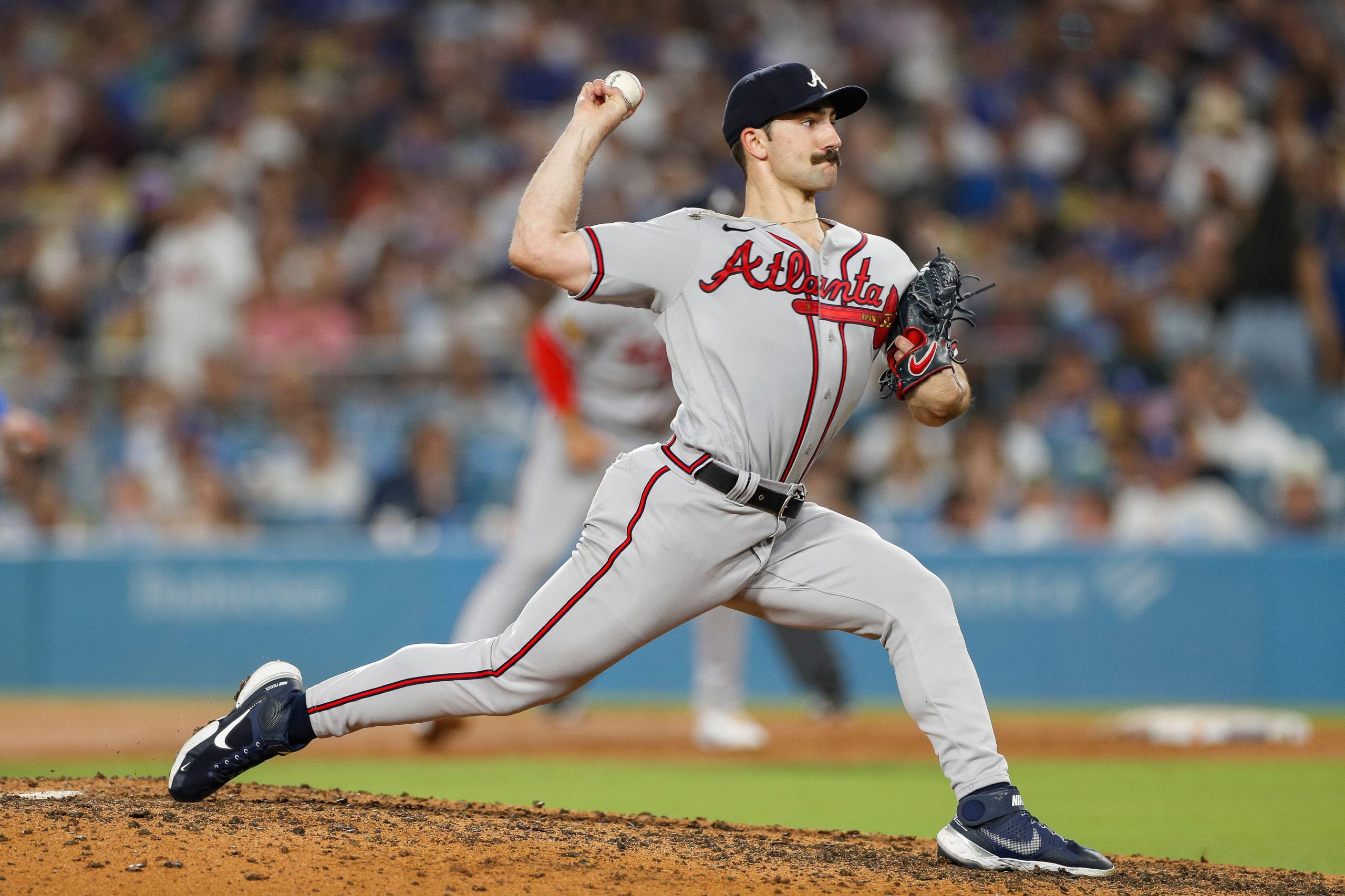
The defeatist nature surrounding the discussion of pitchers and injury rates and workloads irks Strider.
For the Braves’ star, the industry is not even close to understanding the issue because it lacks the information, the data, to leverage for answers.
“Another aspect of the injury conversation that the industry is not thinking about is when guys are moving well, when we have someone who has demonstrated elite health and the ability to recover, we need to understand as best we can what their workload is like, what their movement pattern is like,” Strider said.
Josh Hejka is a Driveline researcher and professional pitcher. He said in-game pitch counts and innings are the only quantifiable data some organizations are collecting at all.
With the Phillies and Mets during the last two seasons, Hejka wore PULSE and collected as much data as he could. He wanted to understand more about his workload and how to best train to handle the demands of being a relief pitcher.
He wishes more pitchers – ideally, every pitcher – wore the device.
“It’s a little frustrating because when a pitcher gets hurt there’s a lot of speculation regarding the cause of the injury. Is it mechanics or X or Y or Z? But for most guys we don’t even know what their throwing workload looked like over the last two or three months,” Hejka said. “We only know their in-game throwing. We don’t know what they were doing when they weren’t on the mound.
“How do we accurately make a judgment as to the root cause of their injuries? And how do we prevent the injuries of others if we don’t even have a baseline level of information about what they’re doing?”
Beyond elevated injury rates, since 2005, starting pitchers have combined for a 102.6 ERA-, compared to a 102.5 ERA- mark from 1988-2004. This year? A 101 ERA-. Relative performance remains unchanged even in the age of pitch limits.
And fewer innings from starters means teams are getting to the soft underbelly of their staffs – middle relievers – more often.
Just as data from the radar guns and spin-tracking tech fueled the velocity and pitch design boom, the industry needs a data avalanche on the workload side to better understand how to optimize performance and keep players healthy.
Those 80-pitch, less-than-five inning outings are placing pitchers deeper into that pit of fatigue.
I asked Williams last month about that outing and his recovery afterward.
In his following start, he allowed four runs over three innings, but he noted he also had two extra days of rest between the Aug. 6 and Aug. 13 starts. He said he felt unaffected by the previous workload.
“I had an extra massage so that helped,” Williams said. “Kept the same shoulder routine, forearm routine. It was all the same.”
Williams hasn’t worn any wearable tech since he was in A ball with the Guardians. He explained he largely bases his between-starts work based on feel. What he does do is curtail his throwing volume between starts once he gets in season, moving from 30-pitch bullpens in the spring to 15-pitch bullpens in the summer.
Over the last year, I surveyed other pitchers about how they respond to volume spread over longer or shorter periods within a game,
Said Cincinnati Reds pitcher Zack Littell: “I definitely don’t respond as well to 100 over four as opposed to 100 over seven.”
Littell said pitching quick, clean innings is like driving on an open highway. There is less physical and mental stress.
But high-stress innings? They hit different.
“It’s like driving in traffic,” Littell said. “You have to be aware of what’s around you. What guys don’t you want to get beat by? Is there a guy on first? Would you rather pitch around this guy? Or try to get a double play? I am going to try and punch out, say, Shohei Ohtani, because I don’t want to allow anything in play?”
Royals starter Seth Lugo was the last pitcher, prior to Williams and Verlander to exceed 120 pitches in an outing back on Sept. 26, 2023.
“Twenty years ago, everyone was throwing 135 pitches. That we cannot do it now? Well, we are not weaker,” Lugo said. “Yes, the roster size has changed over the years, and we are getting to relievers sooner. That’s definitely changed. But I am not the biggest fan of pitch counts.”
Part of today’s reduced workloads are tied to the third-time-through-the-order penalty. Even elite starters with deep enough arsenals to navigate the lineup three times are rarely permitted by their clubs to pitch deep into games. But perhaps they should be. It could be a great advantage.
Lugo has pitched in various roles in his career. He believes there are different styles of pitching that should be placed in different workload buckets.
“A guy who is out there throwing as hard as he can every pitch, throwing max effort, yeah, they are going to fatigue faster,” he said. “But think of guys that have been around for longer. More old school. You are going to save your best bullets for when you are in a jam … If I am throwing 89-91 (mph) all game, I am not really getting tired. I am playing catch.
“So, I never liked the idea that we picked 100 (pitches) because it’s three digits, and that’s when you should be tired, or come out of a game. It’s ridiculous. Just because it’s a round numerical value? We apply that to our bodies? It’s pretty insane to me.”
But whether coming off higher-stress or lower-stress outings, most pitchers do not alter their between-start routines. One reason? Few are measuring something like Fatigue Units.
While most throwing programs count total throws, Driveline has argued it is the quantifiable stress of throws that matter, not raw counts, and that building up greater chronic workloads – which is the throwing habits over a long period of time – is important in allowing pitchers to handle the demands of a full season.
PULSE measures that ability to properly build and manage a chronic workload.
Tampa Bay pitcher Ryan Pepiot faces a new challenge this year: he’s occasionally pitching in afternoon games in the heat and humidity summer-time Florida as the Rays are housed in a temporary minor league home in Tampa.
He’s lost between 8-10 pounds during such outings, he said. He says the strength and conditioning staff does an excellent job of recharging him. Still, he’s fatigued differently from such a start, but the game is not well equipped to measure it. Like so many pitchers, he’s not using wearables to monitor his between-start throwing workload.
While the data-driven Rays rarely allow their starters to face the lineup a third time, Rays pitching coach Kyle Snyder doubts the industry’s approach to limiting work is promoting better arm health.
“For me, it’s done nothing for us, the 100-pitch counts, limiting that. Injuries have done nothing but skyrocket,” Snyder said. “There’s still more that we don’t know than we do know.”
We need more data, to lead to more answers.
What is also striking is how little individualization there is regarding pro workloads.
We know that MLB starters are less frequently reaching 100 pitches. There were only 635 outings of at least 100 pitches last year, just the second time in the pitch-level data era that pitchers combined to fail to reach 700 in a season. This season is in line for another significant decline, a pace for 579 outings. That is down from a record number of 2,414 set in 2014.
But one threshold all starting pitchers generally still meet in a game is 80 pitches.
MLB pitchers are on pace for 3,806 outings of at least 80 pitches, about 90% of all starts, which isn’t that far off from the 1998 mark – 4,057 games – the first year of 30 teams in MLB.
Almost every arm is essentially allotted the same range of pitches in a given start, 80 to 100, regardless of skill, mechanical efficiency, or physical traits.
Driveline trainer Brett Cook said there can be great differences in how different pitchers can get to similar mph readings.
“Something we found to be interesting is just the relationship between arm speed and velocity,” Cook said. “I’ve had pitchers whose arm speed on PULSE will get up to 1200 or 1300 rpms, but they have only an upper-80s fastball. Then I’ve seen other pitchers whose arm speed is at 950-1000 rpms, but they have a mid-90s fastball.
“I think the question right then and there can become ‘Is the pitcher with the mid 90s fastball that much more efficient with their mechanics that they don’t have to use their arm fast, or they are not using their arm as much and truly not placing as much stress per mph on their arm? And if so, potentially, it gives a little more leeway to have more individualized workload prescriptions for their program.”
Right now, the programming, the workloads, are often one-size-fits all in much of professional baseball.
At Driveline, the focus is on individualized training. Solutions and progress begin there.
“We need to transition more to a world where we are giving athletes with PULSE, with radar gun feedback as well, very precise metrics to hit within a session,” Cook said. “That’s how strength and conditioning has been for years. You place weight on a bar, and you track how much you (lift). You might try and add five pounds to the bar week over week.”
There’s a lot to learn, and PULSE can help.
The industry can benefit from smarter pitch counts, and more individualized throwing regimens. That quest begins data collection and learning from it. It begins with PULSE.