
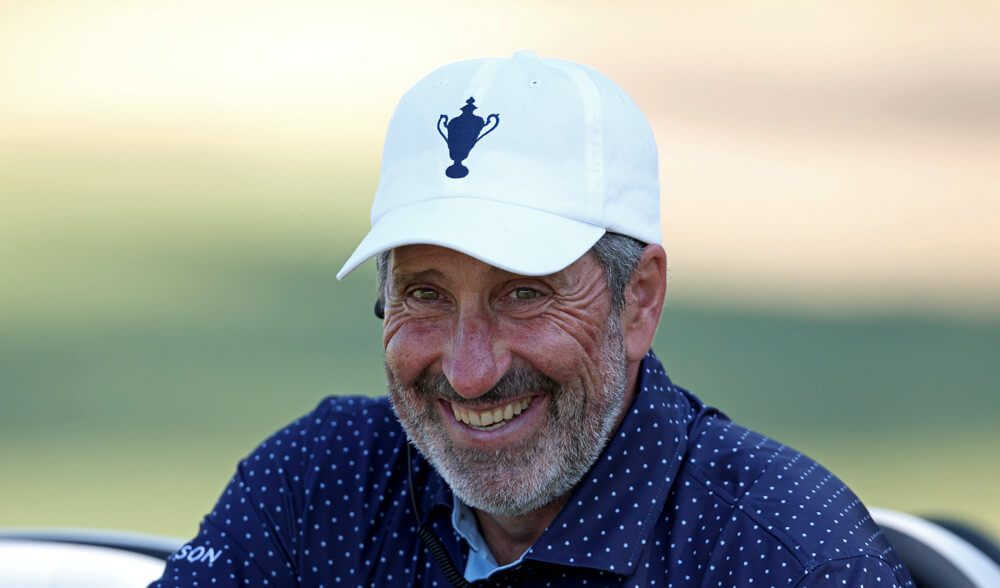
“Money was never my goal when I started playing golf. My goal was to do the best I could and to see where I could reach in competitive situations.”
— José María Olazábal
In an individual sport, Olazábal is notable for being couth not uncouth, cautious not grasping, modest not immodest, a singular man as solid as the Rock of Gibraltar that is visible from Valderrama. You would trust your grandson or granddaughter to his care with complete equanimity.
His favourite subject at school was physics. He speaks five languages which are, in order of importance, Basque (his native language), Spanish, English, French and Italian. He bore the vicissitudes of a debilitating injury that kept him pretty much off his feet and entirely out of the game from September 1995 to March 1997 with dignity. (First diagnosed as rheumatoid arthritis, it was later discovered to be nerve pressure in his lower back.) And then when he returned to the game, he won the third tournament he played in. “I hadn’t played for a year and a half and when I won I cried,” he remembered.
“Money is of no importance to José Maria,” Sergio Gomez, his late manager, once said. “He did a clinic for junior golfers and his fee was a sausage sandwich and a glass of milk. He returned a large cheque from a sponsor saying he had not played all season therefore he could not accept their money. He knows he will not carry his money to his grave. Other golfers have their objective in life to build a financial empire or gain respectability through the supposed power you get through money. He could do many company days at $50,000 or $60,000 but he does not want to. That is not the way José Maria thinks about things. For him money is an instrument not a target.”
Olazábal nods on hearing Gomez’s words. “I have enough money to do a normal life,” he said. “Money helps you in many ways nowadays where everything is money, money, money. Money was never my goal when I started playing golf. My goal was to do the best I could and to see where I could reach in competitive situations. For me it was more important to win more than the amount of money that victory brought me. I got that from my father. My mother had a different view. She knew you had to have enough money to get things, to put food on the table.”
His life and his lifestyle, though not ascetic, is certainly modest. It would be completely out of character for him to live in a large house, or two, have several cars, a yacht perhaps and live a life that shrieks “look at me. I have money.” It is almost unnecessary to say he eschews ostentatiousness.
“There are people who invest my money for me and when the year is done I hope the money that I have saved increases a little bit,” Olazábal said. “My nephew is turning professional and obviously if he needs anything he is going to have it. My niece is studying and I pay part of her studies. I try to provide for family members. If they need anything I try to help them with money. My hobbies? I go shooting with my father so I invest some money in a property [southwest of and 45 minutes from Madrid]. It’s not extremely big but it is big enough for the two of us to shoot some wood pigeon, rabbit, hares.”
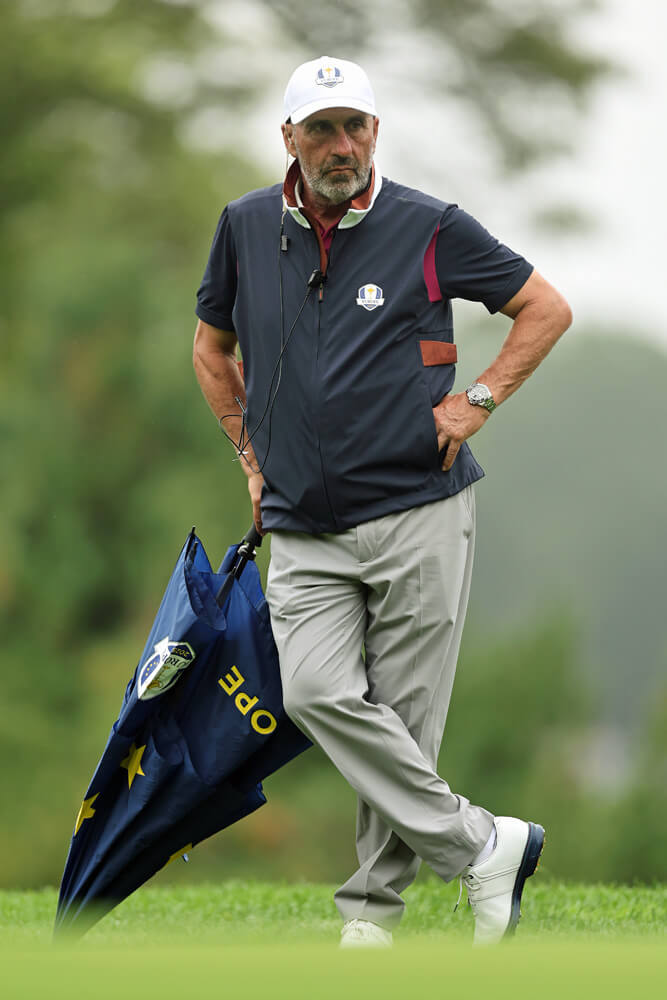
He drives a car, provided by BMW, big enough to contain his golf clubs, the dogs, guns and cartridges and the luggage when he and his father go hunting. His watch is not flashy. You would not expect it to be. Many of the clothes he wears are provided for him by his sponsors. The most expensive thing he has ever spent money on was building the house that he shares with his parents, mother Julia, 77, and father Gaspar, 82.
It is there, in this big house, barely 25 years old, where chickens still roam around outside because his parents have always had chickens, that the family gathers for Sunday lunch. “We love fish, hake or salmon,” he said. “There is often a chicken in the oven with a little sauce, garlic. It is simple food but we enjoy it.
“My mother cooks, I don’t cook,” he added, laughing at the improbability of that. “I am terrible. I have been spoiled in that regard. To be honest my mum and sister cook really well. I travel a lot and every time I came home my mum had cooked and so she is the one who takes care of that.”
More words from Gomez. “José Maria is egalitarian, socially aware, intensely loyal and quite private, a good hearer [meaning listener].”
“Listening is something I learned through time,” Olazábal explained. “I still believe I am a little shy person but not as I used to be. Through time I have learned that you can be better prepared if you are a good listener, take time to think about it, and make a picture of the situation. I would always listen, listen and listen and try to think about what I had heard and what I was told and then I would make an opinion. That is my mother’s influence.”
On this morning at Valderrama, Olazábal talked as he walked, not about golf but about affairs in the world. “I started travelling when I was 15 years old. I travelled around Europe, to the States, to different parts of the world and I was always treated well. I really appreciate that. Ideally I would love a world with no frontiers where everybody would understand each other and live together in peace. At the end of the day we are all human beings. It does not matter what colour you are. Just try to be good to the guy next to you and I think the world would be a better place. That would be like a utopia.
“Now we are in a bad situation,” he continued, a frown on his face. “I don’t like what I see. I am starting to believe that politicians don’t do what is needed to improve the lives of regular people. I think they are more interested in staying in power. The whole society, or at least the politicians, are extremely polarised. It is either black or white. There is nothing in between. In the past they used to sit down and try to get agreements but nowadays it is what I say or nothing at all.
“I don’t mind if they come from the left [of the political spectrum] or the right. What they do has to reach people in general. In the macro economy Spain is doing great but if you go down to a normal life a lot of families are struggling to reach the end of the month. You have Ukraine, Russia, Israel, Palestine.” He exhaled loudly. “I don’t know. Sometimes listening to the news is just depressing.”
“I have lived a wonderful life. … I consider myself a very fortunate guy. I am at peace with myself and will always be in debt to this game.”
— José María Olazábal
After their nine holes, the two men went to a local restaurant in the town where Quiros was born, a few miles from Valderrama. It was the sort of restaurant the locals knew was good and tourists wouldn’t give a second glance. Welcomed by the owner, they quickly made their way to their favourite table and ordered plates of Scolymus hispanicus (oyster cardillo). As they ate, they talked.
Quiros began a conversation about the difficulties for the wife of a travelling professional golfer. “You’re away for three weeks, then you come home for a few days and then you’re off again,” he said. “Your wife has to be very understanding to put up with that.”
At that Olazábal nodded. “I agree. I never wanted to put a woman through that.”
Olazábal’s face, topped by a thatch of luxuriant black hair, looks oval in shape but when he laughs, he throws his head back, and his face splits wide open as an ear-to-ear smile appears on it.
“I don’t complain that I should have won more major championships,” Olazábal said. “I am very proud of it. Who knows? If I had a better technique maybe I wouldn’t have had that fighting spirit. Every time I look in the mirror and say ‘did I give my best?’ I say ‘yes.’ I cannot ask for more.
“I have lived a wonderful life. I have had my health issues, true, but I have dedicated my life to a game that I love, a game that has given me everything that I have now.” At this his voice cracks and tears form in his eyes. “I consider myself a very fortunate guy. I am at peace with myself and will always be in debt to this game.”
And how the game is in debt to him, too, this proud Spaniard, who is such a singular man. Gracias Chema, gracias.