
By Yushi Wang
Note: The following article is an opinion piece. The opinions expressed in this article are the author’s, based on her attendance of the recent event, DreamHack Stockholm, and do not necessarily reflect the views of The Esports Advocate.
At DreamHack Stockholm, the Overwatch Champions Series (OWCS) returned to Sweden for the second consecutive year, marking the renewed partnership between Blizzard, and ESL FACEIT Group (EFG) subsidiary DreamHack.
The 2025 World Finals also marked a milestone moment as the event where Blizzard publicly unveiled its 2026 roadmap for OWCS, outlining structural updates, regional plans, and competitive priorities for the next season.
In this article, I take a closer look at the onsite atmosphere, Blizzard’s leadership insights, and post-match conversations with the competing players to see where this reboot is taking Overwatch esports next.
(Editor’s note: It is important to highlight that DreamHack is a division of EFG, which is owned by Savvy Games Group, a company fully funded by the Saudi Arabian government’s sovereign wealth fund, the Public Investment Fund, or PIF. Please see the end of this article on why some may find this association problematic.)
On-site Observations: What Stockholm Revealed
At this year’s DreamHack Stockholm, the OWCS Grand Finals stage was easily the most eye-catching area in the entire venue. From the movement of the crowd to the atmosphere, seating, and nearby brand booths, you can clearly feel the new energy created by OWCS and DreamHack.
Crowd Flow, Atmosphere, and Stage Size
The entrance flow on the first day was congested. Many people who needed to pick up badges on-site still hadn’t entered even after the first match had started. From the second day on, things improved a lot. Audiences with badges could walk straight in, and waiting times became much shorter.
The venue atmosphere achieves a balance between a “gaming festival” and an “esports event” vibe. The Swedish Prime Minister also attended on the first day, drawing extra attention from local audiences and media, which added a sense of ceremony to the event.
This year, the OWCS stage moved to a larger area inside Stockholmsmässan, and the seating capacity nearly doubled. The front sections filled up early, and on finals day almost every seat in every section was taken. While other games at the event such as The Finals’ first Major, DreamHack Knockout Stockholm 2025, and the Brawl Stars World Finals, also had packed crowds, the OWCS stage stood out in its own way. It was clearly larger, carried more energy, and was noticeably more popular than last year.
Brand Area: Sponsor Composition and Audience Movement
The brand area surrounding OWCS featured a mix of gaming and electronics partners, and there was also an apparent increase in non-gaming brands. These included:
- Red Bull (drinks and racing)
- Lamborghini (car display and simulator)
- The Swedish Police
- Local yogurt brand Arla
- Local school esports leagues
Last year, there was already a non-endemic booth promoting the 2025 Ice Hockey World Championship, and this year the exhibition area showed a similar pattern, with an even broader mix of partners.
In terms of venue layout, the OWCS stage sat in the core area of DreamHack. Its visual presence and natural crowd flow made it the most noticeable part of the entire festival. The heavy traffic around the main stage also pushed more visitors toward the surrounding areas. Even though the closest section was filled with privately rented handmade and indie stalls, many OWCS attendees continued deeper into DreamHack’s official partner zone. This created a clear “event-driven outward flow” effect across the venue.
Event Sponsorship and On-Site Commercial Display
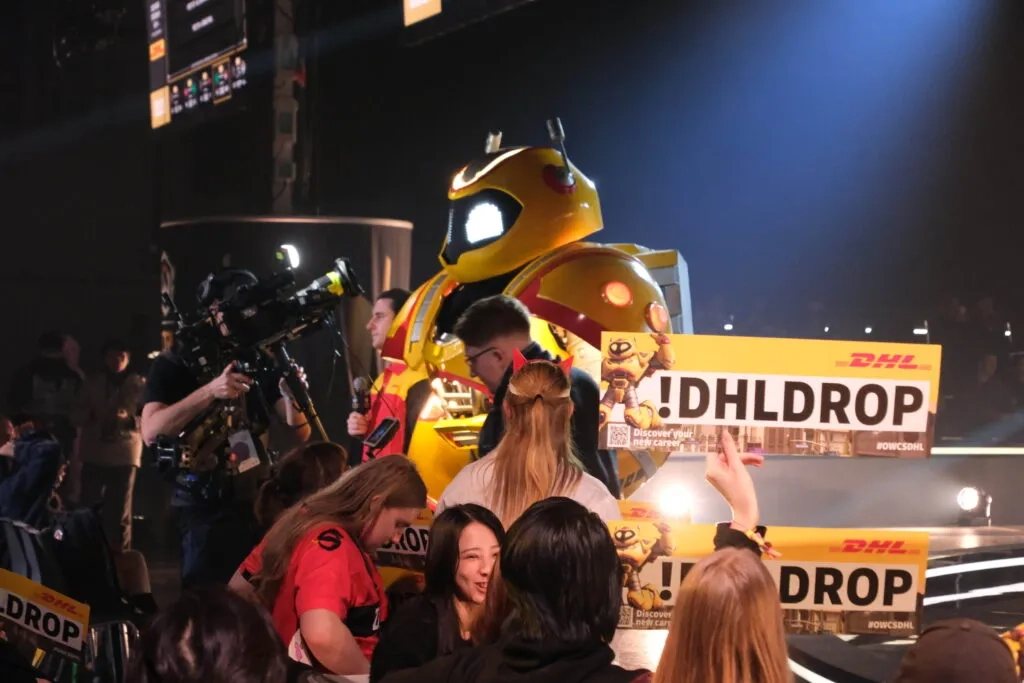
OWCS presented a more polished commercial presence this year, both on-site and in-game. The most noticeable example was DHL’s in-game title-style integration, using in-map billboards directly tied to the broadcast. DHL also provided a robot interaction segment during the mid-show break. This part was fully shown on the international Twitch stream, though not all of it appeared on the Chinese stream.
In terms of merchandise, the organizers released an esports-themed Legendary Pack ahead of the event. Still, only a small selection of Overwatch-related items were available on-site, and there were no other Overwatch esports products. It shows that physical merchandise was not a major focus for this event.
Audience Composition and On-Site Engagement
The makeup of the crowd was mostly local Swedish attendees, with many others travelling from across Europe. There were roughly 100 Chinese fans and 50 Korean fans on-site to support the players from their own countries. One noteworthy feature this year was a dedicated seating area for DreamHack visitors who did not hold OWCS tickets but still wanted to watch the matches. This section was about 50% full during the first two days and became packed entirely on the final day, showing that OWCS has a strong appeal even among non-core fans.
As the event moved into match days, especially the finals, the lines around the stage grew significantly longer. Many spectators arrived very early in the morning to secure front-row spots. The atmosphere and on-site participation were very high.
Blizzard’s Sean Miller on OWCS and the Future of Overwatch Esports
At this year’s DreamHack Stockholm, OWCS once again cooperated with the gaming festival, drawing players and industry attention from around the world. During a break between matches, I spoke with Sean Miller, Blizzard’s Overwatch esports director from the OWL era through OWCS. In the interview, he discussed China’s return to the ecosystem, the structural shift from OWL to OWCS, Blizzard’s partnership with ESL/EFG, and the deeper integration between esports content and the game itself.
1. China’s Return to the OWCS Ecosystem
Speaking about OWCS’s return to the Chinese market, Miller made it clear that the Hangzhou stop “really did exceed our expectations of viewership.” Despite the Chinese server being offline for two years, the Hangzhou event sold out within 15 minutes, and both the on-site and online audience turnout went far beyond what the esports team had projected.
Miller noted that Weibo Gaming (WBG)’s strong performance in Hangzhou stood out as well. The team reached the key stages of the event and demonstrated that Chinese professional players still possess world-class competitiveness, even after the server shutdown period. This aligns with a broader global trend of the competitive gap between regions narrowing.
With the 2026 season plan revealed during the World Finals, Blizzard confirmed that China will join the OWCS Partner Program as an independent region. Miller explained that this means Chinese teams will receive the complete set of in-game entitlements enjoyed by global Partner Teams, including team skins, cosmetics, and revenue-sharing mechanisms. He also mentioned that the Overwatch World Cup will return in 2026, with Team China earning a direct seed into the group stage. Blizzard will work with NetEase to select the teams entering the Partner Program ahead of the new season and to ensure a smooth approval process before major events begin.
Beyond the pro level, China’s collegiate esports system and regional Tier-2 development pathway will also be implemented in the new season, aiming to provide a stable growth structure for emerging players. Miller specifically highlighted Team CC’s participation in the event, noting that their competitive improvement reflects the broader rise of the Chinese scene.
2. From OWL to OWCS: The Shift From Franchising to an Open-Circuit System
As Overwatch esports moved from the Overwatch League (OWL) era to OWCS, “accessibility” became the central, defining concept of the transition. Miller emphasized repeatedly that OWCS aims to make participation easier, the path more apparent, and the competition more discoverable and understandable for players, teams, and viewers. This shift aims to reshape not only the league’s structure but also its commercial, cultural, and ecosystem direction.
“OWL built a unique city-based franchise system powered by heavy investment, but the high barriers and concentrated structure also limited mobility within the ecosystem. In contrast, OWCS was designed from day one around a more direct vision: ‘If you’re good, all you need to do is sign up with a team.’ The open-qualifier model allows top-ranked players to enter the competitive pipeline immediately, and we have already seen teams rise from absolute zero to international offline events.”
For Miller, this almost barrier-free path restores flexibility and movement to the ecosystem and brings Overwatch competition back to its core principle: skill decides everything.
Under OWL’s centralized system, the development of the secondary league was relatively limited. But in the OWCS era, Tier 2 has become a crucial part of the ecosystem. Miller pointed out that the significant improvement of EMEA teams has already proved the competitive value of a strong Tier 2 structure. Today, the FACEIT leagues in NA and EU are even performing better than the old Overwatch Contenders system, which he described as extremely exciting. A continuous, stable tiered structure not only raises the overall competitive level but also forms the foundation of OWCS’s long-term commercial sustainability.
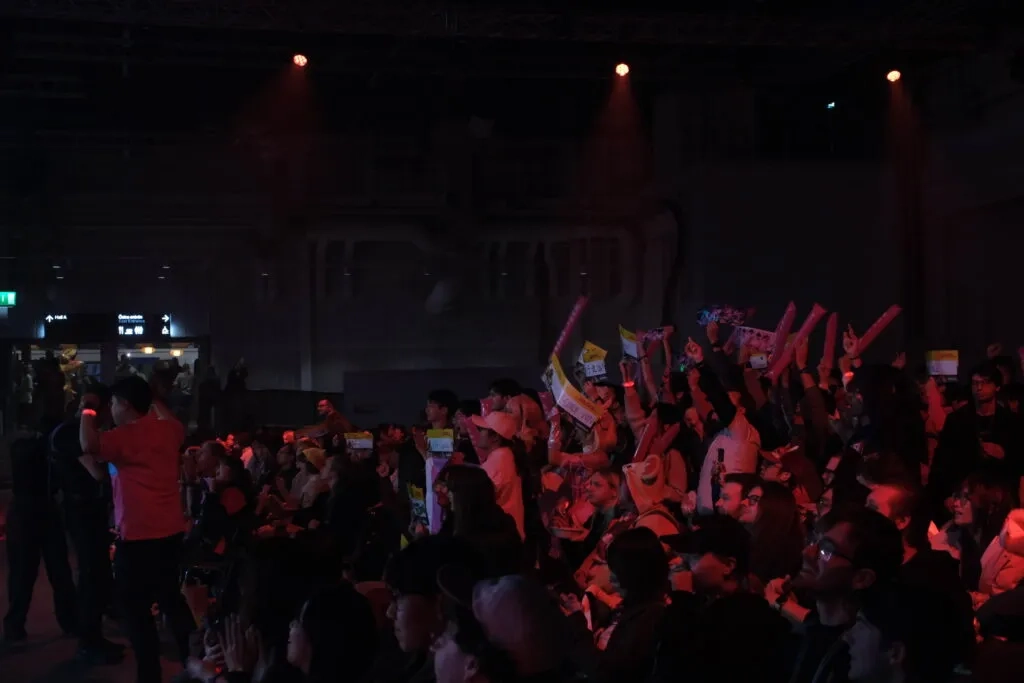
Although OWCS no longer uses city-based branding, Miller does not believe that community identity has weakened. Instead, the World Finals showcased a more organic and influential regional fan culture; the thunderous French supporters for Team PEPS, the cheers for Korean and Chinese teams, and the renewed passion from Southern U.S. fans for the Dallas Fuel. These organically formed identities, emerging directly from the community, feel more authentic and sustainable than the old “city labels.” OWCS encourages teams to continue building their own cultural identities, allowing fandom to grow naturally once again.
3. EFG’s Role and DreamHack Integration
I could see both on-site and on the broadcast that OWCS production this year operated at a very high standard level. Miller praised the stage design and credited it to Blizzard’s partner, EFG. Since OWCS announced its return in January 2024, EFG has served as a third-party partner, providing full tournament support and a deep understanding of Overwatch esports’ needs and details. One crucial step EFG has taken is continuously integrating OWCS into the DreamHack festival, which Miller said makes Overwatch esports feel connected to the global esports ecosystem once again. He is very pleased with this partnership and expects it to continue.
Over the past two years of collaboration with DreamHack Stockholm, Overwatch esports has also achieved a long-term goal: turning the competition into a celebration of the entire game. Miller highlighted that at DreamHack, fans could meet creators face-to-face, talk with character cosplayers, speak with developers on-site, meet the voice actor of the new hero Vendetta at a meet-and-greet, and visit a photo booth featuring a model of Vendetta’s sword. At the same time, the action on the main stage remained intense and entertaining. DreamHack’s platform brings all of these experiences together, making OWCS not just a tournament but a complete community-driven celebration of the game.
4. Connecting Gameplay with the Esports Ecosystem
Lastly, I asked Miller about the connection between the game and its esports ecosystem. Compared with the OWL era, OWCS not only retains the team skin program but also introduces esports-related in-game missions during the season. Players can earn tokens by completing daily tasks or participating in match predictions, and then use those tokens to purchase esports cosmetics.
After I mentioned a few potential ideas for future games with esports collaboration, Miller said they were all great directions to pursue. He believes the purpose of esports should be to extend the game experience itself. Under that philosophy, Blizzard has already explored many approaches, such as China’s dedicated esports hub, team skins paired with crowdfunding mechanisms, and DHL’s in-game billboard integration. He added that more of these initiatives are planned for the future, to make esports an effective and natural part of the overall game ecosystem.
Across the conversation, Miller’s message was clear: Overwatch Esports is entering a phase of renewed stability, global expansion, and structural maturity.
OWCS in 2026 will be Blizzard’s attempt to build a sustainable, open, globally connected competitive ecosystem that reflects how today’s Overwatch community plays, watches, and evolves.
Voices From the Stage: Post-Match Reflections from the Players
Beyond the competition itself and the more systematic observations of the tournament, this event also offered an opportunity to re-examine the current state of players. I interviewed several former OWL players who remain highly active on the OWCS stage; Huang “Leave” Xin, Xu “Guxue” Qiulin, Kim “Shu” Jin-seo, Lee “LIP” Jae-won, Choi “Hanbin” Han-been, and Kim “Proper” Dong-hyun, and I also spoke with members of the newly crowned champions, Twisted Minds, during the post-match mixed zone. Through these conversations, I heard first-hand perspectives on the matches, the format, and the players’ own development paths.
In my conversation with WBG players Huang “Leave” Xin, Xu “Guxue” Qiulin, I could clearly sense his concerns regarding the Chinese Overwatch region. According to Blizzard’s newly announced 2026 plans, China will only officially join as one of the four major regions next season. As a result, this first year of entering OWCS has been challenging. The players said they miss the OWL era, when they could face teams from every region throughout the regular season, and when there were simply more matches — and therefore more opportunities. By contrast, OWCS hosts only a few major international events each year in which Chinese teams can compete against other regions. They also pointed out the broader struggles faced by Chinese teams: the lack of sponsorships, the fact that many players are essentially paying out of pocket to compete, and the difficulty of sustaining a stable income. Only a small number of players are able or willing to keep going under these conditions. Because of this, they believe the Chinese Overwatch scene is still in a recovery phase, working to close the competitive gap left by the complete absence of tournaments in 2024.
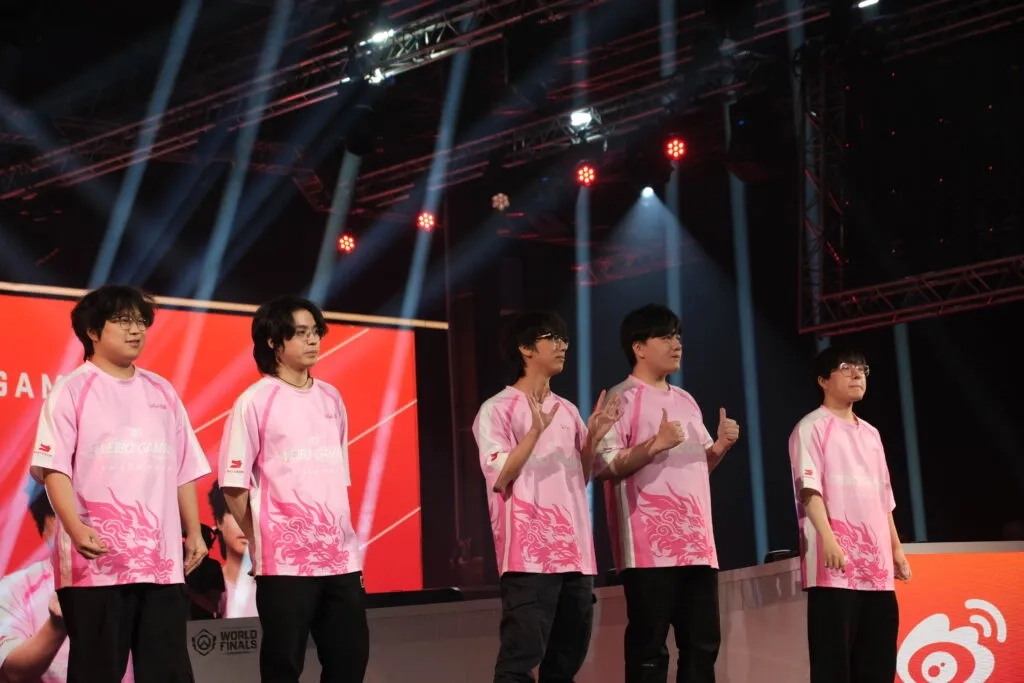
Starting in 2026, Chinese teams will stand on the same footing as other regions in terms of rules, schedules, and qualification pathways, rather than entering international events only through wildcards or special invitations. This kind of structural parity may become a crucial step in revitalizing the ecosystem. Once officially included, Chinese teams will have a more stable year-round competitive path, more opportunities to face top international opponents, and a stronger foundation to attract sponsors, clubs, and investors back into the scene. While the gap created by the absence of competition in 2024 will still take time to close, the implementation of the 2026 system gives the Chinese Overwatch community a clear direction forward. After a long period of stagnation, this may mark the beginning of a new chapter for the region.
Similar concerns about regional competition also appeared implicitly in our interview with Kim “Shu” Jin-seo, Lee “LIP” Jae-won from Crazy Raccoon, a Japanese team competing in the Korea region. After an unexpected loss to Al Qadsiah, I spoke with the team, and they admitted they did not anticipate losing and felt they were unable to match the opponent’s pace at all. On the other hand, both Lip and Shu gave very positive comments about OWCS’s partnership with DreamHack, saying it is an excellent opportunity for audiences unfamiliar with Overwatch to become interested in the game. Since the interview took place before the 2026 Announcement, I also asked about their expectations for next year’s Overwatch esports. They said they hoped for more tournaments and a larger overall competitive schedule.
As this year’s tournament concludes, the circumstances, challenges, and aspirations presented by players from different regions and backgrounds together paint a vivid picture of a competitive ecosystem in transition. From the rebuilding efforts in China, to Korean teams redefining their place on the international stage, to EMEA’s newfound confidence after claiming the championship, the 2025 season stands as both a continuation of the past and the threshold of a new era. The players are ready. The ecosystem is being reshaped. Whether OWCS can turn this moment into a true restart is something I will continue to watch closely.
As the winners’ mixed-zone interviews ended and I walked out of the backstage area with the players of Twisted Minds, the members of Crazy Raccoon who were waiting on the other side of the corridor, stopped in their tracks and applauded them warmly.
In that brief moment, it felt as if I was seeing the future that OWCS hopes to build: not a scene dominated by a single region, nor a structure driven purely by investment pressures, but a space where teams from the different areas and cultures can compete earnestly and communicate with genuine respect on the same stage.
Editor’s Note: EFG is a wholly owned subsidiary of Savvy Games Group, which is owned by the Saudi government, and its Chairman of the Board is the country’s de facto ruler, HRH Crown Prince MBS. EFG is home to tournament organizer ESL, competition platform FACEIT, and esports and gaming festival company DreamHack.
Projects backed or owned by the Saudi Arabian government, such as DreamHack are frequently criticized for helping the government engage in so-called “sports washing,” or using various forms of entertainment to cover up its record on human rights, women’s rights, LGBTQ+ rights, its mistreatment (and executions of) journalists, military actions in Yemen, and more. These and other criticisms have been highlighted by international watchdog groups such as Amnesty International and Human Rights Watch.