
Around 2010, the NCAA told Final Four host cities to generally expect an economic boost between $70 and $200 million. Last year, Glendale, Arizona was told that it could make $270 million dollars in economic impact from hosting a Final Four event in 2024. This year, some groups mentioned the possibility of the state making an impact between $250-$300 million from the Final Four. Others believed it was possibly for the state to bring in over $400 million dollars. The 2017 Final Four in Arizona brought the state $324.5 million dollars of economic benefits. Where did that money go? To install “new floors and facilities…for kids that are at risk and that need just that extra adult support in their life”. How nice. Ultimately, the 2023 Super Bowl set the record by bringing in $1.3 billion dollars of economic impact to Arizona. Those numbers seem big and ridiculous. They are preposterous.
Here is the thing. None of these numbers fit with reality. Not one. There is a reason that the guesses are so wildly all over the place. Remember how the Super Bowl brought $1.3 billion to Arizona? The Staff Director of that study admitted that the $1.3 billion was “not a good number” to use in public. The city of Phoenix released tax-collecting data showing that they “barely broke even” after the Super Bowl. Wait a minute. Are you telling me that after the NFL was given millions of taxpayer dollars for absurd and secret demands that the NFL requires all Super Bowl host cities to agree to, the net gain for Phoenix was what? The sales tax gain for the Super Bowl brought in just $2.3 million.
“The NFL will control and receive 100% of the revenues from all ticket sales, including ticket sales in all suites. In addition, the NFL must have exclusive access to all club seats.” That means revenue will be shared between the league teams, and not simply directed to the host city. — “Super Bowl Doesn’t Always Produce Super-Sized Revenues For Local Taxpayers” Forbes, 02/11/23
Academic research continues to be released showing that any city that hosts the Super Bowl will see no tangible economic impact on the economy. One professor from North Carolina State wrote an article several weeks ago reminding the public that the NFL forces cities to keep quiet on exactly how much taxpayer money goes to NFL requests during Super Bowl week. Then the cities need to hire high-cost security, emergency services and other services for Super Bowl week. When you combine that with the NFL essentially pocketing all the money from every source of revenue, Super Bowl week tends to be a successful time for NFL wallets. Who loses during this week? Well, as two more North Carolina State researches have talked about, massive events like the Super Bowl can lead to socioeconomic issues like gentrification and higher property taxes.
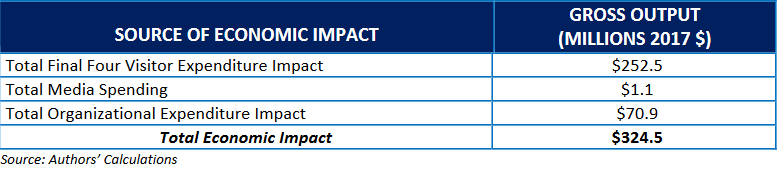
Yet, official government business is done using these fantasy numbers. When Phoenix needed help putting the Final Four together, they asked other cities in the state and cited the $324.5 dollars of economic benefit in that report. As one sports economist from Utah wrote, these numbers are “not possible…That’s not how that works”.
“Even if the 1 billion were true — and it’s not — the economies are in the hundreds of billions of dollars so it wouldn’t show up in the overall data anyways…It’s too small of a business to make any kind of impact like that on the economy” — Professor Dave Berri of Southern Utah University, 12News, 04/03/24
How much of that “tremendous growth” did Glendale see thanks to the Final Four games? According to the State Press, Glendale “won’t break even from hosting (the) Final Four” nor does the city expect to “benefit from hosting the games”.
“From a pure economic benefit to the city of Glendale, we probably will end up spending more money than we would ever get back in sales tax or hotel tax revenue…So it’s not for the city of Glendale. This is not a moneymaker by any stretch…We’re happy to do it, but we won’t come anywhere close to that kind of revenue showing back up in terms of our tax collection” — Glendale city manager Kevin Phelps, State Press, 04/01/24

This wouldn’t be the first time that Glendale struggled to stay financially afloat during a big sports event. After the 2015 Super Bowl, some claimed that local areas saw over $700 million in economic benefits. However, Glendale admitted to losing between $579,000 and $1.2 million. Even today, we continue to see states enacting tax breaks to bring the NCAA Final Four to town. These same cities follow the same playbook as the rest. Play up the economic benefits being brought to town, tout the millions coming in thanks to tourists, and then “explicitly or implicitly justify the cost of building the arena or stadium in question”.
Ok, maybe the city won’t see a lot of money, but surely the merchants around the city will, right? Sadly, they “won’t see a big benefit” either. Thankfully, the same people who previously promised that a Final Four would bring in trillions of dollars in economic impact, are “already declaring this Final Four a winner”…even though the “economic impact numbers aren’t in yet”. Works for me!