
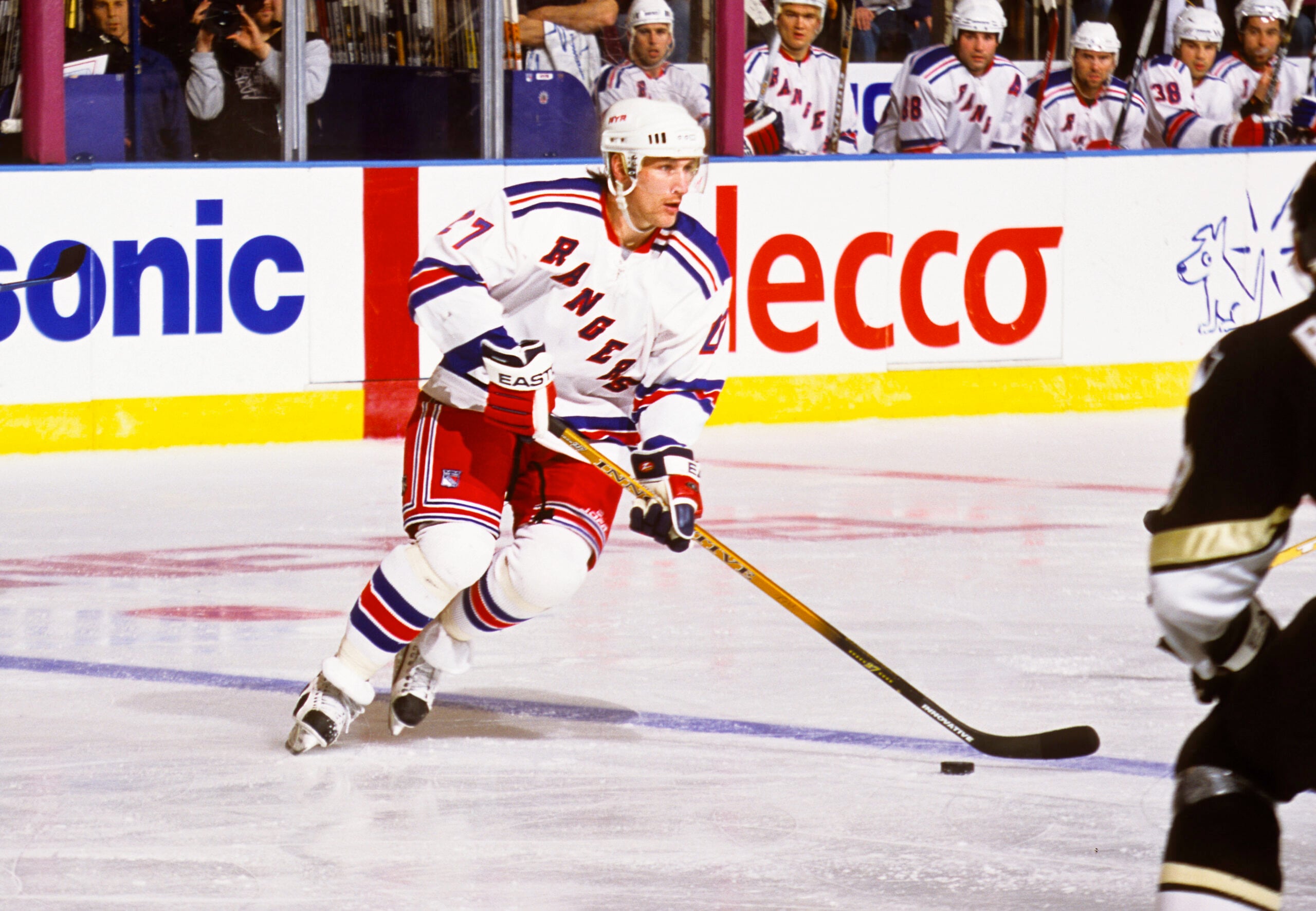
What do you get when you combine elite, world-class stickhandling, a lethal wrist shot, size, and deceptive speed, but mix it with a player who insists on doing things his own way? You get Alexei Kovalev: one of the most gifted wingers in New York Rangers history, one of the NHL’s great “enigmas”, and one of the first Russian-born players to leave a permanent mark on the league.
If you are willing and able to support neuroblastoma research, a rare type of childhood cancer, please do so by clicking here to donate. BSB will be presenting the MVP Awards for both Play Like A Pro Charity Games at MSG this coming Monday. A $500 donation has been made to Band of Parents.
The Rangers selected Alexei Kovalev 15th overall in the 1991 NHL Draft, making him the first Russian-born and Soviet-trained player ever taken in the first round. At a time when the Soviet Union was dissolving and Russian talent was finally flowing into the NHL, the Rangers believed they were drafting their version of Sergei Fedorov, a future superstar who only needed refinement.
Alexei Kovalev arrived in North America without the drama that surrounded earlier defectors like Slava Fetisov and Alexander Mogilny. He debuted in 1992–93 and immediately showed flashes of brilliance, scoring 20 goals and 38 points in 65 games. The following season, at just 20 years old, he elevated his game again with 23 goals and 56 points in 76 games, and a surprising edge, piling up 154 penalty minutes. Then came the spring of 1994.
Unfazed by the pressure of ending a 54-year Stanley Cup drought, Alexei Kovalev was magnificent in the playoffs. He finished third on the Rangers in postseason scoring with 21 points in 23 games. His far-post laser past Martin Brodeur in Game 6 of the Eastern Conference Final against the New Jersey Devils helped spark the comeback that saved the Rangers’ season. When New York finally captured the Stanley Cup, Alexei Kovalev joined Sergei Nemchinov, Sergei Zubov, and Alexander Karpovtsev as the first Russians to have their names engraved on hockey’s most coveted trophy.
At 21, his future on Broadway looked limitless. But the breakthrough many expected never fully materialized in New York. During the 1994–95 lockout, Kovalev returned home to play for Lada Togliatti. When NHL play resumed, his production dipped in the shortened season. He rebounded with 58 points in 1995–96, but injuries limited him to 45 games the following year. As the Rangers drifted from contention, frustration with Alexei Kovalev began to build within the organization.
His effortless style became both a gift and a curse. Because the game seemed to come so easily to him, because he didn’t need to look like he was skating 100 miles per hour to dominate a shift, he was labeled inconsistent. “Enigma” became shorthand for his career. His coachability and work ethic were questioned. He was accused of coasting, even diving. Fair or not, the narrative stuck.
Despite producing 53 points in 1997–98, the Rangers had grown disillusioned. Fourteen games into the 1998–99 season, they traded him to the Pittsburgh Penguins along with Harry York in exchange for Petr Nedved, Chris Tamer, and Sean Pronger. The change of scenery worked.
In Pittsburgh, Alexei Kovalev rediscovered his offensive ceiling. He posted 46 points in 63 games after the trade and added 12 points in 10 playoff games. Over the next two seasons, he recorded 95 and 76 points, blossoming into the star many in New York had once envisioned. Skating alongside Jaromír Jagr and Mario Lemieux certainly didn’t hurt, but Kovalev also proved he could drive offense himself, leading the Penguins in scoring in 2001–02 after Jagr’s departure.
By February 2003, Rangers management wanted a mulligan. In a salary-driven deal, Pittsburgh sent Alexei Kovalev back to New York in a multi-player trade. The reunion, however, quickly soured. He totaled 13 points in 24 games to finish the 2002–03 season, then struggled through 66 frustrating games the following year. The fans turned on him. He appeared unhappy. The magic from 1994 felt distant.
On March 3, 2004, general manager Glen Sather traded him to the Montreal Canadiens for prospect Jozef Balej and a second-round pick as part of the massive pre-lockout fire sale.
Once again, Alexei Kovalev responded to a fresh start. Though he managed only three points in 12 regular-season games in Montreal, he erupted in the 2004 playoffs with 10 points in 11 games. After the lockout, he re-signed with the Canadiens and enjoyed a resurgence, including an 84-point season in 2007–08. In 2009, he captained the Eastern Conference All-Star Team in Montreal and was named All-Star Game MVP. He scored his 1,000th career point on November 23, 2010.
Kovalev later signed with the Ottawa Senators in 2009, scored four goals in a single game in January 2010, and reached the 1,000-point milestone later that year. He returned briefly to Pittsburgh in 2011, then played in Russia’s KHL, signed a short stint with the Florida Panthers in 2013, and even returned to Switzerland’s EHC Visp, where he also served as general manager, before finally retiring for good in 2014. He teased comebacks more than once, referencing Jaromír Jagr as inspiration, but his NHL career ultimately closed with 1,029 points and 430 goals in 1,316 games, the most ever by a player born and trained in the Soviet Union at the time.
Throughout 19 NHL seasons, he averaged 0.78 points per game in the regular season and an even better 0.82 in the playoffs. He finished his career among the top 70 all-time in both goals and points, despite playing his prime years in the low-scoring “dead puck” era.
Alexei Kovalev’s legacy is complicated. The expectations placed on him, fueled by his almost absurd level of skill, were enormous. Because he could do things few others could with a puck, he was judged against a standard that required him to be one of the very best players in the league to avoid disappointment. But strip away the labels, and the picture becomes clearer.
He was a transformative figure during the NHL’s Russian influx. He was one of the first Russians to win the Stanley Cup. He was the last active NHL player from the Rangers’ 1994 championship team. And when the lights were brightest in the spring of 1994, he delivered.
For Rangers fans, his place in franchise history is secure. The talent was undeniable. The brilliance was real. And for one unforgettable spring on Broadway in 1994, Alexei Kovalev was a game-changer in every sense of the word, enigma or not.