
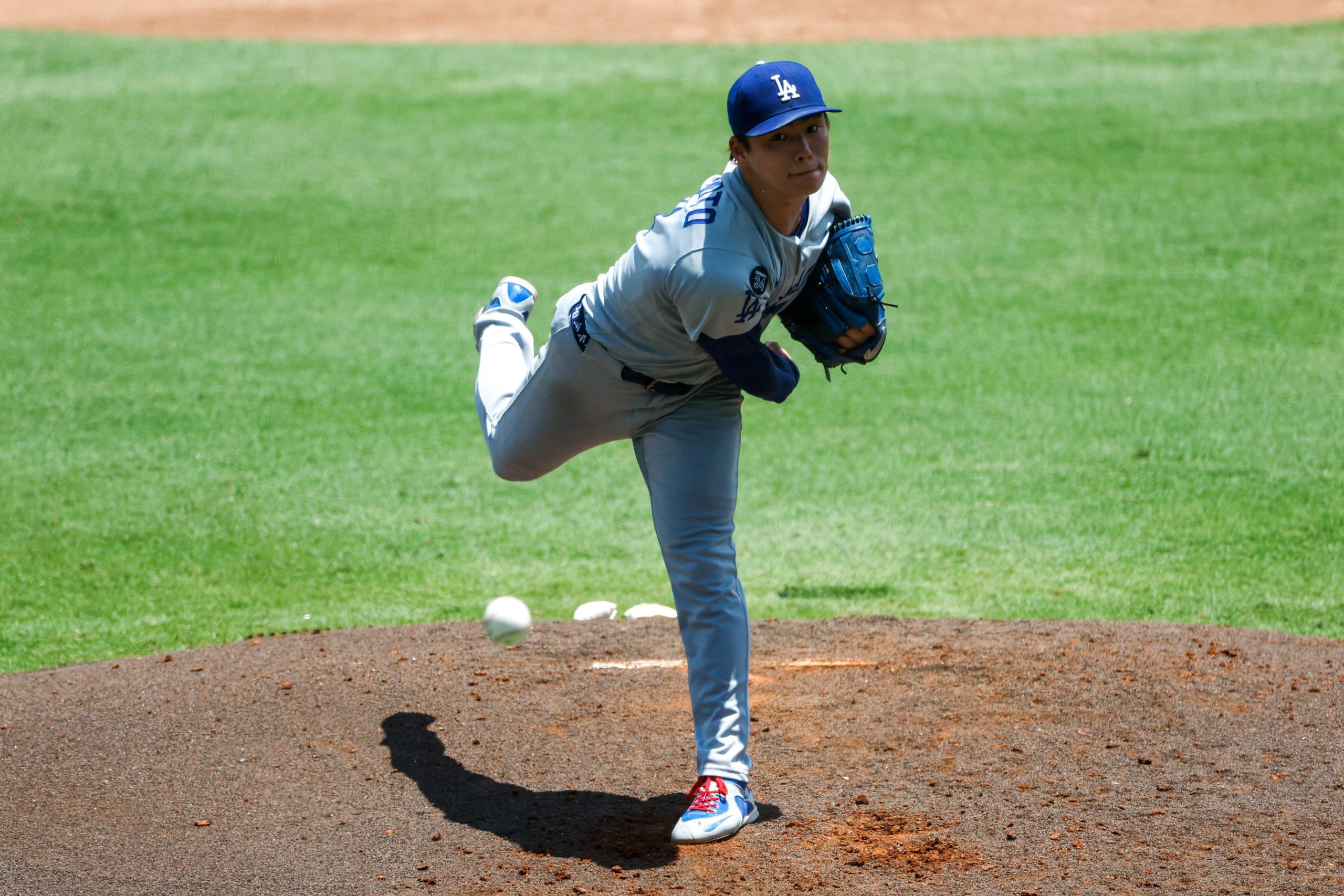
As FOX returned to its World Series Game 7 coverage of the bottom of the ninth inning back in November, the camera was focused on the new pitcher on the mound – Yoshinobu Yamamoto – making his final warm-up pitches. It was a remarkable sight.
Play-by-play voice Joe Davis shared with the audience that the only other pitchers to have appeared in a World Series Game 6 and Game 7 were Grover Cleveland Alexander in 1926 and Randy Johnson in 2001.
Said John Smoltz as Yamamoto readied to make his first offering to Alejandro Kirk with one out, and runners on first and second with the score tied:
“This is unbelievable. I know it’s all hands on deck but man oh man, here we go.”
It wasn’t easy.
Yamamoto hit Kirk with his second pitch, a 96-mph fastball, to load the bases. In the following at bat, Daulton Varsho stung a ground ball toward Dodgers second baseman Miguel Rojas, who stumbled upon fielding the ball. Rojas somehow stayed on his feet and threw home for a force out. The following batter, Ernie Clement drove a fly ball to the left-center warning track where Andy Pages made a remarkable catch, Randy Moss-ing his teammate Kike Hernandez. It was one of the most remarkable half innings in MLB history.
Yamamoto settled down and pitched a scoreless 10th and 11th innings to close the game and lift the Dodgers to back-to-back World Series titles. The effort marked his third win of the series – just the 14th pitcher in MLB history to do so – earning him World Series MVP and baseball immortality.
Johnson is the only other 21st century pitcher to win three games in a single World Series.
Yamamoto threw 130 total pitches over those two days, and 235 total pitches in the series – the seventh most pitches in a World Series on record.
This all came after Dodgers manager Dave Roberts said earlier in the day Yamamoto would not be available. Roberts reversed course with everything on the line.
“I’m kind of crazy for sending him back out there,” Roberts said. “But I just felt he was the best option.”
But was it crazy?
Could the Dodgers have known he would be effective in the most pivotal moment of the season?
Could they have reasonable expectations he would not be at extreme injury risk?
What can data insights from our PULSE technology tell us about such workload management? How can it guide coaches and players?
Driveline’s Max Engelbrekt, pro pitcher and Driveline researcher Josh Hejka, and this author were curious to study Yamamoto’s World Series workload. Was he pushed too far? Could he have been pushed further? What are the limits?
We investigated these questions for our second installment of an occasional series exploring pitching workloads.
Our first piece in the series was a hypothetical exercise exploring what it would take to build a Nolan Ryan-like, season-long workload.
This is a different case: that of an extreme short-sample workload spike that occurred in the real world.
If you have not read the Ryan piece, let us begin with a key metric that will guide us: acute-chronic workload ratio (ACWR). This workload guardrail will give us insight to understanding what Yamamoto did, and what he was capable of without taking on extreme risk.
It is a metric that compares an athlete’s training load over a brief period (acute), a week for a pitcher, to their workload over a longer period (chronic): the previous 28 days for a pitcher in our methodology. The concept of ACWR began outside of baseball, and research extends to a number of sports, too. Most athletic disciplines share a common finding: an athlete should increase their acute workload to build capacity, but not too quickly.
While there’s no single metric number that can safely prevent or predict injury, studies have found there is greater risk for a pitcher to sustain an upper-body injury when their ACWR is greater than 1.3, or a 30% increase in short-term work over their longer-term average.
To be extra safe in our simulations, we do not want our acute workload to exceed chronic by more than 20%.
To quantify pitching workload, we employ a measure called “workload units,” informed by PULSE, to give us an understanding of the stress of all throws a pitcher makes.
Different throws have different values. There is more stress and energy involved in making an in-game game pitch versus light throwing the day before a bullpen. That is straight-forward logic. But all throws add up. They all have value. PULSE allows us to measure the exact forces of all throws to tally and monitor a pitcher’s total workload. This goes well beyond pitch count data.