
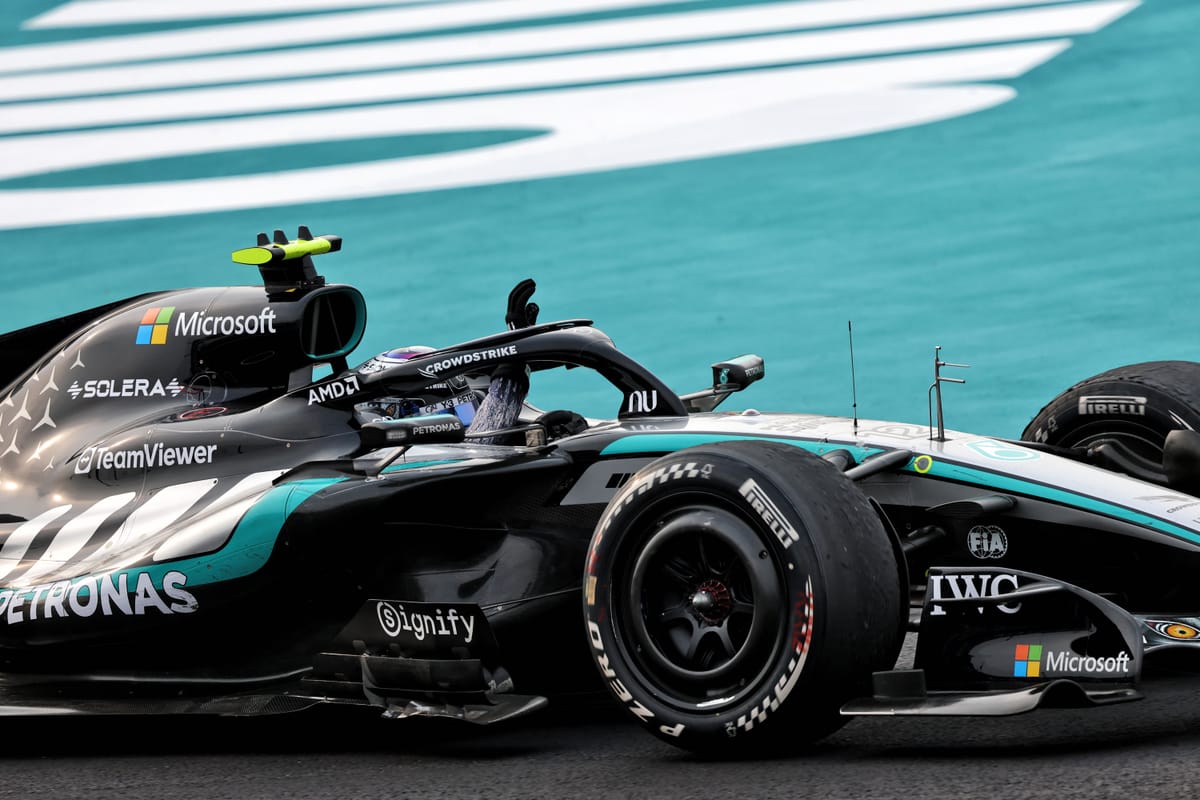
“Don’t remind me of Monza ’24,” said Toto Wolff at Suzuka as he enjoyed his protege Kimi Antonelli’s second consecutive grand prix victory and his position as leader of the world championship, the youngest-ever at 19.
Monza 2024 of course was when Antonelli, as a 17-year-old, made his first appearance in an official Formula 1 session – and binned George Russell’s Mercedes in a high-speed impact with the Parabolica barriers before he’d even completed his second lap.
Consider the psychic shock and comedown of that moment for a 17-year-old – from dancing on the high-wire, living an impossible dream, dissecting those legendary Monza turns in an F1 car as if it were child’s play, to the impending doom sound of the gravel on the car’s underside, presaging the brutal hard bang – and the sense of very public humiliation is all too easy to imagine. In front of the crowd, in front of the F1 community, in front of the team which was giving him this chance, which was about to announce him the next day as Lewis Hamilton’s replacement for 2025. What 17-year-old is going to be mentally equipped for that? It’s got to have hurt.
There was just too much excitement, too much expectation, not enough discipline – and as a result he was overloaded. It was just a crash, drivers have them all the time, but it was a psychologically damaging one coming when it did and under those circumstances.
When looking back at how this situation had arisen, why he was in the car, why Wolff was so excited at the prospect of him causing a sensation, it was because of what everyone had seen in him; the quite incredible raw ability evident since he first sat in a kart.
In that world there was a huge buzz around him even as an 11-year-old, such that Massimo Rivola, then director of Ferrari’s driving academy, believed he’d found ‘the special one’ for the future. Rivola’s recommendation was overruled by Ferrari’s then-team principal Maurizio Arrivabene, who felt Antonelli was ‘too small’ to be a serious prospect (!) – and into the breach immediately stepped Wolff.
Every step along the way, the now Mercedes-backed Antonelli repaid Wolff’s faith and the buzz just kept gathering momentum as he not only won everything but did so in often audacious style which only seemed to be amplified as he made the move to cars, still only 15. He could drive on the outer edges at will, with a phenomenal fast-corner feel that stood him head-and-shoulders above his contemporaries.
But that’s why he arrived so fast, missing out Formula 3, going straight from Formula Regional to Mercedes F1 third driver and a Formula 2 programme. He had so much talent it was assumed he’d bridge the gaps and in the main he did. But there’s a limit. Things become so much more complex in the car and out once you’re on the fringes of F1. The data banks take time to be filled. There’s a lot of understanding and sheer graft involved and for him this was happening years earlier than is the norm, before his teenage brain had even fully developed, as he was still working for his school exams, etc.
Hamilton’s move to Ferrari forced the issue in Wolff’s calculations for the post-Hamilton future. Antonelli had yet to even embark on his F2 season when Wolff decided he was going to put him in Hamilton’s seat for 2025. There seemed little point taking on a more experienced guy such as Carlos Sainz as a stop-gap if the ultimate plan was to put Antonelli in there. Had it not been for Hamilton leaving at the end of the first year of his 1+1 contract – because that’s when the opening was at Ferrari – then Antonelli would likely have been farmed out, George Russell-style, to Williams for his F1 apprenticeship and the spotlight would not have been so intense.
Making your debut for a top team, as the replacement for the most successful driver of all time, when there’s so much you don’t know? The performances were always going to be up and down, regardless of the natural flair.
Max Verstappen had a great debut season as a 17-year-old in 2015 with only one season of previous car racing, but it was in a small team and there were plenty of ordinary performances amid the amazing standouts. In a small team, they go unnoticed. The last rookie in a top team was Hamilton in 2007 and he was able to fight for a title immediately – but he was 21 and had a five-year apprenticeship in the junior categories.
That raw ability can only do so much. Everything else has to be in place as a platform on which to express that. For one thing, Antonelli had to work at understanding when he had to rein in his ability. Often it wasn’t a case of pushing up to the limits of the car, but pulling himself back, as he explained towards the end of last season.
“I still feel I cannot drive the car the way I want,” he said. “My driving style is quite aggressive. And I would tend to throw the car into the corner – and this is when I have the confidence. But it seems like with this generation of cars you can’t really do that. Because maybe of the way the aerodynamics work, the tyres, these cars are very sensitive to wind.
“It’s very sensitive, the car. The limit is so high that once you pass it, there’s no way, it’s just gone. The limit is just so high, but then when you go over it, you have nothing. So the car is just super-unpredictable, really hard to control it.
“So with these cars, I’m still trying to change a little bit the way I drive because still when I have the confidence, I start to throw the car into the corners and then the problem starts to reappear. So what I’m trying to work on is adjusting a little bit my driving style and not changing completely because in some corners the car can take it but in other corners it cannot.
“It’s about trying to understand the moment where you can ask the car more and the corner where I can apply my driving style and the corner where I cannot. So it’s not fully natural, but so far I’m doing the steps in the right way.”
That’s the platform he was building. It was going quite well for the first few races of last season, culminating in a sprint pole at Miami. But a rear suspension change on the Mercedes brought an inconsistency to the rear end which completely destroyed the confidence he had been building. It took until mid-season for Mercedes to ditch that suspension – and from there Antonelli began to rebuild and we again saw the glimpses of the phenomenon. But only glimpses – and not before a couple of silly errors at Zandvoort and Monza (again).
“Obviously expectation got higher and higher and then the European season came and just it felt like everything was just falling apart,” he said in Singapore. “It just felt like everything was not working. Mercedes was fighting for P2 in the constructors’, and [I] was losing them points, and obviously then the team started to put a bit of pressure. It added up, but it’s normal, it’s how it is.
“I think what really made the difference was, after Monza, the meeting I had with Bono [race engineer Pete Bonnington] and Toto. It really helped me make a reset and really try to get back in the form of the first part of the season. Because obviously I was also not happy with how things were going, and I was just getting more and more frustrated, because also I was thinking too much about the final result. And also I was trying to fulfil the team’s expectation but it was just a snowball effect and I felt like I wasn’t going anywhere.”
By the end of the season the recovery was well underway and in Abu Dhabi he gave an overview. “This year has been a massive learning curve for me. Definitely going into Mercedes [for my] first year was a massive opportunity, obviously I was more under the spotlight, more under pressure. But I think that really helped me to grow even faster.
“Definitely I’m happy, quite happy with the season, but mostly I’m happy with how much I grew and how much I matured as a person, and definitely next year I’m going to be much more prepared and much more in control of the situation.”
A winter break and some study time has made a world of difference. As it was always going to.
Sure, there are still the ragged moments – the dropping of the car in FP3 in Melbourne, giving himself and his crew a lot of work to do – and there are for sure incidents still to come.
Also his two consecutive wins owed a little to luck (Russell’s qualifying problems in China, the timing of the safety car in Japan) but in taking that first grand prix victory he’s no longer needing to prove he should be there – and as he relaxes into his talent, with the platform nicely built up, and with a super-competitive car, he’s going to become truly formidable. Even his performance at Suzuka was a step beyond that of China, with a devastating turn of speed on tap.
We’re only at the beginning of what’s to come.