
Dear Aspiring Continent Traverser,
Let me start by saying that, if one really puts their mind to it, pretty much any bike can make it across the country. While there are touring-specific models, many people can accomplish a big tour with the bike they already have.
Having said that, there are good reasons why we have different types of bikes. Some shine in specific uses, such as an aerodynamic tri-bike in its corresponding competition. Other bikes can more authentically bill themselves as multi-use.
So what’s the answer? Let’s examine the qualities we’re looking for in a touring bike. This will hopefully illuminate the kinds of bicycles that will hold up themselves and keep your body happy for the long haul. If your tri-bike doesn’t fit the bill, perhaps another bike in your stable will. Whether you’re self-contained or have a van to haul your stuff on a supported tour, you’re going to put in serious miles on a wide variety of surfaces. With that in mind, let’s talk tires.
Tires
Even on pavement, long days — and sometimes questionably maintained roads — are really best tackled on tires in the 32- to 50-millimeter range. The good news is that bike tires are trending towards wider anyways, so more bikes can accommodate wider tires. Check the specs on your bike (or ask a mechanic at your local bike shop) to figure out the widest tires your bike can run.
In choosing tires, you’re also going to want to prioritize quality and durability. A lighter tire that’s designed for casual day rides (or racing) is not what you want for this endeavor. Spend the money to get something heavy-duty and from a reputable brand so that you’re not cursing your poor bike after several roadside flat changes.
Another consideration: tubes or tubeless? This is hotly debated, and, ultimately, there’s no right answer. However, I’m going to tip my hand here and tell you some things I really like about tubeless tires. You know those little goat heads that are prevalent in the west? Or the tire wire debris that’s sure to litter any major highway? Both cause a lot of punctures, and a properly maintained tubeless tire will usually look at these hazards and laugh. While tubeless tires were initially popular with the mountain biking crowd, I’ve come to think that those goat heads and shards of tire wire (think Southern Tier) are why tubeless tires exist. A little poke here, a little poke there, and that sealant will rush right in and plug the small hole, often before you even notice.
If you have tubeless compatible wheels and haven’t given them a try, the possibility of not having to change a bunch of tubes on your way across the country should be motivation to give them a spin (well before you head out on your adventure). The important thing is to carry the necessary supplies and know-how to fix a flat whichever way you go. And don’t forget the tubes, even if you’re tubeless!
Drivetrain
Traditional touring bikes used to have triple chainrings, but that’s becoming less common these days. The purpose was to get a wide range of gears, especially low gears for climbing with a lot of weight. Now there are so many cassette and derailleur options that we can often get those low gears in a one- or two-chainring setup. If you do go with a 1x (“one-by”), you might sacrifice some gears at the high end, but don’t you want to coast down that hill anyway? It’s a tour, not a race. Don’t think that you have to keep the same set-up that came with your bike; a different cassette or chainring(s) can make a huge difference in covering lots of miles, especially of the uphill variety.
Bags and Racks
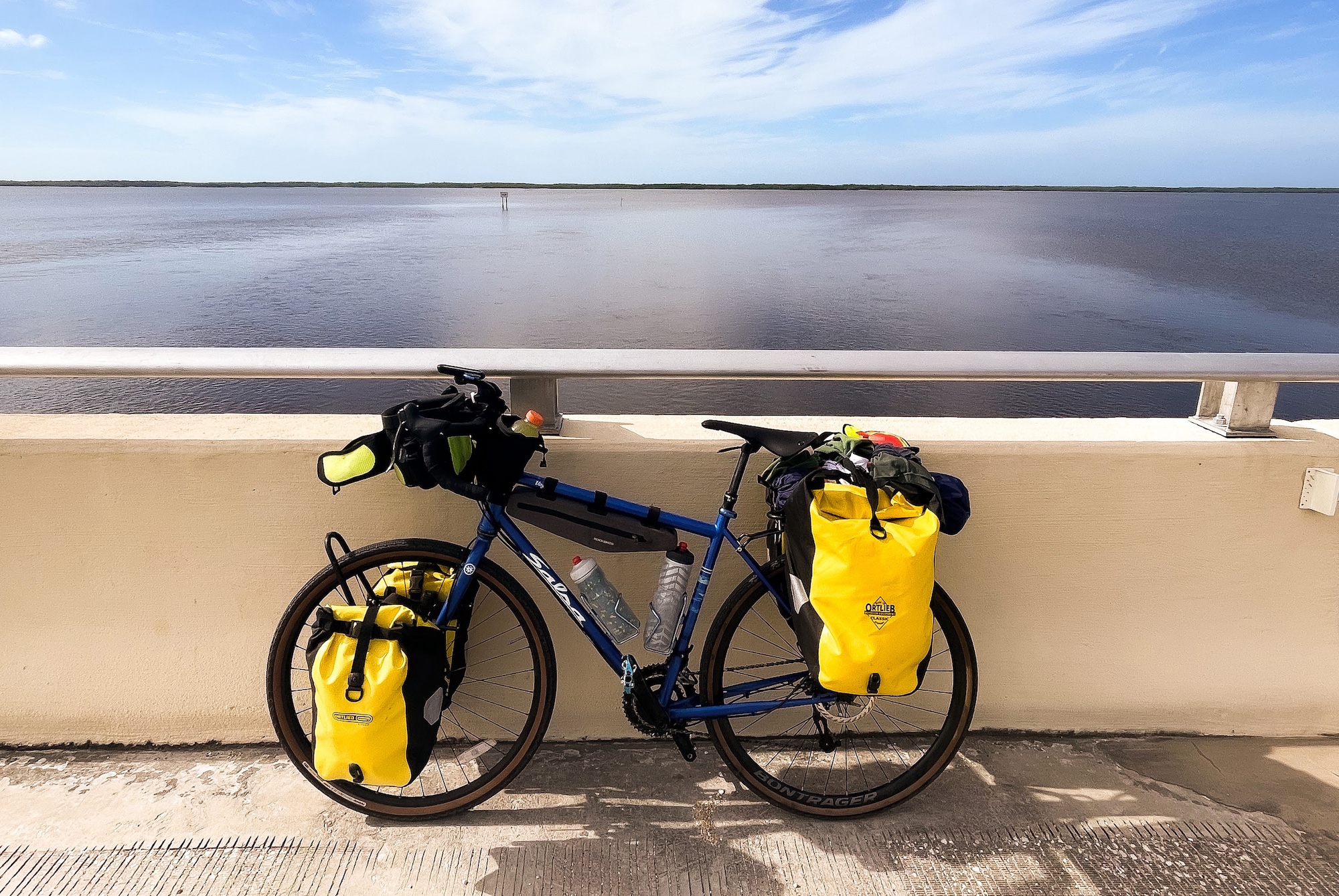
So what about for a self-supported trip? Even if they want to mostly sleep with a roof over their head, a lot of people riding cross-country self-supported plan on at least some camping. This is somewhat of a tipping point as far as what kind of bike will work well. Ideally, the bike has several braze-ons for mounting racks or cages. From there, you’ll have many options for panniers or other bike touring bags. Without braze-ons, you may still have some options for bikepacking style bags, but be mindful of the maximum recommended load for each bag.
The geometry of your bike will also dictate your options for frame bags. When you’re planning to carry a load, you’ll find that touring, gravel, and mountain bikes are the typical choice. Specially designed recumbents and tandems are out there, too.
Touch Points and Set Up
Bicycle options abound, ultimately beyond what this short article can attempt to cover. Much of what you choose will come down to personal preferences. But I will add two bits of advice here. First, if you’re still many months out from your cross-country cycling trip, go ahead and try new things if you’d like: new saddle, new handlebars, new pedals, etc. All of these things can make a huge difference in comfort over thousands of miles.
But if you’re just weeks away, now is not the time to make any big adjustments to your set-up, especially just because you heard it’s better. Stick with what has worked for all your training miles and save the bright, shiny new things for next time.
Ease of Maintenance
Second, simple and widely available parts and components are preferable to complicated and specialized. One example: electronic shifting. I’m definitely not saying that it doesn’t belong on a cross-country bike ride, but a word of caution. If you have issues with it, you may find yourself at a bike shop where this technology is not (yet) in its mechanics’ wheelhouse.
If you’re going with the newest tech, get familiar with potential issues, and be able to problem solve them yourself (or at least with the help of the internet). Many parts these days are brand- or even model-specific, so do your best to carry extras of anything on yours that isn’t standard or easy to source. For example, an extra derailleur hanger takes up virtually no space, and it can save your ride if you break the one currently attached to your bike (like I did, crossing the border between Alaska and British Columbia).
Conclusion
So, dear reader, my intent is not to dodge your question but to gently nudge you towards the conclusion that your tri-bike might present some challenges on a cross-country journey. In looking for a suitable alternative, just keep in mind that you have many great possibilities, and you can confidently look beyond the touring-specific category. You don’t need to spend a fortune either. Prioritize comfort and durability over things like having the newest technology or being lightweight. (Honestly, don’t factor in that last one at all!) Then get out there and get some miles on your new adventure bike.