
There’s a new tennis fantasy game on the scene, with the ATP Tour launching its own product in late March ahead of the European clay swing. I don’t know about you, but this one has gone a little under the radar. I heard it was coming, but didn’t get around to digging into it until just now.
If you’re the same and haven’t taken the time to understand it, then you’re in luck. Below is a comprehensive guide to ATP Fantasy. I go over everything from the nuts and bolts of how to play the game, through to tips, strategies, the best leagues to join and where I personally think there’s room for improvement.
How the ATP Fantasy Game Works
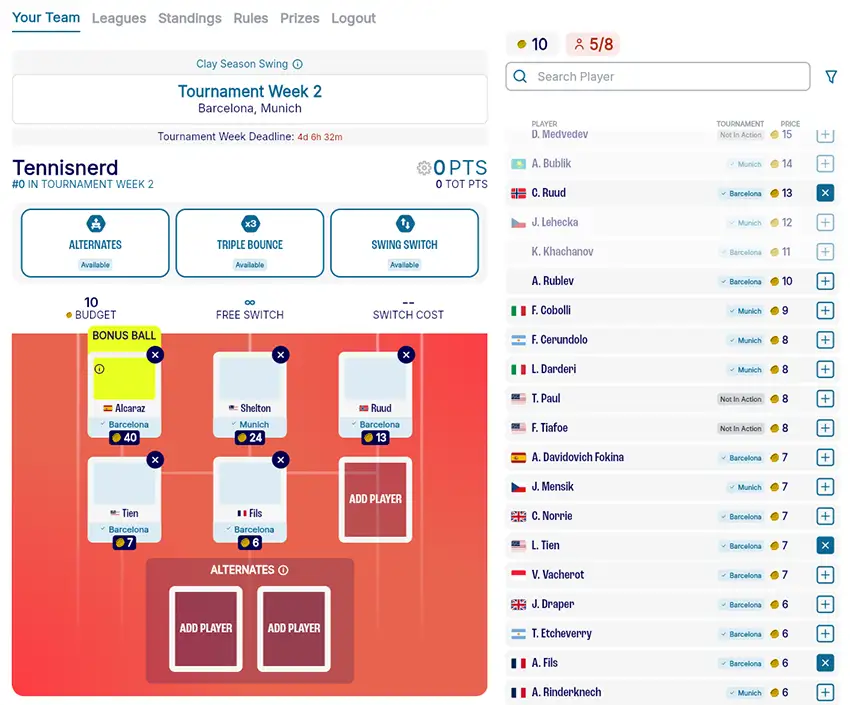
At the very top level, ATP Fantasy is simple. You’re given a budget, then select eight players which collect you points based on how they perform each round.
There’s plenty of nuance around how players are priced and what kinds of outcomes generate the most points, but the essence is as it always is with any fantasy sport: you’re balancing cost vs potential reward on a player by player basis.
Building Your Team
- 100-credit budget
- 8 players total – 6 starters + 2 alternates
- Player prices based on PIF ATP Live Rankings
Here’s a sample of what those prices look like this week:
| Player | Credits |
| Carlos Alcaraz | 40 |
| Jannik Sinner | 36 |
| Alexander Zverev | 33 |
| Novak Djokovic | 30 |
| Alex de Minaur | 19 |
| Casper Ruud | 13 |
| Francisco Cerundolo | 8 |
| Jack Draper | 6 |
| Arthur Fils | 6 |
| Daniel Altmaier | 3 |
| Matteo Arnaldi | 1 |
The above are just an example – already I’m sure you’ll notice some opportunities and issues in the pricing system. More on that later.
Scoring
Points are awarded for each round reached, and are directly tied to the ATP’s point system. If your player wins a Masters 1000, you’ll get 1000 points; if they reach the final of an ATP 250, you’ll pick up 165 points.
Outside of these raw results, there are a range of other actions that can earn you points – or lose you them. Here’s a summary:
| Action | Points |
| Ace | +2 per ace |
| Straight-sets win | +10 |
| Upset win | +20 |
| Double fault | -2 per DF |
| Bagel (losing a set 6-0) | -10 |
| Upset loss | -20 |
Bonus Ball
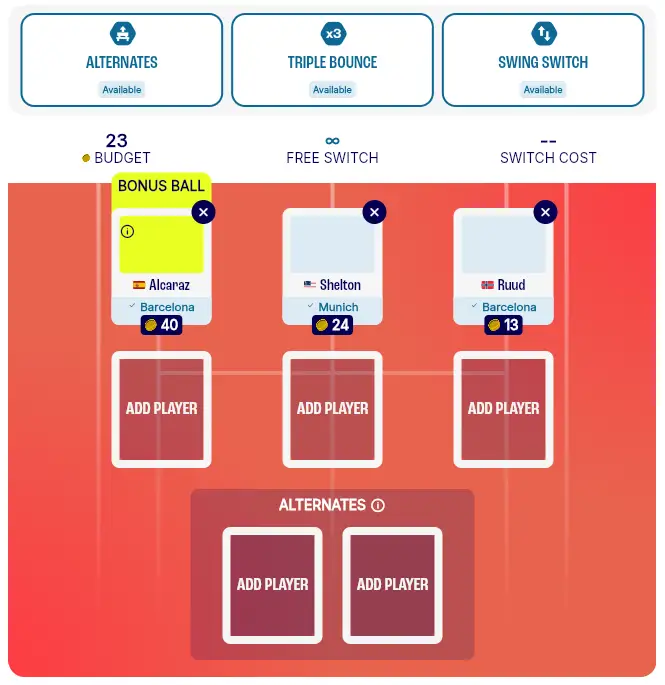
Bonus Ball is ATP Fantasy’s version of having a captain. Each week you designate one starter as your Bonus Ball player, and that player earns double points for the tournament week.
Transfers
The team you initially select isn’t completely fixed – there are a range of different transfer options available. Here’s how these work:
- Unlimited switches before the season starts
- 2 free switches per tournament week after that
- Unused switches roll over (max 8 banked)
- Additional switches beyond your free allocation cost 50 points each
Chips
Where things get a little fun/strategy/messy (depending on how you look at it) is with the game’s chips. There are three of these, each which can be used once per swing, but only one can be played per tournament week. Here’s a breakdown:
| Chip | Effect |
| Alternates | Your 2 bench players’ points count toward your total |
| Triple Bounce | Bonus Ball player earns triple points instead of double |
| Swing Switch | Unlimited switches for the week, no point penalty |
Season Structure
The ATP Fantasy season is chopped up into swings. At the start of each of these, chips reset and you’re able to do unlimited switches as well.
Because the game was launched mid-season, there are just four swings as follows:
| Swing | Dates |
| Clay Season | 30 March – 7 June |
| Grass Season | 8 June – 12 July |
| North American Hard Court | 27 July – 13 September |
| Race to Nitto ATP Finals | 23 September – 8 November |
Each swing has its own leaderboard and prizes. In 2027, I assume there will be at least one more swing added to cover the earlier section of the season.
Leagues, Leaderboards and Prizes
So what’s the point of all this? Well, to beat your friends and win prizes, of course! There are a few different shapes and forms this can take:
- Create private leagues (set a name, invite via code)
- Join existing leagues (enter an invitation code)
- Compete on global monthly, swing, and overall leaderboards
Season-long prizes include ATP partner merchandise, ATP Store gear, and tickets to selected 2027 tour events. Overall season winner receives two tickets to two sessions of the 2027 Nitto ATP Finals, including flights and accommodation.

Is ATP Fantasy Worth Signing Up For?
Short answer: yes, but with some caveats. ATP Fantasy is very new, and I’ve just signed up myself, so it’ll take a few tournament weeks before things become properly clear. However, early signs point towards there being a few quirks in the game’s scoring system that could lead to teething issues over the coming months.
That said, it’s free, it’s run by the ATP Tour, and it’s a fun way of engaging with tennis that should only get better and more popular. Now’s a great time to jump on board and fine-tune your skills before ATP Fantasy becomes more mainstream.
What Works
I like the scoring. A lot, actually. It mirrors actual ATP ranking points, so you don’t need to learn some arbitrary points table. For anyone who follows the tour closely, this will be immediately intuitive.
The chip reset mechanic is an improvement on the model used in Fantasy Premier League, the world’s most popular fantasy sport and an obvious reference point for ATP Fantasy. I’ve played FPL for years, and one of the most stressful parts is knowing you’ve only got one Triple Captain, one Bench Boost, one Free Hit for the entire campaign. Blow one early and you’re kicking yourself until May.
Here, your three chips reset at the start of each swing. That’s four uses of each chip across the year. I’m a fan of that. It rewards active management and gives you room to experiment without the anxiety of a one-shot decision.
Live ranking-based pricing also creates volatility that FPL managers can only dream about. A player can lose half their credit value after one bad tournament. Jakub Mensik, for instance, would have dropped from 12 credits to 6 after a second-round exit at Miami as defending champion.
This means bargains appear if you’re paying attention, and traps too, if you’re not. I find that exciting – it means the game rewards those who are actually watching the tour week to week.
Where It Falls Short
I said I’d circle back to this: the pricing model is the obvious flaw of ATP Fantasy.
Player prices are linked to live ATP ranking, which is great, but not to ATP points, which isn’t so great. Those ranked No 1 through 16 have set values, while 16-20, 21-25, 26-30 and so on are bunched into their own pricing groups.
Bottom line, this leads to a situation where Sinner costs 36 credits and Zverev costs 33. That’s a gap of just three credits for two players separated by over 7,000 ranking points. Why would anyone pick Zverev, when three more gets you Sinner?
This turns the middle tier of premium players (roughly ranks 3 through 10) into dead weight. It’s not necessarily the game’s fault, more just a quirk of Sincaraz domination on the ATP Tour.
YouTuber Expected Aces did an analysis of the Miami Open data that shows why this is an issue for ATP Fantasy. A Sinner-plus-Alcaraz draft padded with cheap fillers nearly matched a perfectly optimised balanced squad. And unless you were bold enough to Bonus Ball Lehecka that week – which, come on, almost nobody would have been – the top-heavy approach with Sinner as Bonus Ball outperformed anyway.
The game’s pricing just doesn’t punish you enough for loading up on the big two, which is a problem as it could well lead to some pretty one-dimensional game play if we’re all just picking Sinner and Alcaraz.
The bonus and penalty structure has some quirks too:
- +10 for a straight-sets win, but no penalty for a straight-sets loss
- -10 for getting bageled, but no reward for bageling someone
- No recognition of return quality or break-point performance
I’d love to see a break-point differential bonus – +2 for each net service break, say. That would incentive away from just picking big servers, which is what’s currently rewarded through the ace and double fault bonuses.
The upset mechanic could use some work too. It only triggers when an unseeded player beats a seeded player. Personally, I’d prefer a scaled system where a bigger ranking gap produces a bigger bonus. That would create far more interesting decisions around cheaper picks.
Finally, there’s no ownership-based pricing in ATP Fantasy. In FPL, knowing that 60% of managers own Erling Haaland shapes how you approach your team – do you follow the crowd or differentiate? Here, there’s no transfer market metagame at all. Whether that bothers you depends on how deep you want the strategy to go, but it’s a feature that would certainly add a bit of nuance.
Tips, Tricks and Strategies for ATP Fantasy
Let’s be real: no-one is good at this game yet. That’s what makes playing ATP Fantasy right now fun. Having just signed up and had a poke around, here’s my gut feel on what will work:
Go Top-Heavy
The pricing compression at the top of the market means picking one of Alcaraz or Sinner – possibly both – is mandatory right now.
Dominic Thiem, the former World No. 3 and 2020 US Open champion who the ATP has appointed as the game’s Official Fantasy Coach, said it himself when laying out his Monte-Carlo squad: you basically have to go with one of those two because they’re so likely to go deep.
Until the pricing gets rebalanced, I’m leaning into the big names and filling around them.
Your Bonus Ball Is Your Highest-Leverage Decision
Doubling a player’s points means doubling everything – round progression, ace bonuses, the lot. Most weeks, I’m putting my Bonus Ball on my highest-priced starter at the biggest event on the calendar. If Sinner is playing a Masters 1000, he’s my Bonus Ball. I’d need a very specific reason to do otherwise.
The cascade is worth understanding too. If your Bonus Ball doesn’t play that week, the designation falls to your second-choice player, then your third. Set your squad order deliberately.
Chase Ace Merchants, but Check the Ratio
At +2 per ace and -2 per double fault, the net value of a player’s serve is their ace-to-DF differential multiplied by two.
Thiem specifically flagged Zverev as a pick partly for his ace output, and I agree with the logic. But a player who fires 12 aces and coughs up 8 double faults is only netting you +8 from serving. Look at the ratios rather than raw ace counts.
Surface context applies here as well. Big servers on fast courts – grass, indoor hard courts – generate more aces and therefore more fantasy value than the same players grinding on slow clay.
I’ll be factoring that in heavily when the tour shifts surface. A guy who’s been an ace machine in the Sunshine Double will likely slow up significantly now we’re on clay.
Exploit Dual-Event Weeks
When two tournaments are on at the same time, spread your squad across both. Pick two or three players from each event and you double your chances of having at least one deep run in your roster.
I’ll be doing this during the 250-level weeks especially, when there’s no single headline tournament dominating the schedule. Concentration risk is real in a game like this – one bad draw can wipe out three of your starters if they’re all at the same event.
Check Who’s Actually Playing
This might be an obvious one, but we all know players withdraw at short notice. Before locking your squad each week, check the entry lists – not just the draw, which comes later, but the provisional entry list. Even better, search for news on X. A player carrying a niggle is a risk, while one who’s skipping the week entirely is a wasted spot.
Understand the Upset Mechanic
The +20/-20 only triggers when a seeded player loses to an unseeded one, or vice versa. This shifts risk calculation in an interesting way. Lower seeds at 250-level events – where there are just eight seeds and the margins between seeded and unseeded players are slim – are dangerous. If your player bumps into a hot qualifier and loses, that’s -20 on top of minimal round points.
Don’t Blow Your Chips Early
Chips reset each swing, giving you four uses across the season – but only one chip per tournament week. Here’s how I’m thinking about timing them:
- Triple Bounce – I’m saving this for the biggest event in each swing. Roland Garros during clay, Wimbledon during grass, the US Open during hard court season. The points ceiling at a Slam is so much higher than at a 500 or 250 that it just makes sense to use this chip here.
- Alternates – most useful during a dual-event week when even your bench players are likely to be active and collecting points. No point playing this when one of your alternates isn’t entered anywhere.
- Swing Switch – I’ll keep this up my sleeve and deploy it before a Grand Slam when I know the most about surface form. That way, if I get hit by injuries and withdrawals out of the blue, I can deploy it as an emergency too.
Follow Thiem, but Think for Yourself
Thiem will publish selections each week in his role as Official Fantasy Coach. His insight is worth reading – he understands clay better than almost anyone, and knows how players think about scheduling.
But if everyone follows Thiem’s picks, squads will cluster. There’s no ownership-based pricing in this game, but in private leagues, differentiation still matters. I’ll be reading Thiem’s column every week, then making my own decisions with this info.
You can find the new ATP Fantasy game here.