
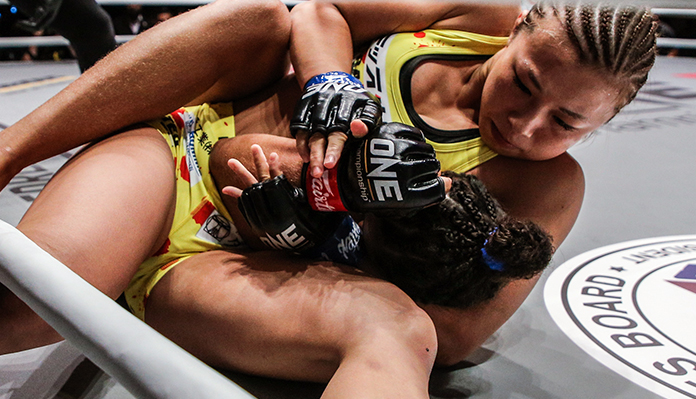
Before Ayaka “Zombie” Miura became one of MMA’s most dangerous submission hunters, she spent her days putting bodies back together.
The Japanese atomweight worked as a clinical educator at an osteopathic center, studying joint mechanics and human anatomy with a precision that most fighters never develop. That background turned out to be the secret weapon behind her devastating ground game, including her signature “Ayaka Lock” — a scarf-hold Americana so effective it has produced nine career victories, seven of them inside ONE Championship.
What sounds like a strange career pivot makes perfect sense to Miura. Understanding how a joint moves, where its limits are, and what angles produce the most leverage isn’t something you pick up from repetitions on a mat alone. It comes from years of scientific study applied with surgical intent.
“Well, being able to fix means being able to break,” Miura said. “Because I understand the structure of the body, I think it’s easier for me to lock in techniques that require bending joints. I often joke that I went from a job healing people to a job breaking them.”
Ayaka Miura still uses her medical skills between fights
The two worlds haven’t fully separated. At Tribe Tokyo MMA, where Miura trains under veteran coach Ryo Chonan, her osteopathic expertise still gets called upon — only now it’s on teammates rather than opponents.
She occasionally takes appointments at a friend’s clinic and steps in to assist when injuries happen in the gym. It’s an unusual dynamic: the same woman who hunts submissions in competition is also the one resetting dislocations during practice.
And despite her nine career finishes, Miura remains characteristically humble about how all that knowledge translates inside the Circle.
She credits repetition over raw ability and downplays the clinical edge she brings to every scramble. What her record makes clear, though, is that all those repeated reps — built on a foundation of genuine anatomical knowledge — have made her one of the most technically precise submission artists in the sport.
“[That knowledge is] probably ingrained in my body,” Miura said. “But I’m not very athletic, and my head isn’t that great, so I’m the type who has to repeat techniques many times before I can do them.”