
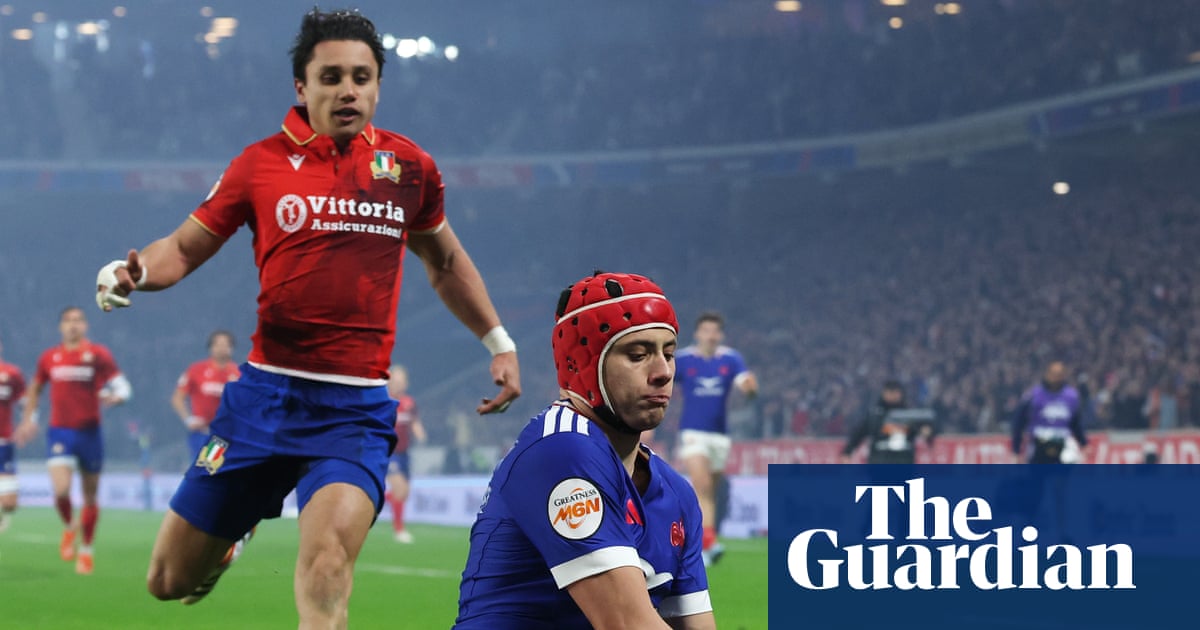
France pulled clear at the top of the table and kept their grand slam ambitions on track with a hard-fought win against Italy on Sunday.
The Azzurri had unfinished business in Lille. It was two years ago in the northern city that Les Bleus, still in the midst of a post-World Cup hangover, escaped with a draw after being outplayed by the visitors.
For the French, that result prompted a rejuvenation of the side which yielded immediate results. France were now an entirely different proposition, as they showed their cross-Alpine neighbours with the drubbing in Rome last year. Italy, however, were also riding high after two high-intensity opening displays in this year’s tournament.
France looked initially to be putting together another first-half frenzy of tries. It was the inevitable Louis Bielle-Biarrey who went over first, latching on to Antoine Dupont’s kick through to score for a record‑breaking eighth consecutive Six Nations game.
France’s second came after an intricate 50-22 found by Thomas Ramos, who was deputising at fly‑half for the injured Matthieu Jalibert. Emmanuel Meafou eventually powered over after a few phases in front of the Italy tryline for his first try with Les Bleus. Gonzalo Quesada’s men did not go under, though, and responded with several forays into the French 22, helped by their dominant rucks. Poor handling and a lightning‑quick France defence invariably stopped them in their tracks, however.
The storm of Azzurri attacks was eventually brought to a end when Dupont snatched the ball away from the onrushing Tommaso Menoncello metres from the tryline. In the ensuing counter, Émilien Gailleton, picking up Bielle‑Biarrey’s scuffed kick, tore through Italy’s defence before finding Ramos for a finish in the corner.
This time Italy did come up with a response. Ramos, desperately covering back after Menoncello’s kick upfield, could only flick the ball to his full-back stand-in. Théo Attissogbe, who opted to run from his tryline, was soon swarmed by the Italy chasers.
Ange Capuozzo finally turned Italy’s territorial domination into points by pouncing on to a ball trickling over the line. Paolo Garbisi’s converted penalty then gave further credence to the idea of an Italy comeback after the break, even if it was followed immediately by another spilled ball from a kick-off.
In any case, Italy were showing they were well worth the respect their hosts were affording them in bringing Meafou and Thibaud Flament back into the second row.
In the second half came a reversal in the game’s dynamics, with France instead keeping Italy in their own 22 but squandering one chance after another to clinch the bonus point. Successive spills, from Attissogbe, then Fabien Brau-Boirie, then Bielle-Biarrey, meant the hosts were still not out of sight by the time as the match entered its final 10 minutes. It was only once Louis Lynagh was sent to the sin bin for a deliberate knock‑on that space emerged for France to open their second-half account. In the passage of play that followed the Italy wing’s departure, the Toulon wing Gaël Dréan rounded off an impressive first cap with his first try, set up by a cross-field kick from Ramos.
Dréan was again involved for the fifth try just before full time, finding Gailleton with a long pass. The Pau centre burst past one defender and finished while being tackled by another to turn France’s victory into a (deceptively) resounding one.
“We didn’t make the most of the opportunities we had,” said the Italy head coach, who also pointed out that his team were down to 13 when France scored their fourth try as Capuozzo went off with a shoulder injury. “Neither side really dominated, and I think we defended very well, but we lacked good attacking possession,” he said, pointing notably to Italy’s lineout struggles.
Fabien Galthié, meanwhile, paid tribute to a “tough and robust” Italy side, highlighting the cagey start of the second half as a turning point. “It was played at a completely different pace compared to our previous games,” he said.
“We hadn’t played that kind rugby yet, so it’s good that we won this battle. I know that we’re romantics here in France, and we only talk about what we do with possession, but what happens off the ball can also win you games.”
A second grand slam of Galthié’s reign is now within reach, but it may not be the formality it had seemed.