
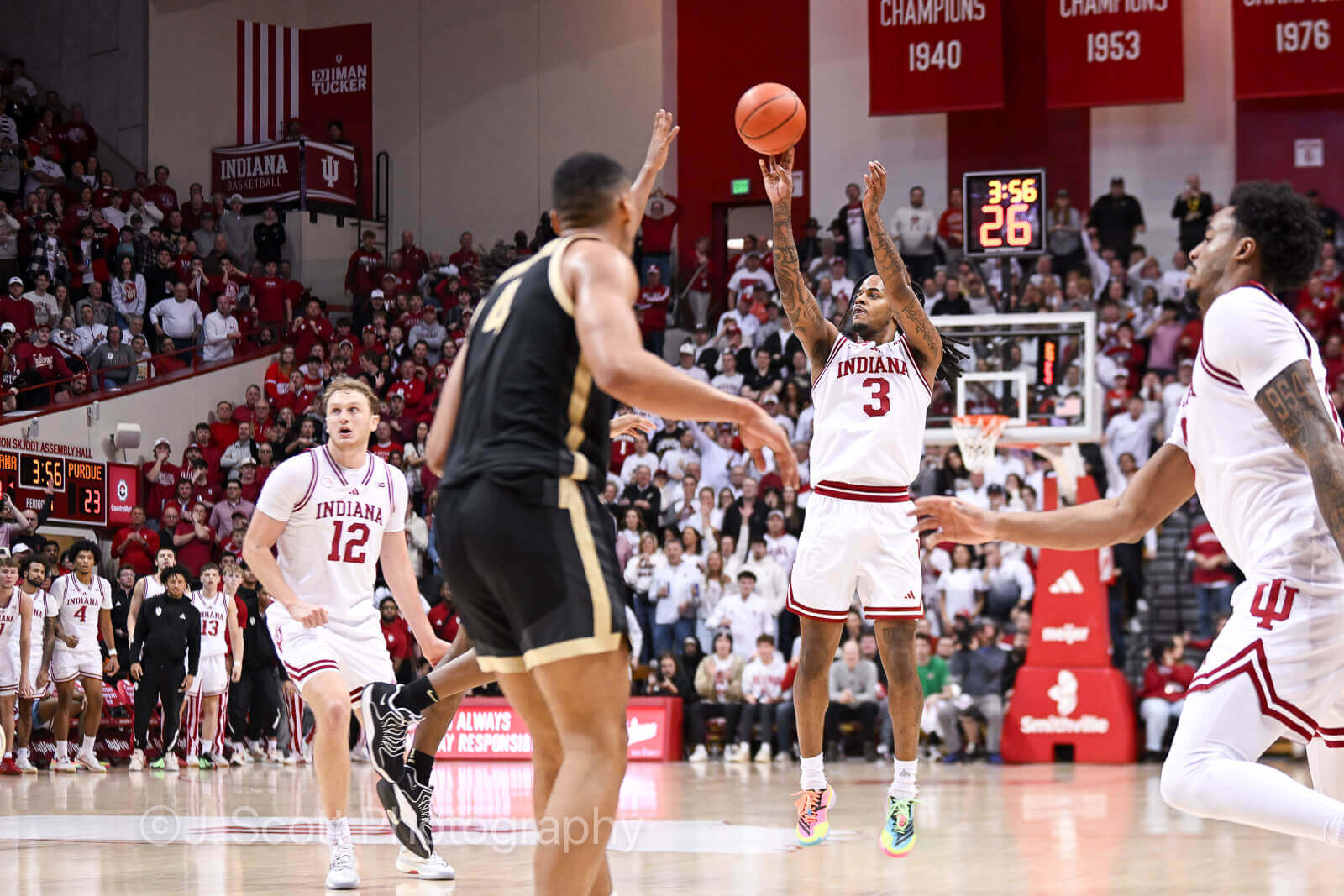
With less than four weeks remaining before Selection Sunday, the NCAA intends to release the top 16 overall seeds this weekend, which will provide a glimpse into what this year’s committee is valuing at this point in the process. I’ll share any key takeaways from that reveal with next week’s projections, but for now, I wanted to look at Indiana’s case as it stands today and what the Hoosiers need to do down the stretch.
Most bracketologists have IU in the 9-10 seed range, right in the middle of what has become a jumbled area of the seed list. Indiana ranks in the top 40 in five of the six team sheet metrics, with KPI the only exception at 48th. The predictive metrics are outpacing the result-based metrics and the Hoosiers rank 39th in WAB, which the committee relied on heavily last season.
While the metrics look good, actual wins and losses paint a picture that is a bit less rosy. The Hoosiers boast victories over three teams in this week’s at-large field, with the wins over Purdue and UCLA falling in Quad 1 and the overtime victory over Wisconsin in Quad 2. The Washington win also falls in Q2 but doesn’t do much other than bolster IU’s record against the top two quadrants. Even so, they are just 4-9 in the top two quadrants and 4-7 in road/neutral games, including losses in six of the Hoosiers’ seven toughest contests away from home.
I’ve heard some discussion that just winning the home games against Northwestern and Minnesota to reach 10 Big Ten victories would be enough to solidify a bid, but I am not convinced that is true. Both of those games are likely to be Q3 contests and losing all three of the other games would drop IU to 2-11 in Q1 and 4-12 in the top two quadrants. It’s unclear how much any of the metrics would take a hit in those games, but I think to feel relatively safe heading into the Big Ten tournament, IU needs to go 3-2 in these final five games. Any combination of three victories would provide at least one more Q1 win and a bit of breathing room.
Here’s a quick refresher about how the NCAA selection committee classifies wins based on the NET rating:
· Quad 1: Home vs. teams ranked 1-30 / Neutral vs. teams ranked 1-50 / Road vs. teams ranked 1-75
· Quad 2: Home vs. teams ranked 31-75 / Neutral vs. teams ranked 51-100 / Road vs. teams ranked 76-135
· Quad 3: Home vs. teams ranked 76-160 / Neutral vs. teams ranked 101-200 / Road vs. teams ranked 136-240
· Quad 4: Home vs. teams ranked 161-365 / Neutral vs. teams ranked 201-365 / Road vs. teams ranked 241-365
The Bracket
The projections below are based on all games played through February 16, 2026. Following the bracket, I included some quick notes on the last four in and first five teams out.
| CHICAGO (MIDWEST) | WASHINGTON, DC (EAST) | |
| Buffalo – March 19/21 | Greenville – March 19/21 | |
| 1) Michigan | 1) Duke | |
| 16) Howard / NJIT | 16) Appalachian St. | |
| 8) Miami (FL) |
8) Iowa | |
| 9) Saint Mary’s | 9) Auburn | |
| Philadelphia – March 20/22 | Tampa – March 20/22 | |
| 5) Alabama |
5) St. John’s | |
| 12) Liberty | 12) Belmont |
|
| 4) Virginia | 4) Vanderbilt | |
| 13) High Point | 13) Stephen F. Austin | |
| Tampa – March 20/22 | Greenville – March 19/21 | |
| 6) North Carolina | 6) Louisville | |
| 11) Missouri / Santa Clara | 11) TCU / UCLA | |
| 3) Florida | 3) Kansas | |
| 14) Portland St. | 14) ETSU | |
| Oklahoma City – March 19/21 | St. Louis – March 20/22 | |
| 7) Wisconsin | 7) Kentucky | |
| 10) Texas | 10) SMU | |
| 2) Houston | 2) Illinois | |
| 15) UT-Martin |
15) Austin Peay | |
| HOUSTON (SOUTH) | SAN JOSE (WEST) | |
| Philadelphia – March 20/22 | San Diego – March 20/22 | |
| 1) Connecticut | 1) Arizona | |
| 16) Bethune-Cookman / LIU | 16) Merrimack | |
| 8) NC State | 8) Utah St. | |
| 9) UCF | 9) USC | |
| Portland – March 19/21 | Portland – March 19/21 | |
| 5) Tennessee | 5) Arkansas | |
| 12) South Florida | 12) Yale | |
| 4) Michigan St. | 4) Gonzaga | |
| 13) UNC-Wilmington | 13) Hawaii | |
| Oklahoma City – March 19/21 | San Diego – March 20/22 | |
| 6) BYU | 6) Saint Louis | |
| 11) Georgia |
11) Miami (OH) | |
| 3) Nebraska | 3) Texas Tech | |
| 14) North Dakota St. | 14) Cal Baptist | |
| St. Louis – March 20/22 | Buffalo – March 19/21 | |
| 7) Clemson | 7) Villanova | |
| 10) Indiana | 10) Texas A&M | |
| 2) Iowa St. | 2) Purdue | |
| 15) Wright St. | 15) Navy |
Last Four In:
UCLA – Aside from KPI, the Bruins are hovering right around 40th in all of the team sheet metrics. They have a pair of Q1 victories (home vs. Purdue, at Washington) and are 6-8 in the top two quadrants with no bad losses, but that win over the Boilers is UCLA’s only one against a team in the at-large mix. The next two games are brutal, with a trip to Michigan State followed by a home date with Illinois.
TCU – After opening the season with a home loss to New Orleans, the Horned Frogs have turned things around to get back in the mix for an at-large. They are up to five Q1 victories, including a home win over Iowa State and neutral court victories over Florida and Wisconsin. TCU has at least one loss in all four quadrants, but the remaining schedule is relatively favorable and provides a chance to further improve upon their metrics.
Santa Clara – The Broncos had been in my projections as the WCC automatic bid in recent weeks, but Saturday’s loss to Gonzaga dropped them back into the at-large pool. Their result-based metrics all sit around 40th and while they are just 1-4 in Q1, they do have six victories in Q2. However, a home win over Saint Mary’s is Santa Clara’s lone victory over a team in the at-large mix and their Q4 loss to Loyola Chicago is tough to explain. The Broncos’ next two games are on the road at San Francisco and Saint Mary’s and they may well need to win both to stay in the field.
Missouri – I thought that Saturday’s 17-point home loss to Texas might knock Mizzou out of the field, but they managed to cling to the final spot. On the one hand, the Tigers have knocked off Florida and Auburn at home and won at Kentucky and Texas A&M. On the other hand, they are in the mid-60s of the NET, with eight of their 17 total wins falling in Q4. Missouri’s next three games are home against Vanderbilt, at Arkansas and home against Tennessee, so this situation is going to sort itself out one way or another.
First Five Out:
San Diego State – The Aztecs remain tied with Utah State atop the Mountain West after beating Nevada last week. However, SDSU is just 1-4 in Q1 and 6-5 in the top two quadrants with just one win over a team in the at-large mix (home vs. New Mexico) to go with a Q3 home loss to Troy. SDSU just needs to keep winning ahead of a February 25th rematch with Utah State.
New Mexico – A road win at Grand Canyon snapped a two-game losing streak for the Lobos, but they remain on the outside looking in. Like Mountain West counterpart San Diego State, they are just 1-4 in Q1, with that lone victory coming at fellow bubbler VCU. New Mexico also boasts a win against Santa Clara, but a Q3 loss at New Mexico State doesn’t help matters. New Mexico needs to avoid a bad loss in this week’s games before a tough closing stretch.
Ohio State – The Buckeyes missed a golden opportunity to pick up a Q1 victory against Virginia on Saturday, but instead they fell to 0-8 in Q1 games. OSU’s predictive metrics are strong, but their two best wins both came at home against UCLA and USC, while a neutral court victory over West Virginia has aged relatively well. Still, the current result-based metrics don’t bode well for selection and the upcoming schedule is tough with four straight games against teams in this week’s field.
VCU – A pair of wins last week extended the Rams’ winning streak to nine games. Most of the team sheet metrics are between 37 and 51, but VCU is 0-4 in Q1 contests. Four Q2 victories and an 8-4 road/neutral mark certainly help though, including a neutral court win against fellow bubbler Virginia Tech. The Rams’ at-large hopes largely hinge on Friday’s game at Saint Louis at this point.
Virginia Tech – The Hokies had a strange week, picking up a great road win at Clemson before getting blown out at home by Florida State. As it stands, they rank outside the top 50 in all but one of the team sheet metrics with a Q3 loss. However, VA Tech boasts three Q1 wins and a total of seven victories in the top two quadrants. With road games left at Miami, North Carolina, and Virginia, there are opportunities for the Hokies to play their way back into the field.
Conference Breakdown:
SEC (11): Alabama, Arkansas, Auburn, Florida, Georgia, Kentucky, Missouri, Tennessee, Texas, Texas A&M, Vanderbilt
Big Ten (10): Illinois, Indiana, Iowa, Michigan, Michigan State, Nebraska, Purdue, UCLA, USC, Wisconsin
ACC (8): Clemson, Duke, Louisville, Miami (FL), NC State, North Carolina, SMU, Virginia
Big 12 (8): Arizona, BYU, Houston, Iowa St., Kansas, TCU, Texas Tech, UCF
Big East (3): Connecticut, St. John’s, Villanova
West Coast (3): Gonzaga, Saint Mary’s, Santa Clara
Mountain West: Utah State
American: South Florida
Atlantic 10: Saint Louis
America East: NJIT
Atlantic Sun: Austin Peay
Big Sky: Portland State
Big South: High Point
Big West: Hawaii
Coastal: UNC-Wilmington
Conference USA: Liberty
Horizon: Wright State
Ivy: Yale
MAAC: Merrimack
MAC: Miami (OH)
MEAC: Howard
Missouri Valley: Belmont
Northeast: LIU
Ohio Valley: UT-Martin
Patriot: Navy
Southern: ETSU
Southland: Stephen F. Austin
SWAC: Bethune-Cookman
Summit: North Dakota State
Sun Belt: Appalachian State
WAC: Cal Baptist
Follow Andy on Twitter (@andybottoms) for more thoughts on college hoops and to receive an update whenever new brackets are posted.
See More: Bracketology, 2025-2026 Bracketology