
“We were on Sante Marie where Pogacar attacked. I mean, he was gone. He was already away,” Bruyneel explained. “Those sections are a lot harder than what they look like on TV, first of all, like a lot harder. And then, you know, the speed that Pogacar came by… it’s mind-blowing how he has this exercise under control. He goes, takes one minute, and then just manages that minute.”
Some people find this predictable style of racing boring, but that is not the case for Bruyneel. “I can hear a lot of people say, ‘Ah, you know, it’s always the same, it’s boring.’ I mean, I love this. It’s just beautiful to watch this kind of dominance and to watch this art. It’s like art. Pogacar has just mastered the art of attacking and keeping the breakaway at bay on any course, in any field, and he just does it.”
George Hincapie added that getting to that point of the race requires massive effort from the whole team. “As a former professional cyclist, knowing how hard it is to first keep a team together on these roads here in Tuscany where there are no straight roads – it’s all up and down, windy, twisty, turny, very technical with the gravel. But to see the whole team up there, Kevin Vermaerke for instance, an American rider, like really just leading the peloton on some of the hardest, most technical roads in Europe is just super impressive to watch.”
A big question fans always ask is why the group behind doesn’t just work together to catch Pogacar. Bruyneel explained the brutal reality of the race speed. “The moment Pogacar leaves, he takes off, everybody’s on the limit and everybody is already isolated. There’s nobody left with teammates because UAE has made it so hard that it just blows up. And it takes a very long time to get organized.”
Hincapie pointed out that Pogacar’s power is only half the story, as his bike handling and positioning are unmatched.
“For me, the most impressive thing is just how good he is at positioning and has no fear and staying in the front of the peloton. Like, these races are all about how you can stay in the front while saving energy. Well, that’s not even a question with him anymore. He is there whenever he wants to be there, and not only by himself, with his whole team. There’s no stopping this guy. And it’s just, we’re witnessing history every time he jumps on a bike.”
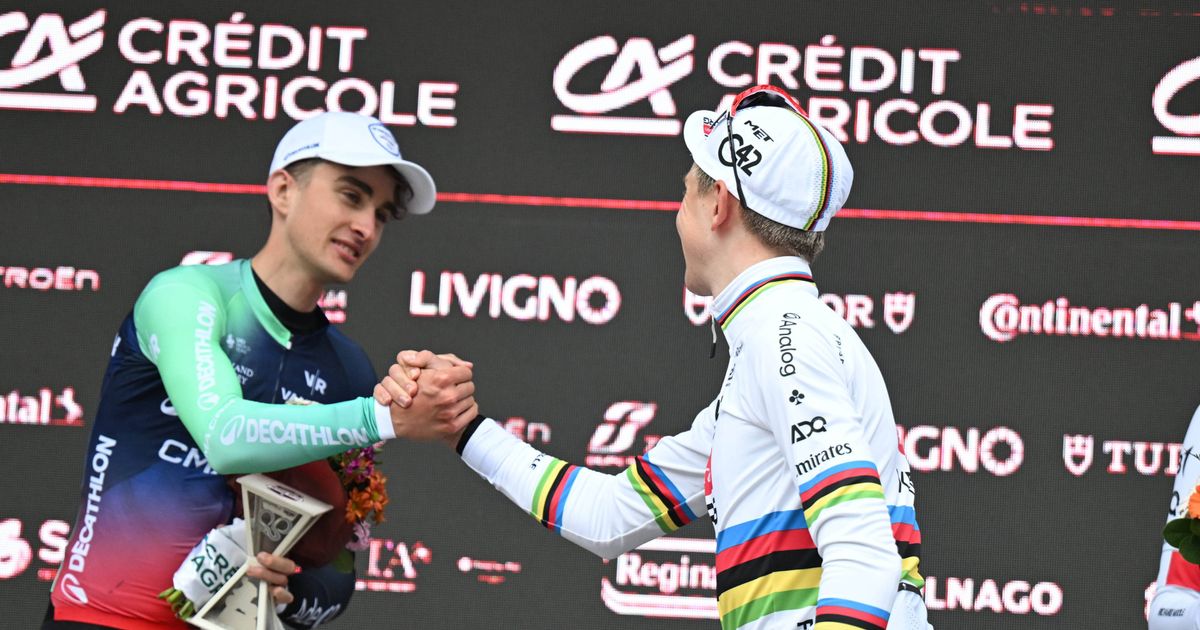
Tadej Pogacar and Isaac del Toro on the podium after Strade Bianche 2026
The teenagers taking over the podium
While Pogacar rode away alone, the battle behind him was fascinating. Nineteen-year-old Paul Seixas and 21-year-old Isaac del Toro fought for the remaining podium spots. Spencer Martin was blown away by Seixas’s effort to drop a very strong rider like Del Toro.
“Paul Seixas attacks, gets clear. Del Toro doing a great job, stays with him. Rides though 30 minutes to the finish line pulling alone… and then impressively drops Del Toro on the climb to the finish. Gets second. I was blown away by that after he pulled him for maybe even over half an hour.”
Hincapie was equally amazed by the young Frenchman’s performance, especially considering how strong Del Toro is.
“Let’s not make a mistake here, Isaac del Toro is a killer, and he was in the perfect position behind Paul Seixas. If he was able to go with Pogacar, he would have gone… Paul Seixas is 19 years old, essentially still a teenager, still essentially a junior rider, getting second place, dropping Isaac del Toro, who just dropped the best riders in the world last week in the UAE. Just really impressive stuff.”
Bruyneel noted a major difference between these modern teenagers and Pogacar when he was their age.
“When Pogacar was 19, 20 years old, he looked like a kid. He was absolutely not formed or optimized. I think that’s the difference, especially with Seixas and Del Toro, that they are already like super top professionals at that age.”