
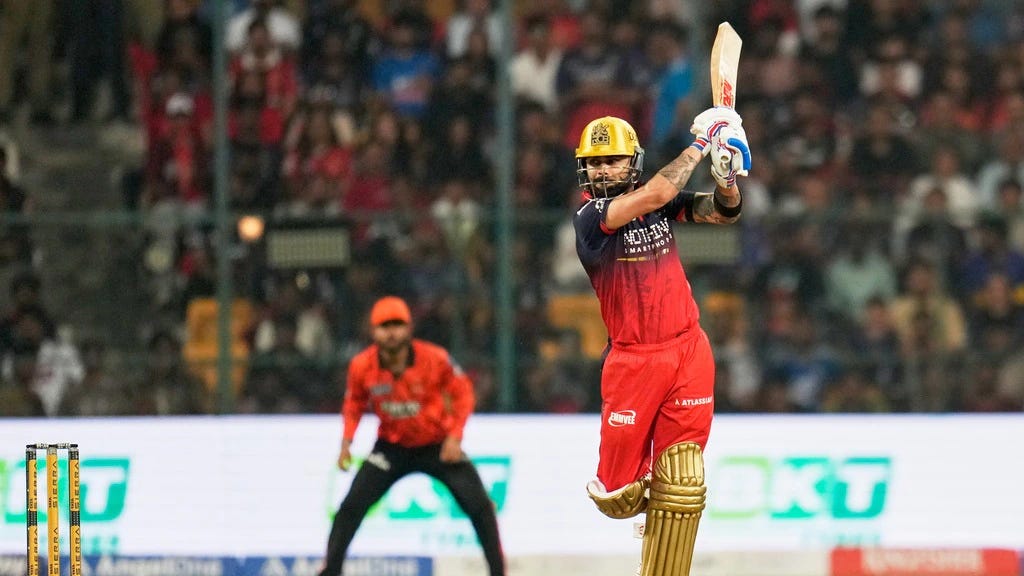
RCB beat SRH by 6 wickets. A dominant performance with bat and ball (against a team that looks like it’s going to struggle with the ball particularly) was just the start the defending champions needed.
But, what happened beyond the headlines?
-
🍺 How Jacob Duffy decimated SRH’s top order.
-
💭 RCB have deliberately built an incomplete bowling unit.
-
🏏 Devdutt Padikkal’s transformation from accumulator to accelerator.
RCB gets drunk on the Duff
✍️ Written by Aarush Adil Khan.

Jacob Duffy made the perfect start to his RCB career with figures of 3-22, including picking up both the dangerous SRH openers in the third over. While he led the line remarkably in Josh Hazlewood’s absence, Bhuvneshwar Kumar deserves some credit for squeezing SRH’s batters in the powerplay too.
Kumar came on in RCB’s second over, and targeted a single channel – hip-height balls that pitched beyond leg stump and swung into the batters’ bodies to cramp them. He kept the pace steady with all his deliveries in the second over ranging between 132 to 134.9 kph, and focussed on trying to bait the southpaws into a bad shot.
The tactic worked because RCB did their homework. Both Sharma and Head are prolific pullers off the ball in the powerplay (the former’s 2nd most favoured ball, and the latter’s third), but neither play it with great control. Abhishek’s control percentage with powerplay pull shots is just 57.5%, and Head’s is 64.85%. If you give them an easy pull shot, they’ll score off you. But, disciplined and repetitive balls that cramp them on the legside can frustrate them.
And, so it proved in Kumar’s over. Sharma scores at 178.22 in the powerplay while Head scores at 190.52. In the 5 legal deliveries that Kumar targeted at the legside-to-batter’s-hip line, the duo scored just 3 runs (plus a leg bye). By the end of the over, Sharma had 7(7) and Head had 7(5), and neither looked comfortable.
Duffy stuck to the same line in RCB’s third over, but sent his first ball down marginally wide on the legside. After giving away the extra, Duffy adjusted to a short middle-to-off outswinger that was begging to be pulled to square leg, and Sharma duly went after it. However, the scrambled seam delivery induced a mishit, a top edge, and an easy catch for RCB keeper Jitesh Sharma. It was a tactic straight out of the Douglas Jardine playbook.
Duffy then doubled down on scrambled seam to Travis Head for the rest of the over. His second ball to the Aussie opener in the over (ball 3.4) was a slow delivery (131 kph) that went back to the leg-to-hip line and length. His third ball to Head (3.5) was another scrambled seam, although it was fuller, 4 kph faster, and closer to off – and was duly dispatched to straight on boundary. Duffy’s fakeout had been caught by Head.
Duffy went back to the original plan – leg-to-hip, but faster at 136 kph. Riding the high of his last boundary, Head took the bait, pulled the ball, and found Phil Salt at square leg. So perfect was Duffy’s bait that the fielder didn’t even have to move. The ball reached him where he was positioned.
Duffy and Kumar had worked together to reduce SRH to 23/2 after 3 overs – and eventually 54-3 in 7 overs after the Kiwi bowled out his 4 overs immediately. It immediately killed the chances of an SRH victory as the batter-heavy side saw half their established order taken out, leaving Ishan Kishan, Heinrich Klaasen, & Aniket Verma with too much to do.
Data from the Jio broadcast & DeepCrease.
RCB’s self-inflicted spin handicap
✍️ Written by Raunak Thakur, who runs Dead Pitch’s Society. Follow him on X.
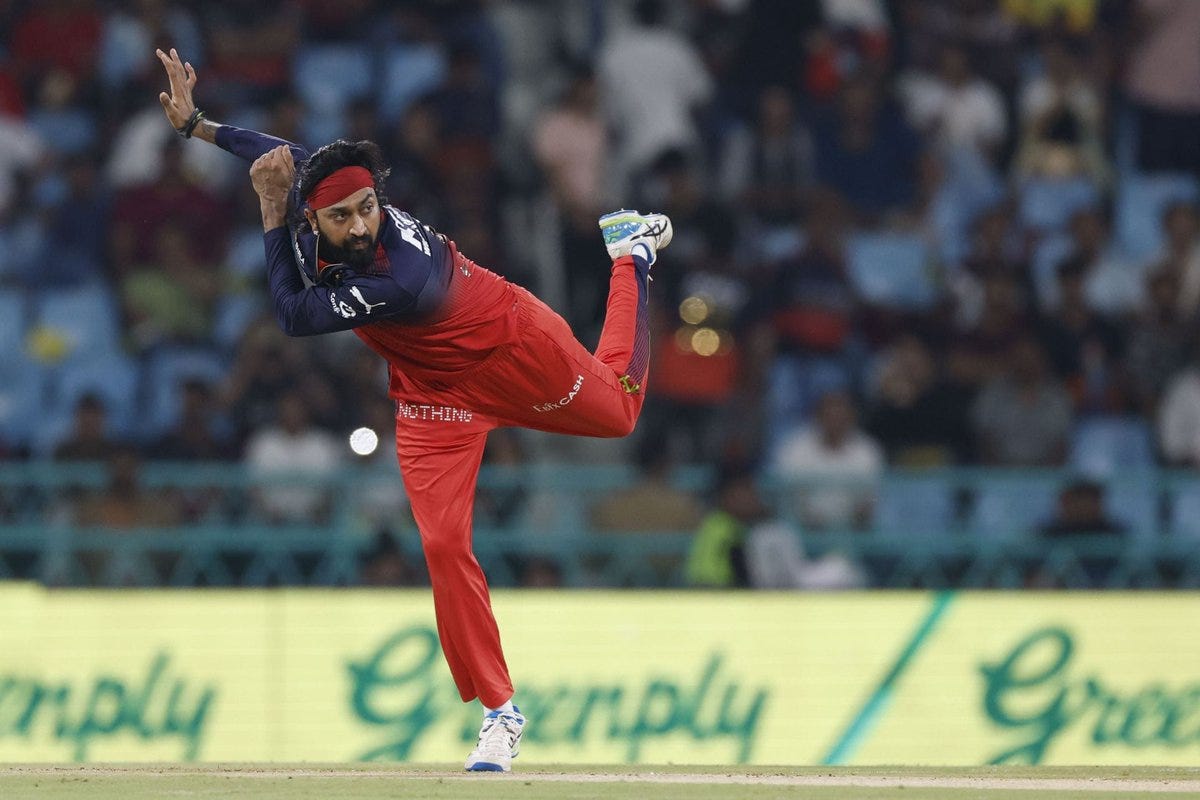
Tonight, RCB didn’t turn to their spinners until the 10th over, despite the fact that their third and fourth pacers were getting hit at over 10 RPO. It wasn’t an entirely confusing decision; Ishan Kishan was at the crease and loves playing leg-spin. Both of RCB’s spinners – Krunal Pandya & Suyash Sharma – bowl the ball right-to-left.
When the spinners did come on after the strategic timeout, they actually did well. Sharma bowled a series of googlies that effectively turned him into an offie against Kishan in the 10th over, while Pandya’s drastic pace variations – from 88 to 104 kph – nearly got the wicket of Heinrich Klaasen in the 11th over. The two overs went for 13 runs combined, but the SRH batters would strike back immediately.
Sharma’s second over saw him start to err with his lines by drifting into Kishan’s pads. He was duly dispatched for 13 runs. Pandya’s second over was even worse as the SRH duo were expecting his variations and picked them up easily to score 21 runs. Even after Klaasen’s wicket, the spinners couldn’t be brought back because Aniket Verma strikes at 272 v leg spin, and 168 v SLA.
In all, the RCB spinners bowled five overs, and conceded 54 runs at an RPO of 10.8. There are two reasons why this number is much worse than it looks; (1) RCB’s third and fourth pacers – who were forced to bowl 7 overs – went at 13.14 RPO, and (2) RCB’s poor planning has meant that the only off-spinner in the squad is the inexperienced U19 player Kanishk Chauhan – who is barely known for turning the ball a lot.
Josh Hazlewood’s injury could not be planned for, but has been adequately replaced (at least on the night) by Jacob Duffy’s stunning 3-22. However, as mentioned above, RCB’s third and fourth pacers – Romario Shephard and Abhinandan Singh – conceded 92 runs in 7 overs but had to be used repeatedly because their only spin options were terrible matchups for SRH’s left-hand batter heavy lineup.
RCB went into tonight’s game with four right-arm pacers and two spinners who turn the ball in the same direction. This leaves RCB’s bowling alarmingly predictable. They never have the option to introduce a useful matchup in the powerplay; they can only go with their two swing bowlers up top, and that’s all teams have to prepare for.
Which brings us to the second part of RCB’s problem; their decision to ignore their lack of off-spinners in their first mini-auction as champions. They won the title last year without a strong off-spin option, but that was mitigated by the presence of two top notch pace options that are missing this year – Hazlewood and Yash Dayal.
The decision to retain Dayal in particular is egregious. The pacer is accused of sexual assault, and had already been dropped from a state league over the allegation before the mini auction. Nevertheless, RCB decided to retain him which led to the most obvious last-minute binning of the pacer in the week before the IPL started. Which meant that RCB had one less spot (and INR 5 Crore tied up in Dayal’s salary) in the mini-auction.
RCB do have another part-time offspin option; Jacob Bethell. However, their choice of foreign players means they are unable to accommodate him. They need all of Phil Salt, Tim David, Jacob Duffy, and Romario Shepherd to provide the balance in their XI (though Salt is probably the most vulnerable if tonight’s performance is an indicator of his form).
RCB’s frontline pacers gave them a great start today; 54/3 in 7 overs, at an RPO of 7.71 (including a 16-run over from Singh). In the last 13 overs, RCB conceded 147 runs at an RPO of 11.3, including two brilliant, unexpected catches from Phil Salt that probably kept the score below 230. Against a team with next to no bowling talent, it was an easy chase for the champions. But, their lack of bowling variation is glaring, and better teams are going to exploit this weakness more ruthlessly.
Data from Cricmetric.
Padikkal takes charge of RCB’s run chase
✍️ Written by Tarun Pratap, who runs The Rank Turner. Follow him on X.
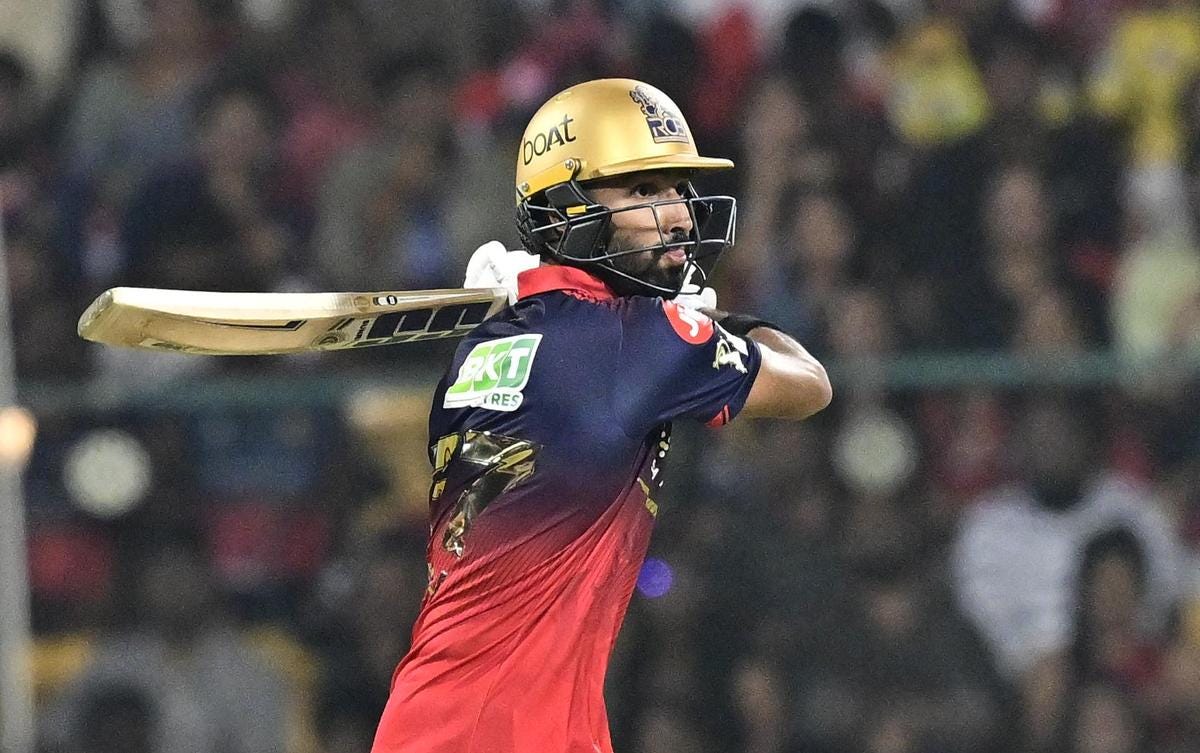
Devdutt Padikkal paced RCB’s successful chase tonight, scoring a rapid 61 (26) after coming in early after Phil Salt’s wicket in the 2nd over. It was a near perfect innings to calm the nerves during a mildly tricky chase, and was completed in ease. The RCB impact player had a control percentage of 76.9%, and faced just 3 dots.
However, his most impressive stat is that 42.3% of his balls faced were dispatched to the boundary, and that he scored four 6s and seven 4s (or a 4-to-6 ratio of 1.75:1). The method of his scoring is somehow more impressive than the numbers. He batted in 8 different overs, and in 5 he struck his very first ball faced for a boundary. In 2 other overs, he dispatched his second ball faced to the fence. It was a clear attempt to target every bowler early to disrupt their plans.
Not only was tonight an outstanding innings to watch, it is the continuation of Padikkal’s rapid improvement at the IPL since last year.
Padikkal made a name for himself in his very first IPL season, scoring 473 runs in 2020 at strike rates in the 120s. He was an accumulator, but one with a lot of promise in the pre-Impact Player era. His powerplay boundary types are proof of this. In 2020, he struck 37 boundaries in the powerplay but only three 6s for a 4-to-6 ratio of 12.3:1. He relied more on timing and finding the gaps than muscling the ball – a tactic that had served him well in List A cricket where he averages around 80!
However, by 2024, he was starting to get left behind the best young talents. To top it off, he had a miserable year in the IPL scoring just 38 runs in 7 innings. He made his Test debut for India the same year, reinforcing an insidious idea; he was just too slow for elite T20 competitions.
But, Padikkal made the conscious decision to change his game ahead of the 2025 IPL.
“I’m trying to bat differently than what I’ve been doing the last few years. It’s a conscious effort… DK [Dinesh Karthik] and Andy [Flower] have worked on me relentlessly over the last couple of months, and that’s really working now,” he said during IPL 2025. In another interview, he admitted: “In previous years, I was stubborn about wanting to bat in a certain way… Once I started changing that this season, I was able to stay one step ahead of the bowler.”
The numbers back up his words. In 2025, he scored nearly as many 6s (five) to 4s (six), for a 4-to-6 ratio of 1.2:1 (which is literally 10x better than his 2020 number!). The jump in maximums came because Padikkal started focussing more on aerial shots to get his game going. The approach has served him well outside the IPL, with Padikkal having big seasons in both List A and T20 domestic tournaments since last year’s title-winning effort with RCB.
By the end of the powerplay tonight, Padikkal had raced to 41 off 17 balls, powering RCB to 76-1 in 6 overs. That platform proved decisive, giving the defending champions the momentum they needed to cruise home with 6 overs to spare. His smart and controlled aggression ensured RCB were ahead of the game from the start.
Data from Cricmetric & ESPNcricinfo.