

NZ beat SA by 9 wickets. It wasn’t a “classic South African choke.” It was a clinical, thorough dismantling of the idea that talent alone wins cricket matches. Rigorous homework and smart tactics count for a lot. Oh, and 33-ball centuries help too.
But, what happened beyond the headlines?
-
📊 How NZ targeted Markram’s corridor of pace uncertainty.
-
🌪️ How NZ targeted QdK & Rickleton with a 34-year old journeyman.
-
🎯 How NZ targeted Miller with catching practice.
-
🏏 Why did the second innings feel like a different game altogether?
If you’re reading this online, remember: you can get it via WhatsApp or direct to your email👇!
✍️ Written by Karan Jain, who runs CricNuance. You can follow him on X.
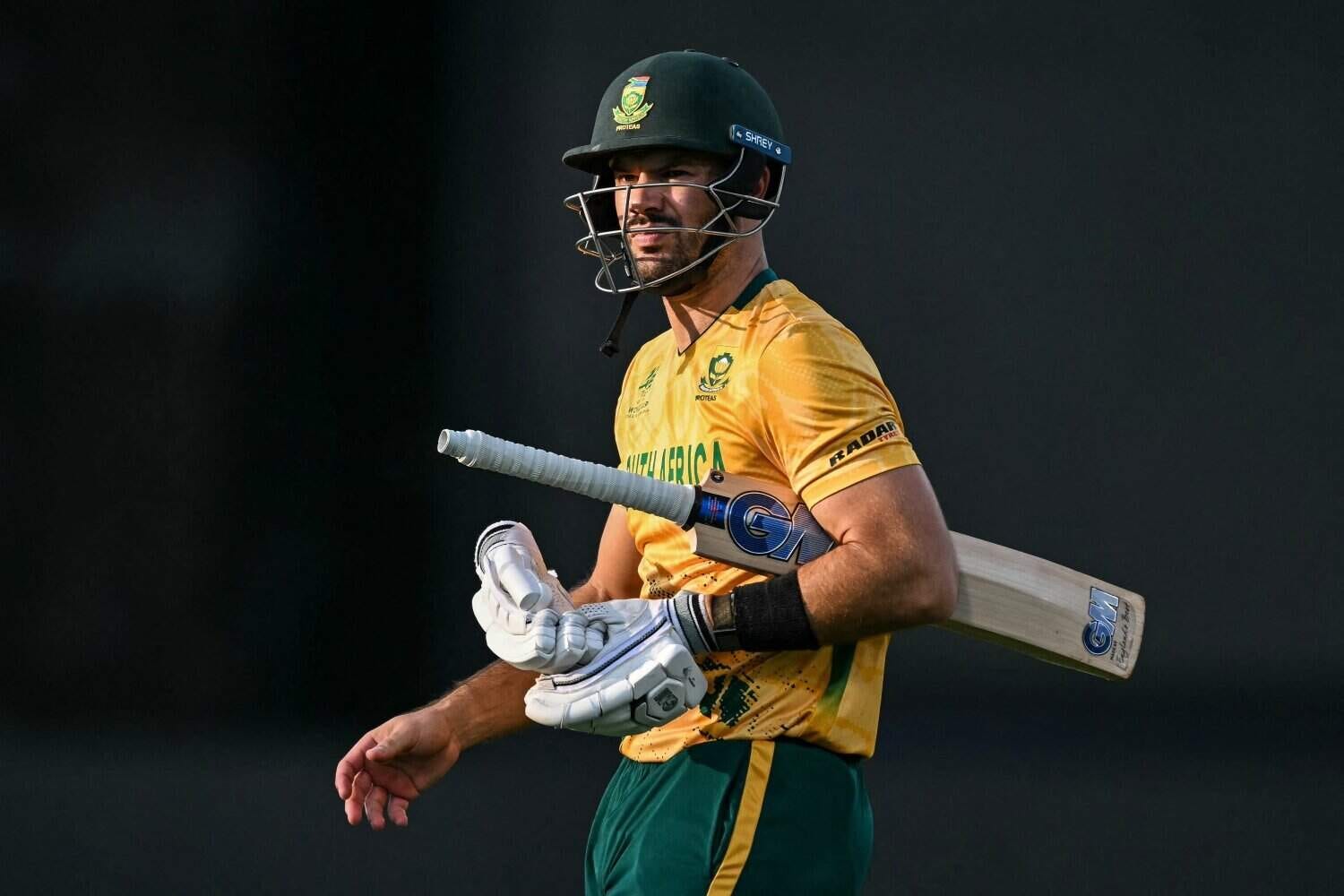
New Zealand came into today’s semifinal with a plan. Or, more specifically, they came into the game with a plan for every top order batter, and winning the toss helped them implement those plans immediately.
Aiden Markram would face a very specific corridor of balls against right arm pace (despite his recent improvements against the bowling type). The left-handers – Quinton de Kock and his clone Ryan Rickleton – would face NZ’s powerplay offie specialist Cole McConchie. You would assume that Miller too would face that LHB specialist, but no. They had another specific corridor of balls with which to target SA’s reliable middle order bat.
Markram’s been dominating this World Cup. He’s scored 268 runs at a SR of 175.2 before tonight, making him the leading run scorer amongst the semifinalists. That strike rate jumps up to 192.9 in the powerplay – and New Zealand threw five overs of right arm pace at him. Since the start of 2025, Markram averages 119 and strikes at 176.7 against right arm pace.
It sounds like a terrible matchup, but NZ had done their homework. In their group stage encounter, the SA skipper scored 45 (16) in the powerplay by punishing deliveries that largely ranged from the outside off line to the wide outside off line. This was playing to his strength. Against pace since 2024, Markram averages 30.2 in the offside channel and 59.7 to the legside deliveries.
However, if you can find that sweet spot targeting his stumps, that average drops drastically to 17.6. That’s what NZ’s pacers aimed for, and hit, with unerring regularity.
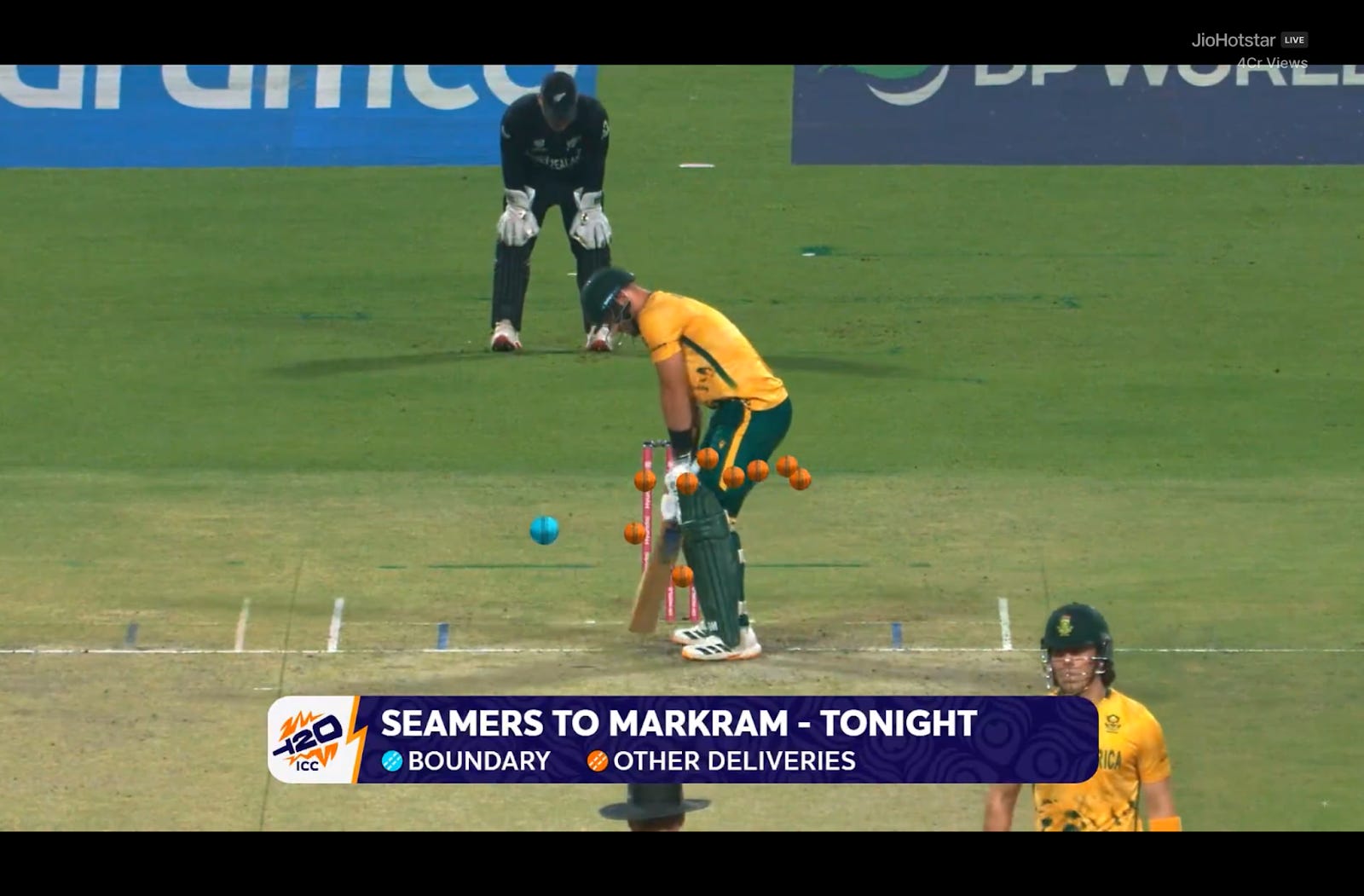
Matt Henry started the proceedings by pitching the ball on a length and hitting the leg-stump line. At one point, he even overcorrected and bowled five wides down the leg side, but the aim was clear: don’t let Markram drive on the offside or a length he can comfortably punish off the backfoot. 4 of Henry’s 5 legal deliveries to Markram were on the stump line, with none over-pitched or short enough to be easily hittable on length.
Lockie Ferguson continued the line of attack when he came on in the 4th. After a couple of quicker length deliveries on the stump line that he couldn’t get away for runs, Markram was overtly frustrated.
He had been going at 200 SR v powerplay pace this World Cup, but tonight he had just 2 (6) v pace. NZ pulled up their deep midwicket fielder to the ring, and Ferguson bowled slightly wider – and much slower – to bait Markram. He took the bait, and Ravindra dropped the catch.
In all, he could only score 8 (12) versus Henry & Ferguson, but Markram did get his release when a looser Jimmy Neesham over in the 5th gave him a maximum. That would be the end of his respite, as the SLAs came on in the middle overs. Markram strikes at just 126.3 versus the bowling type.
Mitch Santner & Rachin Ravindra bowled that stump line to Markram, and after a 15-ball boundary drought for SA, the pressure finally told. Markram got nowhere near a slower length delivery from Ravindra, and skied one to long-off. After failing to get him out once in the group stage encounter, NZ had him out twice tonight.
Data from Cricmetric, & the Jio broadcast.
If you’re reading this online, remember: you can get it via WhatsApp or direct to your email👇!
✍️ Written by Ben Brettell, who runs Cricinspo.

While the Markram battle was dragged out over nearly 8 overs, NZ’s plans for SA’s left-handed top order came to fruition in 5 balls. Cole McConchie is probably a new name to fans outside his home nation. He’s only played 13 internationals and is not a regular fixture in the side, and, at 34, he is hardly an emerging prospect.
However, he was immediately thrown the new ball in the second over. The choice to play off-spin inside the powerplay was clearly driven by match-ups tonight. Across all T20 cricket McConchie’s overall record is solid rather than spectacular – 76 wickets at an average of 26.8 with an economy rate of 7.64. However, against left-handers that average drops to just 21.0.
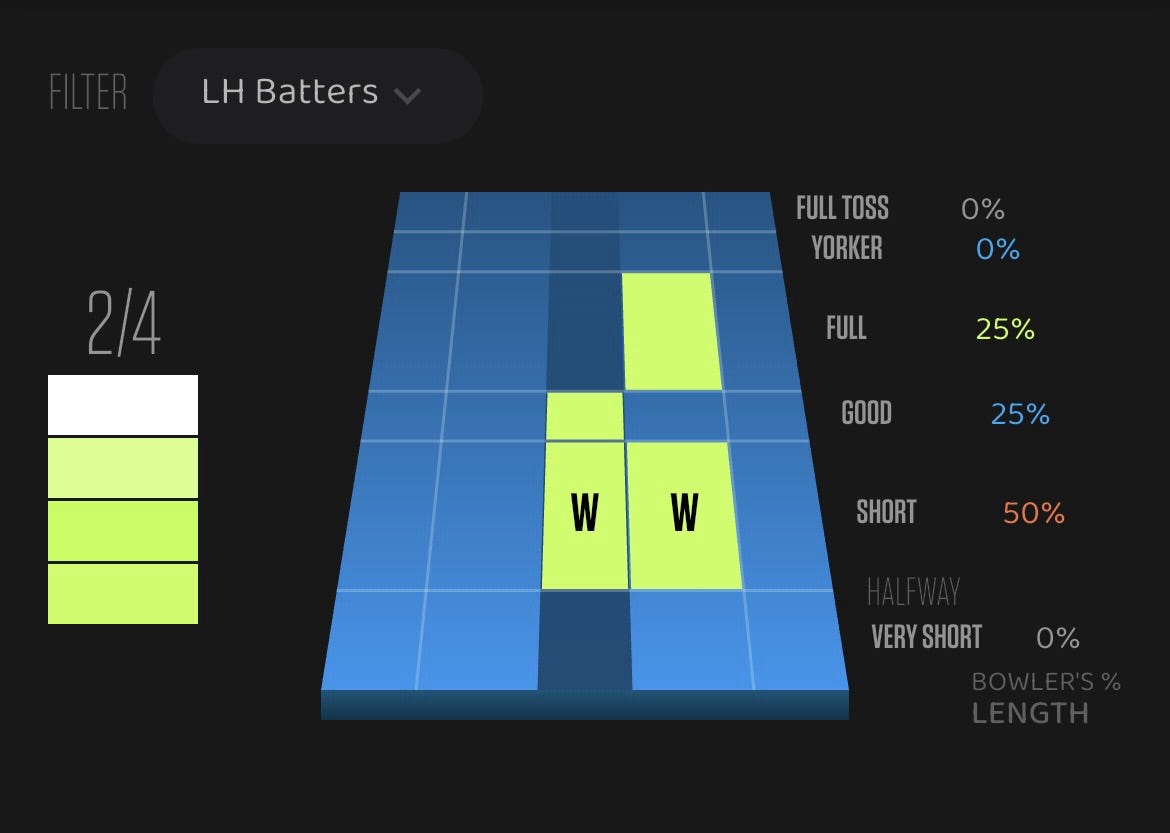
South Africa’s left-handed opener Quinton de Kock presented exactly the situation New Zealand were waiting for. He’d already been dismissed three times by off-spinners in the tournament, each time by deliveries in the channel outside off stump. McConchie went straight to that plan.
His second ball to de Kock was lofted just over mid-on for four, but the line did not change. The very next ball drew an ungainly swipe across the line, sending the ball high into the night sky. Ferguson made no mistake under the high ball.
The new man in was Ryan Rickelton, another left-hander, was tricked by a seemingly “hit-me” ball but which deceptively spun away. McConchie might’ve even had a hat-trick if NZ put a slip in place for the third edge in a row he induced against Dewald Brevis.
The LHB specialist had done his job, probably quicker than even NZ could’ve expected.
Data from ESPNcricinfo & Cricmetric.
If you’re reading this online, remember: you can get it via WhatsApp or direct to your email👇!
✍️ Written by Tarutr Malhotra, who runs Best of Cricket.

When David Miller came out to bat in the 8th over, you would assume that McConchie’s specialist off-spin would return. However, NZ stuck to their analytics. Despite the double-wicket over, the 34-year-old wouldn’t bowl again during the entire innings.
NZ use McConchie as a matchup-specific powerplay specialist, and have reaped the rewards. He’s taken 55% of his T20I wickets in the powerplay, at an economy of just 6.25 and an average of 15.0. Comparatively, his overall NZ numbers stand at 7.88 and 26.6. So, the LHB specialist wasn’t to be used against SA’s most dangerous LHB, regardless of how he’d done on the day.
Instead, NZ capitalised on another brilliant insight. David Miller is not traditionally a great SLA hitter, but he has been scoring at 137.5 against them in 2026. However, Ravindra & Santner came prepared. They knew Miller is particularly susceptible in the long-off region. A full 30% of his wickets versus spin via catches come in that area.
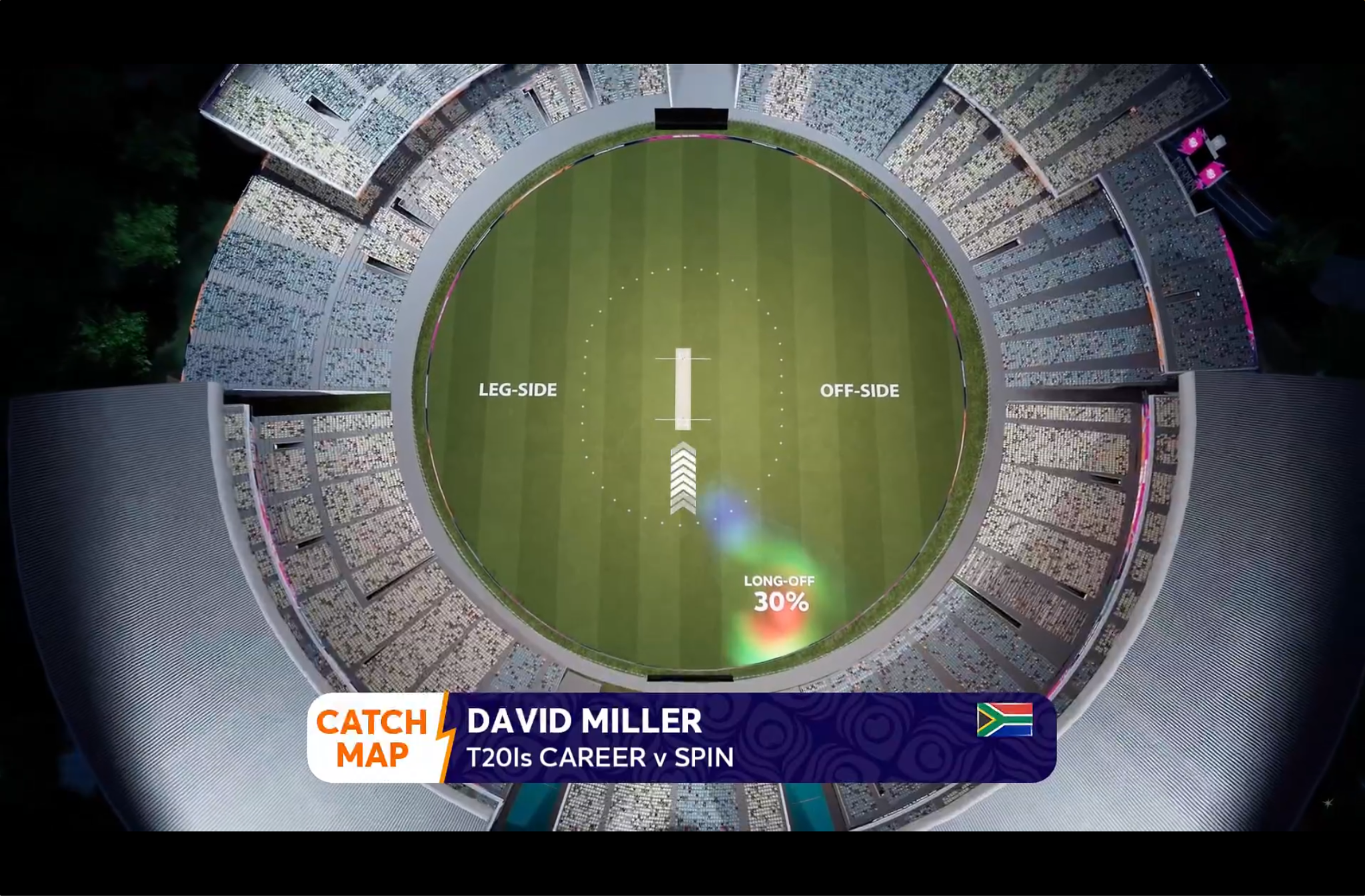
So, both Ravindra & Santner targeted that wide off stump line, spinning away, with a packed cover ring. The length balls sat up nicely to be hit, and Miller just couldn’t resist them.
Of all people, Glenn Phillips dropped the first miscue on 9.1, but a similar ball and miscue was caught by Daryl Mitchell on 9.6. Much like Markram, NZ were smart enough to get Miller out twice tonight after failing to get him out even once in the group stage game.
The next over, the pressure told and Brevis unnecessarily hit a slot ball to a fielder. 10.2 overs into the semifinal, and NZ had reduced SA to 77/5. Marco Jansen put up a worthy rearguard action – ironically off multiple complacent deliveries from the NZ bowlers – but it was too little, too late.
NZ had done their homework, and SA were irreversibly pegged back.
Data from Cricmetric, & the Jio broadcast.
If you’re reading this online, remember: you can get it via WhatsApp or direct to your email👇!
✍️ Written by Tarutr Malhotra, who runs Best of Cricket.

I’ve been sitting here trying to figure out what happened to South Africa.
They were the only unbeaten side in the tournament. They survived a double super over battle. They topped the Group of Death. They beat India, in India. They were the favourites. Their batting order was clicking, their bowling unit was devastating, their fielders were on high alert for every ball.
Until, nothing worked today. We’ve covered how NZ did their homework to decimate SA’s batting order, but the disparity in the two innings is stark. Even the comms recognised it, saying it looked like NZ were batting on a different pitch in the second innings.
So, that’s the first place to look. Except, people at the ground reported that dew was not a factor. The pitch was dry at the innings break. What about historically? In the 18 night T20s played at Eden Gardens since the start of 2023, the side chasing has won…9 times. Exactly half, with one game recorded as a no result.
Okay, so that’s not it. However, looking at those 19 games, something more interesting comes to the fore. Spinners are far more effective. They’ve gone at just 8.24 with an average of 25.72. Comparatively, pacers have gone at 10.55 with an average of 34.96. And, South Africa dropped their second spinner – George Linde – for a fourth pacer, Corbin Bosch.
SA didn’t do their homework. Bosch had a bad night. He gave away 35 runs in his 2 overs. However, Linde’s been having a bad tournament – going at 7.8 an over with an average of 26. Even after tonight’s horror show, Bosch is going at 7.64 with an average of 17.36 – and is the equal 3rd highest wicket-taker in the World Cup with 11 scalps.
Would life have been better with a second spinner? Maybe. But Bosch only got the ball after NZ had already raced to 62/0 in 5 overs. So, maybe we need to look at what NZ did right. Again.
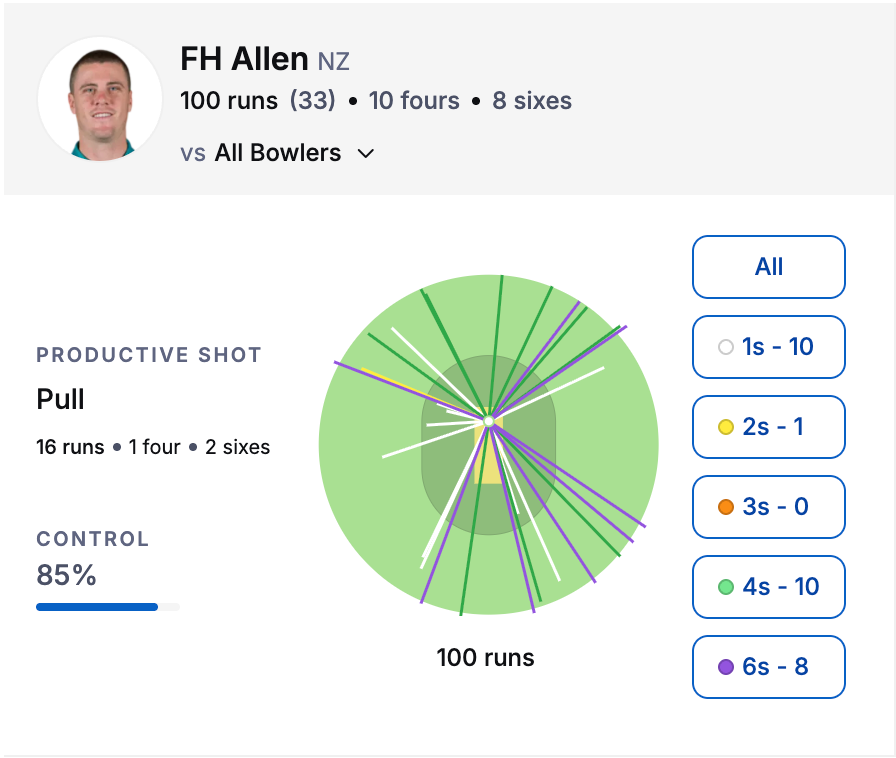
Finn Allen & Tim Seifert were beyond brilliant tonight. They scored 158 runs in 66 balls, conceding just 14 dots between them. Allen in particular was outstanding, scoring a century at over 300 SR. And his play wasn’t a result of poor bowling. Or, well, just poor bowling.
An inch perfect Jansen yorker? Allen shuffled around to flick it to fine leg for a 4. A wide of off Rabada ball with a packed offside? Beautifully cut between slip and short third for one of the prettiest shots of the tournament. A top-of-off targeting length ball by Maharaj that’s spinning away? Smacked over deep midwicket for a maximum. I still don’t understand the physics of that one.
Allen averaged more than 3 runs a ball, without ever looking like breaking a sweat or giving away his wicket. He finished with a control percentage of 85%, and six times as many boundary balls (18) as dots (3).
Going into the 13th over, NZ needed 21 to win, and Allen need 24 for his century. Three 4s and two 6s later, and the NZ opener didn’t even need the entire over to hit both milestones. This game was ridiculous, but not as ridiculous as Finn Allen.
Data from ESPNcricinfo, with help from Shayan Khan.
If you’re reading this online, remember: you can get it via WhatsApp or direct to your email👇!