
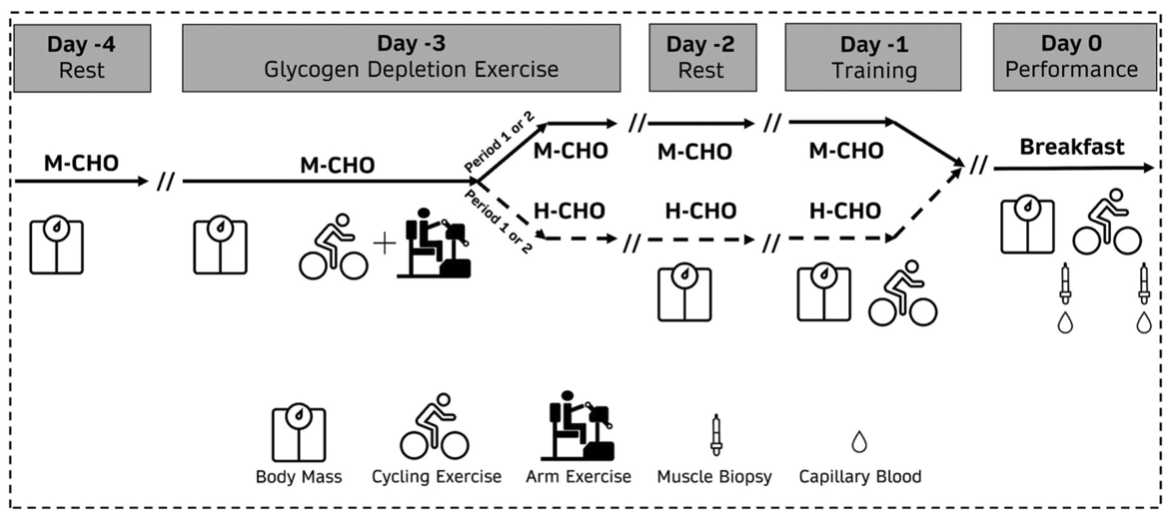
Day -4 was a standardisation day, where the participants all followed a medium carbohydrate diet (M-CHO, 4g/kg body weight of carbs). This was intended to help standardise muscle glycogen levels at the start of the trial.
Day -3 was a glycogen depletion day, where participants performed vigorous cycling and arm exercise, to deplete muscle glycogen in both the lower and upper body.
The exercise comprised of:
On the bike:
-
10-mins at 100W
-
3x 6-sec sprints
-
2x 30-mins at 75% maximal aerobic power (i.e. roughly FTP), with 5-mins recovery between
-
10-mins easy
-
3x 1-min all-out efforts with 5-mins rest
On the arm crank:
-
3x 5-mins arm cranking at 1W/kg body weight, followed by 5-min rest
-
3x 1-min all-out efforts followed by 5 min rest
Back on the bike:
After this exercise, the participants either followed a high-carbohydrate diet (H-CHO, 10g/kg body weight of carbs per day), or a medium-carbohydrate diet for the remaining days, along with one more bout of exercise on Day -1, which comprised of:
Finally, on Day 0, the participants performed a performance test, involving either a 1-min maximal test, or a 15-min maximal test, each followed by 3x 6-sec all-out sprints. 10 participants were allocated to the 1-min test, and 12 participants were allocated to the 15-minute test.
Each participant performed both the high-carb and the medium-carb protocol, in a randomised order, and performed the same performance test after each protocol.
Body weight was monitored regularly throughout, as shown in the figure above.
Food during the study period was supplied by the lab, and closely controlled throughout the investigation. All participants received the same amount of fat, protein and fibre, with the additional carbohydrate in the high-carb diet being made up of easily-digestible, low-fibre carbohydrates, such as sweets and sugary drink.
What did the study find?
The researchers had a number of key findings…
-
Both protocols resulted in reduction in body weight. However, the medium carbohydrate diet resulted in the greatest body weight loss (2% body weight vs 1.2%), and this was determined to be statistically significant.
-
Power output over 1-min and over 15-mins was not impacted by the intervention. In other words, following the medium carbohydrate diet did not negatively impact power output, even though muscle glycogen levels were lower.
-
There was a tendency for W/kg to be higher in the medium-carbohydrate trial, but there were insufficient participant numbers to detect this reliably.
Study limitations
When reviewing scientific literature, it’s always important to consider whether the study has any limitations or shortcomings.
One key limitation of the study is that overall energy intake was not controlled between the high-carbohydrate and the moderate-carbohydrate groups. The high-carbohydrate group ate more kcals than the moderate carbohydrate group. Therefore, it’s unclear whether and to what extent the reduction in body weight in the moderate carbohydrate trial may have been a result of body fat loss, rather than glycogen reduction. That said, it would be difficult to lose notable body fat over just a 4-day period, so it’s likely a significant portion of weight loss was attributable to glycogen reduction.
It also appears that all participants were in a calorie deficit when following the plan (i.e. they were eating fewer calories than they were burning), and it’s not clear whether this is an essential component of a successful carbohydrate unloading plan.
Another limitation is that the exercise performed on Day -3 was very challenging, involving 1H near threshold, and a total of 6x all-out sprints, and 6x 1-min maximal efforts. This is probably not compatible with tapering for, and being in peak shape on the day of an event. Thus the protocol presented in the present study may not be completely translatable into practice.
Finally, we know from this study, that ‘carbohydrate unloading’ doesn’t negatively impact power output for durations up to 15-mins. But we don’t yet know the tipping point where carbohydrate unloading becomes detrimental to performance. It’s not clear, for example, whether carbohydrate unloading would be a help or hindrance in a hilly 10-mile time-trial. Our sense from the theory and experience is that events lasting up to roughly 30-mins may benefit from carbohydrate unloading. However, if you’re competing over ~15-30 minutes, then you should definitely test this nutritional strategy out yourself in training and lower priority races to see how you fare, before using in a high-priority race.
Nutritional recommendations for short cycling events
So what should you be doing in the lead-up to a short race like a hill climb?
Given the ‘aggressiveness’ of the exercise program used in the study, we’ve tried to come up with an adapted protocol that’s better suited to a traditional taper period, allowing an athlete to be in peak shape on race day.
Evidence from the scientific literature (e.g. Tønnessen et al., 2014) and our own experience does suggest that it’s beneficial to include some intensive training roughly 4-days out from competition, which could be used for glycogen depletion. This would usually be a slightly abbreviated interval session, so would not be as ‘aggressive’ as the session used on Day-3, and probably wouldn’t deplete muscle glycogen to such a large extent.
That being the case, it might be helpful to extend the period of time over which a lower carbohydrate intake is followed, meaning other training sessions that form part of the taper can also contribute to reducing muscle glycogen levels.
A good taper that helps to reduce muscle glycogen levels might look something like: