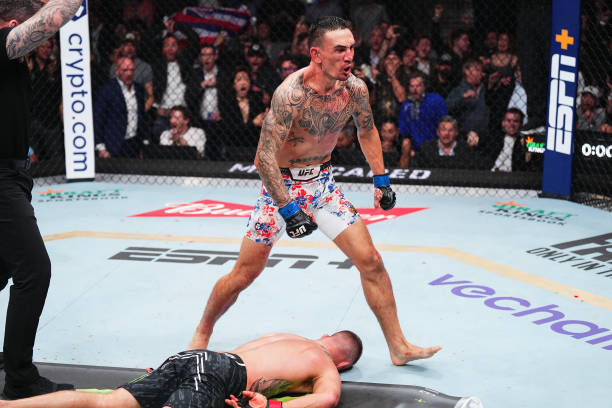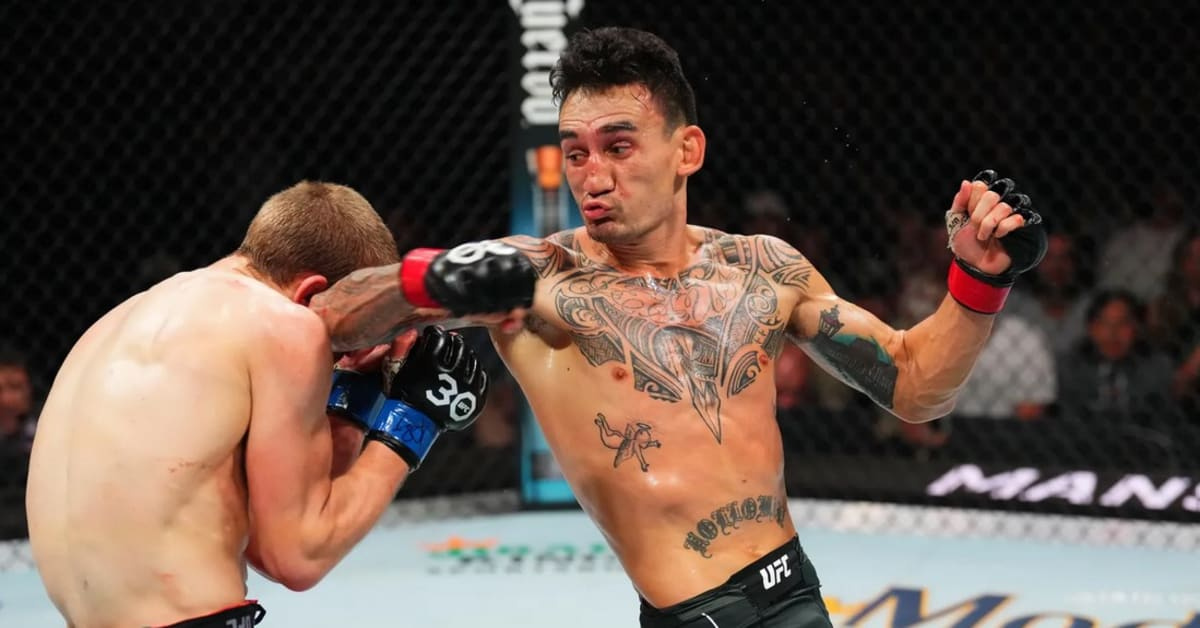
Max Holloway has framed his upcoming rematch with Charles Oliveira as a meeting of two evolved mixed‑martial artists, not a simple striker‑versus‑grappler matchup. Ahead of their five‑round lightweight bout for the BMF title at UFC 326, Holloway has repeatedly emphasized that Oliveira is “a killer” with a complete skill set, and that he feels confident both in his takedown defence and his ability to compete on the ground if the fight goes there.
Max Holloway shuts down ‘striker vs grappler’ talk ahead of Oliveira clash
Speaking with Stake, ‘Blessed’ Max Hollooway explained:
Charles is a killer, man. He’s a great fighter with amazing skills. I find it funny, people say that this is a striker v grappler match up, but this is MMA, man. Charles is not a straight jiu jitsu guy, he uses his strikes to set up his grappling.
“I’ve seen some people say, ‘If it goes to the ground, it’s over for Max,’ and I’m like, what?! I am very confident in my takedown defence, but also my ground game. I’ve been training in jiu jitsu for years, I love it. I have way more jiu jitsu sessions now than any other aspect and I actually like them the most. I like training in the gi.
“I saw some things online with people saying why am I doing that, it’s unrealistic… but if you can’t hold me down in a gi, then you’re not going to hold me down when I’m all sweaty in an MMA fight!
Holloway has pushed back on those who insist he will be in danger if he is taken down, noting that Oliveira is not a pure jiu‑jitsu specialist but a fighter who uses strikes to set up his grappling. Holloway has pointed out that many of Oliveira’s finishes come after he has hurt opponents on the feet, then capitalised on the ground. That observation feeds into Holloway’s preparation: he is treating Oliveira as a balanced threat rather than a one‑dimensional grappler, which shapes his approach to distance, feints, and reactionary takedown defence.
This is MMA, and it happens when people go on these crazy runs, so I wasn’t surprised, nothing surprises me in this game. Charles said himself, he was a cub back then, now he’s a lion! Maybe I was a toddler back then and now I’m a teenager? Jokes aside, I’m glad we’ve both gone on to do what we have done, and I’m looking forward to getting back in there with him.
“This doesn’t change the way I train to be honest. It was so long ago when we fought, and we have both become totally different fighters, that there isn’t much I can take from that fight. When you fight someone back to back like I did with Volk, then it can affect it, but on this occasion not really.
On the topic of grappling, Holloway has been open about where he puts his time in camp. He says he now trains Brazilian jiu‑jitsu more often than any other part of his game and has structured those sessions to harden his ground‑fighting composure.
He has also addressed criticism from fans who question why he still trains in the gi, arguing that if someone cannot pin or control him through the friction of a gi, they are unlikely to do so in a slick, sweaty MMA match. Those sessions are part of a broader effort to show that he is not just a stand‑up fighter who hopes to avoid the ground, but someone who trains to survive and counter in multiple positions.
Holloway has also revisited the context of their first fight, which took place in 2015 at featherweight and ended with a TKO due to an injury‑related stoppage. He has said that Oliveira was “a cub” back then and is now “a lion,” acknowledging how much Oliveira has grown as a finisher and a pressure fighter. Holloway has added that he himself has changed dramatically since that earlier meeting, joking that he may have been a “toddler” in 2015 and is now in a more experienced stage of his career. That shift means he does not view the first fight as a base template for his current strategy; instead, he is treating the rematch as a separate puzzle to solve.
In terms of camp structure, Holloway has indicated that the long gap between the two fights means he is not relying on direct footage from their first encounter for tactical details. He has instead focused on Oliveira’s recent performances, studying how he chains submissions, hunts for opportunities, and transitions between striking and wrestling. This approach has led Holloway to sharpen lateral movement, clinch‑level defence, and counters that can disrupt Oliveira’s rhythm before he can close the distance and initiate his usual grappling pressure.