
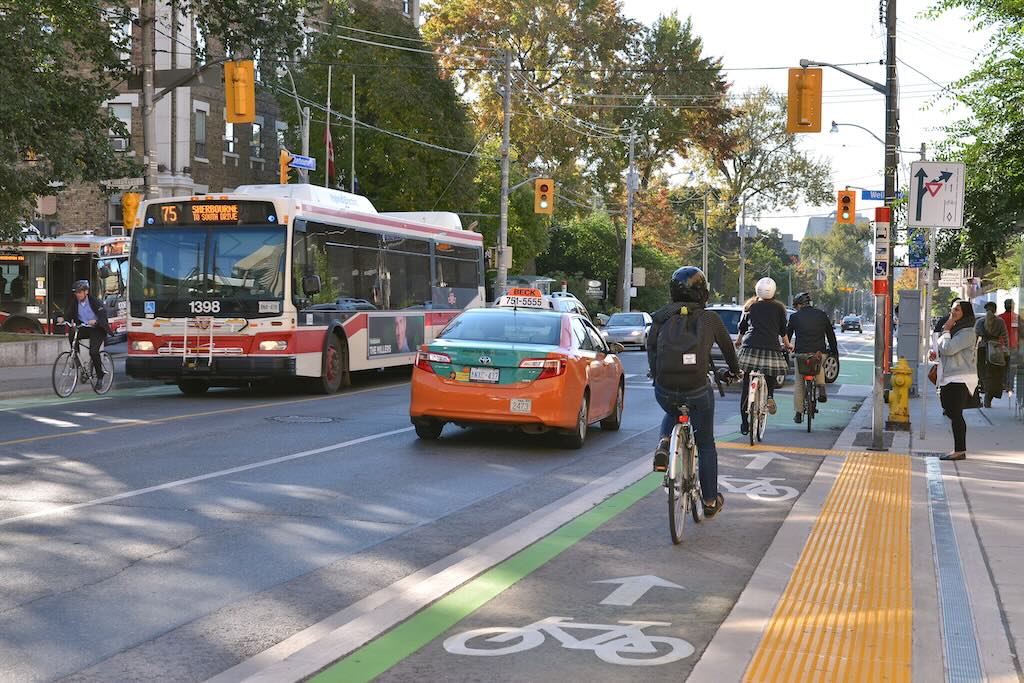
Safe cycling infrastructure is under attack across North America, just when massive investments are needed to provide a solid alternative to car culture and its many associated ills. For example, the legal fight over Toronto’s most high-profile bike lanes is entering a new phase, with the Canadian Constitution Foundation (CCF) stepping into the Ontario government’s appeal of a court ruling that blocked their removal.
The appeal, set to be heard Jan. 28, challenges a July 2025 Ontario Superior Court decision that found the province’s plan to rip out protected bike lanes on Bloor Street, University Avenue, and Yonge Street violated the Charter of Rights and Freedoms.
Those lanes—among the busiest cycling corridors in the country—have become flashpoints in a broader political and cultural battle over active transportation, not just in Toronto but across North America. As Momentum previously reported, courts have increasingly become one of the few remaining venues where cycling infrastructure has found protection amid mounting political backlash.
The dispute centres on Ontario’s Reducing Gridlock, Saving You Time Act, passed in November 2024. The legislation requires municipalities to obtain provincial approval before installing bike lanes that remove a lane of vehicle traffic and explicitly orders the removal of the three Toronto corridors. Cycle Toronto and individual cyclists challenged the law, arguing that removing the protected lanes would increase the risk of serious injury or death, violating Section 7 of the Charter—the right to life, liberty, and security of the person.
In his July ruling, Justice Schabas agreed, concluding that the bike lane removal provisions infringed Section 7 and could not be justified under Section 1, which allows governments to impose reasonable limits on Charter rights.
The CCF is now intervening—not to defend the Ford government’s policy goals, but to contest the constitutional reasoning behind the decision. The organization argues the ruling improperly turns Section 7 into a guarantee of “positive rights,” which would require governments to provide or maintain specific infrastructure.
Toronto bike lane
“Section 7 was meant to protect Canadians from government overreach, yet this ruling twists it into a tool for settling traffic policy debates,” said Josh Dehaas, counsel for the CCF. “The Charter was never intended to empower judges to micromanage infrastructure choices.”
Cycling advocates, however, see the case through a very different lens. When the courts previously upheld a temporary injunction preventing lane removals, they pointed to extensive evidence that removing protected cycling infrastructure would make Toronto’s streets more dangerous.
“The evidence in this case is clear — the removal of heavily used, protected bike lanes on major routes in Toronto will put the lives of cyclists at risk,” said Bronwyn Roe, a lawyer with Ecojustice, which represents the applicants alongside Paliare Roland LLP, in comments made during earlier proceedings.
Cycle Toronto executive director Michael Longfield has framed the case as emblematic of a wider culture war over street space.
“This historic legal challenge has already revealed the truth: despite all the public bluster, the province’s own experts agree that ripping out some of Toronto’s busiest bike lanes won’t reduce traffic congestion,” Longfield said at the time.
The Ontario government has yet to fully outline its appeal arguments publicly, but the case is being closely watched by municipalities, planners, and cycling advocates nationwide. A successful appeal could narrow how Charter protections apply to public safety and infrastructure, while a loss could reinforce the idea that governments cannot knowingly make streets more dangerous without constitutional consequences.
For now, the bike lanes remain in place—an outcome that, in the current political climate, still feels like a small but meaningful victory for cyclists. Whether that protection holds will depend on how far the courts are willing to go in defining the boundary between public safety, political authority, and constitutional rights.