
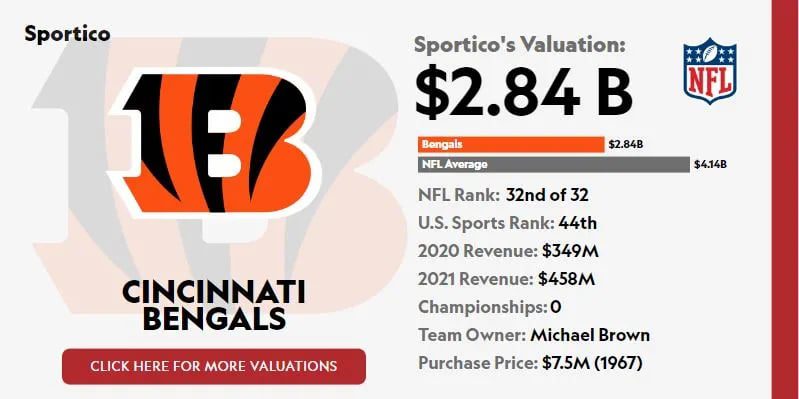
A week ago, I saw an article by Mike Florio that spoke of the Cincinnati Bengals frustration with Hamilton County on the lack of progress with lease negotiations. The Bengals are in somewhat of a hurry. They need to sign a new lease rather soon because their current one runs through 2026. The Cincinnati Enquirer got emails between the team and city showing how displeased both were with the other side. The team believes that there may not be any “political will for any deal” according to their Vice President. They point out how the city gave the team just $39 million for repairs to the stadium when the team wanted $300 million for upgrades. The Bengals said they would have added $50 million to that amount if a deal was agreed. How nice of them.
But just take a look around the city of Cincinnati. They seem quite unified in a non-unified world about not giving the Bengals whatever they wanted. Does a week go by without several people in the local media discussing how much they want the city to stand up to the team during lease negotiations? Or letters to the papers pleading with the city to do better than the last time negotiations occurred? Everyone seems so…angry.
They are angry. They have a right to be angry. Cincinnati continues to suffer from one of the worst city/sports deals ever put together. In 1996, residents in Hamilton County, Ohio, voted to increase their sales tax by 0.5% so that the city could build and maintain new stadiums for their NFL team (Bengals) and MLB team (Reds).
This tax increase was also going to give residents a few perks as well.
For example:
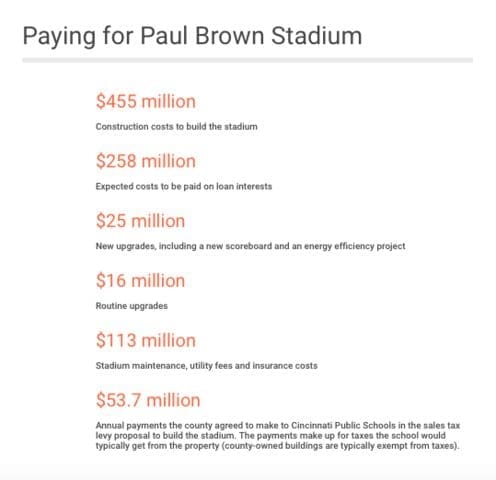
The stadiums were built first. God forbid they had done anything else first. But trouble started before either stadium was actually put together. The costs to build both venues had already gone up considerably in a short amount of time. The expected cost of building both stadiums was in total about $500 million. The final price tag for both was closer to $900 million. Then, much like what happens around the country with new sports venues, the economic development promises never come to life…or even remotely come close to happening. Neither people nor business companies wanted or cared to be closer to these new stadiums. The development around the new venues did not see some magic growth that was projected by the teams.
This meant that the sales tax numbers were never going to be high enough to warrant anyone getting an actual rebate. So not only was the city seeing no growth whatsoever, but the team was already wanting upgrades and repairs just a few years into being built. Again, this meant the city needed to find money quickly and a lot of it. Hamilton County was forced to either slash down or just completely cut most basic services due to the financial issues caused by the Bengals and Reds.

When things went from bad to worse for the county financially, the county was forced to sell a public hospital, stop almost all mass-transit investments, and trim most city positions to the thinnest allowed by law. One former commissioner of Hamilton County called the stadium deal an “albatross that hangs around our necks”. He went on to explain that every year, the county is forced to “either come up with more revenue or take away from spending for other things the county needs”.
Vice summarized just how bad this deal has become to residents:
“Paul Brown Stadium, the home of the Cincinnati Bengals, is the result of the most fiscally disastrous stadium deal in American history. The stadium cost more than double its initial projections, and wound up crippling Hamilton County’s budget. In 2008, Paul Brown Stadium debt accounted for 11 percent of the county’s general fund. In 2010, it was 16.4 percent. It is a fiasco.” — Vice, 2015
This hasn’t stopped the Bengals from continuing to act as if they have no soul. Over the years, the city has repeatedly begged the team to re-work the lease agreement so that the city could slightly breathe with their yearly finances. On the contrary, the Bengals have said no and continue to demand the newest of anything found in a stadium these days. Oh no, Hamilton County is thinking of filing for bankruptcy? Too bad, give us $10 million for this brand-new scoreboard that we want. The lease agreement actually states that if 14 NFL stadiums have some piece of technology or object or whatever it is, then taxpayers must buy the Bengals that thing. Moreover, just for the record, I understand that the Bengals and county did make changes in 2018. But the changes were not that large, and still included a LOT of taxpayer money going towards the team.
Let’s say you are a resident of Hamilton County. The Bengals get an absurd amount of money from taxpayers. Maybe you want to know how many times the Bengals have made such requests for super-awesome technology. Much like anyone else could, you request any information that the Bengals have on public money being given to the team. As the Cincinnati Enquirer found out, this is what the teams lawyers will send you:


Even when the city possibly could get some good news, the team will not even let them have it. Two years ago, it looked like the city would, in fact, see some percentage of revenue from this terrible lease agreement. The original lease states that when the Bengals sell their naming rights of the stadium, the city was entitled to nothing if the team was getting $60 million or less from it. But if it was above that? The city got a 30% cut of whatever was above that number. The Bengals signed a naming rights deal several years ago. When the city asked the Bengals for the financial documents, the team refused and sent a letter claiming that the city was to be given nothing.
This is how the team treats local leaders and residents who are funding the team’s stadium:
“Nearly four months have passed since the Cincinnati Bengals signed a deal with Paycor HCM Inc. over naming rights to the stadium…In the weeks that followed…the team and Paycor officials held a ribbon-cutting ceremony to christen the…16-year-sponsorship deal. Yet Hamilton County, which owns the stadium, is still unaware of the financial terms of the deal and can’t verify if taxpayers will get a share. The county has not approved the name change or the new signage, as officials continue to push for that information.” – WCPO, 11/29/2022
The Bengals claimed in a legal letter that they were allowed to subtract other costs into how much they got for the naming rights…which is absurd. The team also claimed that the contract was “confidential” so the team didn’t have to hand it over. The city barely fought this, and the Bengals got away with it. Yeah, city leaders called the team “arrogant” and “disrespectful” for these actions. But did they actually do anything t0 fix it? No. Who in the world thinks that the team would have actually gone through if the city put their feet to the fire and filed a lawsuit about this? Article 10 of the lease states: “In the event Team sells to a third party naming rights to the Stadium Complex, Team shall be entitled to retain the first $16.67 million of net revenues”. This means that if the amount given to the team is over that number, the city gets 30% of it. The Bengals have no legal grounds to claim confidentiality on these documents when the city and team have a contract that includes language about this exact situation. It is absurd.
Fast-forward to today? The city continues suffering financially, the Bengals continue demanding the newest of new technology, and local media continues to talk about all of this madness. How did the Cincinnati Enquirer recently put it? “Some things never change. In Hamilton County, there’s a special way people have of expressing the same thought: death, taxes, and the Bengals want more money.”
It is nice to hear that the current county leaders acknowledge how badly they did during the original lease negotiations. As one current commission told a local media outlet, “We need to do better in the upcoming lease”.