
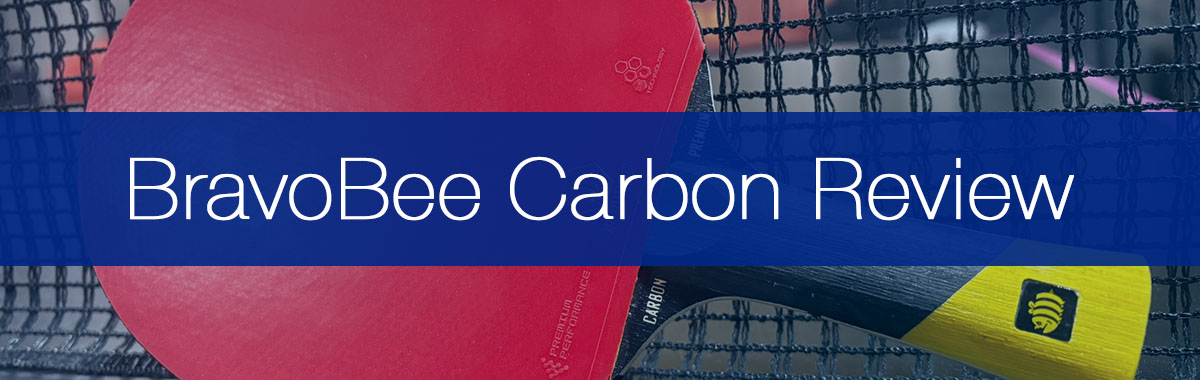
If you’ve been playing with a basic recreational bat and you’re ready to take table tennis more seriously, you’ve probably realized that upgrading your equipment isn’t straightforward.
Jump straight to a fast custom setup and you’ll (expensively) struggle with control. Stick with a cheap premade and you’ll hit a development ceiling almost immediately. The BravoBee Carbon is Sanwei’s attempt to bridge that awkward gap.
I’ve coached dozens of players through this exact transition, and I’ve seen both good and bad choices derail progress. So when Sanwei sent me the BravoBee Carbon to test, I was curious whether it actually delivers on its promise of being a “serious beginner” racket, or if it’s just another overpriced premade with clever marketing.
After several weeks of testing across different skill levels and playing styles, I have a clear answer. This review covers everything you need to know about the BravoBee Carbon, including the one characteristic that genuinely bothered me and might be a dealbreaker for some players.
Sanwei BravoBee Carbon Summary
Sanwei’s BravoBee Carbon successfully bridges the gap between casual premades and beginner custom setups, offering ALL/ALL+ control with enough grip to learn real technique. Its biggest strengths are stability on blocks and forgiving defensive play; its limits are spin potential and a high-pitched contact sound that some players will dislike.
Positioned between budget leisure bats and entry-level custom builds, it’s best for serious beginners or early intermediates who want a confidence-building first racket without overspeeding their development.
Expect to outgrow it in 6-12 months as your serves and power loops demand more spin and precision, and note that the stock rubbers aren’t suitable for sanctioned tournaments.
Benefits
Control-first design that rewards good technique
Excellent for blocking and defensive play
Well-balanced weight at ~175g
Comfortable flared handle with secure grip
Good stepping stone between casual and serious play
Drawbacks
High-pitched metallic sound on power shots is off-putting
Limited spin generation, especially on serves
You’ll outgrow it within 6-12 months of regular training
Not suitable for tournament play due to non-ITTF-approved rubbers
Recommended Playstyles
As this is a beginners racket, all players should still be All-Rounders whilst developing the basic skills before specialising in a specific playstyle.

Design of the Sanwei BravoBee Carbon
Sanwei have designed the BravoBee Carbon to bridge the gap between casual bats and simple custom setups. Here are the key specs and why they matter:
Blade
5‑ply wood plus 2‑ply carbon (7‑ply total). The inner carbon layers enlarge the sweet spot and add stability, so off‑centre contacts should stay predictable. This isn’t a stiff “pingy” carbon, instead think cleaner rebound and guidance rather than raw speed.

Rubbers
Factory inverted sheets on both sides with 2.0 mm sponge. The forehand uses a large‑pore “cake‑hole” sponge which is designed to help you access spin with less effort. The backhand’s denser sponge gives a flatter, more controlled response for blocking and drives.
These topsheets are grippy and forgiving, tuned for consistency over maximum bite. Honestly, I didn’t notice much of a difference between the black and red sides during testing.
Note: the stock rubbers are recreational rather than ITTF‑approved tournament sheets.

Weight & Balance
~175 g assembled. It’s a mid-weight racket which should help learners keep stroke timing and footwork, instead of compensating for a heavy or light racket.
Handle
Flared shakehand only, with three “vibration‑reduction” slots carved into each side of the handle. Apparently they’re designed to soften harsh feedback while preserving useful ball feel but I think they exist primarily to look cool.
Edge tape comes fitted for protection around the edge of the racket.

Case
The BravoBee Carbon comes with a single-racket case that uses a yellow and black colour scheme with a stylised face graphic on the front, giving it a distinctive, slightly aggressive look.
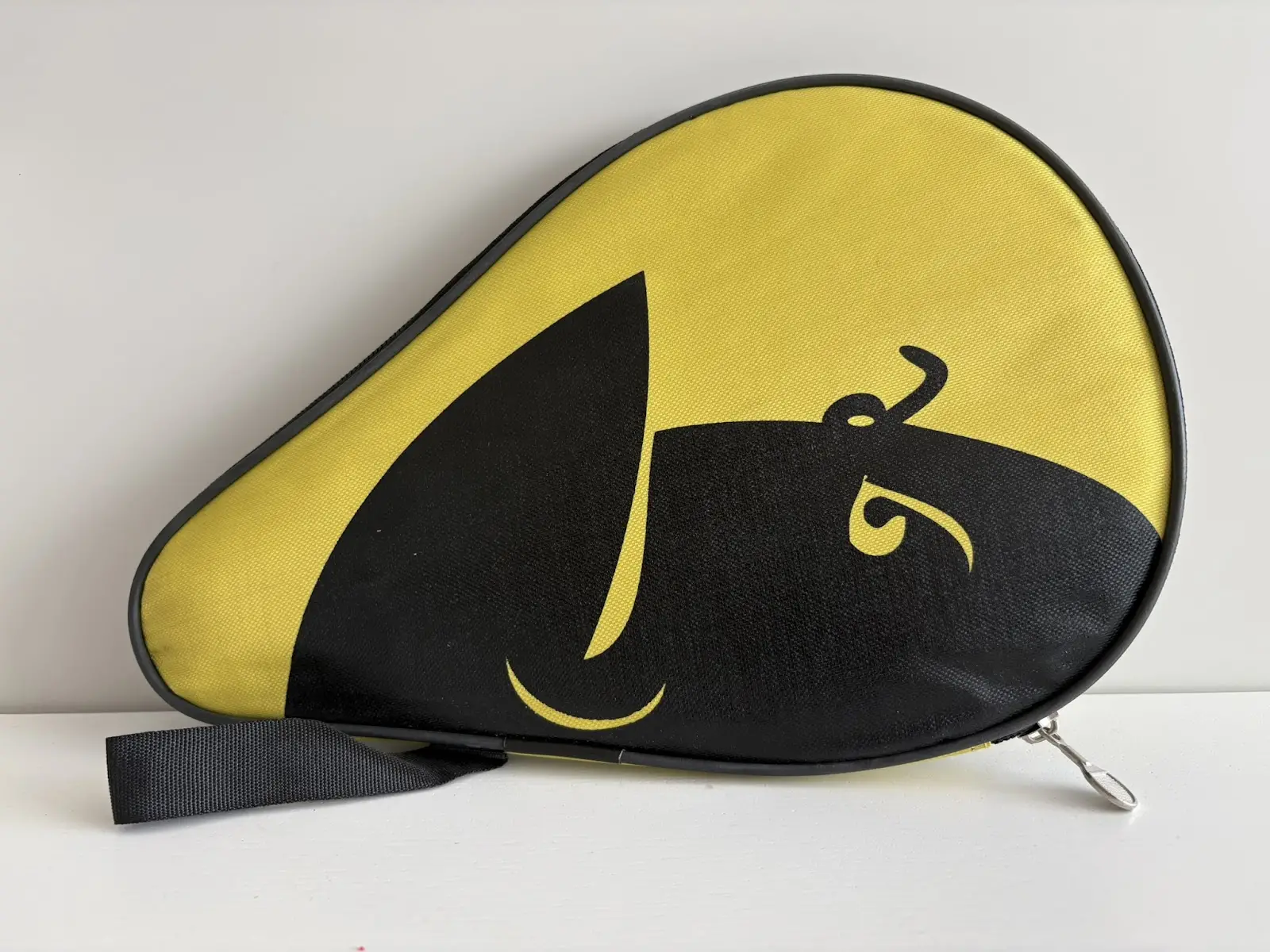
The exterior is textured synthetic fabric, likely polyester or nylon, with light padding. This offers basic protection against scratches rather than hard-shell impact resistance.
A full perimeter zip runs around the edge with a metal zipper pull fitted with a paddle-shaped tab, which is a redeeming feature.
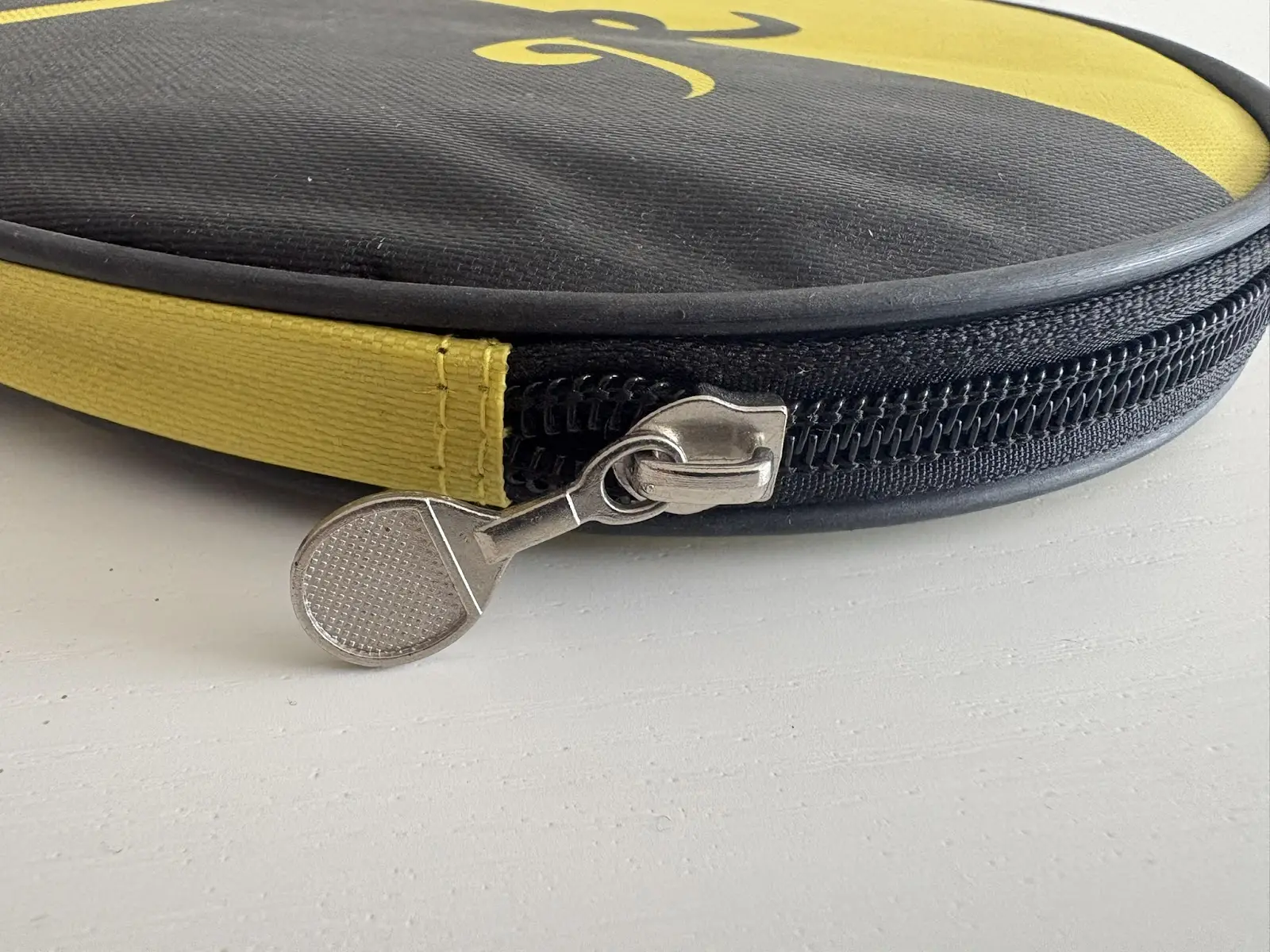
There’s a short fabric carry loop near the handle end for wrist carrying or hanging on a bag strap.
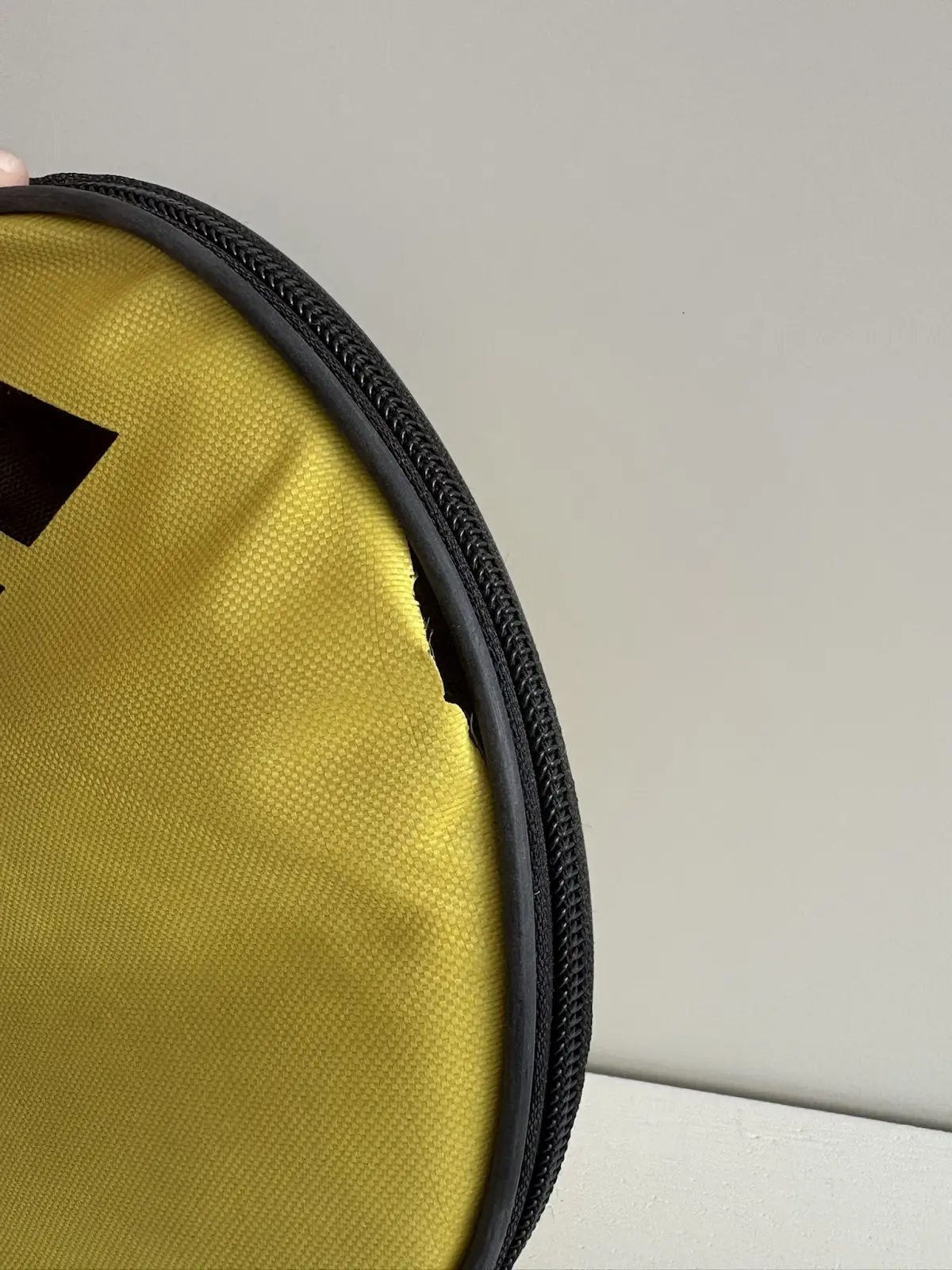
However, the case quality is poor. Mine had a rip in the seam near the zipper straight out of the box. The fabric feels thin, the stitching looks questionable in places, and I don’t expect this case to survive more than a few months of regular transport. If you buy this racket, plan on replacing the case relatively quickly or storing it separately.
What this means on the table
Expect an ALL/ALL+ control‑first character. You should get a safe arc on topspin, easy placement, and forgiving blocks/chops. There’s enough grip to build foundational serves and loops, but advanced, high‑RPM power will definitely expose the ceiling of the factory rubbers.
I got my hands on the racket, so keep reading to see if my experience matches the intended design.

How the BravoBee Carbon fits alongside the BravoBee Leisure rackets
It is important to separate the BravoBee Carbon from the other BravoBee leisure rackets in Sanwei’s range.
The leisure versions are clearly designed for casual play, family use, schools, and offices. They prioritise ease of use, durability, and visual appeal over technical development. They are not built with competition or long-term improvement in mind.
I have not tested those leisure models, and based on their design goals, I would not recommend them to players who want to improve seriously. They serve a different purpose entirely.
The BravoBee Carbon, by contrast, is the only racket in the BravoBee lineup that genuinely points players toward proper table tennis technique and progression. If you are choosing within this family, it is the only one I would consider.
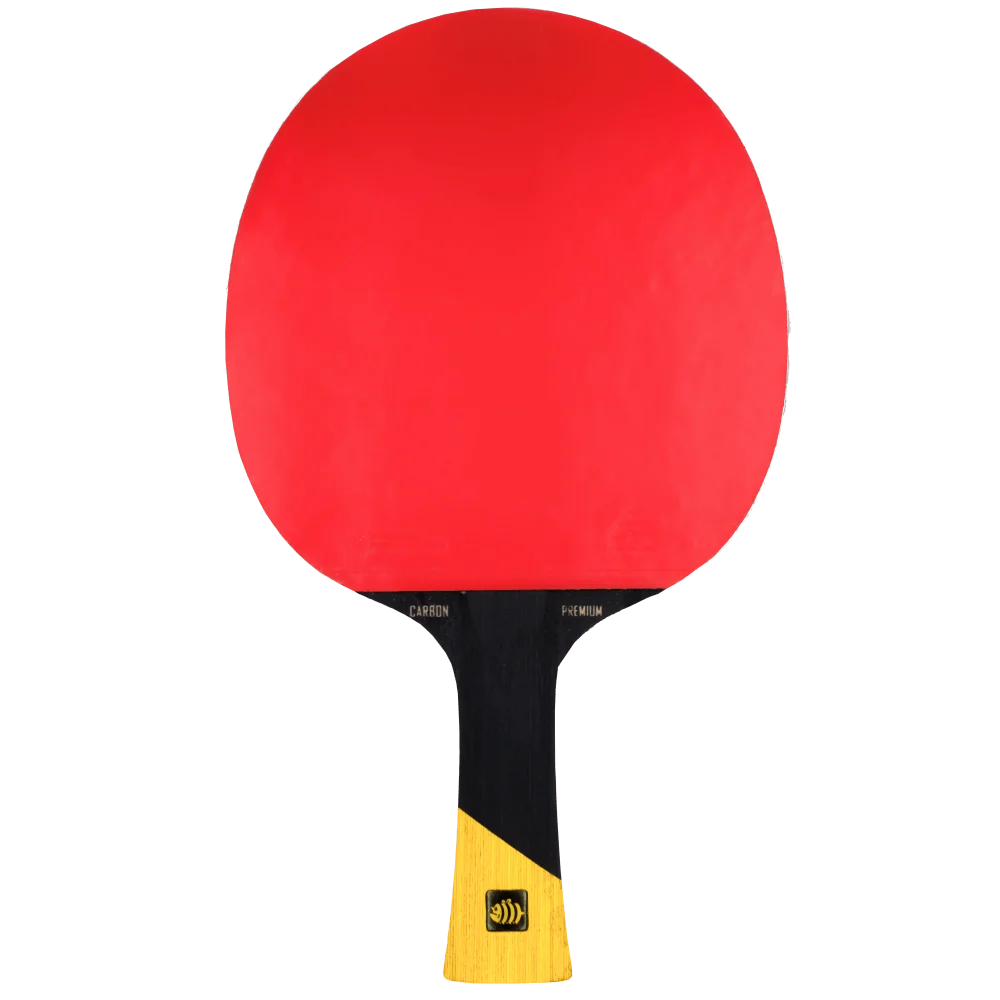
- Weight: 175g
- Speed: Medium-Fast
- Spin: Medium
- Control: Medium-High
- Handle: Flared
- Blade: 7-ply (5 wood + 2 carbon)
- ITTF Approved: No
- Sponge Thickness: 2.0mm
Summary: The Sanwei BravoBee Carbon is a control-oriented 5+2 carbon racket designed to bridge the gap between recreational bats and custom setups, offering excellent blocking and defensive play but limited spin lifespan for regularly training players.
Playtesting the Sanwei BravoBee Carbon
In the hand, the BravoBee Carbon immediately feels like it sits a step above typical recreational premade rackets. The overall construction feels intentional rather than mass-marketed, and that matters more than many beginners realise.
The weight is well judged. It is light enough that you can play longer sessions without fatigue, yet it doesn’t feel hollow or insubstantial. From a coaching standpoint, this helps players maintain good stroke timing and footwork rather than compensating for their racket.
The handle deserves a mention as well. The flared shape is comfortable and secure, especially for players still refining their grip pressure. Everyone using this racket will notice a higher-pitched contact sound, which I will address later, but in terms of ergonomics, it does its job well.
On the table, the BravoBee Carbon overall behaves exactly how I would expect given its construction and intended audience.
The overriding characteristic is control with guidance. It does not simply deaden the ball, nor does it launch it unpredictably. Instead, it gives you a consistent response that encourages you to play correct strokes. When you do things properly, the racket responds positively. When you do things poorly, it does not completely bail you out, which is important for long-term development.
I spent time using it across a range of drills and match-style rallies, deliberately pushing it outside its comfort zone to understand its limits.
In normal club play and structured training, it is easy to use and confidence-building. When pushed into high-intensity exchanges, its limitations become more apparent.

Serving & Returning
Serving with the BravoBee Carbon is genuinely enjoyable for a racket in this category, although I was disappointed with the amount of spin I was able to generate.
The inverted rubbers provide enough grip to generate a medium level of spin on basic backspin and sidespin serves, but I felt this was quite limited. There is a clear limit to how heavy your serves can become.
You can generate spin, but not the kind of vicious, double-bounce action that advanced rubbers produce. There are benefits to this (more control) but it does mean players are likely to grow out of this racket quite quickly.
Short serves are easy to keep low, and the ball does not slip off the rubber in an unpredictable way. For beginners, this is a huge win, because it allows them to actually practise variation rather than simply getting the ball over the net.
On receive, the racket is forgiving. Passive returns, pushes, and controlled flicks are easy to manage, and the ball stays on the table more often than not. This makes it well suited to players still learning how to read spin and adjust angles correctly.
Driving and Looping
This is where the BravoBee Carbon shows both its strengths and its eventual ceiling.
For controlled topspin and driving, especially at moderate pace, it performs very well. The forehand side in particular allows players to access topspin without having to swing excessively hard. The arc is safe, and the ball clears the net comfortably when technique is sound.
As someone who has coached many players through this phase, I appreciate how the racket encourages a full stroke and proper weight transfer. It does not reward lazy swings, but it also does not punish developing players for not being perfect.
When you start accelerating more aggressively, the character changes. At higher impact, the ball can come off faster and flatter than expected, and control becomes more sensitive to timing and angle. This is where stronger players will begin to feel that the rubber and blade combination is no longer keeping up with their intent.
In simple terms, it is excellent for learning to loop. It is less suited to ripping heavy topspin at full power.
Blocking & Chopping
Blocking is one of the BravoBee Carbon’s strongest areas.
Both sides feel stable and predictable, making it easy to absorb pace and redirect the ball. Passive blocks land consistently, and controlled active blocks are straightforward once you settle into the timing.
Chopping and defensive shots are also surprisingly comfortable. There is enough dwell time to impart backspin, and the racket does not feel twitchy when taking pace off the ball. Several players I’ve worked with who favour a more defensive or all-round game would feel very comfortable using this racket.
The Sound of the BravoBee
The most divisive characteristic of the BravoBee Carbon is its sound, which deserves proper discussion.
On flat drives, aggressive blocks, and power shots, the racket produces a distinctly high-pitched, metallic tone. It is sharper than the satisfying “thock” of all-wood blades or even most other carbon rackets.
The sound is most pronounced when you accelerate through the ball. Short pushes sound normal, but the moment you hit with pace, that high pitch kicks in. It is consistent and predictable, but undeniably there.
I found it quite off-putting. Your brain expects certain auditory feedback when you strike the ball properly, and this racket does not provide it. The sound feels almost cheap, even though the construction is solid.
Whilst the sound doesn’t affect performance, auditory feedback is part of how we judge shot quality subconsciously. When the sound does not match expectations, it creates a disconnect.
Some players adapt within a few sessions. Others remain aware of it every time they play. If you rely on sound to judge your contact, this may bother you more than expected.
If you can trial this racket before buying, do so. The sound is subjective but significant enough that it could influence your enjoyment.
Alternatives to buying a Sanwei BravoBee Carbon
If you’re considering the BravoBee Carbon but want to explore similar rackets that occupy nearby niches in the beginner-to-early-intermediate space, these three are worth comparing:
Killerspin JET200

Softer and slower than the BravoBee Carbon, with excellent control but even less spin potential.
STIGA Pro Carbon

Faster and firmer out of the box, with a sharper, more aggressive character.
Palio Expert 3.0

A well-balanced premade with a reputation for predictable feel and solid control, making it slightly easier for absolute beginners.
Overall impressions of the Sanwei BravoBee Carbon Racket
After playing with the Sanwei BravoBee Carbon, my overall impression is very positive, with clear context around its role.
This is not a gimmicky premade racket, and it is not pretending to be professional equipment. It sits squarely in the space between casual leisure bats and custom-built setups, and it does that job well.
The biggest strength of the BravoBee Carbon is that it supports correct development. It rewards good technique, encourages confidence, and provides a stable platform for learning the modern game. For many players, it could comfortably serve as a first “serious” racket.
The main weakness is simply that you will outgrow it quickly if you progress far enough. That is not a flaw so much as an inevitability. Once your strokes become more powerful and spin-oriented, you will want more grip, more dwell, and more precision than this setup can offer.
From a coaching standpoint, I would much rather see a player start with something like this and upgrade later than jump straight into fast, unforgiving equipment too early.
Still unsure? Check out my top recommended pre-made rackets for more information.

David’s been playing Table Tennis since he was 12, earning his first coaching license in 2012. He’s played in national team & individual competitions, although he prefers the more relaxed nature of a local league match! After earning his umpiring qualification in England, David moved to Australia and started Racket Insight to share information about the sport he loves.
Blade: Stiga WRB Offensive Classic | Forehand: Calibra LT | Backhand: Xiom Musa
Playstyle: The All-Rounder