
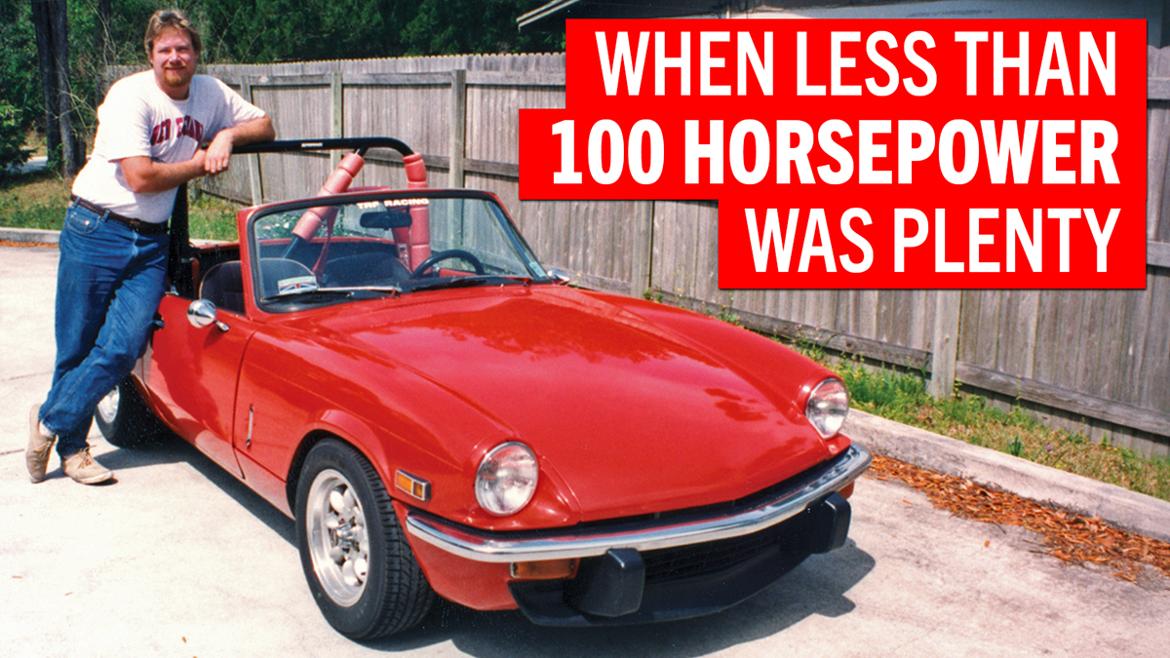
I recently came across an ad for an old race car–a Triumph Spitfire, a popular little British roadster that was very big in SCCA racing back in the ’60s and ’70s.
For many years, a similar Triumph Spitfire was my primary autocross, time trial and hillclimb car.
I bought that Spitfire in 1989 when it was only nine years old and ran it everywhere and every time I could. From SCCA hillclimb and autocross events to Triumph club events and road rallies, I beat the crap out of that 75-horsepower wonder. (The true wonders are not how little power it had, but how often it broke and that the damn thing didn’t kill or maim me.)
While ultimate power was not the Spitfire’s forte, it weighed about 1700 pounds, so it was light as a feather and handled like it was absolutely on rails. Looking back now, I can see that this light weight, and not the sophisticated suspension, was the key to this car’s success.
Like all simple, lightweight roadsters back then, the romance was enhanced with the wind in your face, lack of a constrictive full roll cage and the feeling you were going a million miles an hour when, realistically, you were probably doing more like 65 mph.
To put this into perspective, think about an early Miata, but with half the sophistication, about a third less weight and probably 40 or 50 less horsepower. The words “drives like a go-kart” were probably first uttered while talking about Triumph Spitfires set up for racing.
While perusing that ad, I wondered to myself, why did we race these things? Heck, the mind-blowing 1985 Honda CRX Si that took the autocross world by storm and finally dethroned the 20-year-old Lotus Elan had a mere 91 horsepower.
The answer, I think, is that is what we had, and we liked it.
The top offerings of the ’80s didn’t make the numbers we see today. Even the ultimate cars of the time, like the M3, Corvette and Porsche 911, only had about 200 horsepower or less.
Today’s versions have a minimum of 400 horsepower. Some, like the new Corvette ZR1, make more than a thousand horsepower.
[Randy Pobst on the 1064-horsepower C8 Corvette ZR1: Like a big Miata]
Just as I did back then, I started budget shopping 10-year-old used cars today. More amazing options. Any 10-year-old Corvette or V8-powered Mustang has north of 300 horsepower.
And while we want to believe that performance came cheap back then, my recollection says otherwise. Once I moved on, I sold that totally renovated and improved Spitfire for about $4000. In today’s dollars, that $4000 is equivalent to about $10,000. That kind of money now gets you a myriad of amazing cars, such as a Subaru BRZ, a good BMW, a nice Miata or even a beat-up C5 Corvette.
Back in my day, we would have killed for the kind of performance, safety and handling that $10,000 will get you now. Plus, today’s tires, the ability to easily connect with other enthusiasts around the world, and the myriad of available events to participate in are mind boggling.
Despite the romance of the days gone by, maybe we have come a long way. Rose-colored glasses have a funny way of showing you what you thought was great back then.
Still, life, like racing, was simpler. We had no internet, no digital devices to help us test or learn how to drive better. While we might not have known what we were missing, we had some great times.
While this may all seem like a logical progression, can you even imagine bona fide performance cars with less than 100 horsepower? Trust me, it was fun.
Comments
It all depends on what it’s powering… I could be happy racing with less than 10 horsepower.

Seeing as my current car just barely has more than 100 horsepower (when new, I’m sure it’s lost a few horses over the years), I can see how something like a Spitfire could be fun to drive.
There’s something funny about flooring the gas pedal and then looking down at the speedo to see you haven’t even cracked highway speeds.

I’ve tracked my 91 hp CRX and my 80-ish hp Mini. They’re fun. Not in a taming the savage beast way, but in a chaotic rabid puppy way.

If its light enough, 100hp can be fine. Though I’d be looking at a dedicated racer chassis, not a full bodied car in that range.

Tom1200
UltimaDork
11/24/25 12:39 p.m.
We all know my answer on this.
I am on season 36 with a 95hp car and I am still having a blast.
Low horsepower lightweight cars are donuts in a muddy field at 1 A.M. fun. You won’t impress anyone but you’ll be smiling the whole time.

j_tso
SuperDork
11/24/25 12:49 p.m.
100hp is fine when paired with light weight, and even better with more revs

Planning to get the MGB out to some autocrosses and hopefully a track day next season. I expect to have fun, but am already pretty sure it wants to be way on the other side of the 100hp mark.

wspohn
UltraDork
11/24/25 1:25 p.m.
Light cars with modest output engines can be fun. Just ask Carlo Abarth (well you can’t as he died 40 odd years ago) but little cars with modest power can be a lot of fun, as anyone with a 1275 in a Bugeye can confirm.

When we built my Miata 25 years ago, it made 112 at the wheels. Still happy with it.

Displaying 1-10 of 77 commentsView all comments on the GRM forums
You’ll need to log in to post.