


James Breese | Performance System Architect
All clinical standards and performance engineering frameworks provided by Cricket Matters are overseen by James Breese, Level 4 Sports & Remedial Therapist (LCSP Assoc. Member) and ECB Coach. Our system integrates clinical biomechanics, metabolic nutrition, and neural efficiency to ensure athlete safety and elite performance output.
The Technical Objective.
Most cricketers attempt to maximise performance by chasing the pinnacle first — bowling speed, power hitting, and high-intensity agility — before verifying whether the body can tolerate the load required to sustain them. This top-down approach is a primary driver of recurring injury, inconsistent output, and stalled development.
System Standard: The objective is not to train harder, but to build in sequence.
At Cricket Matters, we treat the cricketer as an engineered biological system where technical output is governed by a strict hierarchy. The Cricket Performance Pyramid defines that hierarchy. This blueprint outlines our Standard Operating Procedure (SOP) for tiered development — the order in which capacity must be built to de-risk performance and stabilise long-term progression.
The Hierarchy of Development.
Performance is a dependent variable. It holds only when the layers beneath it are verified as stable.
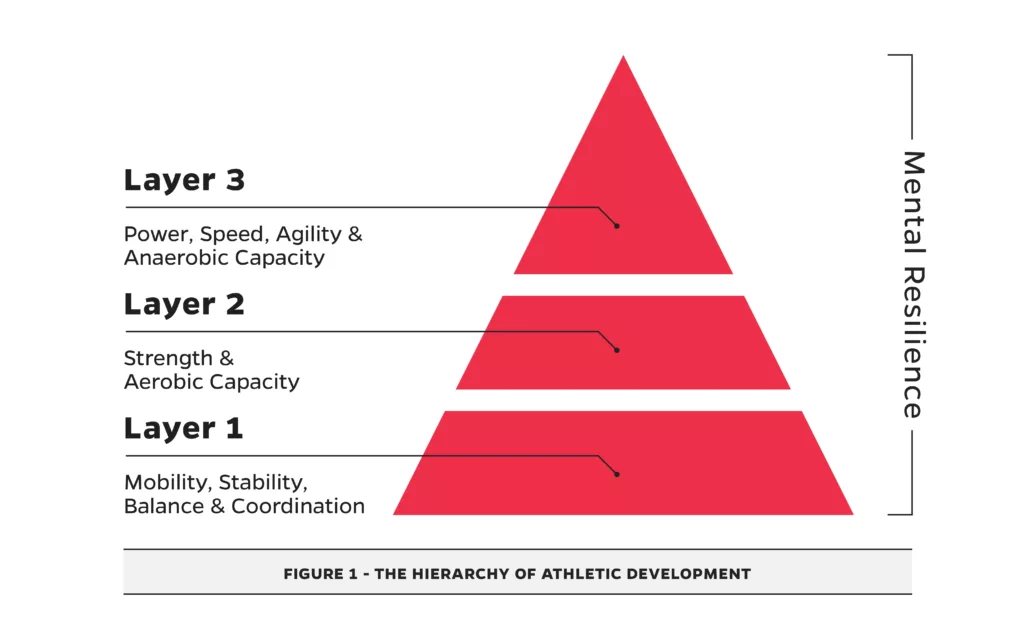
Layer 1: Foundational Movement Integrity.
Restoring degrees of freedom and joint function. At this level, we identify compensatory movement strategies, joint restrictions, and clinical “leaks” that increase energetic cost and injury risk. External load applied to an unstable movement system does not build capacity — it accelerates breakdown.
Layer 2: Physical Capacity & Load Tolerance.
Engineering the biological substrate. Strength and aerobic capacity are developed to increase tissue tolerance and systemic resilience. The objective is not peak output, but repeatability — the ability to absorb, recover from, and adapt to allostatic load without volatility or regression.
Layer 3: Technical Output & Force Expression.
Optimising neural economy. This is the amplification stage where speed, power, and high-skill execution are expressed. Because the foundation is stable, the nervous system no longer needs to impose protective constraints, allowing force to be produced efficiently without degradation or elevated injury risk.
The First Step: Close the Capacity Gap.
Progressing to Layer 3 outputs while a Layer 1 or Layer 2 constraint remains unresolved exposes the system to avoidable risk and performance variance. Without objective verification, training decisions become speculative.To determine precisely where your system sits within the hierarchy, the Cricket Matters Performance Assessment identifies the limiting layer, removes guesswork, and applies the Pyramid as it was designed — as a governed pathway, not a training philosophy.
The Performance Briefing.
Neural Economy & the Capacity Gap. Why gym strength fails to become match-day bowling speed — and what must be engineered for physical capacity to translate into technical output under pressure.
The Origin of System Governance.

The Cricket Performance Pyramid was not created to add another training philosophy. It was created to remove guesswork.
Early versions of cricket athletic development relied heavily on coach experience, intuition, and isolated best practices. While often well-intentioned, this approach produced inconsistent outcomes. Results varied not because athletes differed, but because decisions were opinion-led, sequencing was unclear, and constraints were rarely verified before load was applied.
The turning point was recognising that high-performing systems do not rely on individual judgement alone. They rely on governance.
In business, engineering, and aviation, outcomes are stabilised through Standard Operating Procedures (SOPs) that reduce variability, control risk, and ensure repeatability. Athletic development is no different. When performance depends on human biology under load, ungoverned decisions introduce unnecessary risk.
At Cricket Matters, we moved from opinion-led coaching to a governed, repeatable framework where outcomes are driven by sequencing and verification—not intuition or luck.
The Cricket Performance Pyramid formalises this governance. It defines the order in which capacity must be built, the conditions that must be met before progression, and the constraints that must be resolved before higher outputs are pursued.
This shift—from preference to protocol—is what allows performance to be engineered rather than hoped for.
Introduction to the Cricket Matters Performance System.
Before defining how performance is built, it is essential to understand what is being managed.
At Cricket Matters, performance is not treated as a single outcome or isolated quality. It is the result of five interacting systems that must remain stable, aligned, and continuously managed across training, competition, and recovery.
This governing framework is the Cricket Matters Performance Flywheel.
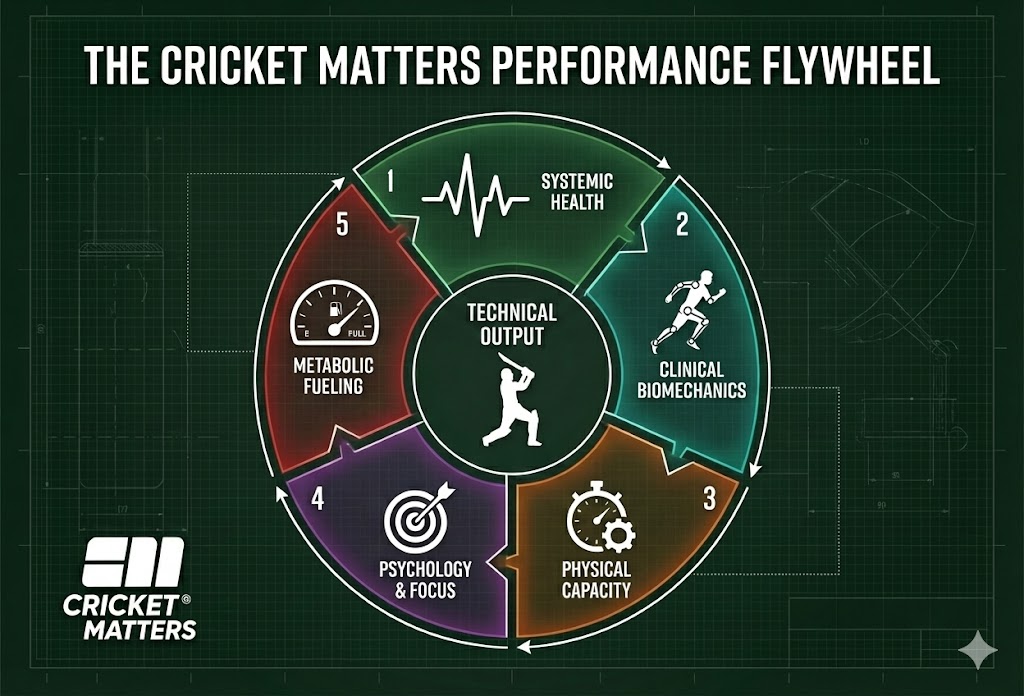
The Flywheel provides a high-level view of the system variables that influence technical output, availability, and long-term progression:
• Systemic Health — recovery capacity, fatigue, medical load, and tolerance to training
• Clinical Biomechanics — movement quality, joint function, and access to required positions
• Physical Capacity — strength, speed, power, and conditioning under load
• Psychology & Focus — decision quality and composure under pressure
• Metabolic Fueling — energy availability, hydration, and recovery support
These systems are not trained in isolation, nor are they addressed sequentially and then ignored. They are managed together, because failure in any one system degrades performance across all others.
Health remains foundational — without sufficient recovery capacity and tolerance to load, development becomes unstable. Movement quality determines whether positions are available and repeatable. Physical capacity governs whether technique holds under fatigue. Psychological control reflects how well the system processes pressure. Fueling determines availability — physically and cognitively — across time.
The Flywheel defines what we manage.
The next question is in what order these systems must be built to de-risk performance and stabilise progression.
That hierarchy is governed by the Cricket Performance Pyramid, which defines our Standard Operating Procedure (SOP) for tiered athletic development.
System Variables Within the Performance Pyramid.
The Cricket Performance Pyramid is not a collection of fitness traits. It is a governed hierarchy of system variables, organised by dependency and load tolerance.
Each variable is developed in sequence to ensure the body can tolerate increasing demands without breakdown. Progression through the Pyramid is based on system readiness, not training time.
| Pyramid Layer | System Variables | Technical Purpose |
|---|---|---|
| Layer 1: Movement Integrity | Mobility, Stability, Balance, Coordination | Restore degrees of freedom, joint function, and movement efficiency so force can be expressed without compensatory leakage. |
| Layer 2: Physical Capacity | Strength, Aerobic Capacity | Build the biological substrate required to tolerate training volume, recover between sessions, and sustain output across time. |
| Layer 3: Technical Output | Power, Speed, Agility, Anaerobic Capacity | Express force rapidly and repeatedly under match intensity once the system is stable and load-tolerant. |
Mental Resilience is not a discrete training layer.
It represents the system’s ability to maintain decision quality, emotional control, and execution stability across all layers. As movement integrity, physical capacity, and output tolerance improve, mental resilience emerges naturally. When any layer breaks down, decision-making and composure are the first to degrade.
Each component is crucial, but some must be developed before others to fully develop the ultimate cricket athlete.
Mental resilience is revealed under load — it is not trained in isolation.
Progression Standard: How Advancement Is Earned.
Progression through the Cricket Performance Pyramid is governed by objective system readiness, not time spent training, motivation, or playing level. Each layer introduces higher mechanical, metabolic, and neurological demands.
Advancement is permitted only when the system below has demonstrated sufficient tolerance to load without compensatory breakdown.
Progression is earned — not assumed.
Progression Standards.
| Progression Gate | Verification Standard | Clinical Rationale |
|---|---|---|
| Entry to Structured Training | FMS ≥ 14/21 with no individual scores of 0 or 1 | Establishes minimum movement integrity and access to required positions. Scores below this threshold indicate unresolved constraints that distort force expression when load is added. |
| Layer 1 → Layer 2 (Movement → Capacity) | Sustained tolerance to training density, no recurrence of pain, breakdown, or output volatility | Strength and aerobic capacity amplify existing movement strategies. Adding load to unresolved restrictions increases injury risk and energetic leakage rather than building capacity. |
| Symmetry Governance | Functional symmetry assessed contextually(e.g. shoulder mobility allowances for bowling and throwing athletes) | Perfect symmetry is neither expected nor required in cricket. As with baseball, asymmetry is acceptable when task-specific, stable, and not associated with pain or compensatory strategy. |
| Layer 2 → Layer 3 (Capacity → Output) | Sustained tolerance to training density, recurrence of pain, breakdown, or output volatility | Layer 3 amplifies speed and power. Progression is allowed only when the biological substrate can absorb load and recover predictably across weeks, not sessions. |
| Ongoing Layer 3 Exposure | Re-verification under fatigue and competition load | Neural economy and decision quality are the first systems to degrade when tolerance is exceeded. Re-assessment ensures output remains supported rather than forced. |
Governing Rule.
If a player cannot maintain movement quality and output stability under increasing load, progression is not permitted — regardless of motivation, playing level, or training history.
This is why the Cricket Matters Performance Assessment is the entry point to the system. It identifies whether progression is limited by movement integrity, load tolerance, or premature exposure to output demands — allowing the Pyramid to function as a governed pathway, not a training philosophy.
The Cricket Performance Pyramid in Practice.

The Cricket Performance Pyramid is not a training philosophy. It is an operational framework.
It exists to ensure that performance output is supported by verified capacity, that progression is earned rather than assumed, and that technical development does not outpace biological readiness.
When applied correctly:
- Injuries reduce because load is introduced only when the system can tolerate it
- Performance stabilises because output is supported, not forced
- Development accelerates because effort is applied to the correct constraint
The Pyramid does not replace coaching. It governs it.
When sequencing is correct, technical work holds. When sequencing is ignored, progress becomes volatile.
This is the difference between training harder and building correctly.
Navigate the System.
Performance doesn’t happen in isolation; it is the result of five interacting systems working in alignment. Use the directory below to identify the specific Standard Operating Procedure (SOP) your game requires — from restoring movement options to building the biological capacity required to sustain output across a full season.
FAQs
Why Does the Pyramid Require Layer 1 Verification Before Layer 3 Training?
Technical Output is a Dependent Variable. Speed, power, and high-intensity skill expression can only be sustained when Movement Integrity is verified. Attempting to engineer Layer 3 outputs on a restricted or compensating system forces the Nervous System to impose protective constraints. The result is inconsistent performance, reduced ceiling, and accelerated tissue breakdown. Layer 1 verification exists to De-Risk Output by ensuring force can be expressed without compensatory leakage.
Can Layers Be Skipped if I Am Already a High-Level or Professional Cricketer?
No. Progression through the Cricket Performance Pyramid is governed by Objective System Readiness, not age, playing level, or training history. High-level athletes frequently present with unresolved Layer 1 Constraints or insufficient Layer 2 Load Tolerance that limit consistency and long-term durability. The Performance Assessmentidentifies the true bottleneck so training effort is applied where it produces measurable return rather than reinforcing compensation.
How Does the Pyramid Stabilise Match-Day Consistency?
Consistency is a function of Allostatic Load Management. By engineering Physical Capacity (Layer 2) in the correct sequence, the Pyramid increases the Biological Substrate’s ability to absorb, recover from, and adapt to training and competition stress across a season. When capacity is sufficient, Layer 3 Outputs—technique, speed, and decision-making—do not collapse under fatigue or pressure.
Why Is the Performance Assessment the Entry Point to the System?
Without Objective Verification, progression decisions become speculative. The Performance Assessment identifies movement constraints, capacity limitations, and tolerance thresholds that determine an athlete’s position within the hierarchy. This allows the Pyramid to be applied as a Governed Pathway, not a generic training philosophy.