
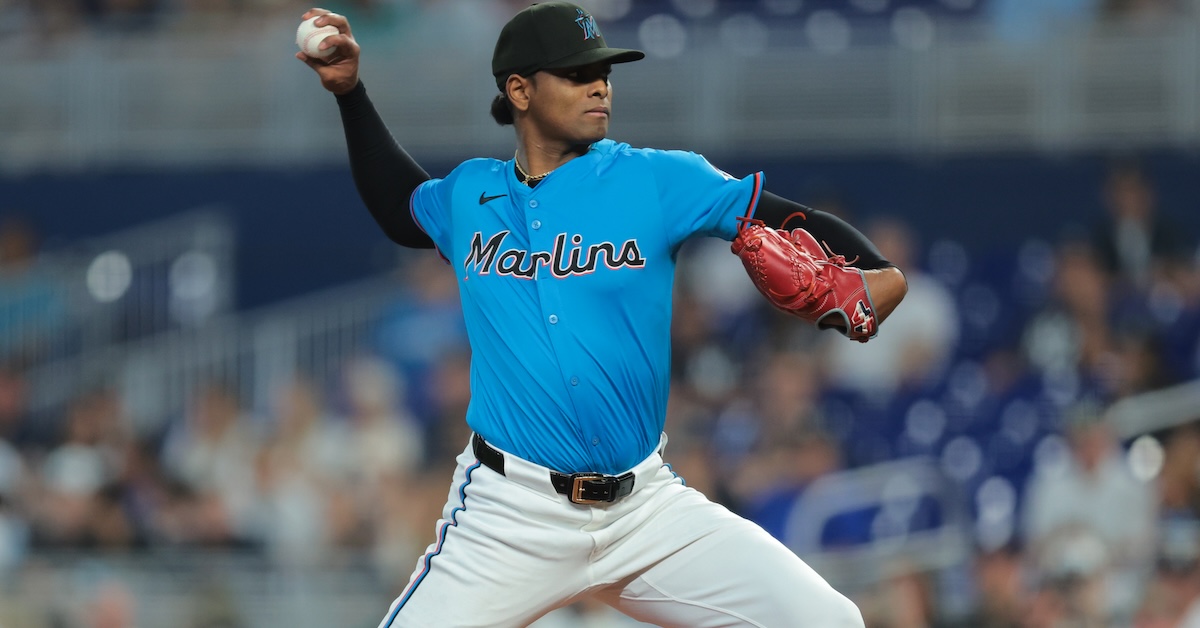
This offseason has been reasonably busy in terms of actual moves, but light on rumors. One of the few exceptions has involved the Marlins’ Edward Cabrera. The Yankees’ interest in the 27-year-old right-hander has been consistent throughout the winter, but it appears they’ve been beaten to the punch.
Cabrera is indeed on the move, but he’s bound for Chicago, not New York, as Michael Cerami of Bleacher Nation reported late Wednesday morning. The Cubs get a hard-throwing starting pitcher, fresh off a 3.53 ERA in 137 2/3 innings, with three years of team control remaining. In order to entice the Marlins to part with Cabrera, Chicago gave up three position player prospects: Owen Caissie, shortstop Cristian Hernandez, and corner infielder Edgardo De Leon. The Yankees, Jon Heyman says, were “never close.”
For the second straight winter, the Marlins have dealt a talented-but-inconsistent starter in his arbitration years to an NL contender. And while I reserve the right to change my mind when we find out how good Starlyn Caba gets, early indications are that the Phillies snookered Miami in the Jesús Luzardo trade. In his first season in Philadelphia, Luzardo was sixth in starting pitcher WAR and was terrific in two playoff appearances. Caba is still a couple years from reaching the majors at all.
So why would Miami president of baseball operations Peter Bendix risk making the same mistake twice?
Two reasons. First, Cabrera has tantalizing talent, but his track record as a big league starter is nowhere near as impressive as Luzardo’s was, even coming off a rough year in 2024. Cabrera has hit the 100-inning mark just once in his career, and had struggled pretty badly with walks up until 2025. The return might not be as sparkly as Marlins fans would’ve hoped, but I think Bendix traded Cabrera at the right time.
Second, pitching is where the Marlins’ depth is. And even without Cabrera, they have plenty of it: Sandy Alcantara, Eury Pérez, Braxton Garrett, flashes of decentness from Ryan Weathers, and back-end-of-the-40-man guys like Max Meyer and Ryan Gusto. Plus a pair of terrific high-minors prospects in Thomas White and Robby Snelling, who ought to contribute in the majors this year. Miami has a better starting pitching situation than a couple teams that made the playoffs in 2025.
You Aren’t a FanGraphs Member
It looks like you aren’t yet a FanGraphs Member (or aren’t logged in). We aren’t mad, just disappointed.
We get it. You want to read this article. But before we let you get back to it, we’d like to point out a few of the good reasons why you should become a Member.
1. Ad Free viewing! We won’t bug you with this ad, or any other.
2. Unlimited articles! Non-Members only get to read 10 free articles a month. Members never get cut off.
3. Dark mode and Classic mode!
4. Custom player page dashboards! Choose the player cards you want, in the order you want them.
5. One-click data exports! Export our projections and leaderboards for your personal projects.
6. Remove the photos on the home page! (Honestly, this doesn’t sound so great to us, but some people wanted it, and we like to give our Members what they want.)
7. Even more Steamer projections! We have handedness, percentile, and context neutral projections available for Members only.
8. Get FanGraphs Walk-Off, a customized year end review! Find out exactly how you used FanGraphs this year, and how that compares to other Members. Don’t be a victim of FOMO.
9. A weekly mailbag column, exclusively for Members.
10. Help support FanGraphs and our entire staff! Our Members provide us with critical resources to improve the site and deliver new features!
We hope you’ll consider a Membership today, for yourself or as a gift! And we realize this has been an awfully long sales pitch, so we’ve also removed all the other ads in this article. We didn’t want to overdo it.
Conversely, the Marlins’ position player group is dire. They have a few position players with the potential to break out in their mid-to-late 20s, but there’s a decent chance this lineup ends up being Kyle Stowers and the Eight Dwarves. What’s the best way to get some cheap pop? Trade away a cheap pitcher.
The headline prospect in this deal is Owen Caissie. You might remember Caissie as the guy who provided some pop at the bottom of the Canadian lineup during the last World Baseball Classic, or as one of the prospects the Padres gave up in the trade for Yu Darvish. If that doesn’t ring a bell, you probably don’t remember Caissie at all.
He is, however, a decent prospect, who at 23 years old is coming off a season in which he hit .286/.386/.551 in Triple-A, with 22 homers and 28 doubles in just 99 games. Caissie is a corner outfielder, and posted a platoon split of more than 250 points of OPS in Triple-A last year, but if he is a platoon bat, he’ll be playing the strong side of the platoon.
I wouldn’t bother to mention this ordinarily, but because it’s the Marlins it’s relevant: Cabrera is only projected to make $3.7 million in arbitration and is under team control through 2028. But Caissie, a rookie, will make the league minimum and stay under team control through 2031.
The other two prospects are long shots. Here’s what Eric Longenhagen has to say:
Hernandez is a mistake-prone shortstop defender who struggles with throwing accuracy. He has the range and athleticism to play the position but, at least right now at age 22, he’s far from having the technical polish. His arm stroke may need to be modified for him to throw accurately. On offense, Hernandez has always had good bat speed, and as he’s gotten older and stronger, he’s developed roughly average raw power, which is nothing to sneeze at for a potential shortstop this age. But while his hit tool improved enough last year to make him a prospect again, his feel for contact is still clunky enough (69% contact rate) to put him in a danger zone. He’s was definitely an arrow up guy in 2025, but is still a fringy prospect.
Edgardo De Leon is a hard-swinging, medium-framed 18-year-old who posted big top-end exit velocities for his age on the 2025 Complex, including a 48% hard hit rate and 107.6 EV90. The effort it requires for him to swing that hard, and some of the mechanical concessions he makes to do so, give him enormous hit-tool risk, and his contact rate was way down at 66%, a pretty scary mark for Rookie Ball. Again, this is a fringe prospect.
So for Miami, this trade hinges on Caissie, who is both big league-ready and the most talented prospect in the deal by far. Whichever team comes out ahead in the long term, Caissie is the big winner in this trade now.
The Cubs’ roster tickles me because it’s both so deep and so flat. Chicago returns only two four-win players from 2025. Both of those players — Nico Hoerner and Pete Crow-Armstrong — posted 109 wRC+ marks but had their overall value boosted by outlier fielding performances at premium positions. That depth and lack of upper-tier star power makes the Cubs highly resilient in the face of injury, and presents few weak spots (if any) to opponents.
However, it also makes it tough to find at-bats for a player like Caissie. Contrast that with the Marlins, who are on track to give significant corner outfield playing time to, like, Esteury Ruiz and Christopher Morel. Caissie, who’d be fighting for playing time in Chicago, could hit cleanup in Miami.
But the Cubs’ depth also extends to their rotation, which is peopled by Matthew Boyd, Cade Horton, Shota Imanaga, Jameson Taillon, and Colin Rea, with Javier Assad, Ben Brown, Jordan Wicks, and top pitching prospect Jaxon Wiggins available as well. And it feels like everyone’s forgotten about Justin Steele, who will return at some point this season if his recovery from Tommy John surgery goes according to plan.
That’s plenty of quality arms even without trading for Cabrera. If I had to pick a nit, it’s this: Unless Cade Horton goes berserk in his sophomore season, the Cubs’ no. 1 starter situation would be one of the weakest among National League contenders. There’s no Cristopher Sánchez or Logan Webb or Yoshinobu Yamamoto here. (And to be clear, I adore Horton, I’m just not getting ahead of myself.)
If Cabrera replicates his 2025 season exactly, he’d probably make the Cubs’ playoff rotation, but as the no. 4 starter at best. That still improves a team that gave heavy postseason innings to Rea last fall, but Cabrera isn’t going straight to the top of the pile.
At least not yet. Because even though this is a five-year major league veteran who’ll turn 28 in April, Cabrera has skills you can’t teach.
One big skill, actually — arm strength. Among pitchers who threw 100 innings in 2025, Cabrera was 10th in average fastball velocity. And the four-seamer is the least useful and effective of his five pitches.
Cabrera gets that velocity with a graceful, easy low-three-quarters delivery, which gives his arsenal a lot of side-to-side movement but not so much vertically. Four of his five pitches (everything except the curveball) had average-or-worse vertical movement, and four of his five pitches (everything except the slider), had at least 1.9 inches of horizontal movement above average.
He got whiff rates in the 40s off both of his breakers — the hard two-plane curveball and the more cutter-action upper-80s slider — but the real party piece is his changeup. He is one of just four starting pitchers — along with Kyle Hendricks, Tarik Skubal, and Merrill Kelly — to throw his changeup more than any other pitch in 2025, but none of those other guys have a changeup quite like Cabrera’s.
If you don’t want to read the next several paragraphs, just watch this and understand that this is a changeup that can get whiffs in the zone against good same-handed hitters.
I love the announcers’ reaction here: the grunt from Tommy Hutton and the inflection on “beautiful” from play-by-play man Kyle Sielaff. It’s how you’d react to an unusually tasty sip of lemonade.
Cabrera’s changeup is, simply put, unique. It averaged 94.2 mph last year, and 93.2 mph for his career. With less than three miles an hour’s worth of separation from the four-seamer, it’s barely a changeup at all. In the Statcast era, only two offspeed pitches have a higher average velocity than Cabrera’s changeup: the splinkers thrown by Jhoan Duran and Paul Skenes.
Except Cabrera’s changeup is extremely not a splitter. It doesn’t dip; it just steams in and veers right, like a mail truck going down a hill without its brakes or right rear tire. And the grip could not be less splittery.
Cabrera owns the four fastest changeups of the Statcast era, and 27 of the top 29. In his career, he’s thrown 272 changeups at 95.0 mph or more; all other pitchers put together have combined for 64. We call Cabrera’s changeup a changeup not because it resembles the other pitches that go by that name, but because of a failure in taxonomy.
And this is not a circus act; opponents hit .203 and slugged .266 off Cabrera’s change in 2025, with just one home run. Add in the two bat-repelling breaking pitches and he was in the 94th percentile for breaking ball run value and the 88th percentile for offspeed run value, according to Baseball Savant. The command issues that plagued him early in his career also started to clear up last year; he walked 8.3% percent of opponents, which isn’t remarkable on its own. But that’s down from a previous career average of 13.3% — no small feat, then.
That looks like ace stuff to me. I imagine the Cubs feel the same, which is why they wanted him. So how did Cabrera only post 2.0 WAR in 26 starts, with a 3.53 ERA that was broadly in line with his FIP and xERA?
The answer is that Cabrera’s fastball, for all its prodigious velocity, sucks. Both of them, in fact. The four-seamer blends in with the sinker, which has pretty predictable movement and runs into the changeup.
To be honest, I don’t know why Cabrera throws a fastball at all. Neither do National League hitters, presumably, though they wouldn’t want him to stop. Opponents posted wOBAs and xwOBAs over .400 against both his four-seamer and sinker in 2025. His sinker generated a .373 opponent average and .609 opponent SLG, both of which were among the 10 highest marks allowed off any pitch in the majors last year.
Presumably, the Cubs have a plan to stop the bleeding with Cabrera’s fastball. With even an average heater, he could be that top-of-rotation arm they need. But making that happen is easier said than done. The Marlins, who for all their other faults are usually pretty good at developing pitchers, haven’t been able to crack it.
What Cabrera really needs is a four-seamer with some legitimate rise to give it some separation from the sinker (if he keeps throwing it, which I wouldn’t) and changeup. But that’s hard to get from his arm slot. If he (throws a dollar in the “he should learn a cutter” swear jar) learns a cutter, does that prove redundant with, or detract from the slider? I don’t know, man, there’s a reason I’m not a pitching coach.
That kind of potential in an established big league starter, no matter how fleeting, is rare on the trade market and expensive as hell in free agency. If the Cubs managed to snag that elusive ace for Caissie and two low-minors lottery tickets, it’ll be a coup. If Cabrera remains an average pitcher with one really cool pitch, he’s still useful, and Caissie was blocked anyway. Nothing ventured, nothing gained.
The Marlins shore up a position of fatal weakness by dealing from a position of depth. And they’re selling high on Cabrera, even if I wished that meant a bigger return. Every day draws us closer to the Pareto frontier.