
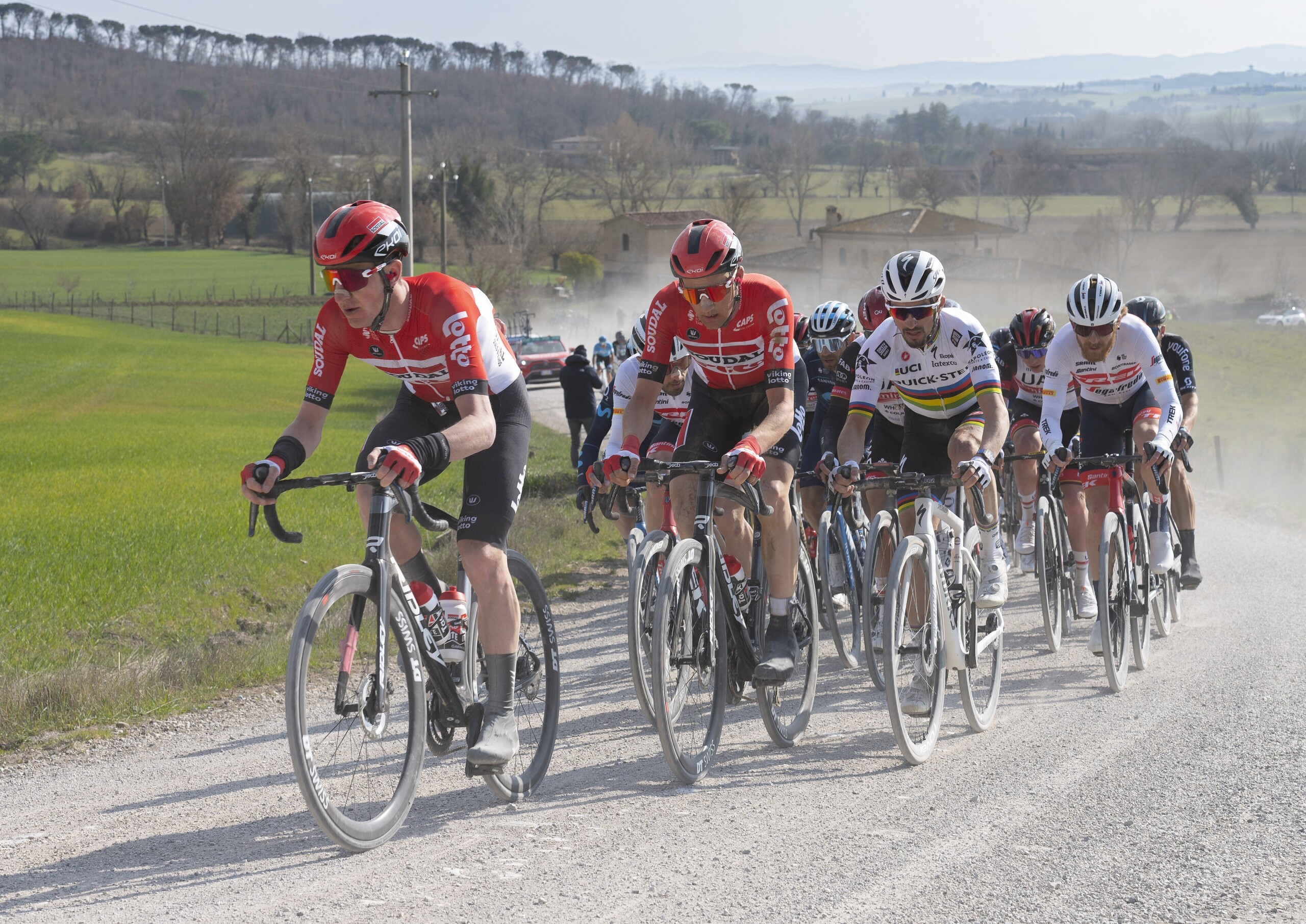
By Steven Sheffield — The Strade Bianche is cycling’s most cinematically beautiful race — a modern classic born from ancient roads, set against the burnt-sienna hills of Tuscany. While the great Monuments carry centuries of history, this race has conjured legend in less than two decades, earning a place in the hearts of cyclists and fans with a speed that surprised even its creators. It is a race of contradictions: brutal and beautiful, medieval and modern, intimate and operatic. The white gravel roads that give the race its name are not some nostalgic affectation — they are living arteries through one of the world’s most storied landscapes, and they have a way of reducing the sport to its essentials. Wheels slip, riders suffer, tactics dissolve, and what remains is the rawest possible expression of what it means to race a bicycle. The finish in Siena’s Piazza del Campo — a medieval shell of pale brick and history, ringed by thousands of screaming fans — is unlike anything else in the sport. No other race ends quite like this. No other race feels quite like this. Before Saturday’s edition sends the peloton into the dust and the drama, test your knowledge of la corsa dei bianchi.
Q1. The race takes its name from the unpaved strade bianche — white roads — that crisscross the Crete Senesi and Chianti wine country south of Siena. The race we know today as Strade Bianche was born in 2007, but it grew out of an older event that had been incorporating these unpaved sectors since 1997. What was the name of that predecessor event, and what made it truly unlike anything else in cycling?
Q2. The most iconic single stretch of the Strade Bianche is the dramatic final approach into Siena’s medieval Piazza del Campo — a short, viciously steep climb through the old city streets that ends with riders crossing the famous shell-shaped square to the finish line. What is the name of this celebrated final climb?
Q3. The inaugural Strade Bianche Donne in 2015 was won by a rider who was, at the time, perhaps better known as a Grand Tour contender than a classics specialist — and whose nationality made the victory a minor sensation in the cycling world. Who won that first edition, and what made her victory particularly notable?
Q4. Fabian Cancellara is the most decorated men’s champion in Strade Bianche history, winning the race three times. His victories came in 2008 — the first spring edition after the race moved from its original autumn slot — then again in 2012 and 2016. His final win, in 2016, was particularly poignant. Why?
Q5. The total distance of the white gravel sectors has varied over the years, but the race typically includes somewhere between 60 and 80 kilometers of unpaved roads. One sector has appeared in nearly every edition and is considered the race’s defining stretch — a long, relentless gravel road through open Tuscan farmland where the race often fractures decisively. What is its name, and what distinction does it carry beyond its role in the race itself?
See answers on next page.
(Visited 8 times, 8 visits today)