

DC beat GG by 7 wickets. The weird bit was that none of it matched the season long trends. GG batted poorly in the PP, then recovered strongly in the middle. DC bat poorly in the PP, but were so good today that the game was all but over in 8 overs.
So, RCB-DC again. That should be fun.
But, what happened beyond the headlines?
-
🎯 How DC nailed GG to the wall with their perfect PP strategy…
-
🏃♀️…and how GG fought back via Mooney & Wareham in the MO.
-
🦥 DC’s bowlers got lazy with their line and length discipline at the death.
-
🐐 How Shafali killed the game by killing GG’s Plan A and B to take her down.
If you’re reading this online, remember: you can get it via WhatsApp or direct to your email👇!
✍️ Written by Raunak Thakur, who runs Dead Pitch’s Society. Follow him on X.
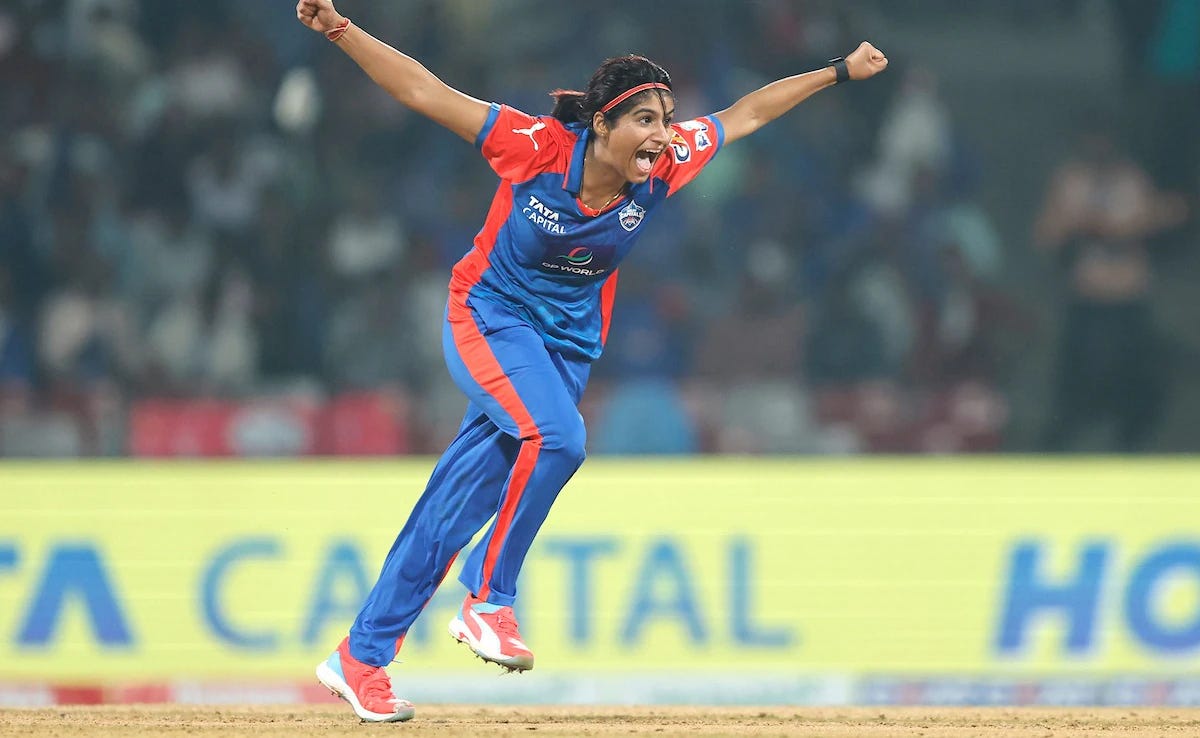
GG’s powerplay average in the first innings this season is 58.5 runs, comfortably above the league average of 46.35. Moreover, they don’t lose many wickets, and regularly make it to the 10-over mark with an RPO of over 9. Last time they played DC, batting first at Vadodara, they were sitting pretty at 95/2 at the halfway stage.
However, today, DC came out with a plan.
The pitch offered movement early. Swing lingered, bounce was uneven, and DC committed fully to pace. Marizanne Kapp and Chinelle Henry attacked hard lengths just outside off, while Nandani Sharma operated as the change bowler on the same template. They aimed to deny the opening pair singles – a staple of GG’s strategy – and let the pressure build.
It was instantly successful. GG scored just 11 runs in the first 3 overs, with the third yielding only 2 runs. The off-side cover region was deliberately packed to stop singles from Sophie Devine, and GG’s usual release through sharp 1s and 2s never materialised. This matters because the moving surface made it much harder to hit the ball to the boundary.
Unsurprisingly, when GG right-handed batters eventually tried to step out and hit the ball, they all fell to similar deliveries – two nicked swinging balls behind, while Anushka Sharma’s miscued attempt to break the shackles was brilliantly caught by Chinelle Henry at mid-on.
At the end of the powerplay – traditionally their strongest and safest period – GG were scrambling at 48/3; their equal lowest total of the season when batting first. And things were only going to get worse.
DC’s big problem this season has been the lack of a reliable fifth bowler. Sneh Rana (10.6 econ) and Minnu Mani (31 ave.) have struggled to bowl four overs a game. Rana in particular has struggled versus GG, where she infamously conceded 32 runs in a single powerplay over to Devine during their first clash of the season.
However, today, with GG’s top 3 RHBs all back in the pavilion before the field settings were relaxed, the off-spinners could come out to play against the two LHBs in the middle. Without the threat of Devine (310 v spin in the PP this season), Sharma (210 v off-spin), & Ash Gardner (149.6 v off-spin), DC’s ill-fitting fifth bowlers had a chance to take on a GG batting order in crisis.
From the 7th to the 15th over, Mani and Rana bowled 5 overs, conceded just 12 runs, and took the wicket of Kanika Ahuja before she could do any damage alongside the ever-present Beth Mooney.
This was part of the plan – Ahuja strikes at just 104.9 versus off-spin, and can become angsty when the boundaries aren’t flowing. Her boundaryless 9-ball stint ended when she charged a Mani delivery, was beaten all ends up, and stumped halfway down the pitch.
Even Mooney, who could only watch helplessly on the other end as she ran out of partners, has struggled versus off-spin this season – scoring at just 109. She couldn’t release the pressure either because DC timed their match-ups perfectly to maximise the value of their fifth bowlers.
In the first match against DC, GG scored 80/0 in the powerplay. In their last game – on the same Vadodara pitch – they scored 53/1 in the first six overs. Today, they struggled to 65/4 by the 10-over mark.
GG’s batting first blueprint has been built on powerplay control. DC targeted that phase precisely, removed its oxygen, and forced Gujarat into unfamiliar tempo management far too early. Mooney was forced to anchor longer than usual, and the acceleration was postponed to prioritise survival.
Data from ESPNcricinfo & Cricmetric.
If you’re reading this online, remember: you can get it via WhatsApp or direct to your email👇!
✍️ Written by Aarush Adil Khan.
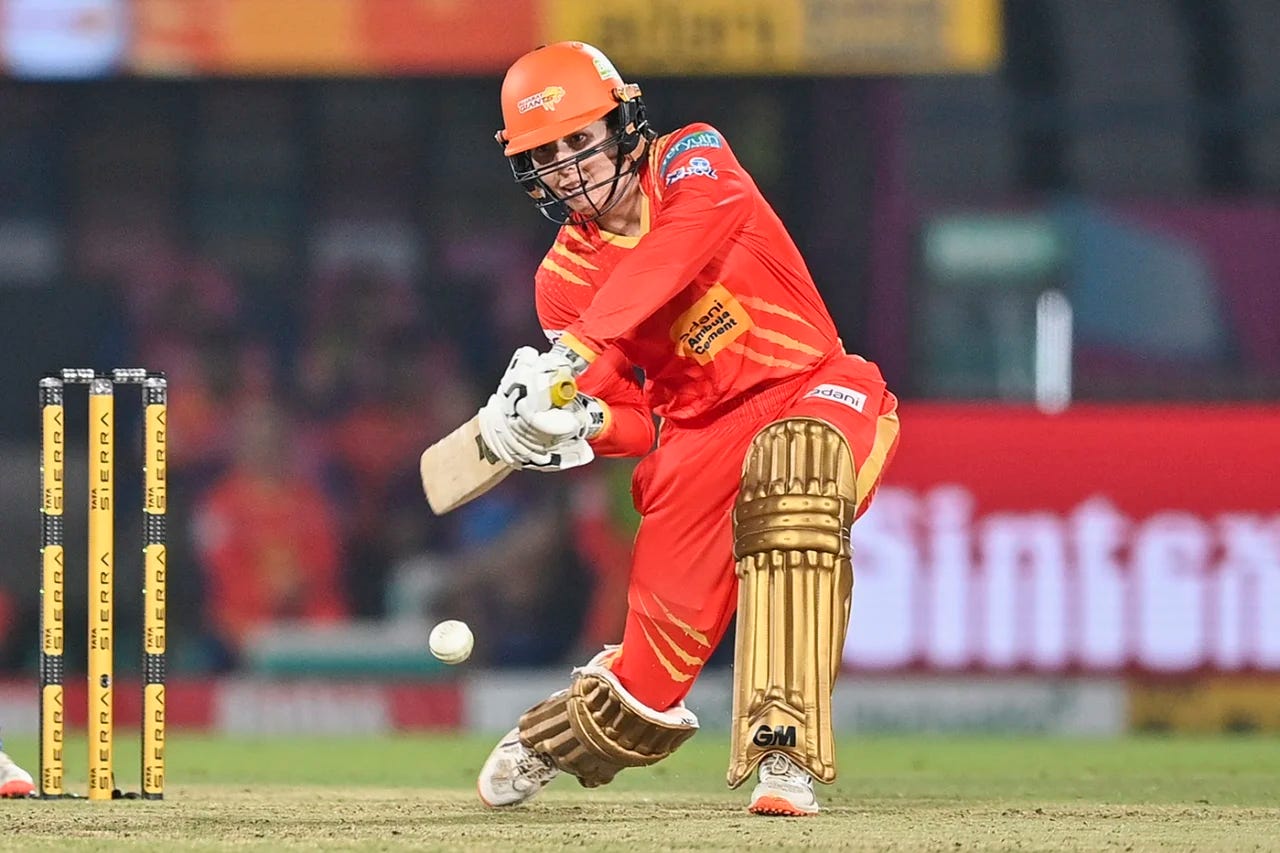
When Georgia Wareham walked out to the middle, GG were tottering at 60/4 after 8.4 overs and were running out of batters to partner Beth Mooney (20 off 20). This season, she usually walks out in the 11th over when GG has put up 92 runs on average. She just needs to set the tone and accelerate. Today, the team needed both runs and wicket preservation.
On the face of it, the Mooney-Wareham partnership struggled with at least the former. In 46 balls, they scored just 5 boundaries (four 4s, one 6). That’s an abysmal balls per boundary rate of 9.2. However, they made up for it the only way the Aussie duo know how – by consistently running between the wickets.
Their partnership only allowed 6 dots – a dot ball percentage of just 13%. They scored 5 singles in their first 6 balls, and the run rate didn’t drop below that rate once. Despite not scoring a boundary in their first 14 balls together, they never scored fewer than five runs in an over – including three separate overs where they scored off every delivery.
Mooney embodied this ethos. She faced 21 balls in the partnership, conceded just one dot and scored 1 boundary – focused on targeting the legside gaps in the field. She still scored 26 runs, at a strike rate of 123.81. Across the 22 yards, Wareham scored 35 (25) with 4 boundaries and a strike rate of 140, and provided an 360-degree threat – including 8 runs dispatched behind square!
Neither Mooney nor Wareham are considered elite boundary hitters – the former had a WPL balls per boundary of 5.46 before today, while the latter’s number is 5.67 – but the Aussies combined to accelerate a flailing innings without taking risks.
By the time Wareham got out in the 17th over, the run rate had picked up (20 off the last 13), and Mooney was able to let loose without the need to preserve her wicket any longer. In the last 3 overs, GG would score 41 runs (including 6 boundaries) taking them to 168/7 – a total that gave them a 55% chance of winning at the innings break, according to ESPN’s win predictor model.
Data from ESPNcricinfo & Cricmetric.
If you’re reading this online, remember: you can get it via WhatsApp or direct to your email👇!
✍️ Written by Gurshan Singh Sangha.

After a difficult run through the middle overs, where they were put under pressure by Beth Mooney and Georgia Wareham’s excellent nine-over stand, DC needed a breakthrough. The latter’s catch on the boundary in the 17th over, combined with specialist finisher Bharat Fulmali getting out a couple of deliveries later, signalled a crucial shift in momentum for DC – or, at least, it should have done so.
When Wareham walked out to the middle, GG’s batting strategy was simple; hit the bad balls, nudge the good ones for singles. This strategy was only amplified in the death overs; the 11 slot balls conceded 5 boundaries and went for 26 runs. Meanwhile, the 10 back-of-the-length deliveries only conceded 13 runs and took the two important wickets of Wareham & Fulmali.
Chinelle Henry’s 17th over – which brought about those wickets – was a perfect example. Her first delivery was a little too full, and was easily hit for a single. Her switch to the slightly shorter deliveries gained her two wickets while only conceding two more runs off the bat that over.
However, confusingly, when she came back for the 19th over, she abandoned this strategy completely. Two consecutive slot deliveries were punished by Kashvee Gautam and Mooney, immediately swinging momentum back to GG. Although Henry briefly returned to a back-of-a-length approach midway through the over, she couldn’t sustain her length discipline, and GG scored 16 runs (including three 4s) off the over.
Meanwhile, Nandani Sharma’s length-based lapses in the 18th over didn’t prove as costly because the majority of the balls were faced by Gautam. However, she still conceded 10 runs after giving away 2 wides – that was a problem both death overs pacers had, giving away 13 extras in the last 4 overs (including two boundaries!).
In the final over, Sharma was messy against Gautam, and better against Mooney. One early fuller ball was dispatched to the boundary (another went for 5 wides), but even when she got it right, Mooney found the ropes – another over gone for double digits, as GG scored 15 runs despite losing a wicket to a run out on the fifth ball.
It should also be said that despite DC’s poor bowling, it took some unexpectedly good batting from Gautam to capitalise on it. Of her 18 runs, 13 came off just 6 slot deliveries at the death. She was sharp with her footwork and clear about her role; punish the bad balls, nudge the good ones – and she did her job perfectly.
On the day, DC’s poor bowling discipline did not cost them. Their stellar work in the powerplay meant that GG only had a par total to defend, and once Shafali Verma got her shooting gloves on, it quickly became an under-par total. However, against RCB’s big hitters in the final, things could get much uglier.
Data from ESPNcricinfo & Cricmetric.
If you’re reading this online, remember: you can get it via WhatsApp or direct to your email👇!
✍️ Written by Aman Patel. Follow him on X.
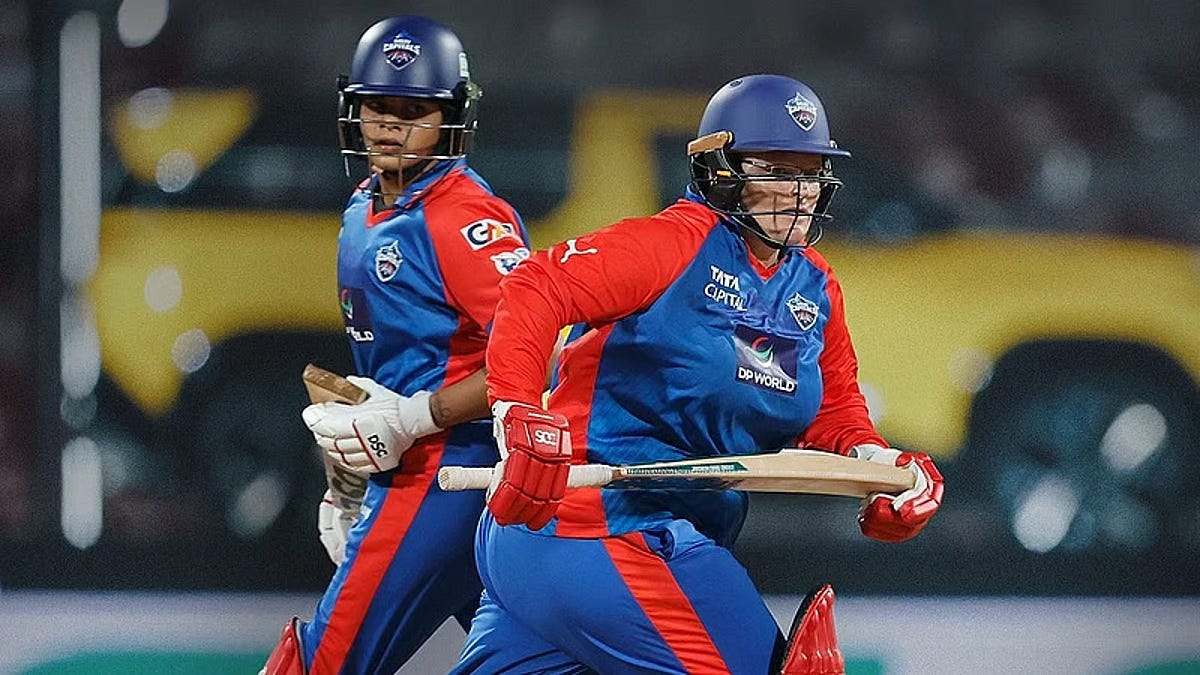
Going into the second innings, GG were confident about defending their relatively low total of 168/7 because the pitch looked a batter’s nightmare. After all, they had seen how it had decimated their own high-flying top order.
However, Shafali Verma came into this game with great records against both of GG’s opening pacers. The DC opener bats at 179 against Renuka Singh, and 165 against Kashvee Gautam across all seasons of the WPL. GG had an ace up their sleeve though; Rajeshwari Gayakwad. In both DC-GG games in 2026, the spinner had taken Verma’s wicket while restricting her to 7 dots in 11 balls faced.
Unsurprisingly, DC turned to the slow left arm orthodox bowler early in the innings. After Renuka and Gautam copied the GG pacers’ game plan to restrict DC to just a run a ball in the first two overs, Gayakwad came on to rattle Verma’s cage. By the end of the over, the tables had turned as the batter forced a 14-run concession in just 6 balls.
The first delivery was a back of the length ball on the off stump, which gripped and spun away from the batter. A similar delivery had dismissed Verma in their previous game when she had tried to lift it over the side and spooned it to the fielder at long on. Tonight, the DC opener stuck to her back foot. The pitch’s variable bounce kept the ball low, but rewarded Verma’s smart play. It went through Mooney’s legs for four byes.
Her reluctance to come forward meant Gayakwad went a little fuller on the next delivery to force Verma away from her body. As the ball landed outside the off stump, Verma stepped forward and got right on top of it to drive it through the covers for a boundary.
Two legal deliveries (and a legside wide) later, Gayakwad pulled her length back, bowling a good length into the stumps. Verma could’ve flicked it, but with the leg slip in place, she didn’t take the bait and just defended. The GG bowler tried the same delivery again to close out an expensive over on a high, but Verma was ready. She stepped forward, and played the ball over mid-off for another boundary.
Verma had negated the Gayakwad threat while manipulating the field and bowling strategy to sow chaos in GG’s powerplay plan. In the first two games, Verma had scored 1 (4) against Gayakwad’s dangerous good length deliveries. She already had 9 (4) after one over tonight.
GG then went to the DC specialist, Sophie Devine. The Kiwi all-rounder had successfully defended single-digit run totals in the 20th over twice against DC this season, and seemed the most logical option to swing momentum back in GG’s direction.
Verma saw her chance to attack, and the cricketing gods favoured her. A wild swipe at a ball outside was missed – then missed everyone else to run for four byes. On the next ball, Devine went closer to Verma’s body – and missed her line to give away five legside wides.
Devine switched to length deliveries on off to stem the bleeding and potentially tempt Verma, but the DC batter replicated her Gayakwad strategy in light of the free runs to open the over; defend the risky balls, even if they lead to dots. When the bowler re-adjusts again to bring you out of your crease, capitalise. Devine’s 2nd and 4th balls – a little too full – were summarily dispatched to the boundary, while the other three good balls were passively defended.
By now, DC were cruising 43/0, and Verma had broken through GG’s best laid plans. Renuka was brought back for the fifth over to face Lizelle Lee – who had been watching with bemusement on the other end – but it did no good. Renuka isn’t the most disciplined bowler at the best of times, but with the run pressure back on GG, she fell apart to give DC five bad balls that were sent to the boundary ropes.
5 overs in, 64/0, and DC had broken their powerplay record for the season. Gayakwad came back again in the 6th, but it was too little too late. Lee had found her eye after the Renuka over, and the 6th over went for 11 runs. By the time GG finally brought on the most sensible matchup in the 8th over – leggie Georgia Wareham to the two big-hitting RHBs – the game was over.
In all, Verma scored 24 of her 31 runs through the covers and mid-on region in the powerplay. It is a testament to her plan of playing late & straight, and sticking to her strengths. This benefitted Lee as well, who got a lot more short and wide deliveries as the bowlers desperately tried to adjust. The South African scored 22 off her 43 runs through cover and mid wicket region.
Verma made headlines at the end of last year when she stepped into India’s team at the last minute, and led their successful charge in the World Cup final. She was praised for improving her game in her months away from the national side, but today’s game proved that it wasn’t a one-time bump.
The DC opener is learning between games now, and the rest of the league/world should be petrified.
Data from ESPNcricinfo & Cricmetric.
If you’re reading this online, remember: you can get it via WhatsApp or direct to your email👇!