
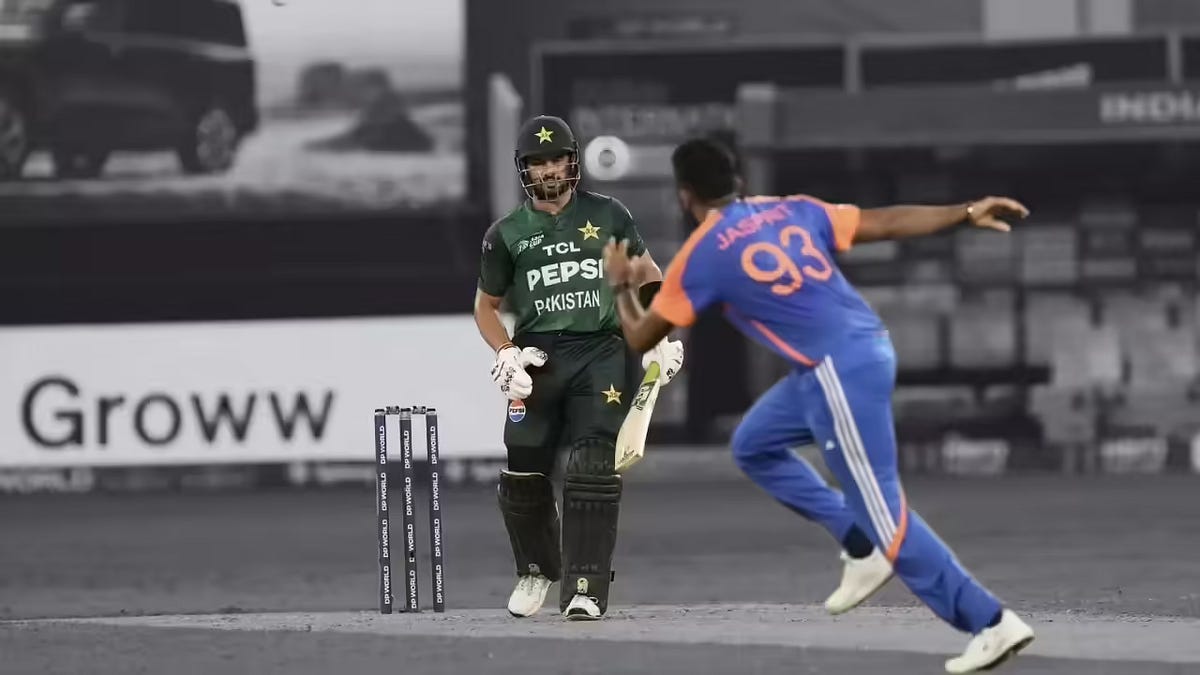
IND beat PAK by 61 runs.
Ishan Kishan flayed the Pakistan bowlers alive on a slow track – and there was no coming back from conceding 77 (40) to the Indian opener.
But, what happened beyond the headlines?
-
🏏 Ishan Kishan was brilliant, but PAK conceded the PP advantage.
-
🕸️ How Saim Ayub’s part-time off-spin outfoxed IND’s elite batting.
If you’re reading this online, remember: you can get it via WhatsApp or direct to your email👇!
✍️ Written by Ben Brettell, who runs Cricinspo.
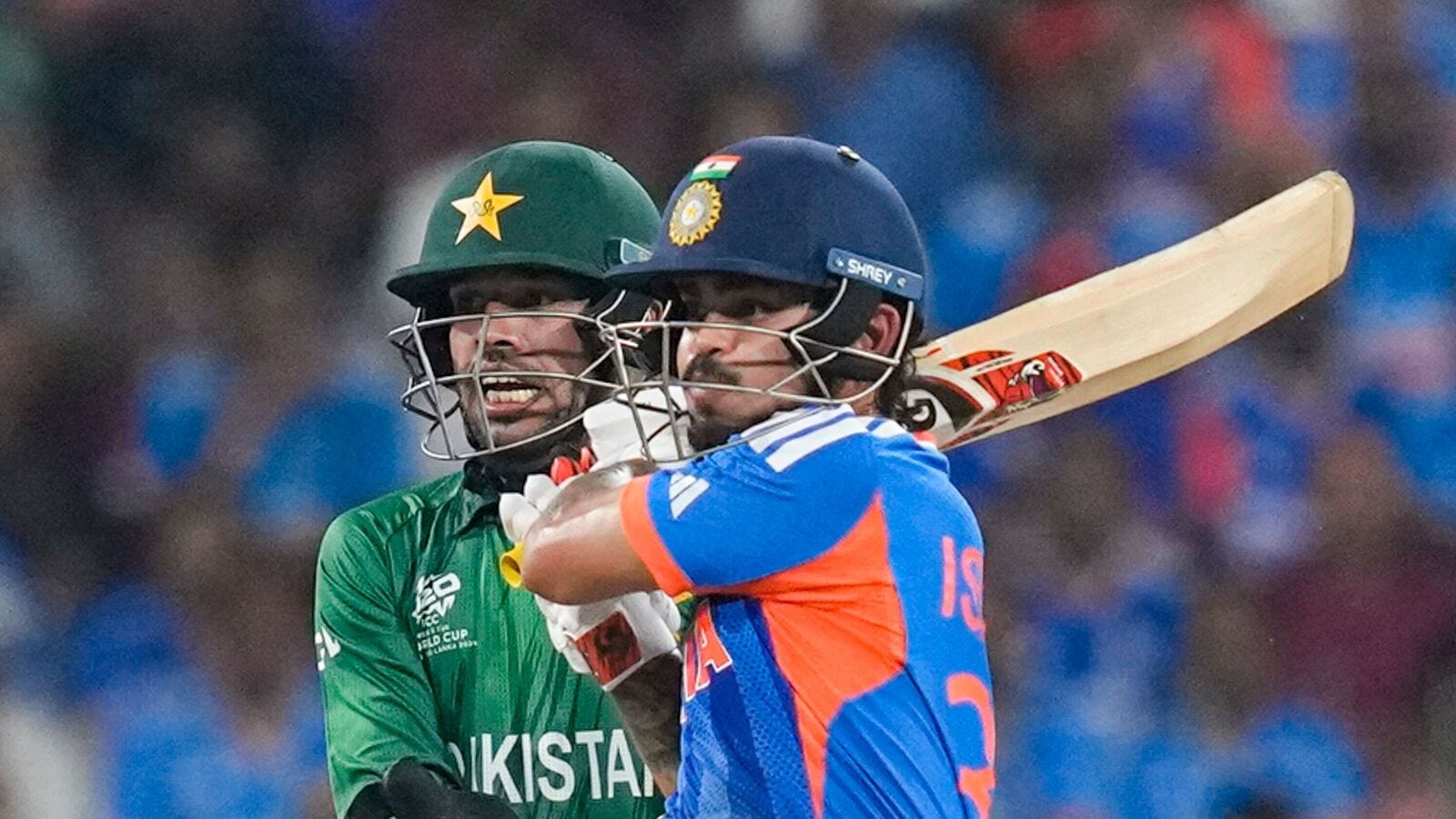
In the end, tonight’s game wasn’t much of a contest, as India continued their superb recent record against their fiercest rivals. Ishan Kishan’s innings was the key, allowing India to set a target Pakistan never looked like chasing.
On a slow surface where reaching the ropes proved tricky, he scored more than half of IND’s boundaries (13/25). Kishan scored 70 off 44 (at a runs per over average of 11.55) on a surface where the average first innings total is just 131 during night games in the last five years.
The rest of India’s batters scored 98 off 80 (RPO of 7.35) while Pakistan scored 114 off 108 (RPO of 6.33). The difference between those numbers can be explained by Kishan’s solid foundation for IND, and PAK crumbling under scoreboard pressure.
And yet, the story isn’t that simple. Kishan was great, but he was also lucky. PAK’s powerplay bowling and field settings were responsible for conceding the advantage, despite their great first over start.
A perfect start for Pakistan
PAK chose to bowl – and on this ground in night games, that’s almost always the right call. 21 of the last 29, and 10 of the last 13 have been won by the chasing side.
It started perfectly for PAK. Abhishek Sharma, playing his first match since the stomach bug that ruled him out against Namibia, looked tentative. PAK threw a curveball immediately – Salman Ali Agha’s off spin in the first over.
On the surface, the match-up wasn’t obvious. Abhishek strikes at 187.3 against right-arm off-breaks in the powerplay across his T20 career. But dig a little deeper and it makes more sense: he’s been dismissed seven times in just 126 balls in that match-up, averaging 33.7. For contrast, against right-arm pace he averages 40.3, and has been out nine times in 207 balls.
There’s also the element of surprise – Salman isn’t a regular powerplay option, and indeed Abhishek has never faced him. Abhishek scratched around for three deliveries, the ball coming slowly off the pitch, then fell to his fourth ball, tamely chipping it to mid on. An early breakthrough, and early control.
PAK doubled down on match-ups by introducing the leg-spin of Abrar Ahmed against Tilak Varma. Again, logical on paper. The problem was that Tilak was at the non-striker’s end, and Abrar’s first 5 deliveries went to Kishan.
Tilak only strikes at 134.6 against leg spin across his T20 career, whereas Kishan strikes at 156.5. He duly cashed in with a 4 and a 6.
Control numbers tell the real story
And yet, despite those moments, the powerplay numbers suggest India never quite settled.
Kishan’s control percentage in the powerplay was just 52%. He faced 9 dot balls, or 36% of his deliveries. In other words, he rode his luck in the powerplay, scoring 42 without ever looking fully in control. Varma’s control was only marginally better at 57%, with 3 dot balls from 7 balls. Those aren’t figures of dominance, they’re figures which show the pressure the batters were under.
PAK were a fraction away from tilting the phase decisively. A direct-hit run-out chance was close, but not close enough. Kishan cleared mid-on by inches with one lofted stroke. Fine margins.
But, once the fielding restrictions relaxed, Kishan scored 35 runs from his next 15 balls, with five 4s, a 6, and just 3 dot balls. By the time he was dismissed for an innings-defining 77 off 40, Kishan’s overall control percentage had climbed to 64.1%.
Tactical errors – where Pakistan went wrong
However, PAK also made a couple of key tactical errors in the powerplay. The first was Shaheen Shah banging it in short to Ishan, a batter who is strong against the short ball. Then Abrar Ahmed bowled a consistent leg stump line to him, without any protection on the leg side boundary.
India closed the powerplay at 52/1 – a respectable recovery on the scoreboard. But context matters. The batters were rarely in full control, and PAK dictated more of that phase than the numbers might initially suggest.


It was a powerplay where the bowling side created enough pressure to justify two or three wickets. Instead, they emerged with just one, and the defending champions had a decisive platform.
IND were able to play relatively low-risk cricket from that point onwards, and despite the threat of a mini-collapse with consecutive wickets in the 15th over, they reached a total which proved well out of their opponents’ reach.
Data from Cricmetric & ESPNcricinfo.
If you’re reading this online, remember: you can get it via WhatsApp or direct to your email👇!
✍️ Written by Tanish Taneja. Follow him on X.
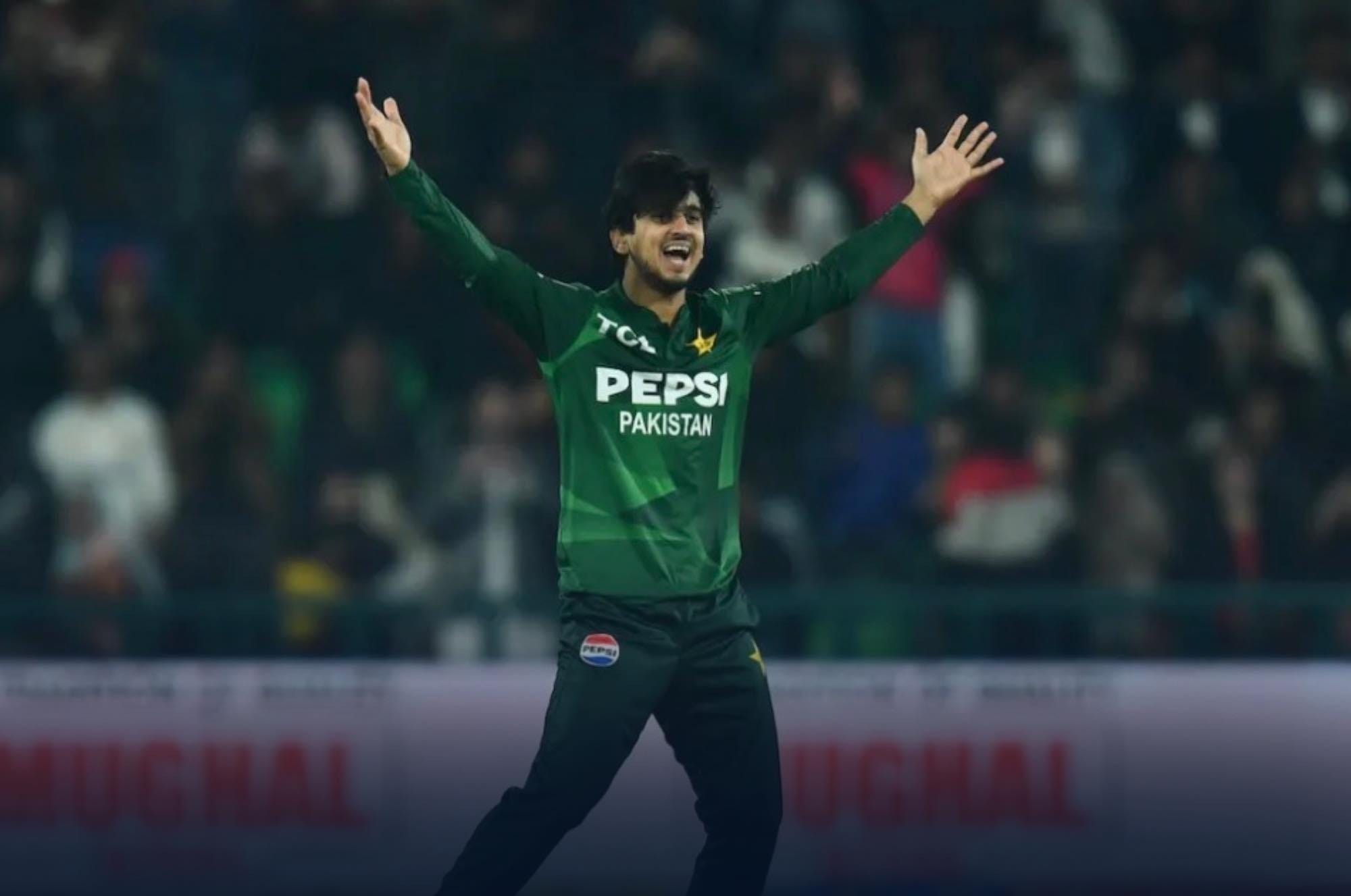
Saim Ayub opens Pakistan’s batting innings, but today his biggest contribution came with the ball. It’s a relatively new tactic – he’s been regularly bowling for PAK since June 2025 – but one that seems to be paying off big dividends already.
In his first 28 games for PAK, Ayub only bowled 5 overs in 3 innings. In the last 36 games, he’s bowled in 30 innings, often taking up multiple overs a game. In this new all-rounder period, Ayub has taken 29 wickets at a strike rate of 17.7 and an economy of just over 7 RPO. He’s become a reliable option for the Falcons.
On a day when IND scored at 8.75 RPO, Ayub conceded just 25-3 in his 4 overs. More impressively, against the devastating Ishan Kishan, Ayub conceded just 16 off 13 balls, with 6 dots and just 3 boundaries. In all, against India’s LHB-heavy batting order, Ayub bowled 21 of his 24 deliveries to them.
As he often does, Ayub bowled the 4th over. He started with shorter deliveries, and the ball seemed to be gripping the surface. A broadcast graphic halfway through the Pakistani innings showed an average turn of 2.4° tonight compared to a WC average of 1.3° at the R Premadasa stadium.
Against Ishan Kishan, he aimed almost every ball outside the line of the off stump. It theoretically gave Kishan enough room to swing his arms, but the slow nature of the pitch and the turn that Ayub extracted from it meant the batter could only find the well placed offside fielders.
The ESPN pitch map for Ayub’s 13 balls to Kishan indicates that they were all either short (69%) or pulled even further back (31%). Ayub found a line and length that stifled Kishan, and he stuck to it with massive success.
Ayub & Salman Agha, another batting-first all-rounder who bowled in the powerplay to similar tight line and length v Kishan, conceded just 25 off 20 balls against the IND batter. The rest of the Pakistani bowlers conceded 52 off 20 v Kishan.
The opener’s numbers in T20Is vs spin provides a historical clue to Ayub’s success. Kishan strikes at just 128 when spinners bowl outside the off stump, with the dot ball percentage touching 40%. These numbers only get worse when pacers are included, and was clearly an area Pakistan wanted to target.
After conceding just 16 in his 2 powerplay overs (including an uncontrolled edge that ran for 4), Ayub switched ends to face Kishan in the 9th. He was hit for a 4 off a slower delivery with the batter moving across the crease to manufacture space. In response, Ayub replicated the ball with a little more bounce and turn, beating Kishan’s replicated shot to clip his bails and get rid of IND’s danger man.
After Kishan’s wicket, Tilak Verma and Suryakumar Yadav consolidated this big foundation. 38 runs in 5 overs kept IND in the hunt for a 200+ score. Then, Ayub came back for his final spell in the 15th over.
First, he trapped Tilak plumb with a fuller arm ball (he had been targetting the fuller lengths v Tilak compared to Kishan). Then, he tempted Hardik Pandya with a flighted length ball just outside off on the Indian’s first ball faced. The ball turned more than Pandya expected, and his wild slog could only find a fielder.
On the hat trick ball, Ayub produced perhaps the delivery of the tournament – an absolute peach drifting in perfectly on full length on middle stump before turning away and barely missing Dube’s edge (and the stumps) by a whisker.
Ayub’s 15th over had stalled another burgeoning IND fight back; they were scoring at 8.92 RPO in the first 14 overs, but scored at just 8 RPO from overs 16 to 19. PAK were always up against the odds versus this elite IND batting order, but Ayub nearly gave them a chance with his disciplined and smart bowling.
Data from ESPNcricinfo.
If you’re reading this online, remember: you can get it via WhatsApp or direct to your email👇!