
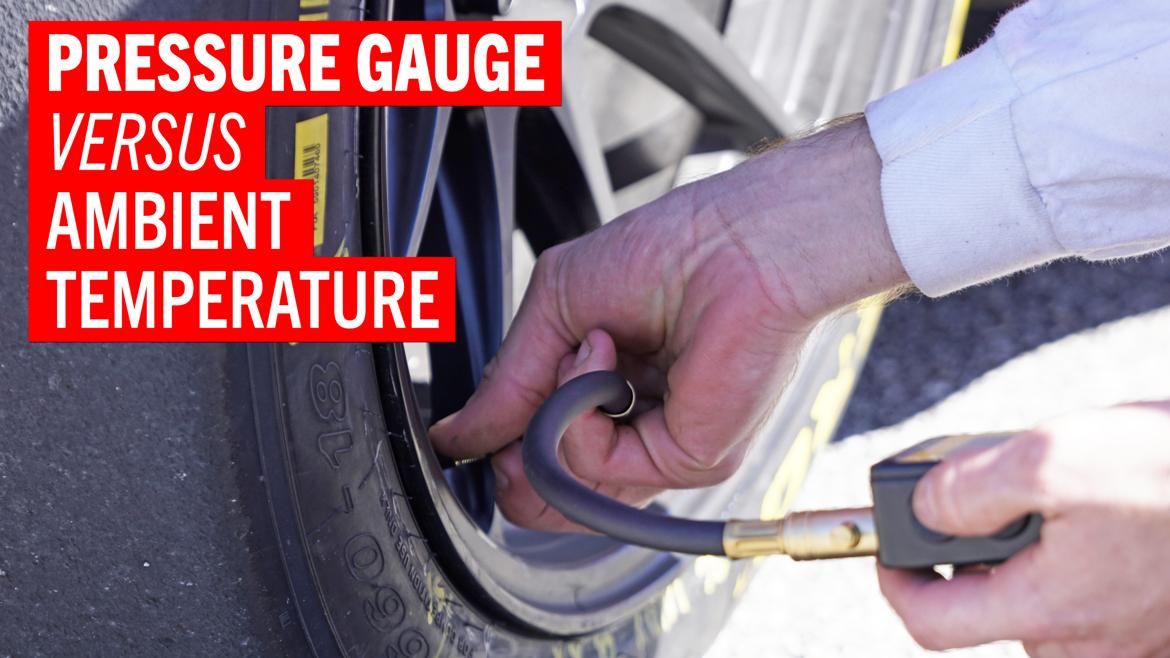
Hopefully this will get some replies with personal experiences.

One time at an autocross I was checking my tires to adjust them and another racer came over with a high end dial gauge and offered to show me how accurate it was. Of course I wanted him to show me, I’m always on the lookout for cool gadgets. The neat part was I had a digital gauge that was the twin to the low cost digital gauge tested here and the readings were identical between his gauge and mine.

Love the mechanical dial gauges but they are fragile. I have found digital gauges both fragile and unreliable. I hate battery powered anything when at remote locations like most autocross locations and many tracks.
kb58
SuperDork
6/23/22 1:52 p.m.
Well the short answer is “yes”, but the real question is, “by how much”, which could/may vary widely between brands and measurement method.

Also take care in selecting the right gauge for the right application. I encountered a successful oval-track racer who was struggling mightily. He then got faster. I found out later what went wrong.
He was using a tire pressure gauge intended for trucks rather than race cars, since his regular gauge broke. His pressures were way off. A gauge has a sweet spot for its accuracy. If you’re looking to measure tires with pressures around 10psi, a truck gauge won’t have anywhere close to the accuracy you need for that range.
For HPDE days I use a dial gauge w/bleeder valve. After the first session I typically bleed off 6-8 psi of really hot air, probably near 180 F. Any idea how accurate the gauge is at that point?
PT_SHO
New Reader
6/27/22 2:49 p.m.
In reply to MisterJA :
OOOooo, great question. I was at Thunderhill for an autocross this weekend. Afternoon conditions, air 105F, track surface 135+, tire tread surfaces 140+ after a couple of runs. The air coming out as I was bleeding the tires made it uncomfortable to even be in the way of it!
So here’s what you do. Read off a tire that hasn’t been run and is in the shade. Then bleed off the tire you’re interested in. Then go back to the shade tire and take a reading of the “known” pressure. If it changed much, there’s your answer. Extra credit: if it changed, then bleed a little, maybe 1/2 psi, through your gauge and see if it cools it enough to make a difference. YMMV.
Bill_C
New Reader
2/21/26 1:48 p.m.
My daily driver is a 2015 Chevy Volt with onboard TPMS. It has always been very consistent at all temps. I can see the pressure of each individual tire. If it is sitting with one side facing the sun, the pressure on that side will be higher. Logical. I use it to make sure my other gauges are accurate. I’ve not had to deal with handheld gauges freezing. I have tossed out one of the fairly new dial gauges made by Slime, because it was 6 pounds off. I have a really old dial type made by Victor. The glass is cracked, but it is still only 1/2 pound off. I have a $10 digital that is dead on with the car at all temps. I have a Milton for the end of the air hose and it seems to be dead on also.

In reply to MisterJA :
Gage accuracy has nothing to do with temperature. A given volume of air will have different pressure at a different pressure.
Pressure and temperature have a directly proportional relationship for a fixed amount of gas in a constant volume, defined by Gay-Lussac’s Law .As temperature increases, the kinetic energy of gas molecules rises, causing more frequent, forceful collisions with the container walls, which increases pressure
I didn’t run the numbers so I have no idea what a 100 degree F change does to pressure. But it does change it.

cyow5
HalfDork
2/21/26 2:56 p.m.
In reply to porschenut :
Gauge accuracy is very much a function of temperature, especially for analog gauges. You can see this in the article, but it doesn’t really vary much for temps you’ll be racing in. You are right that tire pressure goes up because the air heated, not the gauge. But that’s not what the article was exploring
If you want to estimate what change in pressure you get in a tire, just look at the relative temperatures in the absolute scale. So going from 30F to 130F is 490R to 590R. About 20% increase.