
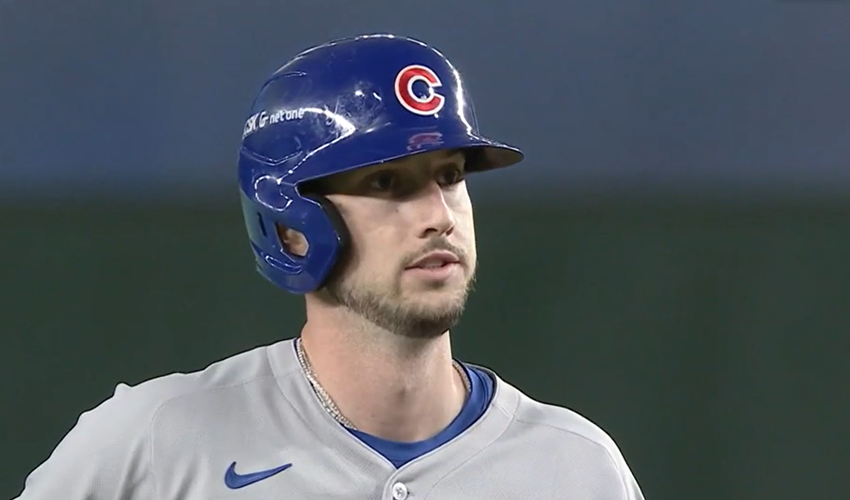
Oh man, people are going to be pissed.
BREAKING: Star outfielder Kyle Tucker and the Los Angeles Dodgers are in agreement on a free agent contract, sources tell ESPN.
— Jeff Passan (@JeffPassan) January 16, 2026
The World Series champion Los Angeles Dodgers signed the consensus No. 1 free agent on the market in outfielder Kyle Tucker. His 4-year, $240 deal is a record in terms of average annual value (if you don’t count the $70 million of a certain two-way player on the Dodgers). This is exactly the kind of deal Andrew Friedman covets in his really-good-not-HOF-level players — but I’ll admit, $60 million AAV shocked even me. There are sure to be deferments ($30 million of the $240 million, reportedly) and he has an opt-out after the second- and third years, which means the contract will likely be front-loaded and/or have a big signing bonus. Still, it’s a shocking number.
Tucker fills a big hole in their outfield — perhaps the biggest on the roster — and the rest of baseball is mad as hell (and apparently are going to continue to take it). The Dodgers will lose their third- and sixth-highest draft picks in 2026 after forfeiting their second- and fifth-highest picks by signing Edwin Diaz. The bonus pool will be hurt because of that, so don’t be surprised if they acquire a competitive balance draft pick or two before July. But back to Tucker.
I wrote a bit about Tucker and why I wasn’t eager for the Dodgers to sign him.
“At least with Freeman, we knew there was going to be a decline in power as he entered his mid-30s. Tucker isn’t even 30 yet and has already seen a bit of a decline. With all things being equal, Cody Bellinger might be the better option for any team — not just the Dodgers — going forward. You’ll get 70-75% of Tucker’s offensive production and substantially better defense for more than half the cost in years and money.
Tucker’s going to get his bag. It might be from the Dodgers, it might be from the Blue Jays, Yankees, Phillies or someone else. But this is more of a buyer beware moment, and while it’d be easy for the Dodgers to throw money at their lack of outfield production, Tucker may not be the right guy for them. Then again, the free-agent options are so limited that the Dodgers might be more willing to take a chance on him to take advantage of their World Series window even more than they already have.
If the Dodgers sign Tucker, I won’t be upset. I just don’t think he’s the best option nor do I really think they’ll sign him.”
Then again, it’s hard to argue with overall results. Since his debut in 2018, he has been a Top 10 hitter in baseball with a 138 wRC+, despite injuries in that time (none super serious, more nagging than anything). He has a career 11.5 BB% and 15.6 K%, to go along with a .234 ISO and a .366 wOBA. He’s not prime Mike Trout or anything, but he’s a very productive hitter.
While Tucker doesn’t exactly solve the Dodgers’ lack of youth (and not that 29 is old), he should help take some pressure off the likes of Mookie Betts, Freddie Freeman, Max Muncy and, too some extent, Shohei Ohtani, who is expected to pitch more this season than he did last season. And Tucker won’t be relied upon to be “the guy,” as he was with the Cubs. I don’t know what that says about him, but not everyone can be — nor has to be — “the guy.”
Tucker will also be a big upgrade defensively in right field, as Teoscar Hernandez will almost certainly move back to left field. While Tucker’s defense has dipped to merely average in right field, that’s much better than what we witnessed from Hernandez in 2025. There’s also a non-zero chance (my speculation) a move to first base could be in the future plans, as his arm strength is fine for right field, but it isn’t Ichiro Suzuki-esque or anything. When Freddie Freeman hangs up his spikes (he’s under contract for two more years and will be almost 39 at the end of it), perhaps Tucker slides into first (no, not that way) while opening a spot for one (or two) of the Dodgers’ premium outfield prospect, as Hernandez will also be a free agent at that time.
He also provides positive value on the base paths, as he’s solid when it comes to BaseRuns. His 3.8 BsR was 22nd-best in the majors and his 18.6 career mark is 27th since his debut in 2018. Tucker also has the third-best stolen base success rate among active players (and all-time) at 88.1% (119-for-135) despite not possessing anything close to elite sprint speed (26th percentile in 2025). That could also be a reason to move him to first base, when the position opens up.
——
For some reason, a common comparison that is making the rounds in regards to Tucker is Anthony Rendon. Rendon, who recently agreed to a buyout with the Angels, signed a massive 7-year, $245 million deal after helping the Nationals to a World Series title in 2019. The comparison is there based on production and percentage of games played.
| Player | AVG | OBP | SLG | wRC+ | G | GP% |
| Tucker | .273 | .358 | .507 | 138 | 719 | 82.6 |
| Rendon | .290 | .369 | .490 | 128 | 816 | 83.9 |
Games and game played percentage based off full seasons. Tucker’s first full season was 2020 (debuted in 2018 and played a little in ’19), while Rendon’s was 2014 (debuted 2013).
Rendon had a few lower-body injuries before signing with the Angels, with the most severe being a left knee sprain that cost him a little more than two months in 2015. He followed that up with a left quadriceps injury that cost him a month later that season. He also had a left toe contusion in 2018 that cost him a couple weeks. The big injuries came after he signed with Anaheim. He had leg and hip issues, but his right wrist injury is what derailed his career.
Tucker’s pre-free agent injuries — most of which have come in the last two years — have been arguably more severe than Rendon’s. He suffered a right shin contusion in June of 2024 that was misdiagnosed by the Astros’ training staff. It actually ended up being a shin fracture, and that limited him to just 78 games. He also was diagnosed with a hairline fracture in his right hand in June, yet decided to play through the injury. He struggled significantly in the second half before ending his season with a poor September that saw him hit just .158/.200/.316.
While the injuries haven’t been as frequent as they were with Rendon, the severity has been a bit more significant. Luckily, the injuries have come by fouling a ball of his shin and sliding head-first into second base. They aren’t soft tissue or structural injuries to his shoulder or elbow or hamstring. The concern is there (and could be why teams weren’t falling all over themselves to sign him to an 8-to-10-year contract), but it might be a bit overblown, even if the numbers are close to alignment when comparing him to Rendon.
——
The fit seemed somewhat obvious based on age, production and position (despite my objection). The fact that the Dodgers and Andrew Friedman finally got his short-term, high-AAV deal for a superstar is a big win for him and the Dodgers. Non-Dodger fans are going to be pissed about this deal — some for the right reasons, some for the wrong. But the Dodgers were patient and pounced when other teams didn’t give Tucker what he sought on the open market.
The Dodgers added Tucker to an offense that scored the second-most runs in baseball last season. It doesn’t seem fair, yet it very much is. There aren’t going to be many chances to not only 3-peat, but to maximize Ohtani’s prime. The Dodgers supplementing this roster with this player is exactly that. All teams should be following the Dodgers’ model, yet not many of them do. That’s a shame.