
Overview of the System
Dynix is a cloud-based lap time simulation platform designed to help drivers, engineers and teams understand vehicle performance and prepare for race events. The platform focuses on making lap time simulation more accessible while still providing the flexibility required for deeper engineering analysis.
One of the core concepts behind Dynix is a role-based workflow. Users can interact with the platform either as a driver or an engineer, and the same simulation data is presented differently depending on the role selected. The goal is to make the insights useful for both technical and non-technical users while keeping everyone working with the same underlying data.
The platform also emphasizes collaboration, allowing multiple users to work on the same vehicle model and simulation data within shared workspaces.
Dynix is currently available as a cloud-based web application, allowing users to run simulations and analyze data directly through the browser.
How the System Works
Dynix performs lap time simulation to estimate the theoretical performance of a vehicle on a selected race circuit.
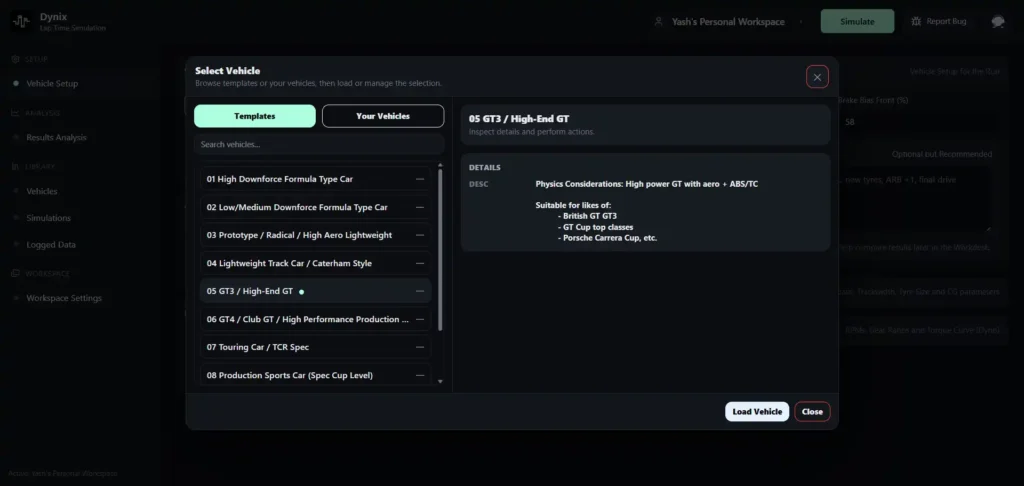
Users begin by selecting a vehicle template, which allows them to start simulations quickly without needing to create a full car model from scratch. The template parameters can then be adjusted to match a specific car or race setup.
Typical vehicle inputs include parameters that are commonly available to club and semi-professional teams, such as:
- Vehicle weight and weight distribution
- Brake bias
- Tyre grip coefficient (adjustable for track conditions or tyre wear)
- Wheelbase and track width
- Wheel radius
- Engine torque curve
- Gearbox ratios and drivetrain configuration
The simulation model is based on a quasi steady-state lap time simulation with four-wheel load transfer modelling, allowing the system to generate a realistic speed profile and driver input traces around the track.
The simulation produces outputs including:
- Predicted lap time
- Speed trace around the circuit
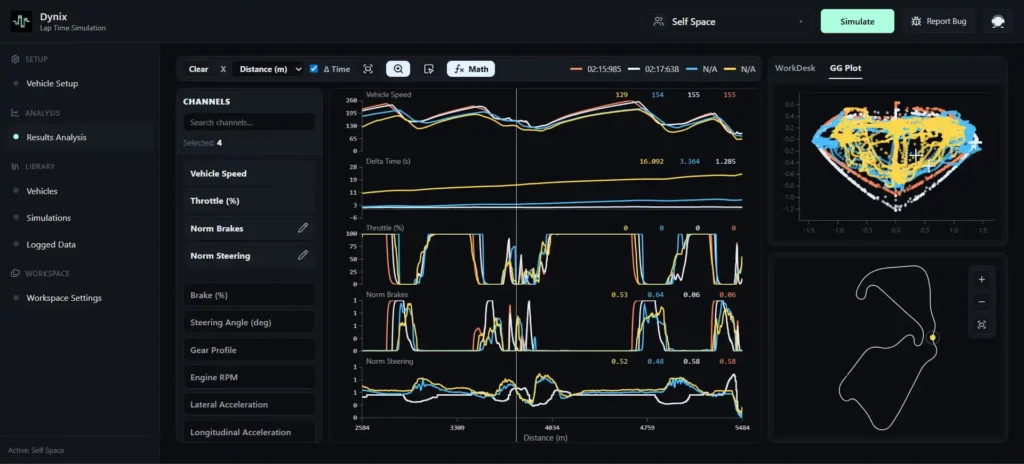
- Throttle, brake and steering inputs
- Gear selection and engine RPM
- Acceleration data
Dynix also allows users to upload real telemetry data (CSV format) to overlay with the simulation results. This enables drivers and engineers to compare real laps with the simulated theoretical limit and identify areas for improvement.
Key Differentiation
Dynix focuses on three main design goals:
- Simplicity of setup
- User-friendly interaction
- Meaningful simulation accuracy
Many existing lap time simulation tools are either highly technical engineering software or simplified tools that lack analytical flexibility. Dynix attempts to sit between these two extremes.
The role-based system is the main differentiating feature. Drivers and engineers work with the same simulation data, but the interface adapts to their role.
For example:
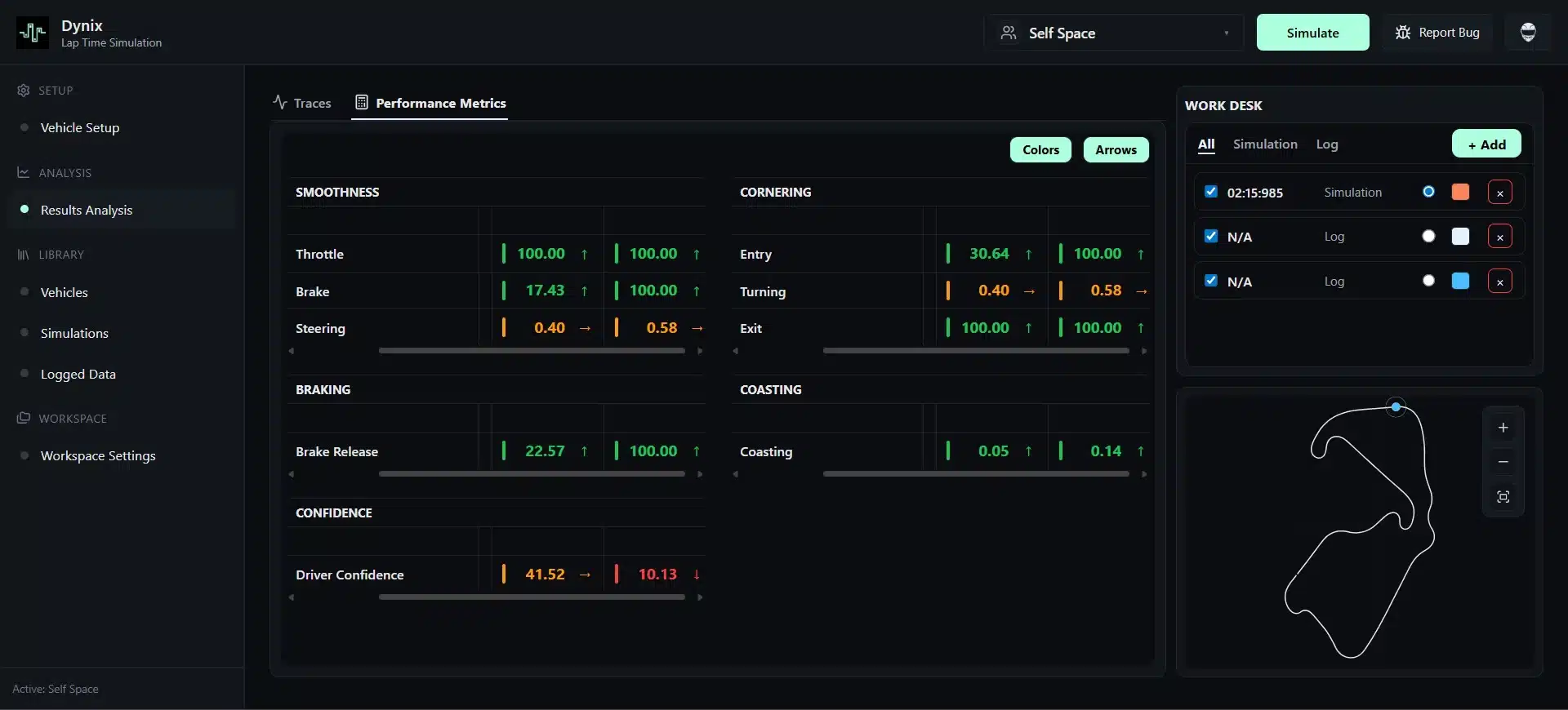
Drivers see pre-calculated performance metrics, such as braking smoothness, throttle control and corner entry–mid–exit performance ratings.
Engineers instead have access to flexible data tools, including custom math channels and additional telemetry channels for deeper analysis.
Another key feature is collaborative workspaces, where drivers, engineers and coaches can work on the same simulation environment while interacting with the data in ways suited to their role.
The aim is to create a system where simulation and data analysis can be used together without requiring all users to have the same technical background.
Benefits for Drivers
For drivers, Dynix is primarily intended as a preparation and learning tool.
The lap time simulation provides a theoretical reference for how the car could perform if driven at the optimal limit. This allows drivers to study:
- Braking points
- Throttle application patterns
- Minimum corner speeds
- Ideal driving inputs
By comparing real telemetry data with the simulation, drivers can identify where performance may still be available and where their driving differs from the simulated ideal.
Dynix also generates driver performance metrics based on throttle, brake and steering inputs, providing a simple way to evaluate driving consistency and technique.
This can be particularly useful for young drivers, driver coaches and development programmes, as it allows performance insights to be explored even before hitting the track and during race weekends.
Current Use and Development
Dynix is currently being tested and developed alongside real race programs, including work with Motion Motorsport and drivers Will Puttergill and Chris Nylan, who won the 2025 750 Motor Club ClubEnduro Class B championship and are moving into Class A competition.
The platform continues to evolve, with future development focusing on expanding the simulation capabilities and improving data visualization and analysis tools.
The long-term aim is to build a platform where simulation and performance data can exist within a single collaborative environment, accessible to drivers, engineers and teams at various levels of motorsport.
Dynix can be accessed at –dynixsimulations.com