
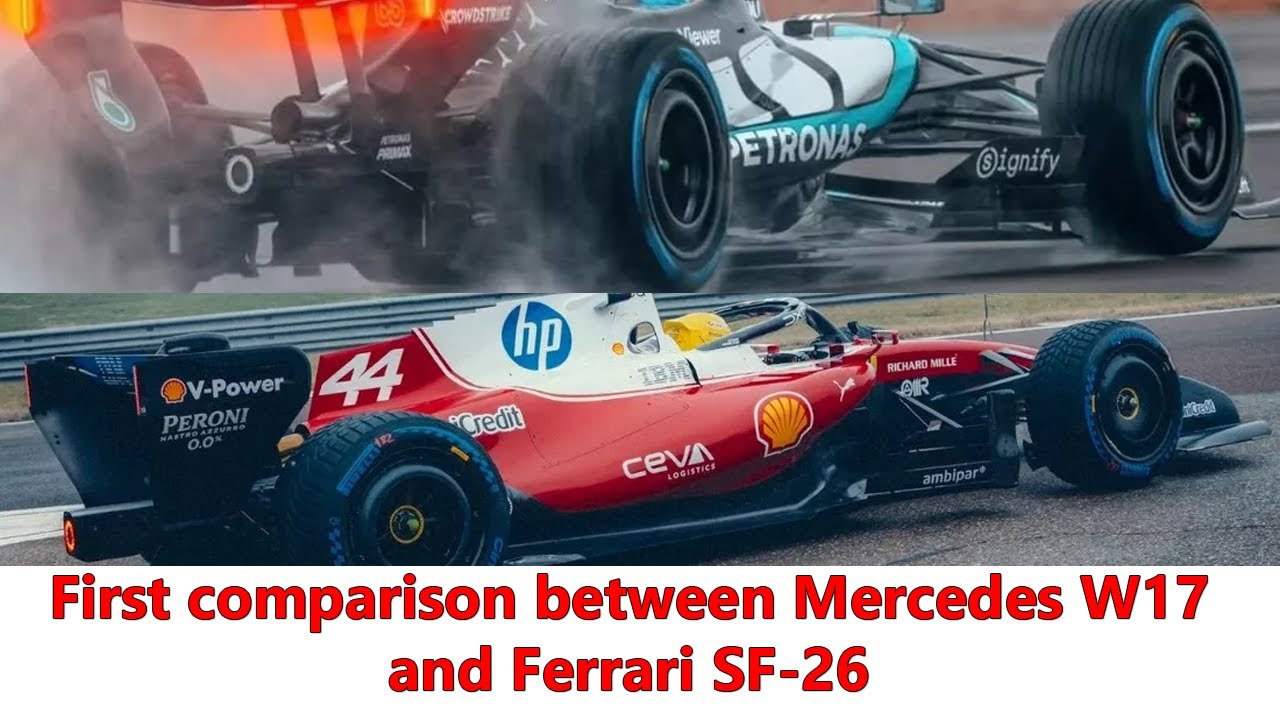
Before the start of the Barcelona test, only two of the four top teams had actually run on track, allowing for a first, necessarily brief but still meaningful comparison between the black-and-silver Mercedes W17 and the red Ferrari SF-26. Mercedes appear to have started from a more advanced and better-defined technical base, while Ferrari are already promising significant and visible developments during the upcoming test sessions. Even at this very early stage of the 2026 Formula 1 season, a number of interesting technical details are beginning to emerge, offering the first clues about the direction taken by both teams.
McLaren are still keeping a deliberately low profile, choosing not to reveal too much too soon, while Red Bull have at least shown their new car, even if only partially. For now, however, among the top teams, only Mercedes and Ferrari have truly put their cards on the table and allowed observers to start analysing concrete on-track data rather than just renderings and launch imagery. The Brackley-based team are beginning the new regulatory cycle with the pressure that inevitably comes from needing to return to winning ways after failing to secure any world titles during the ground-effect era. That period has so far delivered three Constructors’ Championships to Red Bull and two to McLaren, leaving Mercedes unusually empty-handed by their own very high historical standards.
Ferrari, on the other hand, are eager to put behind them the bitter and painful disappointment of last season, when the Scuderia slipped all the way down to fourth place in the Constructors’ Championship. That result was particularly hard to swallow given that the initial expectation at Maranello was to fight consistently at the front against the papaya-coloured McLaren cars. Instead, the year turned into a frustrating campaign marked by inconsistency and missed opportunities, making the 2026 project a crucial turning point for the team led on track by Charles Leclerc and Lewis Hamilton.
The new generation of more agile and lighter cars theoretically allows the competitive order to be reshuffled, with everyone starting again from scratch after designing their cars on a clean sheet of paper. In theory, the new regulations level the playing field and reward those who interpret them best from the very beginning. For that reason, and with a slightly less emotional approach than during the official launch days, when the Mercedes W17 ran at Silverstone during its filming day and the Ferrari SF-26 appeared at Fiorano, it is now possible to attempt an initial technical comparison. This exercise remains limited in scope, but it is still useful for drawing some broad evaluations ahead of the first collective tests at the Circuit de Barcelona-Catalunya.
Those tests actually began in staggered fashion, with only a few teams running on the opening day, while others decided to start exploring their new cars only from Tuesday onwards. This delayed start underlines how cautious teams are being with reliability and preparation, especially given the complexity of the new technical regulations and the importance of gathering clean, reliable data from the very first laps.
Mercedes are under particular scrutiny because, according to widely accepted and persistent paddock rumours, they should be equipped with the most powerful power unit in the field. The factory team will benefit directly from this advantage, along with customer teams McLaren, Alpine and Williams, once the Williams FW48 completes all chassis homologation checks and receives FIA approval to make its track debut. The Grove-based team has already confirmed that it will skip the trip to Spain in order to focus on virtual testing on the dynamic rig, a choice that reflects both caution and confidence in simulation tools.
However, Toto Wolff’s team need to reclaim their status in Formula 1, as memories of the title-winning streak during the hybrid era from 2014 to 2021 are starting to fade. Being beaten for a third consecutive season by a customer team like McLaren, would be extremely difficult to accept from a sporting and symbolic point of view. Mercedes therefore face enormous pressure to prove that the W17 represents a true step forward rather than another transitional car.
Looking back at the W17 renderings released before George Russell and Kimi Antonelli completed 67 laps at Silverstone, the impression was not of a car already fully refined and polished. While several interesting solutions were visible, the overall picture suggested a concept that still needed work and track validation.
The transformation seen on the black-and-silver car for its first on-track appearance instead highlights the determination of technical leaders James Allison and Simone Resta not to waste time refining a car that needs to be competitive from the very start of the season. The changes introduced between the renderings and the filming day version suggest that Mercedes are pushing hard to accelerate their development curve as early as possible.
While Honda, Ferrari and Audi are expected to seek a political compromise to neutralise the clever solution that allows the Brixworth-built internal combustion engine to run with an 18:1 compression ratio when hot, while remaining within the prescribed 16:1 limit during ambient-temperature checks, Mercedes must also prove that they are not relying solely on the presumed superiority of their power unit. The overall aerodynamic efficiency and mechanical balance of the W17 will be just as critical.
Early signs have already appeared in this regard. The W17 that ran on a wet Silverstone track already featured far more aggressive aerodynamic concepts. The spoon-shaped front wing is no longer the basic version seen in the renderings, as it now introduces a flow diverter in the footplate designed to recreate an outwash effect. Ferrari’s solution on the SF-26 appears to be at a less advanced stage, as the team await the first developments promised by Loïc Serra, which are expected to arrive during the early test sessions.
Both Mercedes and Ferrari, despite being engaged in commercial filming activities, also found time to conduct initial experiments with the movable aerodynamic devices. During a single straight-line run at Fiorano, Lewis Hamilton activated the active aerodynamics on the Ferrari SF-26, revealing a slightly delayed opening between the rear and front elements. This appeared to be a deliberate attempt to understand how aerodynamic balance could be influenced beyond the basic regulatory constraints.
Unusual details were also observed on the Mercedes W17. While Kimi Antonelli was driving, only the third front-wing flap was seen opening at the front, while the second remained fixed, apparently locked by the two nose support pylons together with the main profile. These details underline how much fine-tuning is already taking place. A clearer picture of these technical solutions should emerge in Barcelona, as teams may be developing different configurations to be used depending on circuit characteristics.
Another interesting aspect comes from analysing the nose designs. Ferrari’s nose appears particularly refined around the junction with the pylons, with a noticeably smaller cross-section than that of the W17. However, from another viewing angle, the Mercedes nose looks more deeply undercut, which in theory should allow a greater volume of airflow to pass beneath the chassis and feed the floor more efficiently.
Looking at the front brake ducts, the SF-26 features a high and narrow cooling inlet integrated within the carbon shroud, while the black-and-silver car also requires an additional small external intake. Ferrari are using Brembo braking components, whereas Mercedes rely on Carbon Industrie discs. This difference could have implications for cooling efficiency and aerodynamic cleanliness, making it particularly interesting to see which solution will prove more effective over a full race distance.
Moving to the sidepods, both cars feature radiator inlets developed from fairly similar initial concepts, with triangular-shaped openings that are more or less twisted. Ferrari appear to be the only team keeping the cooling masses entirely within the sidepods, while the Mercedes W17 has distributed part of the cooling above the turbocharged six-cylinder engine. This solution feeds auxiliary systems with air entering through the inlets on either side of the airbox.
At Maranello, the technical staff want to exploit the new engine with a steel cylinder head, which is expected to run hotter and therefore require less cooling. This approach could allow for tighter bodywork and aerodynamic gains, but it will be tested properly only during the Bahrain tests, when cooling outlets will need to be opened to cope with the high ambient temperatures at the Sakhir circuit.
Based on these observations, Mercedes have shown a sidepod with a more pronounced undercut than Ferrari’s, and the outer edge of the sidepod itself adopts a wing-like shape that suggests a stronger downwash effect. The Ferrari SF-26 appears less sculpted underneath, instead encouraging airflow to move laterally towards the coke-bottle area, potentially prioritising stability over extreme aerodynamic aggression in this early specification.
Both cars seem to have identified the possibility of opening a lateral slot in the diffuser ramp to increase the airflow inside the extractor, boosting downforce without compromising aerodynamic efficiency. This represents a clear departure from older concepts seen in recent seasons and highlights how teams are converging on similar solutions under the new rules.
The challenge has officially begun. At this very early stage of the 2026 Formula 1 season, Mercedes appear slightly more advanced in terms of visible development, but Ferrari are already promising to significantly evolve their car during testing. The key factor for the SF-26 will be having a solid and responsive technical platform that reacts positively to the updates introduced over the coming weeks, allowing Charles Leclerc and Lewis Hamilton to fight at the front once the season gets underway.

Let other Scuderia Fans know about us


